
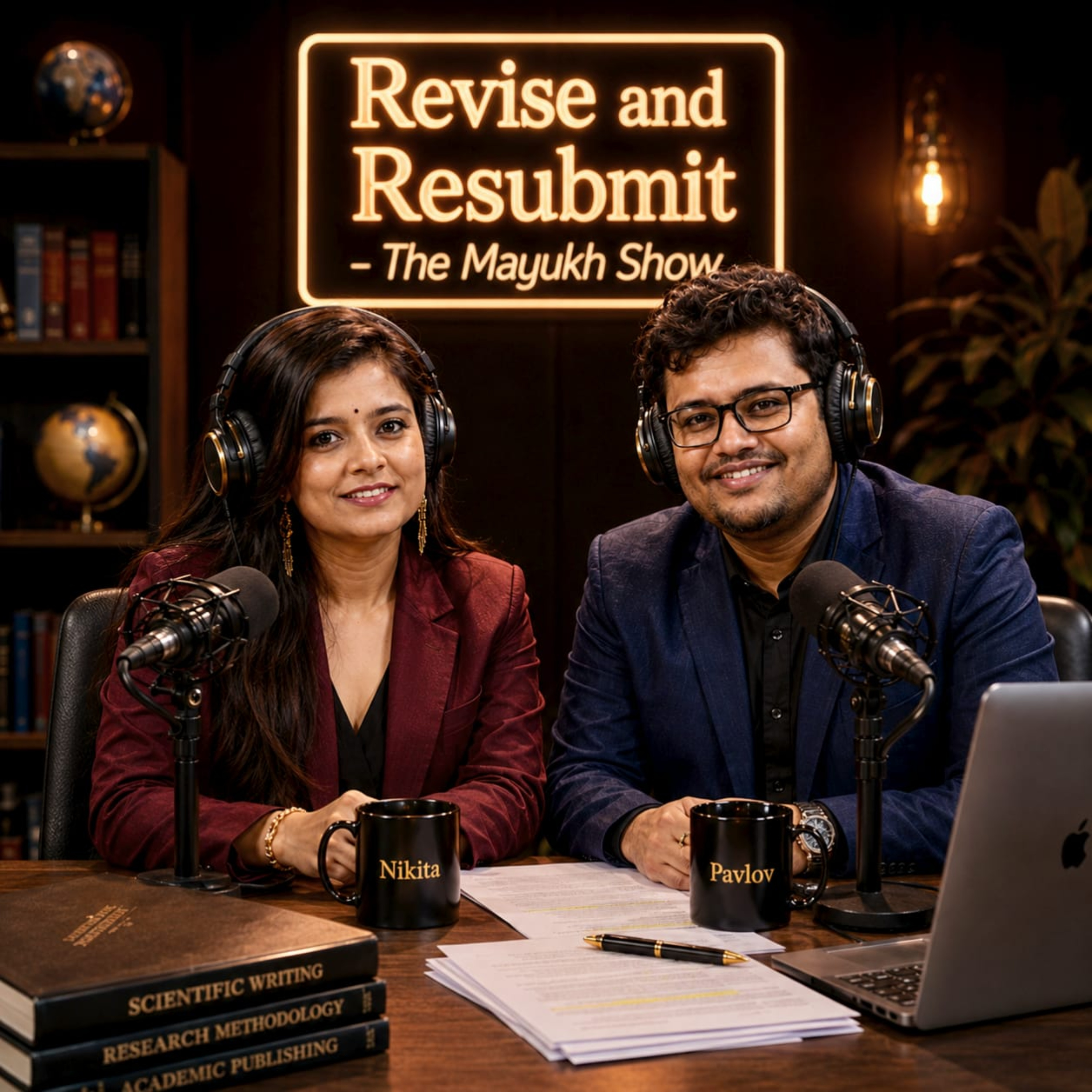
PODCAST · education
Revise and Resubmit - The Mayukh Show
by Mayukh Mukhopadhyay
In Revise and Resubmit, a dynamic AI duo— Nikita and Pavlov — guides you through the fascinating world of academic research. Whether they’re debating emerging trends, revisiting theories, or exploring the latest innovations, their conversational style makes scholarly insights accessible and engaging for academics. Papers chosen by Mayukh. Powered by Google NotebookLM.
-
652
Reimagining Interdisciplinarity (Nolan et al., 2026) | FT50 JMS
English Podcast Starts at 00:00:00Bengali Podcast Starts at 00:45:30Hindi Podcast Starts at 01:02:28Danish Podcast Starts at 01:20:47ReferenceNolan, R., Siedlok, F., & Hibbert, P. (2026). Reimagining Interdisciplinarity: Sensitization, Reflexivity, and Mobilization Across Landscapes of Practice. Journal of Management Studies. https://doi.org/10.1111/joms.70158Youtube Channelhttps://www.youtube.com/@weekendresearcherPodcast Websitehttps://mayukhmukhopadhyay.com/reviseandresubmitAOM SIM Curriculum Committeehttps://sim.aom.org/curriculum/curriculum-committeeAOM SIM-Bytes Curriculum Lessonshttps://sim.aom.org/simthrive/teaching/simbytes🎙️ Welcome to Revise and Resubmit, where we pause for a moment with ideas that might otherwise pass quietly through the crowded corridors of academia.Today, we turn to a fascinating new paper, “Reimagining Interdisciplinarity: Sensitization, Reflexivity, and Mobilization Across Landscapes of Practice,” by Ryan Nolan, Frank Siedlok, and Paul Hibbert.📚 Published online on 11 September 2026 in the prestigious Journal of Management Studies, this is a paper from an FT50 journal, published by the Society for the Advancement of Management Studies and John Wiley & Sons Ltd.And perhaps what makes this paper especially interesting is that it asks us to reconsider something we have become rather accustomed to praising: interdisciplinarity.We often speak of bringing disciplines together as though collaboration were a matter of drawing the right organisational chart, creating the right structures, or placing the right people around the same table. But what happens when the table itself becomes a place of negotiation, uncertainty, and sometimes quiet disagreement?🌱 Nolan, Siedlok, and Hibbert invite us to look at interdisciplinary research not simply as something we have, but as something we do. Through practice theory, they introduce three ideas: sensitization, reflexivity, and mobilization. Together, these offer a way of understanding how researchers recognise different ways of knowing, navigate competing professional responsibilities, and somehow make collaboration possible without forcing everyone into one supposedly unified reality.For early career researchers, this may feel particularly familiar. The desire to collaborate can coexist uneasily with disciplinary expectations, career pressures, evaluation systems, and the persistent question of whether the work will still “count.”✨ Perhaps the deeper invitation of this paper is to stop asking only, What is interdisciplinarity? and begin asking, How is it sustained, negotiated, and sometimes unravelled in practice?So, as we enter this conversation, here is the question I want to leave quietly with you:🤔 If interdisciplinarity is less about bringing different disciplines into agreement, and more about learning how to live and work productively with their differences, what might we need to change about the way we lead, evaluate, and experience research itself?🙏 A warm thank you to Ryan Nolan, Frank Siedlok, and Paul Hibbert, and to the Society for the Advancement of Management Studies and John Wiley & Sons Ltd. for bringing this important work into the scholarly conversation.🎧 Subscribe to Revise and Resubmit on Spotify, and follow our YouTube channel, Weekend Researcher. You can also find the channel on Amazon Prime and Apple Podcasts.🌟 Until next time, keep reading, keep questioning, and perhaps most importantly, keep revising.
-
651
Testing Einstein (Odom & Kennefick, 2026) - Weekend Book Review
English Podcast Start at 00:00:00Bengali Podcast Start at 00:49:44Hindi Podcast Start at 01:13:23Danish Podcast Start at 01:27:55 ReferenceOdom, B. C., & Kennefick, D. (Eds.). (2026). Testing Einstein. The MIT press. https://doi.org/10.7551/mitpress/15746.001.0001Youtube channel link https://www.youtube.com/@weekendresearcherPodcast Websitehttps://mayukhmukhopadhyay.com/reviseandresubmit🎙️✨ Welcome to Revise and Resubmit, and welcome to another episode of Weekend Book Review! 📚🌌There are some books that do not simply tell us what happened. They quietly remind us how patiently humanity has searched for truth, and how every certainty we celebrate today once stood on fragile ground. 🌠 As I settled into Testing Einstein: One Hundred Years of Experimental Relativity, I found myself thinking less about spectacular discoveries and more about the countless unseen moments of doubt, persistence, and careful observation that made those discoveries possible. Perhaps the most extraordinary stories are not about genius alone, but about the people who refused to stop asking difficult questions. 💡🔭Edited by Brian C. Odom, the Chief Historian at NASA whose work beautifully connects science with its broader human story, and Daniel Kennefick, a physicist and historian of science renowned for illuminating Einstein's scientific legacy, this remarkable collection invites us into a century of experimental relativity. 🚀📖 Rather than presenting Einstein's theories as inevitable triumphs, the editors reveal a richer and far more human narrative where precision instruments, determined researchers, historical circumstances, and even political and cultural forces all shaped the path toward understanding gravity itself.From the painstaking pursuit of the gravitational redshift to the emergence of black hole science and the breathtaking era of gravitational wave detection, this book reminds me that science rarely advances in dramatic leaps. Instead, it grows through patience, disagreement, revision, and relentless curiosity. 🔬✨ Every experiment becomes a conversation between nature and the people trying to understand it, and every answer seems to open the door to an even deeper mystery.🎧 So, join me as we explore Testing Einstein: One Hundred Years of Experimental Relativity, uncover the remarkable human stories behind experimental gravity, and discover why proving an idea can sometimes be as fascinating as imagining it.❓After all, if even Einstein's greatest ideas had to patiently earn the world's confidence through generations of careful experiments, what truths around us are still quietly waiting to be tested?🙏 My heartfelt thanks to editors Brian C. Odom and Daniel Kennefick, and to The MIT Press, for bringing this remarkable work to readers.💙 If you enjoy thoughtful book conversations like this, please subscribe to Revise and Resubmit on Spotify, and subscribe to the Weekend Researcher YouTube channel. 🎥🎙️ You can also listen on Amazon Prime Music and Apple Podcasts. Thank you for being part of this journey. 🌟
-
650
The Power of Proximity to Coworkers (Emanuel et al 2026) | FT50 QJE
English Podcast Starts at 00:00:00Bengali Podcast Starts at 00:50:20Hindi Podcast Starts at 01:11:59Danish Podcast Starts at 01:28:39ReferenceEmanuel, N., Harrington, E., & Pallais, A. (2026). The Power of Proximity to Coworkers. The Quarterly Journal of Economics, 141(3), 1825–1870. https://doi.org/10.1093/qje/qjag027Youtube Channelhttps://www.youtube.com/@weekendresearcherPodcast Websitehttps://mayukhmukhopadhyay.com/reviseandresubmitAcademy of Management PDW on Space Economy Registration Flyerhttps://cto.aom.org/discussion/flagship-aom-2026-pdw-space-economy-consolidating-a-research-agenda-8AOM SIM Curriculum Committeehttps://sim.aom.org/curriculum/curriculum-committeeAOM SIM-Bytes Curriculum Lessonshttps://sim.aom.org/curriculum/simbytes🎙️✨ Welcome to Revise and Resubmit. I am truly delighted that you've chosen to spend this moment with me. There are some ideas that arrive quietly, almost unnoticed, and yet they linger long after the conversation has ended. They remind us that the spaces we share are never merely spaces. They become part of who we are becoming. 🌿📚Today, we explore a fascinating paper, "The Power of Proximity to Coworkers," by Natalia Emanuel, Emma Harrington, and Amanda Pallais, published online on 12 May 2026 in The Quarterly Journal of Economics. 🏆📖 This is one of the world's most prestigious academic journals and proudly belongs to the FT50 journal list, where groundbreaking research continues to shape our understanding of economics, organizations, and society.Not so long ago, many of us discovered that work could happen almost anywhere. Kitchen tables became offices. Bedrooms became meeting rooms. Conversations became little glowing squares on a screen. And somewhere along the way, we began asking a quiet question. What, if anything, had been left behind? 💻🏡This study does not answer that question with nostalgia. Instead, it listens carefully to the evidence.Following software engineers through office closures, remote work, and the gradual return to shared workplaces, the authors uncover something beautifully subtle. Sitting close to colleagues does more than shorten the distance between desks. It shortens the distance between experience and curiosity. 🌱🤝 Junior employees receive more feedback. Their work improves. Skills that might have taken years to develop begin to emerge through countless small conversations that rarely appear on a calendar.And yet, the story is not without its quiet complexity. Senior engineers often produce more code when they work remotely, free from the interruptions that mentoring naturally brings. Productivity, it seems, wears more than one face. 📈💡Perhaps that is what makes this paper feel so deeply human. It reminds us that learning is rarely dramatic. More often, it happens in passing. A brief suggestion. An unexpected question. A glance at someone else's work. These moments are so ordinary that we hardly notice them, until one day we realize they have gently shaped the people we have become. 🌍❤️As we journey through this remarkable research together, I hope you'll think not only about offices or remote work, but about your own life. Who helped shape you simply by being nearby, and how much of who you are today was learned without either of you ever realizing it? 🤔✨🙏 My heartfelt thanks to Natalia Emanuel, Emma Harrington, and Amanda Pallais, and to Oxford Academic, for publishing this exceptional contribution in the prestigious FT50-listed The Quarterly Journal of Economics.🎧 If you enjoy thoughtful conversations where research meets the quiet truths of everyday life, please subscribe to Revise and Resubmit on Spotify, and subscribe to Weekend Researcher on YouTube. You can also listen on Amazon Prime and Apple Podcasts. 🌟 Thank you for being here, and for bringing your curiosity with you.
-
649
Inventing ELIZA (Ciston et al 2026) - Weekend Book Review
English Podcast starts at 00:00:00Bengali Podcast Starts at 00:33:36Hindi Podcast Starts at 00:54:20Danish Podcast Starts at 01:13:18 ReferenceCiston, S., Berry, D. M., Hay, A. C., Marino, M. C., Millican, P., Shrager, J., Schwarz, A. I., & Weil, P. (2026). Inventing ELIZA. https://doi.org/10.7551/mitpress/15790.001.0001Youtube channel link https://www.youtube.com/@weekendresearcherPodcast Websitehttps://mayukhmukhopadhyay.com/reviseandresubmit🎙️📚✨ Welcome to Revise and Resubmit, and to another episode of Weekend Book Review. I am genuinely delighted that you're here. There is something quietly magical about opening a book that promises not merely to tell us where technology has been, but to gently remind us of who we have always been whenever we find ourselves speaking to a machine. 🤖💙Today, we journey through Inventing ELIZA: How the First Chatbot Shaped the Future of AI, published by The MIT Press on July 14, 2026. It is written by an extraordinary group of scholars and creators, Sarah Ciston, David M. Berry, Anthony C. Hay, Mark C. Marino, Peter Millican, Jeff Shrager, Arthur I. Schwarz, and Peggy Weil. Together, they bring expertise from computer science, philosophy, digital humanities, cognitive science, literature, and the arts. 🌍📖 It feels fitting that a story about one of history's first conversations between humans and computers is told by voices that come from so many different ways of understanding the world.For many of us, conversations with artificial intelligence have become almost ordinary. We ask questions, seek advice, even confess worries that we might hesitate to share elsewhere. It all feels remarkably new. And yet, sixty years ago, another conversation had already begun.This book invites us to meet ELIZA, the world's first chatbot, not as a museum piece, but as a living idea whose echoes still surround us today. Through remarkable archival discoveries, including the long lost original source code and forgotten scripts, the authors reveal that ELIZA was far more imaginative than history had remembered. It was not simply a clever illusion. It was a new way of imagining what dialogue between humans and machines could become. 💻✨But perhaps the most moving figure in these pages is Joseph Weizenbaum himself. He built ELIZA with curiosity and playfulness, only to become increasingly unsettled as people began believing the machine truly understood them. He watched as users projected empathy, wisdom, even companionship onto lines of code. What began as an experiment slowly became a cautionary tale about our remarkable willingness to see ourselves reflected in technology. 🌱💭As I read this book, I found myself wondering whether the history of artificial intelligence is really the history of machines at all. Perhaps it is the history of our own longing to be heard, understood, and accompanied, even if the listener exists only through computation.So, as we begin today's Weekend Book Review, I invite you to carry one quiet question with you. 🤔✨ When we believe a machine understands us, what is it truly revealing about the machine, and what is it revealing about ourselves?🙏 My heartfelt thanks to Sarah Ciston, David M. Berry, Anthony C. Hay, Mark C. Marino, Peter Millican, Jeff Shrager, Arthur I. Schwarz, Peggy Weil, and The MIT Press for this thoughtful and timely book.🎧 If you enjoy book reviews and conversations where ideas meet humanity, please subscribe to Revise and Resubmit on Spotify, and subscribe to the Weekend Researcher YouTube channel. You can also listen on Amazon Prime Music and Apple Podcasts. 🌟 Thank you for joining me. Let's begin.
-
648
Praying for Rain (Espín-Sánchez 2026) | FT50 QJE
English Podcast Starts at 00:00:00Bengali Podcast Starts at 00:49:40Hindi Podcast Starts at 01:06:08Danish Podcast Starts at 01:33:02ReferenceEspín-Sánchez, J.-A., Gil-Guirado, S., & Ryan, N. (2026). Praying for Rain. The Quarterly Journal of Economics, 141(3), 2363–2422. https://doi.org/10.1093/qje/qjag026Youtube Channelhttps://www.youtube.com/@weekendresearcherPodcast Websitehttps://mayukhmukhopadhyay.com/reviseandresubmitAcademy of Management PDW on Space Economy Registration Flyerhttps://cto.aom.org/discussion/flagship-aom-2026-pdw-space-economy-consolidating-a-research-agenda-8AOM SIM Curriculum Committeehttps://sim.aom.org/curriculum/curriculum-committeeAOM SIM-Bytes Curriculum Lessonshttps://sim.aom.org/curriculum/simbytes🎙️🌧️ Welcome to Revise and Resubmit. I am so glad you've joined me today. There are certain questions that seem to follow humanity across every generation. They wait quietly beneath our routines, returning whenever the sky remains empty a little longer than we hoped. They ask not only what we believe, but why we continue believing. 🌾✨Today's journey takes us through a remarkable paper, "Praying for Rain," by José Antonio Espín Sánchez, Salvador Gil Guirado, and Nicholas Ryan, published online on 11 May 2026 in The Quarterly Journal of Economics. 📚🏆 This is one of the world's most prestigious academic journals and proudly belongs to the FT50 journal list, where research often reshapes how we understand people, institutions, and society.There is something deeply human about waiting for rain. We can measure clouds, predict seasons, and calculate probabilities, yet the experience of waiting has always carried something beyond numbers. It carries hope. It carries memory. Sometimes, it carries prayer. ☁️🙏This study begins with what sounds like an ancient custom, but gradually unfolds into something surprisingly modern. Looking across two centuries of records from Murcia, Spain, and extending their investigation to communities around the world, the authors ask a gentle but profound question. Why do certain traditions endure?Their answer is neither cynical nor dismissive. Instead, it invites us to notice how people learn from the rhythms of nature. In places where the chance of rainfall naturally grows as a drought continues, prayers offered during the hardest moments are also more likely to be followed by rain. 🌦️ Little by little, experience becomes tradition. Tradition becomes belief. And belief becomes part of the story a community tells itself about hope, resilience, and survival.Perhaps what fascinates me most is that this paper is not simply about religion or weather. It is about the quiet partnership between the world outside us and the meanings we create within it. It reminds us that culture is often shaped not only by what is true, but by what repeatedly feels true in the lives of ordinary people. 🌍💙As we explore this extraordinary research together, I hope you'll listen not only as a student of economics or history, but as someone who has also waited for something beyond your control. After all, how many of our deepest convictions begin with a coincidence that arrives at exactly the moment we needed it most? 🤔🌈🙏 My heartfelt thanks to José Antonio Espín Sánchez, Salvador Gil Guirado, and Nicholas Ryan, and to Oxford Academic, for publishing this outstanding contribution in the prestigious FT50-listed The Quarterly Journal of Economics.🎧 If you enjoy conversations where research meets the quiet mysteries of being human, please subscribe to Revise and Resubmit on Spotify, and subscribe to Weekend Researcher on YouTube. You can also find us on Amazon Prime and Apple Podcasts. 🌟 Thank you for listening, and for bringing your curiosity along.
-
647
The Fitzroy (Sally Fiber 1995) - Weekend Classics
English Podcast starts at 00:00:00Bengali Podcast Starts at 00:25:03Hindi Podcast Starts at 00:41:32Danish Podcast Starts at 00:58:55ReferenceThe Fitzroy: The Autobiography of a London Tavern: by Sally Fiber, (co-authored with Clive Powell-Williams), Temple House Books [an imprint of The Book Guild Ltd], 1995, 114 pp., ISBN: 9781857760231. https://www.abebooks.com/signed-first-edition/Fitzroy-Autobiography-London-Tavern-Fiber-Sally/31922800663/bdYoutube Channelhttps://www.youtube.com/@weekendresearcherPodcast Websitehttps://mayukhmukhopadhyay.com/reviseandresubmit🎙️ Welcome to Revise and Resubmit, the episode Weekend Classics.There are books that tell us about a place, and then there are books that make us feel we have briefly stood inside it. This week, I found myself stepping through the doors of a London pub that seems to have gathered an entire vanished world around itself.📖 The Fitzroy: The Autobiography of a London Tavern, published on 21 August 1995 by Temple House Books, is Sally Fiber's remarkable act of remembrance, written with Clive Powell-Williams. And perhaps nobody could have written this particular book quite as she did.Fiber was born in 1936 and grew up inside the Fitzroy Tavern. Her grandfather, Judah "Pop" Kleinfeld, and later her parents ran the establishment. So when she writes about the Fitzroy, she isn't looking back at history from a comfortable distance. She is remembering the rooms in which she grew up, the people who passed through them, and the strange mixture of affection, danger, fame and ordinary life that surrounded her childhood.🍻 And what people they were.Dylan Thomas drank here. Augustus John drew a self-portrait in her mother's autograph book. George Orwell, Nina Hamnett and Jacob Epstein belonged to the world that gathered around this corner of Fitzrovia. Yet Fiber also remembers detectives, politicians, Albert Pierrepoint, police raids, scandal, murder and courtroom battles.That contrast is what stayed with me.The Fitzroy was somehow both literary salon and rough neighbourhood pub. A place where art and gossip could occupy the same table, where a memorial for Dylan Thomas could take place in the bar, and where charity collections could quietly change children's lives.🌃 Reading Fiber, I kept thinking about how cities disappear without really leaving. Buildings remain. Street names remain. Perhaps even the pubs remain. But the particular people, voices and rituals that gave those places their meaning slowly become impossible to recover.This book is Fiber's attempt to recover them.And perhaps that is why a tavern can have an autobiography at all. If a building can remember through the people who passed through it, then what exactly are we losing when a neighbourhood loses its old gathering places?🤔 So, when a place becomes famous for the people who once inhabited it, are we really remembering the place itself, or are we remembering a version of ourselves that no longer exists?My thanks to Sally Fiber and Clive Powell-Williams, and to Temple House Books, an imprint of The Book Guild Ltd, for this fascinating journey into Fitzrovia's past.🎧 If you enjoyed this episode of Weekend Classics, please subscribe to Revise and Resubmit on Spotify and to the Weekend Researcher YouTube channel. You can also find the channel on Amazon Prime Music and Apple Podcasts.Until next time, keep reading, keep questioning, and perhaps occasionally look twice at the old places we think we already know. 📚🍻
-
646
ESG investing and pollution outsourcing (Yan et al., 2026) | FT50 SMJ
English Podcast Starts at 00:00:00Bengali Podcast Starts at 00:42:58Hindi Podcast Starts at 01:05:22Danish Podcast Starts at 01:18:51ReferenceYan, S., Zhang, F., & Li, Z. (2026). ESG investing and pollution outsourcing. Strategic Management Journal, 1–36. https://doi.org/10.1002/smj.70115Youtube Channelhttps://www.youtube.com/@weekendresearcherPodcast Websitehttps://mayukhmukhopadhyay.com/reviseandresubmitAOM SIM Curriculum Committeehttps://sim.aom.org/curriculum/curriculum-committeeAOM SIM-Bytes Curriculum Lessonshttps://sim.aom.org/curriculum/simbytes🎙️🔎 Welcome to Revise and Resubmit!Today, I want to take you into a rather intriguing corner of the world of corporate sustainability, where appearances can be deceiving and the most important clue may be hiding somewhere just beyond the obvious. 🌍🕵️♂️Our paper today is titled “ESG Investing and Pollution Outsourcing”, by Shipeng Yan, Fan Zhang, and Zhengyu Li, published online on 3 August 2026 in the Strategic Management Journal, a highly prestigious academic journal and proudly part of the FT50 journal list. 📚🏆 The paper is published by John Wiley & Sons Ltd.Now, ESG investing has often been presented as a powerful new force for corporate accountability. The logic seems straightforward. Investors care about environmental performance, so companies should have every reason to become cleaner, greener, and more responsible. 🌱💰But as I began exploring this study, I found myself drawn to a rather more curious possibility.What if the pollution does not disappear?What if it simply moves?Using global firm data covering 2006 to 2019, Yan, Zhang, and Li investigate whether companies facing pressure from ESG investors might reduce pollution within their own operations while quietly shifting some of that environmental burden onto suppliers. The result is a fascinating and uncomfortable puzzle: a company may appear cleaner on paper, while the pollution associated with producing its goods remains much the same. 🔍🏭The authors describe this as a sophisticated form of corporate decoupling. And the story becomes even more interesting when we look at the conditions under which this behaviour weakens. ESG investors can sometimes make a genuine difference when they provide access to green technologies or when they have greater visibility into the environmental practices of suppliers.In other words, perhaps the real test of ESG is not simply asking, “Is this company cleaner?” 🌿Perhaps we should ask, “Where did the dirt go?”That question takes us beyond corporate reports and sustainability promises, into the complicated world of supply chains, incentives, institutional pressure, and the curious ways organisations respond when someone is watching. 🧩📊❓ So, if a company becomes greener only because the pollution has been moved somewhere we cannot easily see, are ESG investors really changing corporate behaviour, or merely changing the appearance of it?🙏 My sincere thanks to Shipeng Yan, Fan Zhang, and Zhengyu Li, and to John Wiley & Sons Ltd. for bringing this important research to the academic community.🎧 If you enjoy Revise and Resubmit, please subscribe to Revise and Resubmit on Spotify and to Weekend Researcher on YouTube. 📺 You can also find the podcast on Amazon Prime and Apple Podcasts.🌍 Until next time, keep questioning the evidence, follow the trail, and remember: sometimes the most revealing clue is the one that seems to have disappeared.
-
645
Conceptual Form (Prasada 2026) - Weekend Book Review
English Podcast starts at 00:00:00Bengali Podcast Starts at 00:49:57Hindi Podcast Starts at 01:08:58Danish Podcast Starts at 01:34:17 ReferencePrasada, S. (2026). Conceptual Form: The Hidden Structure of Commonsense Concepts. The MIT Press. https://doi.org/10.7551/mitpress/15449.001.0001michellj. (2019). An Interview with Sandeep Prasada, PhD | MindCORE. Upenn.Edu. https://mindcore.sas.upenn.edu/2019/11/01/sandeep-prasada-phd/Youtube channel link https://www.youtube.com/@weekendresearcherPodcast Websitehttps://mayukhmukhopadhyay.com/reviseandresubmitAOM SIM Curriculum Committeehttps://sim.aom.org/curriculum/curriculum-committeeAOM SIM-Bytes Episode 1 - Dr Ed Freemanhttps://sim.aom.org/teaching/simbytes🎙️ Welcome to Revise and Resubmit, Episode: “Weekend Book Review”.There are certain things I have always taken for granted. A dog is a dog. A tree is a tree. A book is a book. We rarely stop to ask how, exactly, our minds arrived at such certainty.And perhaps that is why Sandeep Prasada’s Conceptual Form: The Hidden Structure of Commonsense Concepts caught my attention.📖 Published on 18 August 2026 by The MIT Press, this is a book about something almost invisible: the hidden structures that allow us to think about the ordinary world with such extraordinary ease.Prasada, a professor at Hunter College, City University of New York, has spent much of his career asking deceptively simple questions about the machinery of thought. How do we form concepts of dogs, trees, people, freedom or justice? How do these concepts develop? And how are they connected to language, perception and the brain?With a PhD in Cognitive Science from MIT and research published across leading journals in cognitive science and developmental psychology, Prasada brings that long intellectual journey to this book. 🎓His central proposal is both subtle and strangely familiar. Concepts such as DOG do not merely contain information about dogs. They provide what he calls “mental lenses”, particular ways of thinking and talking about what a concept represents.That idea made me pause.Because perhaps much of what we call common sense is not really as simple as we imagine. Perhaps, beneath the words we use effortlessly every day, there are structures quietly guiding what seems natural, what seems possible, and even what seems necessary.🧠 The book challenges approaches that explain concepts mainly through prototypes, examples or accumulated knowledge. Instead, Prasada directs our attention towards the formal structures that organise our understanding of kinds and their instances.For me, that makes this more than a book about philosophy or cognitive science. It becomes a small invitation to look differently at the most ordinary moments of thinking.After all, if the mind is constantly looking through lenses we rarely notice, how much of the world are we actually seeing for the first time?🙏 My thanks to Sandeep Prasada and The MIT Press for this fascinating contribution to our understanding of human thought.And if you enjoy thoughtful conversations about books and ideas, please subscribe to Revise and Resubmit on Spotify and to the Weekend Researcher YouTube channel. 🎧 We are also available on Amazon Prime Music and Apple Podcasts.So, before we begin, I want to leave you with one question:If our concepts quietly decide how we see the world, who is really doing the seeing, our eyes, or the hidden structures of the mind? 🤔📚
-
644
Virtual influencer marketing: A meta-analytic review (Barari et al., 2026) | FT50 JAMS
English Podcast Starts at 00:00:00Bengali Podcast Starts at 00:42:13Hindi Podcast Starts at 01:01:25Danish Podcast Starts at 01:23:05ReferenceBarari, M. M., Eisend, M., & Kulczynski, A. (2026). Virtual influencer marketing: A meta-analytic review. Journal of the Academy of Marketing Science. https://doi.org/10.1007/s11747-026-01186-wYoutube Channelhttps://www.youtube.com/@weekendresearcherPodcast Websitehttps://mayukhmukhopadhyay.com/reviseandresubmitAOM SIM Curriculum Committeehttps://sim.aom.org/curriculum/curriculum-committeeAOM SIM-Bytes Curriculum Lessonshttps://sim.aom.org/curriculum/simbytes🎙️✨ Welcome to Revise and Resubmit! 📚🚀There are moments when the future arrives so quietly that we hardly notice it. One day, we are following people. The next, we find ourselves following digital creations that smile, speak, recommend, and even inspire us with surprising familiarity. It makes me wonder whether what moves us is authenticity itself, or simply our belief that we have found it. 🤖💭In today's episode, I invite you to join me as we explore a fascinating research article, "Virtual Influencer Marketing: A Meta-Analytic Review," by Mojtaba Moji Barari, Martin Eisend, and Alicia Kulczynski. 🌟 Rather than offering another headline about artificial intelligence or social media trends, this remarkable study patiently gathers evidence from 210 independent experimental studies and 643 effect sizes, allowing the bigger picture to emerge with unusual clarity.What I find especially compelling is that the story is not about technology replacing humanity. Instead, it is about the delicate balance between novelty and trust. ✨🤝 Virtual influencers capture our attention because they feel fresh and unexpected, yet credibility remains something far more difficult to manufacture. As audiences become increasingly familiar with these digital personalities, the excitement of novelty slowly fades, while the quiet importance of trust grows stronger. It feels less like a tale of machines competing with humans and more like an exploration of what persuasion has always depended upon.The authors also uncover something deeply intriguing. The more human a virtual influencer appears, the more differently people respond to its messages, its intelligence, and even the products it represents. 🧠📱 In many ways, this research asks us to reconsider not only how brands communicate, but also how we ourselves decide whom to believe.📖 What makes this paper even more significant is that it appears in the Journal of the Academy of Marketing Science, one of the world's most prestigious academic journals and a proud member of the FT50 journal list. That distinction reflects the journal's exceptional scholarly impact and the rigor of the research it publishes. 🏆🎓So, come along with me as we unpack the evidence, question the assumptions, and discover what this landmark meta-analysis reveals about the evolving relationship between technology, marketing, and human psychology. 🌍💡❓If the faces shaping our decisions no longer belong to real people, then what does authenticity truly mean in the age of artificial influence?🙏 My sincere thanks to Mojtaba Moji Barari, Martin Eisend, and Alicia Kulczynski, and to Springer Nature, for making this outstanding research available to the academic community.🎧💙 If you enjoy thoughtful conversations on cutting-edge research, please subscribe to Revise and Resubmit on Spotify, and subscribe to the Weekend Researcher YouTube channel. You can also find us on Amazon Prime and Apple Podcasts. Your support helps us bring more world-class research stories to curious minds everywhere. 🌟
-
643
Great and Unfortunate Things (Arday 2026) - Weekend Book Review
English Podcast Start at 00:00:00Bengali Podcast Start at 00:38:39Hindi Podcast Start at 01:00:07Danish Podcast Start at 01:19:01ReferenceJason Arday (2026). Great and Unfortunate Things. Simon & Schuster. https://www.simonandschuster.co.uk/books/Great-and-Unfortunate-Things/Jason-Arday/9781398542747Wikipedia of Jason Arday https://en.wikipedia.org/wiki/Jason_ArdayYoutube channel link https://www.youtube.com/@weekendresearcherPodcast Websitehttps://mayukhmukhopadhyay.com/reviseandresubmit🎙️ Welcome to Revise and Resubmit, Episode: “Weekend Book Review”.Some memoirs are about achievement. Some are about adversity. And occasionally, a book arrives that makes you wonder whether the two can ever really be separated.Today, I’m looking at Jason Arday’s Great and Unfortunate Things, published in the United States on 11 August 2026 by Simon & Schuster, with the UK edition scheduled for 27 August. The publisher describes it as an underdog story, but as I began to consider the life behind these pages, that phrase started to feel almost too small.📖 Arday was a social commentator, presenter and public speaker who rose from a childhood in South London, where he was diagnosed with autism and developmental delays, to an extraordinary academic career at Cambridge. His story, as presented in the memoir, is inseparable from his mother Giff, whose faith and determination refused to accept the limits others had placed upon her son. He did not speak until eleven. He did not learn to read and write until eighteen. And eventually, he found himself among the youngest professors in Cambridge's history.But I think there is something more difficult, and more human, about reading this book now.Arday's life and memoir have become the subject of intense public scrutiny, including questions about the accuracy of some biographical details and allegations concerning his academic record, matters that have been disputed and remain deeply contested. He resigned from Cambridge amid that scrutiny. And then, on 14 August 2026, came the devastating news of his death. Recent reporting says his family attributed the pressure to a sustained campaign of abuse and harassment, while authorities have said his death is not considered suspicious.🌹 The publisher has nevertheless maintained the planned rollout of the memoir in both territories.That leaves me with a complicated feeling as a reader. I want to engage with the story of a boy whose mother refused to give up on him, while also acknowledging that memoir asks us to consider questions of truth, memory and responsibility.Perhaps that is what makes this book so sombre now. Behind every remarkable life story is a human being, with all the triumphs, contradictions and uncertainties that come with being human.🙏 My thanks to Jason Arday and Simon & Schuster for bringing this memoir to readers.If you enjoy thoughtful conversations about books, ideas and the lives behind them, please subscribe to Revise and Resubmit on Spotify and to the Weekend Researcher YouTube channel. 🎧 We’re also available on Amazon Prime Music and Apple Podcasts.And before we turn the page, I want to leave you with one question:When a life story becomes larger than the person who lived it, how do we decide what deserves to be remembered? 🤔📚
-
642
Jailcraft(Marrison et al., 2026) | FT50 AMJ
English Podcast Starts at 00:00:00Bengali Podcast Starts at 00:44:38Hindi Podcast Starts at 00:58:17Danish Podcast Starts at 01:09:07ReferenceMarrison, A., Lok, J., & de Rond, M. (2026). Jailcraft: Atmospheric Security Work in Violent Contexts. Academy of Management Journal. https://doi.org/10.5465/amj.2025.0026Youtube Channelhttps://www.youtube.com/@weekendresearcherPodcast Websitehttps://mayukhmukhopadhyay.com/reviseandresubmitAOM SIM Curriculum Committeehttps://sim.aom.org/curriculum/curriculum-committeeAOM SIM-Bytes Curriculum Lessonshttps://sim.aom.org/curriculum/simbytes🎙️ Welcome to Revise and Resubmit.There are places where violence does not announce itself.It gathers quietly. In a corridor. In a silence that lasts a little too long. In the way people look at one another, or perhaps in the way they suddenly stop looking.📚 Today, I want to take you into one such world with “Jailcraft: Atmospheric Security Work in Violent Contexts”, by Adrian Marrison, Jaco Lok and Mark de Rond, published online on 7 August 2026 in the Academy of Management Journal, published by the Academy of Management.And this is no ordinary academic journal. The Academy of Management Journal is one of the world's most prestigious management research journals and is part of the FT50 journal list, a distinction that immediately tells us something about the significance and scholarly standing of this work. 🎓The paper draws on 12 months of immersive ethnography with prison officers in an English prison. But what the authors discover is rather more subtle than the familiar idea of security as surveillance, rules and physical control.They call it “jailcraft.”It is the ability to sense an atmosphere before something happens. To recognise tension gathering in the air. Sometimes to amplify that tension deliberately, as a means of control. And, when violence appears imminent, to know how to dampen it.🌫️ What fascinated me is the paper's insistence that atmosphere is not merely something surrounding security work. It is something officers actively work on.The body becomes an instrument. Silence becomes information. A glance, a posture, a visible presence, a carefully chosen intervention can alter the emotional temperature of an entire space.And yet there is a troubling paradox here.The very practices that prevent violence may also keep the possibility of violence permanently present.That raises a much larger concern. If societies become increasingly organised around security, surveillance and the anticipation of threat, might we eventually begin carrying the atmosphere of the prison with us, even into places that are supposed to feel free?🔍 That is where this research becomes more than a study of prison officers. It becomes a study of how we live with fear.🙏 My sincere thanks to Adrian Marrison, Jaco Lok and Mark de Rond, and to the Academy of Management for publishing this fascinating research.And if you enjoy conversations where academic research meets the questions beneath everyday life, please subscribe to Revise and Resubmit on Spotify and the Weekend Researcher YouTube channel. 🎧 We’re also available on Amazon Prime and Apple Podcasts.So let me leave you with one question:If security depends on constantly sensing the possibility of danger, what happens to us when that sense of danger becomes the atmosphere we call ordinary life? 🤔
-
641
The Scaling Curve (Claude & Sacerdoti 2026) - Weekend Book Review
English Podcast Start at 00:00:00Bengali Podcast Start at 00:41:57Hindi Podcast Start at 01:05:14Danish Podcast Start at 01:28:22 ReferenceClaude St. John (2026). The Scaling Curve. Titanium Books. https://www.amazon.in/Scaling-Curve-Anthropic-Survive-Superintelligence-ebook/dp/B0GPJDNLQ8I "wrote" a 250-page book over two weekends. - Tod Sacerdotihttps://www.linkedin.com/posts/sacerdoti_i-wrote-a-250-page-book-over-two-weekends-share-7431747258934677504-jv-d/Youtube channel link https://www.youtube.com/@weekendresearcherPodcast Websitehttps://mayukhmukhopadhyay.com/reviseandresubmit🎙️✨ Welcome to Revise and Resubmit, and welcome to another episode of Weekend Book Review! 📚🤖There are books about artificial intelligence that leave me impressed by the machines. And then there are books that leave me wondering about the people who build them. The Scaling Curve: Dario Amodei, Anthropic, and the Race to Build and Survive Superintelligence belongs firmly in the second category.As I began reading, I kept returning to one unsettling thought: what if the people most frightened by a technology are also the people who feel they have the greatest responsibility to build it? 🌌Written under the pseudonym Claude St. John, the book explores the remarkable journey of Dario Amodei, from a childhood shaped by an intense search for objective truth, through his work in biophysics, neuroscience, Baidu and Google Brain, to his pivotal role in discovering the scaling patterns that helped transform modern AI.And then comes the extraordinary decision. In 2021, Amodei left OpenAI and, alongside his sister Daniela and a small group of colleagues, helped create Anthropic, built around an idea that initially sounds almost contradictory: perhaps the people most concerned about powerful AI should be the ones developing it. 🧠⚡What makes this story fascinating to me is that contradiction at its centre. Amodei has warned that advanced AI could pose extraordinary risks to humanity. Yet he continues to build increasingly capable systems, including Claude, because he believes that understanding the danger may require confronting it directly.The book moves between biography, technology, business, philosophy and warning. It takes us through scaling laws, the turbulence surrounding OpenAI, Anthropic's rise, the FTX connection, and the enormous question hanging over all of it: can we build something vastly more intelligent than ourselves without losing control of it? 🌍🔬There is another fascinating layer here. Claude St. John is not a traditional biographical author, but a pseudonym used by Tod Sacerdoti in an AI-assisted publishing experiment. That makes the book's own creation strangely relevant to its subject. A book about the people building AI has itself emerged from a process involving AI.And perhaps that is where I found myself most intrigued. 📖✨We often ask whether machines will become intelligent enough to change humanity. But perhaps the quieter question is what happens to us while we are building them.❓If the people racing toward superintelligence are also the people warning us about its dangers, how can we know when responsibility has become courage, and when it has quietly become ambition?🙏 My thanks to Tod Sacerdoti, publishing under the name Claude St. John, and to Titanium Books for bringing this provocative book to readers.🎧 If you enjoy Weekend Book Review, please subscribe to Revise and Resubmit on Spotify and to the Weekend Researcher channel on YouTube. 📺 You can also listen to us on Amazon Prime Music and Apple Podcasts.🌟 Until next time, keep reading, keep questioning, and perhaps most importantly, keep wondering what the future is asking of us.
-
640
Toward an Architecture of Visioning (Lee, 2026) | FT50 AMR
English Podcast Starts at 00:00:00Bengali Podcast Starts at 00:42:12Hindi Podcast Starts at 01:01:52Danish Podcast Starts at 01:23:05ReferenceLee, Y.-T. (2026). Toward an Architecture of Visioning: Insights From Gaudí’s Sagrada Familia. Academy of Management Review. https://doi.org/10.5465/amr.2025.0897Youtube Channelhttps://www.youtube.com/@weekendresearcherPodcast Websitehttps://mayukhmukhopadhyay.com/reviseandresubmitAcademy of Management PDW on Space Economy Registration Flyerhttps://cto.aom.org/discussion/flagship-aom-2026-pdw-space-economy-consolidating-a-research-agenda-8AOM SIM Curriculum Committeehttps://sim.aom.org/curriculum/curriculum-committeeAOM SIM-Bytes Curriculum Lessonshttps://sim.aom.org/curriculum/simbytes🎙️✨ Welcome to Revise and Resubmit! I am truly delighted that you have chosen to spend a little time with me today. 📚☕ There are some research papers that offer answers, and then there are those rare ones that quietly change the questions we ask ourselves. Today's episode belongs to the second kind.🏛️🌅 Imagine standing before a building that has outlived its architect, survived generations of uncertainty, and yet continues to grow with remarkable purpose. I have often wondered whether great visions belong to the people who first imagine them, or whether they slowly become something larger, something that many hands and many hearts keep alive.💭 In this fascinating new paper, "Toward an Architecture of Visioning: Insights From Gaudí’s Sagrada Familia," Yih-Teen Lee invites us into that quiet mystery. Rather than treating vision as a speech delivered from a podium or a sentence framed on a corporate wall, this work suggests that vision is something living. It is crafted with imagination, structured through symbols, time, and tangible practices, and then carried forward as others begin to inhabit it, reshape it, and make it their own.🌟 Inspired by Antoni Gaudí's extraordinary Sagrada Familia, this research gently reminds me that enduring leadership is perhaps less about leaving behind instructions and more about creating conditions where others can continue dreaming long after we are gone. A vision, in this telling, is not a destination. It is a conversation that stretches across generations.📖 It is fitting that this remarkable contribution appears in the Academy of Management Review, one of the world's most respected academic journals and a proud member of the prestigious FT50 journal list. Research published here often shapes how scholars and leaders think for years, sometimes decades, to come.🎧 So, wherever you are listening from, I invite you to slow down for a while. Let us wander through the unfinished halls of the Sagrada Familia and reflect on what it truly means to build a future that we ourselves may never see completed.🤔 And perhaps, by the end of our journey together, one quiet question will remain with us. If the truest visions are never really finished, then who, in the end, is their author? ✨🙏 My heartfelt thanks to Yih-Teen Lee for this thoughtful contribution, and to the Academy of Management for publishing it in the prestigious Academy of Management Review, an esteemed FT50 journal whose influence reaches across the world of management scholarship.💙 If you enjoy thoughtful conversations like this, please subscribe to Revise and Resubmit on Spotify, and subscribe to the Weekend Researcher YouTube channel. 🎥🎙️ You can also find us on Amazon Prime and Apple Podcasts. Your support helps us continue bringing timeless and transformative research to curious minds everywhere. 🌍📚
-
639
Discovery and Creation (Alvarez & Barney, 2007) - Weekend Classics
English Podcast starts at 00:00:00Bengali Podcast Starts at 00:42:43Hindi Podcast Starts at 01:03:27Danish Podcast Starts at 01:25:23ReferenceAlvarez, S.A. and Barney, J.B. (2007), Discovery and creation: alternative theories of entrepreneurial action. Strat.Entrepreneurship J., 1: 11-26. https://doi.org/10.1002/sej.4Youtube channel link https://www.youtube.com/@weekendresearcherPodcast Websitehttps://mayukhmukhopadhyay.com/reviseandresubmit/🎙️✨ Welcome to Revise and Resubmit, and welcome to another episode of Weekend Classics! 📚☕ I am genuinely happy you are here because every now and then, we stumble upon a paper that quietly changes the way we see the world. This is one of those moments.💡 When I think about entrepreneurship, I often picture someone spotting an opportunity before anyone else does. But what if that picture is only half the story? What if the greatest opportunities are not waiting patiently to be found at all? What if they come into existence only because someone decides to act?🌱 In today's classic, Discovery and Creation: Alternative Theories of Entrepreneurial Action, Sharon A. Alvarez and Jay B. Barney invite me to rethink one of the biggest assumptions in business and innovation. They present two compelling ways of understanding entrepreneurship. One suggests that opportunities already exist, hidden in plain sight, waiting for the right person to discover them. The other argues that opportunities are built step by step through experimentation, persistence, and imagination. Neither view is treated as universally right. Instead, the real insight lies in recognizing which world I am operating in before deciding how to lead, invest, hire, or take risks.🚀 What makes this paper so enduring is that it reaches far beyond startups. It reminds me that every important decision begins with a simple question about reality itself. Am I uncovering something that already exists, or am I helping create something that never existed before? That subtle distinction can change everything.🎧 So grab your favorite drink, settle in, and let's explore a paper that continues to shape how scholars and entrepreneurs think about opportunity, uncertainty, and competitive advantage.🤔 And as you listen, I want to leave you with one question. The next big opportunity in your life, will you discover it... or will you create it? 🌟🙏 My sincere thanks to authors Sharon A. Alvarez and Jay B. Barney, and to the Strategic Management Society and John Wiley & Sons, Ltd. for publishing this remarkable contribution in the Strategic Entrepreneurship Journal.💙 If you enjoy episodes like this, please subscribe to Revise and Resubmit on Spotify, and subscribe to the Weekend Researcher YouTube channel. 🎥🎙️ You can also listen on Amazon Prime Music and Apple Podcasts. Your support helps bring more timeless research to curious minds everywhere. 🌍📖
-
638
Do big prizes attract talent or big heads? (Knox et al., 2026) | FT50 AOS
English Podcast Starts at 00:00:00Bengali Podcast Starts at 00:19:41Hindi Podcast Starts at 00:39:25Danish Podcast Starts at 00:49:46ReferenceKnox, B. D., Omer, T. C., & Stallings, M. A. (2026). Do big prizes attract talent or big heads? The role of prize concentration, relative skill information, and narcissism in public and private tournament choice. Accounting, Organizations and Society, 117, 101650. https://doi.org/10.1016/j.aos.2026.101650Youtube Channelhttps://www.youtube.com/@weekendresearcherPodcast Websitehttps://mayukhmukhopadhyay.com/reviseandresubmitAcademy of Management PDW on Space Economy Registration Flyerhttps://cto.aom.org/discussion/flagship-aom-2026-pdw-space-economy-consolidating-a-research-agenda-8AOM SIM Curriculum Committeehttps://sim.aom.org/curriculum/curriculum-committeeAOM SIM-Bytes Curriculum Lessonshttps://sim.aom.org/curriculum/simbytes🎙️ Welcome to Revise and Resubmit! 🌟I am so grateful that you have chosen to spend these moments with me. Every episode is an invitation to slow down, to think a little more carefully, and to notice the quiet questions that often hide beneath the loud conclusions. 📚✨Today, we turn our attention to a fascinating new paper, "Do big prizes attract talent or big heads? The role of prize concentration, relative skill information, and narcissism in public and private tournament choice," by Brian D. Knox, Thomas C. Omer, and Matthew A. Stallings, published in Accounting, Organizations and Society, one of the world's most respected academic journals and a proud member of the prestigious FT50 journal list, published by Elsevier. 🏆📖As I reflected on this study, I found myself thinking about the competitions that quietly shape our lives. We often assume that the biggest rewards naturally call forth the brightest minds. It is a comforting belief, almost elegant in its simplicity. Yet life has a way of reminding us that what shines from a distance is not always what endures when we move closer. 🌿💭The authors invite us into that delicate space between ambition and appearance. Through carefully designed experiments, they reveal that extraordinary prizes do indeed attract extraordinary talent, but only when people have a clear understanding of their own abilities. When certainty fades and choices become visible to others, something else begins to emerge. Prestige itself becomes a stage, and confidence, sometimes misplaced, can step into the spotlight ahead of genuine capability. 🎭✨What makes this research so compelling is not simply its findings, but its quiet reminder that organizations, universities, and businesses do not merely design incentives. They also shape the kinds of people those incentives invite. In that sense, every promotion, every executive search, and every public competition tells a story about what we choose to value. 🌍🧠I am excited to explore this remarkable work with you, not only as an accounting and organizational study, but as a reflection on human nature itself, where aspiration, identity, recognition, and self-belief meet in ways that are both subtle and deeply familiar. ☕📘🙏 My sincere thanks to Brian D. Knox, Thomas C. Omer, and Matthew A. Stallings for this thought-provoking contribution, and heartfelt thanks to Elsevier and the editorial team of Accounting, Organizations and Society for publishing this outstanding research in one of the prestigious FT50 journals.💙 If you enjoy conversations where rigorous research meets thoughtful reflection, please subscribe to Revise and Resubmit on Spotify and to our YouTube channel, Weekend Researcher. 🎧📺 You can also listen on Amazon Prime and Apple Podcasts, so you can take these conversations wherever your day leads you.🤔✨ And as we begin, perhaps the question worth carrying with us is this. When the brightest prize catches our eye, are we witnessing the quiet confidence of true ability, or simply the louder echo of someone who longs to be seen?
-
637
The Uses of Argument (Toulmin 1958, 2003) - Weekend Book Review
English Podcast Start at 00:00:00Bengali Podcast Start at 00:40:00Hindi Podcast Start at 01:01:08Danish Podcast Start at 01:22:59 ReferenceToulmin, S. E. (2003). The uses of argument. Cambridge university press. https://doi.org/10.1017/CBO9780511840005Youtube channel link https://www.youtube.com/@weekendresearcherPodcast Websitehttps://mayukhmukhopadhyay.com/reviseandresubmitWelcome to 🎙️ Revise and Resubmit, and to another episode of 📚 Weekend Book Review. I am genuinely delighted that you are here with me today, because every so often a book comes along that quietly changes the way we think without ever demanding applause. The Uses of Argument by Stephen Edelston Toulmin is one of those rare works. ✨As I held this book in my hands, I found myself wondering whether arguments are really about winning, or whether they are simply our imperfect attempts to understand one another. That quiet question seems to echo through every page, inviting reflection rather than confrontation. 🌿Stephen Toulmin was a remarkable British philosopher, educator, and one of the great architects of modern argumentation theory. A student of Ludwig Wittgenstein, a former radar researcher during the Second World War, and later an influential professor, Toulmin believed that human reasoning could never be squeezed into a single rigid formula. Instead, he saw arguments as living things, shaped by the worlds in which they are spoken, whether in science, law, ethics, or ordinary conversation. His famous Toulmin Model continues to shape disciplines ranging from communication studies to computer science. 🧠📖Originally published in 1958 and reissued by Cambridge University Press in 2003, The Uses of Argument gently but firmly challenges the comforting certainty of formal logic. Rather than asking us to chase perfect proofs, Toulmin asks us to pay attention to context, evidence, qualifications, and the wonderfully human ways in which we justify what we believe. It is less a manual for debate and more an invitation to think with greater humility and greater care. 💡🌍As we journey through this remarkable book together, I hope we will discover that reasoning is not merely an intellectual exercise. It is a deeply human conversation, full of uncertainty, conviction, revision, and grace. Perhaps the strongest arguments are not those that silence others, but those that leave enough room for understanding to grow. 🌱✨🙏 My heartfelt thanks to Stephen Edelston Toulmin for leaving behind such an enduring intellectual legacy, and sincere thanks to Cambridge University Press for continuing to bring this timeless work to readers around the world.💙 If you enjoy thoughtful book conversations like this, please subscribe to our podcast on Spotify, and to our YouTube channel, Weekend Researcher. 🎧📺 You can also find Revise and Resubmit on Amazon Prime Music and Apple Podcasts, so you never miss an episode.🌟 Now, let us open these pages together and ask ourselves something that feels both timeless and deeply personal. When we defend what we believe, are we really proving that we are right, or are we quietly revealing how we have learned to make sense of the world? 🤔📚
-
636
Making the Invisible Hand Visible (Minni, 2026) | FT50 QJE
English Podcast Starts at 00:00:00Bengali Podcast Starts at 00:46:02Hindi Podcast Starts at 01:08:05Danish Podcast Starts at 01:34:00ReferenceMinni, V. (2026). Making the Invisible Hand Visible: Managers and the Allocation of Workers to Jobs*. The Quarterly Journal of Economics, 141(3), 1871–1920. https://doi.org/10.1093/qje/qjag017Youtube Channelhttps://www.youtube.com/@weekendresearcherPodcast Websitehttps://mayukhmukhopadhyay.com/reviseandresubmitAcademy of Management PDW on Space Economy Registration Flyerhttps://cto.aom.org/discussion/flagship-aom-2026-pdw-space-economy-consolidating-a-research-agenda-8AOM SIM Curriculum Committeehttps://sim.aom.org/curriculum/curriculum-committeeAOM SIM-Bytes Curriculum Lessonshttps://sim.aom.org/curriculum/simbytes🎙️🌿 Welcome to Revise and Resubmit. I am truly grateful that you have chosen to spend these next few moments with me. There is something quietly comforting about returning to an idea that asks us to look again at the ordinary, only to discover that it was never ordinary at all. 📚✨Today, we turn to a remarkable new study, "Making the Invisible Hand Visible: Managers and the Allocation of Workers to Jobs," by Virginia Minni, published online on 23 March 2026 in The Quarterly Journal of Economics. 🌍📖 This is not just another academic journal. It belongs to the prestigious FT50 journal list, a collection of publications that have shaped the way scholars and practitioners understand business, economics, and organizations across the world. 🏆We often imagine careers unfolding through talent, determination, or perhaps a little luck. 🍃 Yet there are moments that seem almost impossible to trace. A conversation. A reassignment. Someone noticing a strength that even we had overlooked. And only years later do we realize that our path quietly shifted because another person saw us differently.This paper lingers in that quiet space.Drawing on personnel records from more than 200,000 employees, 30,000 managers, spanning 11 years across 100 countries, Virginia Minni uncovers something both simple and profound. Exceptional managers do not merely supervise. They recognize hidden potential. They move people into roles where their abilities can finally breathe. 🌱💼The remarkable part is that these changes do not fade when the manager moves on. Productivity rises. Careers accelerate. Salaries grow. Confidence settles into places where uncertainty once lived. The influence remains, almost like a memory that continues shaping the present long after its source has disappeared.There is something deeply human in that observation. Perhaps the greatest leaders are not remembered because they stood at the center of every success, but because they quietly rearranged the lives around them until others could become the people they were always capable of being. 💡❤️As we explore this fascinating research together, I hope you'll find yourself reflecting not only on organizations, but on your own journey. Was there ever someone who quietly placed you where you truly belonged, without you realizing it at the time? 🤔✨🙏 My heartfelt thanks to Virginia Minni and Oxford Academic for bringing this outstanding contribution to the scholarly community through the prestigious FT50-listed The Quarterly Journal of Economics.🎧 If you enjoy thoughtful conversations like this, please subscribe to Revise and Resubmit on Spotify, and subscribe to Weekend Researcher on YouTube. You can also find us on Amazon Prime and Apple Podcasts. 🌟 Your support helps bring more timeless research to curious minds everywhere.
-
635
The Market for “Lemons” (Akerlof 1970) - Weekend Classics
English Podcast starts at 00:00:00Bengali Podcast Starts at 00:44:11Hindi Podcast Starts at 01:02:54Danish Podcast Starts at 01:16:05ReferenceAkerlof, G. A. (1970). The Market for “Lemons”: Quality Uncertainty and the Market Mechanism. The Quarterly Journal of Economics, 84(3), 488–500. https://doi.org/https://doi.org/10.2307/1879431Professor Jishnu Das's Substack, The Cranky Corner article on Alerkof's Retirementhttps://jishnudas.substack.com/p/george-akerlof-retiresYoutube channel link https://www.youtube.com/@weekendresearcherPodcast Websitehttps://mayukhmukhopadhyay.com/reviseandresubmit/🎙️✨ Welcome to Revise and Resubmit, and to another episode of Weekend Classics. I'm so glad you're here. ☕📚Some papers don't just answer a question. They quietly change the way we see the world. Today's classic is one of those rare works. At first glance, it seems to be about used cars. 🚗 But if you stay with it, you realize it is really about people, trust, and the invisible bargains we make every single day.Have you ever wondered why someone selling something always seems to know a little more than you do? Why a deal that looks fair can still leave you uneasy? George A. Akerlof took those ordinary feelings and transformed them into one of the most influential ideas in economics.Published in the Quarterly Journal of Economics on 1 August 1970, "The Market for 'Lemons': Quality Uncertainty and the Market Mechanism" explores what happens when sellers possess information that buyers simply cannot see. 🤔 Buyers become cautious. They offer only an average price. The best products quietly disappear, leaving behind the "lemons." Before long, an entire market begins to lose its quality, not because people stopped producing good things, but because trust itself became scarce.🌍 What makes this paper unforgettable is that it reaches far beyond used cars. It helps explain medical insurance, hiring decisions, lending in developing economies, and the enormous economic cost of dishonesty. It also reminds us why brands, warranties, certifications, and professional licenses matter so much. They are not just symbols. They are promises that help strangers trust one another.💡 Sometimes the strongest economies are built not only on money, but on credibility.So as we revisit this timeless classic together, I invite you to think beyond markets and ask yourself this. If trust is the most valuable currency we share, what happens when we can no longer tell the difference between what's genuine and what's just convincing? 🤯🙏 My sincere thanks to George A. Akerlof and The MIT Press for this remarkable contribution to scholarship.🎧 If you enjoy episodes like this, please subscribe to Revise and Resubmit on Spotify, and subscribe to the Weekend Researcher YouTube channel. You can also listen on Amazon Prime Music and Apple Podcasts. Thanks for being part of the journey! 🚀
-
634
Ghostly Futures and Organization Studies (Fleming & Rhodes, 2026) | In Memoriam
English Podcast Start at 00:00:00Bengali Podcast Start at 00:30:49Hindi Podcast Start at 00:49:08Danish Podcast Start at 01:02:50ReferenceFleming, P., & Rhodes, C. (2026). Ghostly Futures and Organization Studies. Organization Studies. onlineFirst. https://doi.org/10.1177/01708406261447713Youtube channel link https://www.youtube.com/@weekendresearcherPodcast Websitehttps://mayukhmukhopadhyay.com/reviseandresubmitEGOS In memoriam Peter Fleminghttps://www.egos.org/egos/about/in_memoriam_Fleming🎙️👻 Welcome to Revise and Resubmit.Some papers arrive quietly. Others arrive carrying a silence that is impossible to ignore.Today's episode is one of those moments.Before we begin, we pause to remember Dr. Peter Fleming, who passed away in July 2026 at the age of 54. 🌹🕊️ We offer our deepest respect and our sincere condolences to his family, friends, colleagues, students, and the global academic community. His voice challenged complacency. His scholarship questioned power. His kindness shaped generations of researchers. Though he is no longer with us, his ideas continue to speak.Today we turn to Ghostly Futures and Organization Studies, a remarkable collaboration between Peter Fleming and Carl Rhodes, published online in Organization Studies, one of the world's most prestigious journals, recognized on both the emeritus FT and ABDC A* journal lists. 📚✨This is not a paper about ghosts in the ordinary sense. It is about the futures that never arrived. The futures we quietly abandoned. The futures we fear are already waiting for us.The authors ask us to imagine organizations as places haunted not only by memories but also by possibilities. Some futures have been lost. Others have been denied. Still others appear on the horizon like approaching storms. Together they shape how people work, hope, hesitate, and sometimes surrender. 👥⏳As I read this paper, I found myself thinking about every unfinished project, every abandoned reform, every promise that once felt within reach. Organizations often tell us to look ahead. Yet Fleming and Rhodes remind us that looking ahead can also fill us with disappointment, fatalism, or even despair. And perhaps the most unsettling realization is this. Sometimes the future controls the present long before it ever arrives.There is something deeply moving about reading these words now. They feel both intellectually daring and quietly personal. They remind me that scholarship can outlive the scholar. A thoughtful idea continues its journey even after its author has taken leave.So, as we begin today's conversation, I leave you with a question. 👀💭What if the greatest force shaping our organizations is not the past we remember, but the future we have already stopped believing in?🙏 Our heartfelt thanks to Dr. Peter Fleming, Professor Carl Rhodes, Organization Studies, and SAGE Publications for this profound and thought provoking contribution to organizational scholarship.🎧 If you enjoy conversations like this, please subscribe to Revise and Resubmit on Spotify, and our YouTube channel, Weekend Researcher. You can also find us on Amazon Prime Music and Apple Podcasts. Your support helps us keep important research alive, one conversation at a time. 🌟📖
-
633
Dark Academia (In Memoriam Peter Fleming 2021) - Weekend Book Review
English Podcast starts at 00:00:00Bengali Podcast Starts at 00:38:03Hindi Podcast Starts at 00:57:32Danish Podcast Starts at 01:16:23ReferencePeter Fleming (2021). Dark Academia: How Universities Die. Pluto Press. https://www.plutobooks.com/product/dark-academia/Youtube channel link https://www.youtube.com/@weekendresearcherPodcast Websitehttps://mayukhmukhopadhyay.com/reviseandresubmitEGOS In memoriam Peter Fleminghttps://www.egos.org/egos/about/in_memoriam_Fleming🎙️📚 Welcome to Revise and Resubmit, and to another episode of Weekend Book Review.Some books arrive at exactly the moment when they become impossible to read as ordinary books. They become conversations with someone whose voice we now know has fallen silent. Today feels like one of those moments.I come to Dark Academia: How Universities Die with a mixture of admiration and quiet sadness. Reading it now, I cannot help but hear more than an argument about universities. I hear the voice of a scholar who cared deeply about what a university could be, and who refused to mistake efficiency for education or management for wisdom. 🌧️📖Peter Fleming never wrote to comfort institutions. He wrote to challenge them. Throughout a remarkable career spanning the University of Cambridge, Queen Mary University of London, Cass Business School, and later the University of Technology Sydney, he became one of the most fearless critics of corporate culture, neoliberalism, and the quiet erosion of human dignity in modern workplaces. Yet those who knew him remember something equally important. They remember a generous mentor, an ironic wit, and a colleague whose kindness matched the sharpness of his intellect. His passing in July 2026 leaves the academic world immeasurably poorer, but his ideas continue to ask difficult questions that refuse to disappear. 🕯️In this book, Fleming invites me into what he calls the "zombie university," a place where metrics replace meaning, rankings eclipse curiosity, and scholars slowly surrender time, imagination, and even their health to systems that measure almost everything except genuine learning. The pages are often unsettling because they feel painfully familiar. Behind discussions of managerialism, commercialization, surveillance, and competition lies a quieter grief. It is the grief of watching an institution built for discovery gradually forget why it existed in the first place.As someone who has spent years inside academic life, I found myself pausing often. I was not simply reading about universities. I was thinking about corridors, supervisors, classrooms, late night writing sessions, and the fragile hope that knowledge can still change both people and society. Perhaps that is why this book feels less like a critique and more like a warning offered with genuine affection. 🍂✨So today, let us revisit a work that asks uncomfortable questions with remarkable honesty. And as we begin, I wonder whether the real question is not whether universities are dying, but whether we still remember what they were meant to keep alive. 🤔💭🙏 My heartfelt thanks to Professor Peter Fleming and Pluto Press for giving us a book that continues to provoke, unsettle, and inspire.🎧 If you enjoy thoughtful conversations like this, please subscribe to Revise and Resubmit on Spotify, and our YouTube channel, Weekend Researcher. You can also find us on Amazon Prime Music and Apple Podcasts. Your support helps us keep important books and important conversations alive. 🌟📚
-
632
Unwind the clock? (Koo et al., 2026) | FT50 SMJ
English Podcast Starts at 00:00:00Bengali Podcast Starts at 00:43:49Hindi Podcast Starts at 01:04:49Danish Podcast Starts at 01:23:28ReferenceKoo, W. W., Zhang, M., & Choudhury, P. (2026). Unwind the clock? Temporal distance and user interactions on a digital platform. Strategic Management Journal, 1–26. https://doi.org/10.1002/smj.70105Youtube Channelhttps://www.youtube.com/@weekendresearcherPodcast Websitehttps://mayukhmukhopadhyay.com/reviseandresubmitAcademy of Management PDW on Space Economy Registration Flyerhttps://cto.aom.org/discussion/flagship-aom-2026-pdw-space-economy-consolidating-a-research-agenda-8AOM SIM Curriculum Committeehttps://sim.aom.org/curriculum/curriculum-committeeAOM SIM-Bytes Episode 1 - Dr Ed Freemanhttps://www.youtube.com/shorts/EBSA7WvQNSILinkedin Post By Professor Erica Stecklerhttps://www.linkedin.com/posts/erica-steckler-ph-d-427272_simbyte-episode-1-ed-freeman-activity-7469092002098225152-PbHM🎙️🌍 Welcome to Revise and Resubmit, a place where research is not merely read, but remembered. Thank you for joining me.There are moments when the world feels astonishingly connected. A question is asked in one country. An answer appears from another. Somewhere between midnight and sunrise, knowledge quietly crosses an ocean. We often imagine this journey to be effortless. Yet perhaps it is not. 🌌💭Today, I invite you to linger over a remarkable paper titled "Unwind the Clock? Temporal Distance and User Interactions on a Digital Platform." Written by Wesley W. Koo, Miaomiao Zhang, and Prithwiraj Choudhury, and published in the Strategic Management Journal, one of the world's most prestigious FT50 academic journals, this study asks us to notice something we rarely see. ⏰📚✨Time, after all, leaves no footprints. It slips quietly between people who may never know they almost met.Using proprietary data from StackOverflow, the authors reveal that every additional hour separating two regions quietly weakens the exchange of ideas. Fewer questions are seen. Fewer answers receive recognition. Conversations that might have changed someone's understanding simply fade into silence because the participants happen to live on different sides of the clock. 🌎⌛💻What touched me most was not the mathematics, elegant though it is. It was the thought that the smallest and most specialized communities bear the greatest burden. The familiar subjects continue to find listeners. But the rare questions, the unusual skills, the lonely corners where expertise patiently waits, often remain unseen because nobody happens to be awake at the right moment. 🌱💡And yet the paper offers quiet hope. It suggests that platforms need not surrender to the tyranny of chronology. By gently reshaping how content is presented, by allowing important ideas to surface beyond the instant they were created, technology can become less of a clock and more of a bridge. 🌉✨Perhaps that is the deeper story here. Progress is not always about moving faster. Sometimes it begins by waiting long enough for someone else, somewhere else, to arrive.So as we begin today's conversation, I leave you with a question. 🤔💫If knowledge can disappear simply because two curious minds greet the same day at different hours, how many remarkable conversations have already passed us by without either person ever realizing they almost met?🙏 My heartfelt thanks to Wesley W. Koo, Miaomiao Zhang, and Prithwiraj Choudhury, and to John Wiley & Sons Ltd. for publishing this outstanding contribution in the Strategic Management Journal, a globally respected FT50 journal that continues to shape the frontiers of management research. 🌟📖🎧 If you enjoy these journeys into influential scholarship, please subscribe to Revise and Resubmit on Spotify, subscribe to Weekend Researcher on YouTube, and remember that our episodes are also available on Amazon Prime and Apple Podcasts. Until next time, thank you for listening. 🌍🎙️📚
-
631
False-Positive Psychology (Simmons et al. 2011) - Weekend Classics
English Podcast starts at 00:00:00Bengali Podcast Starts at 00:24:36Hindi Podcast Starts at 00:47:20Danish Podcast Starts at 01:10:11ReferenceSimmons, J. P., Nelson, L. D., & Simonsohn, U. (2011). False-Positive Psychology: Undisclosed Flexibility in Data Collection and Analysis Allows Presenting Anything as Significant: Undisclosed Flexibility in Data Collection and Analysis Allows Presenting Anything as Significant. Psychological Science, 22(11), 1359-1366. https://doi.org/10.1177/0956797611417632Youtube channel link https://www.youtube.com/@weekendresearcherPodcast Websitehttps://mayukhmukhopadhyay.com/reviseandresubmit/🎙️✨ Welcome to Revise and Resubmit, and to another episode of Weekend Classics. Grab your favorite cup of coffee, settle into your chair, and join me for a journey through one of those rare research papers that quietly changed the way an entire generation of scholars thinks about science. 📚☕Have you ever wondered whether a statistically significant result is always telling the truth? Or could it simply be the product of a hundred tiny decisions that nobody ever gets to see? 🤔Today, I am opening a paper that did exactly that. In 2011, Joseph P. Simmons, Leif D. Nelson, and Uri Simonsohn held up a mirror to psychological research and asked an uncomfortable question. What if researchers, often with no dishonest intention at all, could make almost any hypothesis appear significant simply by making ordinary choices about collecting data, selecting variables, or deciding when enough participants had been tested? 📊🔍The brilliance of this paper is not that it accuses science. It reminds us that science is deeply human. Every spreadsheet carries judgment. Every analysis carries choice. Every manuscript tells a story about what was included and what quietly remained in the shadows. 🌱To make their point unforgettable, the authors even presented a delightfully absurd experiment suggesting that listening to music could literally make people younger. It sounds ridiculous, and that is exactly why it works. The satire exposes a serious weakness. If flexibility hides in the research process, almost anything can look convincing. 🎵⏳😄But this is not a story about broken science. It is a story about better science. The paper ends with practical recommendations for authors and reviewers, showing that transparency does not require expensive tools or impossible standards. It simply requires the courage to reveal the full journey instead of only the polished destination. 💡📖So, before we begin, ask yourself this. If truth depends not only on the data we collect but also on the choices we never report, how many celebrated discoveries would survive if every hidden decision stepped into the light? 🌍✨🙏 My sincere thanks to Joseph P. Simmons, Leif D. Nelson, and Uri Simonsohn, and to the Association for Psychological Science for publishing this remarkable work in Psychological Science.🎧 If you enjoy episodes like this, please subscribe to Revise and Resubmit on Spotify, subscribe to Weekend Researcher on YouTube, and remember that you can also listen on Amazon Prime Music and Apple Podcasts. Your support helps keep thoughtful research conversations alive. 🚀📚
-
630
The unintended (negative) consequence of training (Gyensare et al., 2025) | ABDC-A* JOOP
English Podcast Starts at 00:00:00Bengali Podcast Starts at 00:49:49Hindi Podcast Starts at 01:10:05Danish Podcast Starts at 01:27:44ReferenceGyensare, M. A., Soetan, G., Ogbonnaya, C., Agyapong, J.-A., & Roodbari, H. (2025). Sustaining employees thriving at work through polychronicity and work engagement: The unintended (negative) consequence of training. Journal of Occupational and Organizational Psychology, 98, e70017. https://doi.org/10.1111/joop.70017Youtube Channelhttps://www.youtube.com/@weekendresearcherPodcast Websitehttps://mayukhmukhopadhyay.com/reviseandresubmitAOM SIM Curriculum Committeehttps://sim.aom.org/curriculum/curriculum-committeeAOM SIM-Bytes Episode 1 - Dr Ed Freemanhttps://www.youtube.com/shorts/EBSA7WvQNSILinkedin Post By Professor Erica Stecklerhttps://www.linkedin.com/posts/erica-steckler-ph-d-427272_simbyte-episode-1-ed-freeman-activity-7469092002098225152-PbHMWelcome to 🎙️✨ Revise and Resubmit ✨🎙️, the podcast where academic research meets human stories, where journal articles become conversations, and where every paper invites us to see familiar workplaces in a slightly different light.📚 Today, we turn our attention to an intriguing article published in the prestigious Journal of Occupational and Organizational Psychology, an ABDC-A* ranked journal that has long served as a home for rigorous scholarship on work, people, and organizations.The paper, "Sustaining Employees Thriving at Work Through Polychronicity and Work Engagement: The Unintended (Negative) Consequence of Training", by Michael Asiedu Gyensare, Gbemisola Soetan, Chidiebere Ogbonnaya, Joan-Ark Agyapong, and Hamid Roodbari, asks a deceptively simple question. 🌱Why do some employees continue to learn, grow, and flourish even when their workdays seem crowded with competing demands?Imagine a hotel lobby on a busy afternoon. A frontline employee welcomes guests, answers calls, resolves complaints, coordinates with colleagues, and somehow still finds room to learn something new. We often celebrate this ability as efficiency. Yet beneath that surface lies a deeper story about attention, energy, and the quiet ways people sustain themselves at work.🧩 The authors explore the idea of polychronicity, a person's preference for handling multiple activities at once. Their findings suggest that people comfortable with juggling tasks often become more engaged in their work, and that engagement fuels learning, one of the key dimensions of thriving at work.But here the story takes an unexpected turn.🎭 Training, something organizations usually view as unquestionably beneficial, can sometimes become a burden. When training demands too much time, effort, or emotional energy, it begins to erode the very engagement it seeks to create. What appears to be nourishment can, under certain circumstances, become exhaustion.There is something quietly profound about that insight. The path to growth is not always blocked by a lack of opportunities. Sometimes it is crowded by too many of them.🌟 As we explore this study, conducted with 261 frontline hotel employees and their colleagues across ten four-star hotels in Ghana, we will reflect on a timeless organizational dilemma. How do we help people become better without overwhelming them in the process?🤔 And perhaps the deeper question is this: when organizations offer us more opportunities to learn, how do we know whether those opportunities are helping us thrive, or merely teaching us new ways to become tired?🙏 Our sincere thanks to the authors for their thoughtful contribution and to John Wiley & Sons Ltd and the British Psychological Society for publishing this important work.📖 If you enjoy conversations about cutting-edge academic research, please subscribe to Revise and Resubmit on Spotify, YouTube channel Weekend Researcher, Amazon Prime, and Apple Podcasts. 🔔🎧Until next time, keep reading, keep questioning, and keep revising. 📚✨
-
629
Thriving at work (Kleine et al. 2019) - Weekend Classics
English Podcast Start at 00:00:00Bengali Podcast Start at 00:52:09Hindi Podcast Start at 01:05:48Danish Podcast Start at 01:26:39ReferenceKleine A-K, Rudolph CW, Zacher H. Thriving at work: A meta-analysis. J Organ Behav. 2019;40:973–999. https://doi.org/10.1002/job.2375Youtube channel link https://www.youtube.com/@weekendresearcherConnect on linkedinhttps://www.linkedin.com/in/mayukhpsm/🎙️📚 Welcome to Revise and Resubmit! 📚🎙️And welcome to another episode of 🌟 Weekend Classics 🌟, where we revisit influential research papers that continue to shape how we think about organizations, people, and work.Today, we explore a question that sounds simple but touches almost every workplace on Earth.💡 Why do some employees come alive at work while others merely survive?Some people walk into the office energized. They learn. They grow. They tackle challenges with curiosity. They leave work feeling accomplished rather than drained. What creates that difference?This episode dives into the landmark article "Thriving at Work: A Meta-Analysis" by Anne-Kathrin Kleine, Cort W. Rudolph, and Hannes Zacher, published in the prestigious ABDC-A* indexed Journal of Organizational Behavior.🔍 The authors did not study a handful of workers. They analyzed evidence from 73 independent studies involving 21,739 employees. That is a research lens wide enough to reveal patterns hidden from any single organization.Their findings tell a compelling story.🚀 Employees thrive when they bring psychological resources to work. Confidence matters. Proactivity matters. Positive emotions matter.🤝 Relationships matter too. Supportive coworkers help. Supportive leaders help. Organizations that genuinely support employees help even more.And the outcomes?📈 Better performance.😊 Higher job satisfaction.💪 Better health.🔥 Less burnout.❤️ Stronger commitment.But perhaps the most fascinating discovery is that thriving is not simply another name for engagement or positive mood. It stands on its own. It contributes something unique. Something measurable. Something powerful.Think about that for a moment.Organizations spend billions trying to improve productivity. Yet this research suggests that helping people feel both energized and continuously learning may be one of the most important investments of all.✨ Thriving is not a luxury. It is not a bonus feature. It may be one of the clearest signs that human potential is being fully expressed at work.🤔 So here is the question we leave with you today:If thriving combines vitality and learning, what would happen if organizations measured success not only by what employees produce, but by how much they grow while producing it?🙏 Our sincere thanks to the authors for this remarkable contribution and to John Wiley & Sons Ltd for publishing this influential research in the Journal of Organizational Behavior.🎧 If you enjoyed this episode, subscribe to Revise and Resubmit on Spotify, follow Weekend Researcher on YouTube, and find us on Amazon Prime and Apple Podcasts.🔔 Until next time, keep reading, keep questioning, and keep revising before you resubmit!
-
628
The Social Attribution of Innovation (Aversa et al., 2026) | FT50 AMJ
English Podcast Starts at 00:00:00Bengali Podcast Starts at 00:47:06Hindi Podcast Starts at 01:06:28Danish Podcast Starts at 01:21:43ReferenceAversa, P., Gouvard, P., & Makarova, M. A. (2026). The Social Attribution of Innovation: Uncovering the Heads Behind the Guillotine. Academy of Management Journal. https://doi.org/10.5465/amj.2024.0314Youtube Channelhttps://www.youtube.com/@weekendresearcherPodcast Websitehttps://mayukhmukhopadhyay.com/reviseandresubmitAcademy of Management PDW on Space Economy Registration Flyerhttps://cto.aom.org/discussion/flagship-aom-2026-pdw-space-economy-consolidating-a-research-agenda-8AOM SIM Curriculum Committeehttps://sim.aom.org/curriculum/curriculum-committeeAOM SIM-Bytes Episode 1 - Dr Ed Freemanhttps://www.youtube.com/shorts/EBSA7WvQNSILinkedin Post By Professor Erica Stecklerhttps://www.linkedin.com/posts/erica-steckler-ph-d-427272_simbyte-episode-1-ed-freeman-activity-7469092002098225152-PbHM🎙️✨ Welcome to Revise and Resubmit. I’m so glad you’re here. There are some research articles that do more than present an argument. They quietly unsettle the habits of thought we have carried for years, and ask us to look again at something we believed we already understood. Today, I want to sit for a while with one such piece: The Social Attribution of Innovation: Uncovering the Heads Behind the Guillotine by Paolo Aversa, Paul Gouvard, and Maria A. Makarova, published online on 12 June 2026 in the Academy of Management Journal 📚This is, of course, no ordinary journal. Academy of Management Journal is one of the most prestigious outlets in management research and belongs to the FT50 journal list 🏛️✨ So when a paper appears here, it often arrives carrying both rigor and consequence. And this one does exactly that.What I find especially moving is the paper’s refusal to accept the familiar comfort of the “hero innovator” story. Instead, the authors lead us into a subtler and more human terrain, where inventions and inventors are not simply paired by fact, but bound together through public memory, social judgment, and repeated acts of attribution. Through the strange and enduring case of the guillotine, they show us how Dr. Joseph-Ignace Guillotin, who did not invent the machine, nevertheless became inseparable from it in the historical imagination. ⚙️🩸🧠Paolo Aversa, Paul Gouvard, and Maria A. Makarova write with a precision that feels, to me, almost forensic, yet the implications are deeply human. They remind us that recognition is rarely innocent. It gathers around those who seem to embody a problem, a value, or a public mood. Their idea of an evaluation-attribution spiral is especially compelling, because it captures how society slowly fastens a name to an innovation until the bond feels inevitable, even when it is not. 🔍💭In a way, this is a paper about invention, but also about memory, reputation, and the quiet machinery by which history decides who will stand at the center of the story.My thanks to Paolo Aversa, Paul Gouvard, and Maria A. Makarova, and to the Academy of Management, for publishing this fascinating article in such a prestigious FT50 journal 🙏📖 If you enjoy these reflective research conversations, please subscribe to Revise and Resubmit on Spotify, and also follow the Weekend Researcher YouTube channel 🎧📺 The podcast is also available on Amazon Prime and Apple Podcast 🍎✨And as we begin, I want to leave you with a question 🤔 If history remembers the wrong inventor for the right reasons, what does that reveal about innovation, and what does it reveal about us?
-
627
The Broken Machine (Jones-Imhotep 2026) - Weekend Book Review
English Podcast starts at 00:00:00Bengali Podcast Starts at 00:16:42Hindi Podcast Starts at 00:41:549Danish Podcast Starts at 01:04:33ReferenceEdward Jones-Imhotep (2026). The Broken Machine: Histories of Technology, Social Order, and the Self. The MIT Press. https://doi.org/10.7551/mitpress/14893.001.0001Youtube channel link https://www.youtube.com/@weekendresearcherPodcast Websitehttps://mayukhmukhopadhyay.com/reviseandresubmitAcademy of Management PDW on Space Economy Registration Flyerhttps://cto.aom.org/discussion/flagship-aom-2026-pdw-space-economy-consolidating-a-research-agenda-8AOM SIM Curriculum Committeehttps://sim.aom.org/curriculum/curriculum-committeeAOM SIM-Bytes Episode 1 - Dr Ed Freemanhttps://www.youtube.com/shorts/EBSA7WvQNSILinkedin Post By Professor Erica Stecklerhttps://www.linkedin.com/posts/erica-steckler-ph-d-427272_simbyte-episode-1-ed-freeman-activity-7469092002098225152-PbHM🎙️✨ Welcome to Revise and Resubmit, and to this episode of Weekend Book Review.I’m very glad you’re here. Some books do not arrive with noise. They arrive quietly, almost like a thought one has been postponing for years. The Broken Machine: Histories of Technology, Social Order, and the Self, published on 19 May 2026 by The MIT Press, feels to me like one of those books. 📚🛠️In this episode, I’m sitting with Edward Jones-Imhotep’s remarkable and unsettling study of breakdown, not merely as a mechanical event, but as a deeply human drama. What happens when a machine fails? What sort of society reveals itself in that moment? And perhaps more intimately, what kind of self is called into being when order falters? 🌫️⚙️Jones-Imhotep, a distinguished historian of science and technology at the University of Toronto, has long been attentive to the fragile boundary between systems and selves. Readers who know his earlier work, especially The Unreliable Nation, will recognize that rare quality in his scholarship: the ability to make machines feel historical, political, and strangely personal. Here, he turns to the modern Atlantic world and traces how broken technologies, from the guillotine and railway systems to slave societies, Gantt charts, and Cold War electronics, became instruments for deciding who belonged, who was disciplined, and who stood outside the imagined order of democracy and civility. 🕰️🔍There is something haunting in that idea. That a breakdown is never only a breakdown. That a faulty machine may also become a mirror. And that, for more than two centuries, societies have used such moments not only to repair devices, but to judge character, emotion, responsibility, even worth. This book seems to suggest that the modern self was shaped not in the smooth functioning of technology, but in those uneasy instants when things stopped working. 💭So today, on Weekend Book Review, I want to linger with this book carefully, and ask what it means to read malfunction as culture, as politics, and as a way of understanding the moral architecture of modern life. 🧠✨My thanks to Edward Jones-Imhotep and The MIT Press for this thought-provoking work. If you enjoy these conversations, please subscribe to Revise and Resubmit on Spotify, and also follow the Weekend Researcher channel on YouTube 🎧📺. You can also find the podcast on Amazon Prime Music and Apple Podcasts 🍎🎙️And as we begin, I want to leave you with a small, restless question: when a machine breaks, are we really watching technology fail, or are we glimpsing the hidden rules by which a society imagines itself? 🌌
-
626
Rewriting the Imprint (Mueller & Reus, 2026) | FT50 JoM
English Podcast Starts at 00:00:00Bengali Podcast Starts at 00:55:35Hindi Podcast Starts at 01:15:45Danish Podcast Starts at 01:36:08ReferenceMueller, M. J., & Reus, T. H. (2026). Rewriting the Imprint: How #MeToo Led CEOs From Male-Dominant Cultures to Increase Gender Equality. Journal of Management. https://doi.org/10.1177/01492063261449761Youtube Channelhttps://www.youtube.com/@weekendresearcherPodcast Websitehttps://mayukhmukhopadhyay.com/reviseandresubmitAcademy of Management PDW on Space Economy Registration Flyerhttps://cto.aom.org/discussion/flagship-aom-2026-pdw-space-economy-consolidating-a-research-agenda-8AOM SIM Curriculum Committeehttps://sim.aom.org/curriculum/curriculum-committeeAOM SIM-Bytes Episode 1 - Dr Ed Freemanhttps://www.youtube.com/shorts/EBSA7WvQNSILinkedin Post By Professor Erica Stecklerhttps://www.linkedin.com/posts/erica-steckler-ph-d-427272_simbyte-episode-1-ed-freeman-activity-7469092002098225152-PbHM🎙️📚 Welcome to Revise and Resubmit!Every so often, a piece of research arrives that makes you wonder whether people really change, or whether the world simply gives them permission to become who they were always capable of being. 🌍✨Today's episode takes us into that uncomfortable, fascinating space where culture, memory, and leadership collide. We are discussing the remarkable new paper, "Rewriting the Imprint: How #MeToo Led CEOs From Male-Dominant Cultures to Increase Gender Equality," by Michael J. Mueller and Taco H. Reus, recently published online on 5 June 2026 in the prestigious Journal of Management.Now, the Journal of Management is not just another academic outlet. It belongs to the elite FT50 journal list, a collection of publications that shape the global conversation in business and management research. 🏆📖The authors ask a deceptively simple question. What happens when the values we inherit from childhood collide with a movement that reshapes society? Can a CEO raised in a deeply male-dominated culture genuinely rethink old assumptions? Or are early imprints too deeply carved into the human mind?Drawing on the global wave of the #MeToo movement, this study suggests something surprisingly hopeful. It finds that many leaders who once seemed least likely to change became the very people who increased opportunities for women the most. Not because they were forced to, but because a social movement created what the authors call a "second sensitive period," a moment when old beliefs could be rewritten. 💡🌱Maybe that is the larger story here. Maybe institutions do not change because rules change. Maybe they change because people find themselves staring at a mirror they never expected to face.And that leaves us with a question worth carrying into the rest of our day. 🤔If a movement can rewrite the deepest cultural imprints of a corporate leader, what forgotten imprint inside each of us is still waiting to be rewritten?🙏 Our sincere thanks to authors Michael J. Mueller and Taco H. Reus, and to SAGE Publications for bringing this outstanding research to the academic community.🎧 If you enjoy thoughtful conversations about world-class research, please subscribe to Revise and Resubmit on Spotify, and to our YouTube channel Weekend Researcher. You can also find us on Amazon Prime and Apple Podcasts. 📺🍎🎙️Because behind every published paper, there is a story about people. And sometimes, those stories change the world. ✨
-
625
Reasoning with Concepts (Gärdenfors & Matías Osta-Vélez, 2026) - Weekend Book Review
English Podcast starts at 00:00:00Bengali Podcast Starts at 00:49:04Hindi Podcast Starts at 01:12:26Danish Podcast Starts at 01:35:54 ReferenceGärdenfors, P., & Matías Osta-Vélez. (2026). Reasoning with Concepts. In The MIT Press eBooks. The MIT Press. https://doi.org/10.7551/mitpress/15931.001.0001Youtube channel link https://www.youtube.com/@weekendresearcherPodcast Websitehttps://mayukhmukhopadhyay.com/reviseandresubmitAcademy of Management PDW on Space Economy Registration Flyerhttps://cto.aom.org/discussion/flagship-aom-2026-pdw-space-economy-consolidating-a-research-agenda-8AOM SIM Curriculum Committeehttps://sim.aom.org/curriculum/curriculum-committeeAOM SIM-Bytes Episode 1 - Dr Ed Freemanhttps://www.youtube.com/shorts/EBSA7WvQNSIA discussion note on SIMByteshttps://sim.aom.org/discussion/a-message-from-sims-curriculum-committee-chair-sheldene-simola-with-jennifer-griffin🎧✨ Welcome to Revise and Resubmit. This is our Weekend Book Review, the little corner of the week where I get to sit down with a book that asks us to think a little harder about the world and, perhaps, about ourselves.You know, we often imagine that reasoning is something cold and mechanical. We picture logic as a row of tidy equations marching across a blackboard. But then you watch a child recognize a dog they have never seen before, or you hear someone say, "This feels like home," and suddenly you realize that the mind works less like a calculator and more like a landscape.That is exactly where Peter Gärdenfors and Matías Osta-Vélez invite us to wander in their remarkable new book, Reasoning with Concepts: Conceptual Spaces as a Framework, published by The MIT Press on 26 May 2026. Gärdenfors, one of the pioneers of cognitive science and the architect behind the theory of conceptual spaces, has spent decades asking how meaning itself is organized. Alongside him, philosopher of science Matías Osta-Vélez brings a deep curiosity about how humans and intelligent systems actually make sense of the world.And together they offer a beautiful, almost geometric idea. Maybe our minds do not reason by following rigid rules. Maybe we move through invisible spaces, where thoughts have shape, memories have distance, and ideas become neighbors. Similarity, typicality, analogy, expectation, they are not separate puzzles at all. They are different paths through the same mental landscape.As someone fascinated by both marketing and artificial intelligence, I found myself wondering whether the future of AI will belong not to machines that calculate faster, but to machines that can understand concepts the way people do. Perhaps intelligence is less about finding the right answer and more about knowing which ideas belong close together.📖 So today, we are going to explore a book that quietly bridges psychology, philosophy, cognitive science, and AI, and asks one deceptively simple question: How do our minds know what belongs where?💛 A heartfelt thank you to authors Peter Gärdenfors and Matías Osta-Vélez, and to The MIT Press, for bringing this thought-provoking work into the world.🎙️ If you enjoy conversations where research feels a little more human, please subscribe to Revise and Resubmit on Spotify and follow our YouTube channel, Weekend Researcher. You can also find us on Amazon Prime Music and Apple Podcast.🌌 And when this episode is over, I hope one question stays with you: if our lives are really built from concepts connected by invisible distances, then what forgotten idea has been sitting quietly at the center of your own mental map, waiting for you to notice it?
-
624
Fly Solo, Then Return Home? (Sieger et al 2026) | FT50 JMS
English Podcast Starts at 00:00:00Bengali Podcast Starts at 00:43:27Hindi Podcast Starts at 01:00:07Danish Podcast Starts at 01:20:36ReferenceSieger, P., Brinkerink, J., Baù, M., Karlsson, J. and De Massis, A. (2026), Fly Solo, Then Return Home? Offspring's Entrepreneurship Experience and their Future As Family Business Successors. J. Manage. Stud.. https://doi.org/10.1111/joms.70114Youtube Channelhttps://www.youtube.com/@weekendresearcherPodcast Websitehttps://mayukhmukhopadhyay.com/reviseandresubmitAcademy of Management PDW on Space Economy Registration Flyerhttps://cto.aom.org/discussion/flagship-aom-2026-pdw-space-economy-consolidating-a-research-agenda-8AOM SIM Curriculum Committeehttps://sim.aom.org/curriculum/curriculum-committeeAOM SIM-Bytes Episode 1 - Dr Ed Freemanhttps://www.youtube.com/shorts/EBSA7WvQNSIA discussion note on SIMByteshttps://sim.aom.org/discussion/a-message-from-sims-curriculum-committee-chair-sheldene-simola-with-jennifer-griffin🎙️📚 Welcome to Revise and Resubmit!The place where research papers stop looking like intimidating stacks of PDF files and start sounding like stories about real people, real choices, and the wonderfully complicated business of being human. 🌍✨Today, we are diving into a fascinating new article, "Fly Solo, Then Return Home? Offspring's Entrepreneurship Experience and their Future As Family Business Successors," by Philipp Sieger, Jasper Brinkerink, Massimo Baù, Johan Karlsson, and Alfredo De Massis, recently published online on 29 May 2026 in the Journal of Management Studies, one of the world's most respected management journals and a proud member of the prestigious FT50 journal list. 🏆📖Every family business carries a quiet question that is rarely written into the balance sheet. Will the next generation stay, or will they leave? And perhaps even more importantly, if they leave to chase their own dreams, can they ever truly come back?This paper follows thousands of families across Sweden and discovers something deeply human. Sometimes the child who walks away to build a company of their own is not abandoning the family legacy at all. They are preparing themselves for it. Entrepreneurship becomes less of an escape and more of an apprenticeship. 🚀🏡But life is never that simple. What happens when that independent venture becomes wildly successful? What happens when personal ambition and family obligation begin pulling in opposite directions? The authors show that succession is not just a business transaction. It is a conversation between generations, shaped by opportunity, identity, and the enduring gravity of home. ❤️In many ways, this research reminds us that families are strange little economies. We invest in each other, we compete with each other, we leave, and sometimes, after seeing the world, we discover that the road forward circles back to where we started.🙏 Our sincere thanks to the authors for this thoughtful contribution and to the Society for the Advancement of Management Studies and John Wiley & Sons Ltd. for bringing this outstanding work to the scholarly community.🎧 If you enjoy conversations where big ideas meet everyday life, please subscribe to Revise and Resubmit on Spotify and follow our YouTube channel Weekend Researcher. You can also find us on Amazon Prime and Apple Podcast. 🔔🎙️📺And before we begin, here is a question worth carrying with you:🤔 When young people leave home to discover who they are, are they really walking away from their family's story, or are they quietly writing its next chapter?
-
623
Strategic Management: A Stakeholder Approach (Freeman 1984) - Weekend Classics
English Podcast starts at 00:00:00Bengali Podcast Starts at 01:00:44Hindi Podcast Starts at 01:22:59Danish Podcast Starts at 01:46:50ReferenceFreeman, R. E. (1984). Strategic Management: A Stakeholder Approach. Cambridge University Press. https://doi.org/10.1017/cbo9781139192675Youtube channel link https://www.youtube.com/@weekendresearcherPodcast Websitehttps://mayukhmukhopadhyay.com/reviseandresubmitAcademy of Management PDW on Space Economy Registration Flyerhttps://cto.aom.org/discussion/flagship-aom-2026-pdw-space-economy-consolidating-a-research-agenda-8AOM SIM Curriculum Committeehttps://sim.aom.org/curriculum/curriculum-committeeAOM SIM-Bytes Episode 1 - Dr Ed Freemanhttps://www.youtube.com/shorts/EBSA7WvQNSILinkedin Post By Professor Erica Stecklerhttps://www.linkedin.com/posts/erica-steckler-ph-d-427272_simbyte-episode-1-ed-freeman-activity-7469092002098225152-PbHM🎧✨ Welcome to Revise and Resubmit, and to another episode of our beloved Weekend Classics.Every once in a while, I come across a book that feels less like a management textbook and more like a gentle correction to the way we've been looking at the world. Strategic Management: A Stakeholder Approach is one of those books.When R. Edward Freeman first published it back in 1984, the business world was still largely telling one story. Companies existed to serve shareholders. Profit came first, and everything else followed. But Freeman, who began his academic journey studying mathematics and philosophy before becoming one of the world's most influential thinkers in business ethics, asked a wonderfully simple question. What if a company is really a community? What if customers, employees, suppliers, governments, and even society itself are not distractions from business, but the very reason business exists?I have always loved books that make complicated ideas feel deeply human, and this one does exactly that. It reminds me that behind every quarterly report is a factory worker heading home to family, a supplier betting on a contract, a customer placing trust in a brand, and a manager trying to balance impossible expectations. Freeman did not merely give us a framework. He gave us a different pair of glasses.Perhaps that is why this book still matters more than forty years later. In an age of AI, climate change, social media storms, and global uncertainty, the old map often feels too small for the territory. Stakeholder theory asks us to widen the frame and see business as an ongoing act of creating value together.📖 So today, we revisit this modern classic from Cambridge University Press, originally part of the Pitman series in Business and Public Policy, and explore why generations of scholars and managers still return to its pages.A heartfelt thank you to Professor R. Edward Freeman for giving the world an idea that continues to shape how we think about capitalism, and to Cambridge University Press for keeping this remarkable work alive for new readers.🎙️ If you enjoy conversations where books become stories and theories become human, please subscribe to Revise and Resubmit on Spotify, YouTube channel Weekend Researcher, Amazon Prime Music, and Apple Podcasts. Your support helps this little community of curious minds keep growing.💭 And before we begin, I want to leave you with one question.If the true measure of a business is not simply the wealth it creates for owners, but the lives it touches along the way, then who, really, is the most important stakeholder in the story?
-
622
Remote Work and Hiring Requirements (Wang et al 2026) | FT50 ASQ
English Podcast Starts at 00:00:00Bengali Podcast Starts at 00:49:24Hindi Podcast Starts at 01:08:26Danish Podcast Starts at 01:21:52ReferenceWang, S., Zhang, L., & Liao, Z. (2026). Remote Work and Hiring Requirements: Cross-Country Evidence from Job Postings. Administrative Science Quarterly. https://doi.org/10.1177/00018392261450609Youtube Channelhttps://www.youtube.com/@weekendresearcherPodcast Websitehttps://mayukhmukhopadhyay.com/reviseandresubmitAcademy of Management PDW on Space Economy Registration Flyerhttps://cto.aom.org/discussion/flagship-aom-2026-pdw-space-economy-consolidating-a-research-agenda-8🎙️✨ Welcome to Revise and Resubmit.There was a time when remote work sounded like liberation. 🌍💻No traffic jams. No fluorescent office lights. No manager watching the clock from across the room. Just a laptop, an internet connection, and the quiet promise that work could finally fit around life instead of the other way around.But every revolution leaves behind a different kind of pressure.Today’s episode explores the fascinating new paper “Remote Work and Hiring Requirements: Cross-Country Evidence from Job Postings,” written by Shinan Wang, Letian Zhang, and Zhenyu Liao, published online on 29 May 2026 in Administrative Science Quarterly 📚🏛️, one of the world’s most prestigious FT50 journals.The researchers analyzed more than 50 million job postings across 28 European countries. And hidden inside that mountain of data was a troubling shift in the modern labor market.Remote jobs increasingly ask for more.More skills. More qualifications. More experience.According to the study, remote positions often require nearly 25% more skills than comparable in-person jobs. Why? Because remote work changes how organizations trust people.When employees are physically distant, training becomes harder. Informal learning disappears. Managers cannot simply walk across the office to solve confusion in real time. At the same time, companies suddenly receive applications from an enormous global talent pool, allowing them to become more selective than ever before. 📈And so hiring changes.Employers begin relying heavily on measurable signals like certifications, technical expertise, and years of experience. Cultural fit and human chemistry slowly lose ground to metrics and keywords.The résumé becomes a filter.The worker becomes a checklist.What makes this paper powerful is that it reveals something larger than remote work itself. It reveals how digital life quietly transforms human expectations. Flexibility sounds humane. But flexibility also creates competition on a scale previous generations never imagined.The office may disappear.But the pressure follows us home.And maybe that leaves us with a difficult question tonight:If remote work gives us freedom from physical offices, why does it also make workers feel they must become endlessly optimized just to belong? 🌌🙏 Special thanks to Shinan Wang, Letian Zhang, Zhenyu Liao, and SAGE Publications for this outstanding contribution to scholarship in the prestigious FT50 journal Administrative Science Quarterly.🎧 Subscribe to Revise and Resubmit on Spotify and follow the YouTube channel Weekend Researcher 🚀Also available on Amazon Prime Music and Apple Podcast 🍎🎙️
-
621
Sensemaking, Organizing, and Surpassing (Weick 2020) - Weekend Classics
English Podcast Start at 00:00:00Bengali Podcast Start at 00:38:46Hindi Podcast Start at 01:04:00Danish Podcast Start at 01:26:32ReferenceWeick, K.E. (2020), Sensemaking, Organizing, and Surpassing: A Handoff*. J. Manage. Stud., 57: 1420-1431. https://doi.org/10.1111/joms.12617Tribute by Dave Snowden (Another pioneer of SenseMaking and complexity science)https://thecynefin.co/karl-weick-1936-2026/Youtube Channelhttps://www.youtube.com/@weekendresearcherPodcast Websitehttps://mayukhmukhopadhyay.com/reviseandresubmit/🎙️📚 Welcome to Revise and Resubmit — this is Weekend Classics. 🌙Tonight’s episode begins with remembrance.We pay our deepest respect to Professor Karl E. Weick, who passed away on 21 May 2026 at the age of 89. 🌹 His work transformed how scholars understood organizations, uncertainty, and the fragile process through which human beings create meaning from chaos.In this episode, we revisit “Sensemaking, Organizing, and Surpassing: A Handoff,” published in the Journal of Management Studies in November 2020.Some papers explain theories.This one explains people.Karl Weick reminds us that life is rarely understood while it is being lived. People move through confusion first. Meaning comes later. Organizations, therefore, are not simply structures or systems. They are ongoing conversations where individuals attempt to explain uncertainty to themselves and to one another.The essay reflects on how human beings organize experience into stories that feel stable enough to survive another day. Weick explores how familiarity shapes judgment, how assumptions quietly become reality, and how unconscious fears influence collective behavior inside institutions.There is a quiet sadness beneath these ideas.Because the modern world moves faster than our ability to understand it. People react before they reflect. Teams improvise before they comprehend. And often, entire organizations continue functioning through narratives built after confusion has already passed.Yet Weick never writes with cynicism.Instead, he writes with compassion for imperfect people trying to create order in uncertain environments.Perhaps that is why his work still feels alive today.Not because it offers certainty, but because it acknowledges how deeply uncertain human life truly is.And maybe the lingering question from this essay is this:If organizations are built from stories we create after events unfold, then how much of our professional life is genuine understanding, and how much is simply our attempt to make peace with uncertainty? 🌌🙏 We sincerely thank Professor Karl E. Weick, the Society for the Advancement of Management Studies, and John Wiley & Sons for this remarkable contribution to scholarship.🎧 Subscribe to Revise and Resubmit on Spotify and follow the YouTube channel Weekend Researcher. Also available on Amazon Prime Music and Apple Podcast. 🚀
-
620
Bayesian Experimentation in Early-Stage Ventures (Contigiani et al. 2026) | FT50 SEJ
English Podcast Starts at 00:00:00Bengali Podcast Starts at 00:48:48Hindi Podcast Starts at 01:07:41Danish Podcast Starts at 01:26:30ReferenceContigiani, A., Denoo, L., & Hablicsek, M. (2026). Toward a theory of Bayesian experimentation in early-stage ventures. Strategic Entrepreneurship Journal, 1–34. https://doi.org/10.1002/sej.70031Youtube Channelhttps://www.youtube.com/@weekendresearcherPodcast Websitehttps://mayukhmukhopadhyay.com/reviseandresubmitAcademy of Management PDW on Space Economy Registration Flyerhttps://cto.aom.org/discussion/flagship-aom-2026-pdw-space-economy-consolidating-a-research-agenda-8🎙️📚 Welcome to Revise and Resubmit ✨There is something strangely comforting about the myth of the entrepreneur who simply knows. The founder with perfect instincts. The visionary who walks into uncertainty and somehow comes out carrying the future in both hands. But this paper, thoughtful and quietly provocative, asks us to slow down and reconsider that story. 🤔⚡Today, we’re diving into Toward a Theory of Bayesian Experimentation in Early-Stage Ventures by Andrea Contigiani, Lien Denoo, and Márton Hablicsek, published online on 20 May 2026 in the Strategic Entrepreneurship Journal 📖🌍And this matters not only because the ideas are powerful, but because Strategic Entrepreneurship Journal belongs to the prestigious FT50 journal list, one of the most respected collections of academic journals in management and business research. 🎓🏆What fascinated me about this article is its refusal to worship experimentation as some universal cure. In startup culture, we hear endless praise for testing, pivoting, iterating. But the authors ask a harder question: what if experimentation itself carries costs? 💡⚙️Using a Bayesian framework, the paper explores when startups should experiment and when they should move directly into the market. And the answer, as it turns out, depends on uncertainty, adaptation costs, and the lurking possibility that competitors may copy what founders learn along the way. 📈🔍The paper becomes even more human when it talks about bias. Founders often begin with strong beliefs about what customers want, beliefs shaped by ego, hope, obsession, or intuition. The authors argue that the more biased those beliefs are, the more valuable experimentation becomes. In other words, testing is not just about learning about the market. Sometimes it is about learning the limits of ourselves. ❤️🧠I kept thinking about how deeply this applies beyond startups. We all carry priors into our lives. Assumptions about work, relationships, ambition, success. And reality keeps handing us evidence, asking whether we are brave enough to update what we believe. 🌌This paper gives entrepreneurs a rigorous framework, even a measurable “Return to Experimentation,” but beneath the equations is a profoundly human tension between conviction and correction. Between holding onto an idea and letting the world reshape it. ✨So maybe the real question is not whether experimentation helps startups succeed. Maybe it’s this: how do we know when persistence is wisdom, and when it is simply refusing to learn? 🎧🤍Our thanks to Andrea Contigiani, Lien Denoo, Márton Hablicsek, and to John Wiley & Sons Ltd and the Strategic Management Society for publishing this remarkable work. 🙏📘Subscribe to Revise and Resubmit on Spotify and follow Weekend Researcher on YouTube 🎥🎙️Also available on Amazon Prime and Apple Podcasts 🍎🎶
-
619
Bayesian Entrepreneurship (Agrawal et al. 2026) - Weekend Book Review
English Podcast starts at 00:00:00Bengali Podcast Starts at 00:52:17Hindi Podcast Starts at 01:03:46Danish Podcast Starts at 01:25:56 ReferenceAgrawal, A., Camuffo, A., Gambardella, A., Gans, J., Scott, E. L., & Stern, S. (Eds.). (2026). Bayesian Entrepreneurship. https://doi.org/10.7551/mitpress/15918.001.0001Review EssayMukhopadhyay, M. (2026). Book review Bayesian entrepreneurship : edited by Ajay Agrawal, Arnaldo Camuffo, Alfonso Gambardella, Joshua Gans, Erin L Scott and Scott Stern, US, The MIT Press, 2026, 348, $120.00 (Hardcover), ISBN 9780262052153 . Journal of Small Business & Entrepreneurship, 1–5. https://doi.org/10.1080/08276331.2026.2672838Youtube channel link https://www.youtube.com/@weekendresearcherPodcast Websitehttps://mayukhmukhopadhyay.com/reviseandresubmitAcademy of Management PDW on Space Economy Registration Flyerhttps://cto.aom.org/discussion/flagship-aom-2026-pdw-space-economy-consolidating-a-research-agenda-8🎙️📚 Welcome back to Revise and Resubmit, and this is another episode of Weekend Book Review 🌙☕Some books try to teach you how to build a company. Bayesian Entrepreneurship asks something deeper: how do we make decisions when the future refuses to sit still? 🤔✨Published in 2026 by The MIT Press, this edited volume brings together Ajay Agrawal, Arnaldo Camuffo, Alfonso Gambardella, Joshua Gans, Erin L. Scott, and Scott Stern, scholars whose work lives at the intersection of innovation, strategy, and uncertainty. 📖⚙️What makes this book refreshing is its quiet rejection of the startup myth. Instead of glorifying instinct or genius, the editors frame entrepreneurship as a process of learning. Founders begin with beliefs, test them through experiments, gather evidence, and revise their assumptions along the way. 🌱📈At the center of the book is Bayesian reasoning, the idea that progress comes from updating what we think we know when reality pushes back. Entrepreneurs here are not fortune tellers. They are investigators, carrying bold theories into uncertain markets and learning, sometimes painfully, what survives contact with the real world. 🔍✨I found myself drawn to the humanity of that idea. Because outside business, isn’t that how most of us live? We move forward with incomplete information, revising ourselves in real time. ❤️Ajay Agrawal’s influence on experimentation and innovation is felt throughout the book, while Joshua Gans brings sharp insights into strategy and persuasion. Arnaldo Camuffo and Alfonso Gambardella add depth from the world of management and innovation studies, and Erin L. Scott and Scott Stern ground the collection in practical entrepreneurial learning. Together, the editors create a conversation that feels rigorous, but deeply alive. 🎓🌍So as we step into Bayesian Entrepreneurship, maybe the real question is not whether entrepreneurs can predict the future. Maybe it’s this: how willing are we to change our minds when the evidence asks us to? 🌌🎧My thanks to the editors and to The MIT Press for this thoughtful collection. 🙏📘Subscribe to Revise and Resubmit on Spotify and follow Weekend Researcher on YouTube 🎥🎙️Also available on Amazon Prime Music and Apple Podcasts 🍎🎶
-
618
Kinship Interlocks (O’Brien, 2026) | FT50 ASR
English Podcast Starts at 00:00:00Bengali Podcast Starts at 00:41:56Hindi Podcast Starts at 00:56:22Danish Podcast Starts at 01:20:39ReferenceO’Brien, S. (2026). Kinship Interlocks: How the Intimate Exchange of Wealth, Status, and Power Generates Upper-Class Persistence. American Sociological Review. https://doi.org/10.1177/00031224261425688Youtube Channelhttps://www.youtube.com/@weekendresearcherPodcast Websitehttps://mayukhmukhopadhyay.com/reviseandresubmit🎙️✨ Welcome to Revise and Resubmit.Sometimes a research paper does more than explain the world. Sometimes it lifts a corner of the fabric and shows us the hidden stitching, the quiet arrangements by which power survives itself. Today, I want to sit with one of those papers. 📚👀This episode turns to Kinship Interlocks: How the Intimate Exchange of Wealth, Status, and Power Generates Upper-Class Persistence by Shay O’Brien, published online on 25 March 2026 in the American Sociological Review, a prestigious FT50 journal published by SAGE Publications. That matters because the venue signals serious scholarship. But the paper’s real force comes from its question: how do some families remain on top for generations while others do not? 🏛️💼👑What makes this paper so striking is that the answer is not money alone. Wealth matters, yes, but O’Brien asks us to see something more intimate and more unsettling. Families at the top endure because they braid wealth, status, and power through kinship itself. Through marriage, obligation, protection, and the soft invisible traffic of advantage, they create what the paper calls kinship interlocks. 🧬🔗It is a powerful phrase because it captures a hard truth. The upper class is not just a collection of successful individuals. It is a networked inheritance machine. It protects its own from risk, cushions them from failure, and gives them lifts that can look from the outside like merit or luck, when often it is family structure quietly doing the work behind closed doors. 🚪✨And the paper does not let us look away from the social conditions of that durability. These arrangements are shaped by race, gender, and sexuality, by the deep cultural rules that decide who counts as proper family and who does not. So upper-class persistence is not only an economic story. It is a moral and political one. It is about who gets protected, who gets promoted, and who gets written into continuity itself. 🧠⚖️Using a remarkable mixed-methods dataset spanning 122 years of elite life in Dallas, Texas, O’Brien shows that elite persistence is not accidental. It is collaborative, organized, and intimate. A class project carried across generations in the language of loyalty and family, but with consequences far beyond the family tree. 🌳📊I love papers like this because they make abstraction feel personal, and the personal feel structural. They remind me that sociology, at its best, does not just name inequality. It shows us how inequality learns to reproduce itself with elegance, patience, and devastating efficiency.My sincere thanks to Shay O’Brien for this extraordinary work, and to SAGE Publications for publishing it in the American Sociological Review, one of the most prestigious journals on the FT50 list. 🙏📖If this kind of research conversation speaks to you, please subscribe to Revise and Resubmit on Spotify, and subscribe to the YouTube channel Weekend Researcher. You can also find the show on Amazon Prime and Apple Podcast. 🔔🎧📺And as we begin, here is the question I cannot shake: when privilege survives for generations, are we really looking at inheritance, or at a family’s quiet genius for turning intimacy into infrastructure? 🤔✨
-
617
Strategies for Theorizing from Process Data (Langley, 1999) - Weekend Classics
English Podcast starts at 00:00:00Bengali Podcast Starts at 00:22:42Hindi Podcast Starts at 00:43:52Danish Podcast Starts at 01:03:07ReferenceLangley, A. (1999). Strategies for Theorizing from Process Data. Academy of Management Review, 24(4), 691–710. https://doi.org/10.5465/amr.1999.2553248Youtube channel link https://www.youtube.com/@weekendresearcherPodcast Websitehttps://mayukhmukhopadhyay.com/reviseandresubmit/From Process Data to Process Theory (webinar by Ann Langley)https://www.youtube.com/live/C3xqP_EVYXQ?si=9mlCWPf7HLrikBRv🎙️✨ Welcome to Revise and Resubmit and to this episode of Weekend Classics.There are some papers I read for insight, and then there are some I return to almost like conversation. Not because they are easy, and not because they flatter me with certainty, but because they remind me that scholarship, at its best, is a way of staying honest in the presence of complexity. 📚💭Today, I’m revisiting Strategies for Theorizing from Process Data by Ann Langley, published on 1 October 1999 in the Academy of Management Review, one of those FT50-listed spaces where ideas are expected to carry weight, and published by the Academy of Management. And this paper does carry weight, though not the heavy, joyless kind. It carries the weight of someone who has looked at the mess of organizational life and refused to reduce it too quickly. 🧠🌀What Langley seems to understand, and what I find deeply moving as a researcher, is that organizations do not live in neat categories. They live in time. They unfold. They hesitate. They collide with contingency. They become what they are through sequences, through interruptions, through moments that only later begin to look like patterns. ⏳🔍This paper takes that messiness seriously. It walks us through seven strategies for making sense of process data, those sprawling, temporal, often unruly traces of change that researchers know so well. Some strategies cling closely to narrative. Some impose structure through visual maps or quantification. Some reach toward replication and broader generality. And all of them, in one way or another, wrestle with the same difficult hope: how do we make theory from movement without betraying the movement itself? ✨📈That is what I love here. Langley does not offer a magic trick. She offers judgment. She offers humility. She reminds us that method and theory are not strangers meeting after the fact. They grow up together. And she says something that feels true far beyond academia, that no strategy, however rigorous, can spare us the creative leap. Small perhaps, but necessary. Human, definitely human. 🎧❤️There is also real generosity in this paper. It does not insist on one correct road. It makes room for plurality, for mixed strategies, for the possibility that useful theory is sometimes accurate but untidy, sometimes elegant but partial, and often born from the researcher’s willingness to sit with ambiguity a little longer than is comfortable. 🌱🧩So in this episode, I want to linger with this classic, not just as a methods paper, but as a meditation on what it means to see organizations in motion and to think with care while the world is still unfolding.My heartfelt thanks to Ann Langley for this remarkable work, and to the Academy of Management for publishing it. 🙏📖If you enjoy these reflective journeys into foundational research, please subscribe to Revise and Resubmit on Spotify, and subscribe to the Weekend Researcher channel on YouTube. You can also listen on Amazon Prime Music and Apple Podcast. 🔔🎙️📱And as we begin, here’s the question I want to leave hanging in the air between us: when we theorize from process data, are we really explaining change, or are we learning, little by little, how to become more patient witnesses to it? 🤔✨
-
616
Contention, Corporate Activism, and Collaboration (Odziemkowska & Briscoe, 2026) | FT50 AOMA
English Podcast Starts at 00:00:00Bengali Podcast Starts at 00:45:06Hindi Podcast Starts at 01:08:04Danish Podcast Starts at 01:30:06ReferenceOdziemkowska, K., & Briscoe, F. (2026). Contention, Corporate Activism, and Collaboration: The Blurring Boundaries Between Firms and Social Movements. Academy of Management Annals. https://doi.org/10.5465/annals.2024.0273Youtube Channelhttps://www.youtube.com/@weekendresearcherPodcast Websitehttps://mayukhmukhopadhyay.com/reviseandresubmit🎙️✨ Welcome to Revise and Resubmit.Some academic articles do more than summarize a field. They shift the light. They make familiar institutions look newly strange, and newly important. Today, I want to sit with one of those pieces. 📚🌍This episode turns to Contention, Corporate Activism, and Collaboration: The Blurring Boundaries Between Firms and Social Movements by Kate Odziemkowska and Forrest Briscoe, published online on 8 May 2026 in the Academy of Management Annals, published by the Academy of Management. This is a prestigious FT50-listed journal, one of the most respected venues in management research. 🏛️✨What makes this article so compelling is its central claim: the old line between firms and social movements is no longer as clear as we once believed.For years, the script seemed straightforward. Movements challenged corporations. Activists applied pressure. Firms responded, resisted, or adapted. But this review shows that the story has changed. Sometimes firms are still the target of contention. Sometimes they act as participants, taking public positions on social and political issues. And sometimes they become partners, collaborating directly with activists and movements. 🤝⚡That shift matters. Because once corporations begin speaking the language of justice, values, and social change, we have to ask harder questions. Are they amplifying important causes, or absorbing them? Are they supporting movements, or reshaping them in the image of corporate power? 🧠⚖️Odziemkowska and Briscoe do not offer easy answers, and that is part of what makes the paper so good. They show both the promise and the tension in this new landscape. Digital media, political polarization, and executive visibility have made firms more present in public life than ever before. And with that presence comes influence, not just economic influence, but cultural and symbolic power. 📱🏢💬To me, this is what makes the article feel so timely. We are living in a world where brands can sound like movements, CEOs can sound like activists, and collaboration can sometimes blur into co-optation. The old boundaries have not vanished. But they have become unsettled, and that unsettled space is exactly where this paper asks us to think. 🌫️📖So in today’s episode, I want to explore what happens when firms are no longer just pressured by social movements, but start becoming architects of the social and political landscape itself.A sincere thank you to the authors, Kate Odziemkowska and Forrest Briscoe, and thanks as well to the Academy of Management for publishing this important article in the prestigious FT50 journal Academy of Management Annals. 🙏📘If you enjoy episodes like this, please subscribe to Revise and Resubmit on Spotify, and subscribe to Weekend Researcher on YouTube. You can also listen on Amazon Prime and Apple Podcast. 🎧📺🍎And as we begin, here is the question I want to leave hanging in the air: when corporations start speaking in the language of movements, are they advancing social change, or quietly redefining who gets to lead it? ❓✨
-
615
Constructing Opportunities for Contribution (Locke & Golden-Biddle, 1997) - Weekend Classics
English Podcast starts at 00:00:00Bengali Podcast Starts at 00:46:34Hindi Podcast Starts at 01:05:08Danish Podcast Starts at 01:27:03ReferenceLocke, K., & Golden-Biddle, K. (1997). Constructing Opportunities for Contribution: Structuring Intertextual Coherence and “Problematizing” in Organizational Studies. Academy of Management Journal, 40(5), 1023–1062. https://doi.org/10.5465/256926Youtube channel link https://www.youtube.com/@weekendresearcherPodcast Websitehttps://mayukhmukhopadhyay.com/reviseandresubmit/VSSER-2026 Paper Explainer Websitehttps://mayukhpsm.github.io/vsser26/🎙️✨ Welcome to Revise and Resubmit, and to another episode of Weekend Classics.Some papers do not just sit in the archive of management scholarship. They keep breathing. They keep whispering to anyone who has ever stared at a blinking cursor and wondered, “But what exactly is my contribution?” 📚🤔Today, I want to spend some time with one of those papers. It is Constructing Opportunities for Contribution: Structuring Intertextual Coherence and “Problematizing” in Organizational Studies by Karen Locke and Karen Golden-Biddle, published in the Academy of Management Journal on October 1, 1997, by the Academy of Management. And even now, nearly three decades later, it feels startlingly alive. 🌟What I love about this paper is that it tells the truth about academic writing, a truth many of us learn the hard way. Research does not enter the world simply because it is insightful. It enters because it is written into the world persuasively, carefully, almost artfully. ✍️🧠Locke and Golden-Biddle show us that contribution is not just discovered. It is constructed. First, scholars build what they call intertextual coherence. In other words, they gather the scattered voices of prior research and make them sound, for a moment, like a conversation. Sometimes that conversation feels unified, sometimes progressive, sometimes contradictory. But it must feel like a recognizable intellectual space. 🧩📖And then comes the bolder move. Problematizing. The turn where the writer says: yes, this is the conversation, but something is missing here. Something is unresolved. Something we thought we understood may not be understood at all. That is where the opening appears. That is where a paper makes room for itself. 🚪⚡I find this deeply human, maybe because it mirrors how we make meaning in life too. We inherit stories, patterns, assumptions. Then, if we are brave enough, we ask whether those stories are complete. Whether the pattern holds. Whether the assumptions deserve to survive. 💭❤️This is a paper about rhetoric, yes. But it is also about intellectual courage. About the quiet architecture of persuasion. About how scholars do not merely report knowledge, but shape the very conditions under which knowledge can matter. 🎓🔍So in today’s Weekend Classics, I want to revisit this enduring piece not as a technical artifact, but as a kind of field guide for anyone who writes, revises, doubts, and dares to claim that their work belongs. ☕📘Thank you to the authors, Karen Locke and Karen Golden-Biddle, and thanks as well to the Academy of Management for publishing this remarkable paper. 🙏If you enjoy episodes like this, please subscribe to Revise and Resubmit on Spotify, and to the Weekend Researcher channel on YouTube. You can also find the podcast on Amazon Prime Music and Apple Podcast. 🎧📺🍎So here is the question I want to leave with you as we begin: when we say a paper makes a contribution, are we discovering a gap in the world, or are we learning how to write one into view? ✨❓
-
614
A Curation Approach to Identity Management (Arnett 2026) | FT50 ASQ
English Podcast Starts at 00:00:00Bengali Podcast Starts at 00:18:56Hindi Podcast Starts at 00:36:40Danish Podcast Starts at 00:51:25ReferenceArnett, R. D., Lee, S. S., & Hewlin, P. F. (2026). A Curation Approach to Identity Management: The Costs of Combining Identity Expression and Suppression. Administrative Science Quarterly. https://doi.org/10.1177/00018392261431827Youtube Channelhttps://www.youtube.com/@weekendresearcherPodcast Websitehttps://mayukhmukhopadhyay.com/reviseandresubmitAcademy of Management PDW on Space Economy Registration Flyerhttps://cto.aom.org/discussion/flagship-aom-2026-pdw-space-economy-consolidating-a-research-agenda-8🎧 Welcome to Revise and Resubmit.There are some research papers that do more than explain the workplace. They reveal what it costs to survive it.Today, I want to spend a little time with a remarkable new paper titled A Curation Approach to Identity Management: The Costs of Combining Identity Expression and Suppression by Rachel D. Arnett, Serenity S. Lee, and Patricia Faison Hewlin, published online on 12 April 2026 in Administrative Science Quarterly 📚✨, one of the most prestigious academic journals in management and organization studies, and proudly part of the FT50 journal list. That matters, of course, because FT50 signals rigor, influence, and scholarly weight. But what matters even more to me is the ache inside this paper, the human truth it is trying to name.Because what this article studies is not simply identity at work. It studies the exhausting choreography of deciding, every day, which parts of yourself can come into the room and which parts must wait outside. 🪞💼The authors focus on employees from marginalized groups, especially employees of color, and they examine something called curation. Now that word sounds elegant, almost artistic. It makes you think of museums, playlists, beautiful selections. 🎨🎵 But in the workplace, curation can mean something far more intimate and far more painful. It means expressing parts of your identity in ways that feel acceptable, while suppressing other parts that might be judged, misunderstood, or used against you.And what this paper shows, with stunning clarity, is that this balancing act is not necessarily a smart compromise. It may actually deepen psychological strain. Why? Because it creates ambivalence. It leaves a person wondering whether their identity is a source of strength or a source of danger. 🌗💭 A resource or a liability. A truth to live by or a truth to edit.That tension does something to the spirit. It wears people down. It turns self-presentation into self-surveillance. And eventually, for many, it does not just produce discomfort. It produces the desire to leave.I think that is what makes this paper so powerful. It does not only tell us something about marginalized employees. It tells us something about institutions, about belonging, and about the hidden emotional taxes that formal inclusion can still fail to erase. 🧠❤️So in this episode, I want to sit with that tension. I want to ask what happens when authenticity becomes strategic, and when survival at work begins to look like a form of careful, exhausting curation.If you value thoughtful conversations on powerful academic research, please subscribe to Revise and Resubmit on Spotify 🎙️ and follow Weekend Researcher on YouTube 📺✨. You can also find the channel on Amazon Prime and Apple Podcast 🍎🎧 Your support truly helps keep these conversations alive.My sincere thanks to the authors, Rachel D. Arnett, Serenity S. Lee, and Patricia Faison Hewlin, and to SAGE Publications for bringing this important research into the world 🙏📘So here is the question I want to leave with you today 🤔When a person spends each workday deciding what to reveal and what to conceal, are they managing identity, or are they quietly paying the price of a workplace that still does not know how to welcome a whole human being?
-
613
Entrepreneurial fear of failure (Cacciotti et al 2020) - Weekend Classics VSSER26
English Podcast starts at 00:00:00Bengali Podcast Starts at 00:15:22Hindi Podcast Starts at 00:27:33Danish Podcast Starts at 00:46:27ReferenceCacciotti, G., Hayton, J. C., Mitchell, J. R., & Allen, D. G. (2020). Entrepreneurial fear of failure: Scale development and validation. Journal of Business Venturing, 35(5), 106041. https://doi.org/10.1016/j.jbusvent.2020.106041Youtube channel link https://www.youtube.com/@weekendresearcherPodcast Websitehttps://mayukhmukhopadhyay.com/reviseandresubmit/VSSER-2026 Paper Explainer Websitehttps://mayukhpsm.github.io/vsser26/🎙️✨ Welcome to Revise and Resubmit and to another episode of Weekend Classics.I am glad you are here.Some papers do not just study a phenomenon. They lean in close to the human condition. This one does exactly that. 💭📘Today, I am exploring Entrepreneurial Fear of Failure: Scale Development and Validation by G. Cacciotti, J.C. Hayton, J.R. Mitchell, and D.G. Allen, published in the Journal of Business Venturing on 17 June 2020. And yes, this is an FT50-listed journal, which tells us something about the rigor. But what stays with me is not only the rigor. It is the recognition that entrepreneurship is not just about vision, hustle, and heroic perseverance. It is also about fear. Real fear. Quiet fear. The kind that sits beside ambition and asks what happens if this all falls apart. 🎧🔥What I find deeply compelling about this paper is that it refuses the easy version of the story. It does not ask people to imagine failure from a safe distance. It does not treat fear of failure as a fixed personality flaw. Instead, it turns toward entrepreneurs in the mess of lived experience, where uncertainty is not theoretical and risk is not a classroom exercise. There, fear appears as something more layered, more immediate, more human. It is cognitive, yes, but also affective. It is thought and feeling braided together. 🧠❤️The authors build and validate a multidimensional scale to understand this fear as it is actually experienced by entrepreneurs. And in doing so, they give us something precious. They give us language for the invisible weather inside entrepreneurial life. 🌧️🚀 Concerns about money. Doubts about personal ability. Worries about social esteem. The ache of possibly not becoming who you hoped you could become.That matters because once we measure something well, we stop romanticizing it poorly.So in today’s episode, I want to sit with this paper not merely as a methodological contribution, but as a reminder that behind every venture is a person making meaning under pressure. Someone hoping, calculating, improvising, and at times trembling. 📚✨If you enjoy these deep dives into classic research, please subscribe to Revise and Resubmit on Spotify, and also follow the YouTube channel Weekend Researcher 🔔🎥 You can also listen on Amazon Prime Music and Apple Podcast. Your support helps keep these conversations alive and thoughtful. 🙏My thanks to the authors, G. Cacciotti, J.C. Hayton, J.R. Mitchell, and D.G. Allen, and to Elsevier, the publisher, for this remarkable contribution.So here is the question I want to leave you with today 🤔💡When we say an entrepreneur is brave, are we talking about the absence of fear, or about the strange and deeply human skill of learning how to continue while fear quietly remains?
-
612
Identifying and Using NICs (Salmen et al 2026) | FT50 JoM
English Podcast Starts at 00:00:00Bengali Podcast Starts at 00:23:11Hindi Podcast Starts at 00:46:11Danish Podcast Starts at 00:56:26ReferenceSalmen, A., Urbig, D., & Aguinis, H. (2026). Identifying and Using Nonlinear and Interactive Control Variables. Journal of Management. https://doi.org/10.1177/01492063261431571Youtube Channelhttps://www.youtube.com/@weekendresearcherPodcast Websitehttps://mayukhmukhopadhyay.com/reviseandresubmitAcademy of Management PDW on Space Economy Registration Flyerhttps://cto.aom.org/discussion/flagship-aom-2026-pdw-space-economy-consolidating-a-research-agenda-8🎙️✨ Welcome to Revise and Resubmit... the podcast where ideas are not just summarized, but felt, turned over, questioned, and brought a little closer to life.Today, we step into a paper that does something rare in academic research. It does not merely point out a mistake. It reveals a habit of seeing. A habit so ordinary, so widely accepted, that most scholars barely notice it at all... until someone shows us what has been missing in plain sight. 👀📚The article is titled Identifying and Using Nonlinear and Interactive Control Variables, written by Andreas Salmen, Diemo Urbig, and Herman Aguinis, and published online on 24 April 2026 in the Journal of Management 🏛️, one of the most prestigious academic journals in the world and proudly part of the FT50 journal list. Published by SAGE Publications, this is the kind of article that does not simply add to a conversation. It changes the terms of the conversation itself. 💡Here is the trouble at the heart of the paper. In management research, we often test relationships that are not neat or straight. Life is rarely linear. Organizations are not linear. Human behavior is not linear. So scholars increasingly examine nonlinear and interactive effects. And yet, even while doing that, many continue to rely on only linear control variables, as if complexity in the main argument can somehow coexist with simplicity in the background. 🔍📈Salmen, Urbig, and Aguinis show us why that is risky. After reviewing 548 quantitative articles published between 2021 and 2023 in Academy of Management Journal, Journal of Management, and Strategic Management Journal, they found something startling ⚠️: about 73% tested for nonlinear and interactive effects, but only 3% included nonlinear and interactive control variables. Just 3%.That number lands with force because the omission is not innocent. It can bend the evidence. It can distort statistical tests. It can bias effect sizes. It can even reverse the very conclusions researchers thought they had discovered. 🧠⚡And so this paper offers more than critique. It offers a path. A five-step, theory-driven guide for identifying, evaluating, and incorporating the control variables that complexity requires. It is methodological, yes. But it is also moral in the scholarly sense. It asks researchers to be more honest about causality, more transparent about omission, and more careful about what we call knowledge. 📝✨If you care about robust research, causal inference, theory development, or simply the hidden architecture of good scholarship, this episode is for you.🎧 Subscribe to Revise and Resubmit on Spotify, and follow the YouTube channel Weekend Researcher for more conversations like this. You can also find us on Amazon Prime and Apple Podcasts. 🚀📺🍎Our thanks to the authors, Andreas Salmen, Diemo Urbig, and Herman Aguinis, and to SAGE Publications for this important contribution in the Journal of Management.So here is the question we carry into today’s episode 🤔: if so much of what we believe depends on what we choose to control for, then how many celebrated findings have been shaped not by what researchers saw, but by what they never thought to look for?
-
611
Toward a theological turn in entrepreneurship (Smith et al 2021) - Weekend Classics VSSER26
English Podcast starts at 00:00:00Bengali Podcast Starts at 00:18:32Hindi Podcast Starts at 00:36:47Danish Podcast Starts at 00:53:30ReferenceSmith, B. R., McMullen, J. S., & Cardon, M. S. (2021). Toward a theological turn in entrepreneurship: How religion could enable transformative research in our field. Journal of Business Venturing, 36(5), 106139. https://doi.org/10.1016/j.jbusvent.2021.106139Youtube channel link https://www.youtube.com/@weekendresearcherPodcast Websitehttps://mayukhmukhopadhyay.com/reviseandresubmit/VSSER-2026 Paper Explainer Websitehttps://mayukhpsm.github.io/vsser26/https://mayukhpsm.github.io/vsser26_smithetal2021/🎙️✨ Welcome to Revise and Resubmit, and to this episode of Weekend Classics.I am always drawn to papers that do more than make an argument. I love the ones that quietly open a door, then ask us whether we have been standing in the wrong room all along. 📚💭Today’s paper does exactly that.We are looking at Toward a theological turn in entrepreneurship: How religion could enable transformative research in our field by Smith, B. R., McMullen, J. S., and Cardon, M. S., published in the Journal of Business Venturing on 8 July 2021, and brought to us by Elsevier. 🌍🕊️At first glance, entrepreneurship is often told as a story of markets, incentives, risk, innovation, and profit. And yes, those things matter. But this paper gently, and then forcefully, reminds us that millions of people across the world do not live by economic logic alone. They live by belief, by calling, by faith, by sacred obligation, by a sense that work is not merely transactional but meaningful. 🔍🙏What happens, then, when entrepreneurship research begins to take religion seriously, not as a side note, not as an inconvenient variable, but as a living force in how people imagine opportunity, endure failure, make decisions, and define success? That is the bold invitation at the heart of this editorial.The authors argue that religion has been strangely neglected in entrepreneurship scholarship, despite being so central to human life across history and across cultures. They show us why that neglect happened, from assumptions of secularization to the practical difficulties of measurement, but they also show us why those barriers should not stop us. 🚪⚡In fact, they suggest that a theological turn could make the field richer, more honest, and far more transformative. It could help us understand why some entrepreneurs are driven not only by profit, but by service. Not only by opportunity, but by purpose. Not only by recovery after failure, but by redemption after loss. 🌱🔥And what I find especially moving here is that this is not just a methodological suggestion. It is a reminder that people are whole beings. They do not leave their deepest convictions at the door when they start a venture. They carry them into uncertainty, into ambition, into struggle, and into hope.So in this episode, I want us to sit with that possibility together. What if entrepreneurship research has been listening carefully, but not completely? What if some of the most powerful explanations have been hiding in plain sight, in prayer, in doctrine, in ritual, in belief, in the moral imagination of the entrepreneur? 🤔✨Thank you for joining me on Revise and Resubmit. If you enjoy these episodes, please subscribe to the podcast on Spotify, and also follow the YouTube channel Weekend Researcher 🎧📺. You can also find the show on Amazon Prime Music and Apple Podcasts 🍎🎙️My thanks to the authors, Smith, B. R., McMullen, J. S., and Cardon, M. S., and to Elsevier for the original publication. 🙏📘And now, here is the question I cannot stop thinking about: if faith shapes how so many people understand risk, purpose, suffering, and possibility, then how much of entrepreneurship have we misunderstood by pretending the sacred was never in the room?
-
610
Human–AI partnerships (Patil et al. 2026) | FT50 JCP
English Podcast Starts at 00:00:00Bengali Podcast Starts at 00:42:56Hindi Podcast Starts at 01:00:49Danish Podcast Starts at 01:22:41ReferencePatil, R. K., Rice, D. H., & Janiszewski, C. (2026). Human–AI partnerships: Living and working with AI Assistants, AI Agents, and AI Companions. Journal of Consumer Psychology, 00, 1–28. https://doi.org/10.1002/jcpy.70025Youtube Channelhttps://www.youtube.com/@weekendresearcherPodcast Websitehttps://mayukhmukhopadhyay.com/reviseandresubmitAcademy of Management PDW on Space Economy Registration Flyerhttps://cto.aom.org/discussion/flagship-aom-2026-pdw-space-economy-consolidating-a-research-agenda-8🎙️✨ Welcome to Revise and Resubmit.There are some papers that do more than explain a trend. They pause long enough to notice a change in the weather of ordinary life. This is one of them.Today, we are turning to a fascinating new article, Human–AI Partnerships: Living and Working with AI Assistants, AI Agents, and AI Companions, by Ripinka Koli Patil, Dan Hamilton Rice, and Chris Janiszewski, published online on 16 April 2026 in the Journal of Consumer Psychology 🧠📘, a prestigious FT50 journal, published by the Society for Consumer Psychology under John Wiley & Sons Ltd.And what makes this paper feel so timely, so quietly intimate, is that it does not ask only what AI can do. It asks what AI can become in our lives.For a long time, we treated technology like a hammer 🔨, or a search bar, or a machine waiting for commands. Useful, yes. Intelligent, maybe. But still a thing. Still an object. Still something outside the circle of relationship.This paper suggests that circle is changing.The authors offer a taxonomy that feels less like a technical map and more like a portrait of our near future. Some AI systems will remain assistants 🤖, helping us finish tasks, organize choices, and smooth the rough edges of daily life. Some will become agents ⚙️, acting with greater autonomy, making decisions, carrying out intentions, and operating almost like delegated selves. And some may become companions 💬💙, woven into our routines not only through competence, but through familiarity, trust, and something that starts to resemble presence.That is where the paper becomes deeply human. Because repeated interaction changes everything. The more often we return to an intelligent system, the more that system stops feeling like software and starts feeling like a participant in our decision-making, our consumption, our habits, and perhaps even our emotional world.📍This is not just a paper about technology. It is a paper about attachment, dependence, convenience, agency, and the subtle ways people make room for new kinds of partners in everyday life.And because this appears in the Journal of Consumer Psychology, one of the prestigious journals on the FT50 list, it also signals something important for scholars and practitioners alike: this conversation is no longer peripheral. It is central.So as we begin, I want to sit with the question at the heart of this paper. If an AI helps us choose, remember, advise, comfort, and act, again and again, at what point does it stop being a tool in our hand and start becoming a presence in our life? 🤔✨🙏 My sincere thanks to Ripinka Koli Patil, Dan Hamilton Rice, and Chris Janiszewski, and to the Society for Consumer Psychology under John Wiley & Sons Ltd., for this important and timely contribution.🔔 If you enjoy thoughtful research conversations like this, please subscribe to Revise and Resubmit on Spotify and subscribe to Weekend Researcher on YouTube.🎧 You can also listen on Amazon Prime and Apple Podcast.So let us begin with a question that feels both scholarly and strangely personal: when AI starts to know us well enough to help shape our choices, are we using it, or are we already learning how to live with it?
-
609
Contextualizing Entrepreneurship (Welter 2011) - Weekend Classics VSSER26
English Podcast starts at 00:00:00Bengali Podcast Starts at 00:18:58Hindi Podcast Starts at 00:40:08Danish Podcast Starts at 01:03:31ReferenceWelter, F. (2011). Contextualizing Entrepreneurship—Conceptual Challenges and Ways Forward. Entrepreneurship Theory and Practice, 35(1), 165-184. https://doi.org/10.1111/j.1540-6520.2010.00427.xYoutube channel link https://www.youtube.com/@weekendresearcherPodcast Websitehttps://mayukhmukhopadhyay.com/reviseandresubmit/VSSER-2026 Paper Explainer Websitehttps://mayukhpsm.github.io/vsser26_welter2011/🎙️✨ Welcome to Revise and Resubmit and to this episode of Weekend Classics.I am glad you are here, because today we are stepping into a paper that quietly changes the way we see entrepreneurship, not as a story of lone genius or raw hustle, but as something shaped by place, time, memory, institutions, and the people around us.📚 Today’s featured paper is Contextualizing Entrepreneurship: Conceptual Challenges and Ways Forward by Friederike Welter, published in Entrepreneurship Theory and Practice, an FT50 listed journal, in January 2011 by SAGE Publications.What I love about this paper is that it asks us to slow down. It asks us to look again. Because entrepreneurship does not happen in thin air. It happens somewhere. It happens under pressure. It happens within families, within neighborhoods, within rules, within histories, and sometimes within the ruins of systems that have already collapsed.🌍 Welter reminds us that context is not background scenery. It is part of the plot. Social context shapes what feels possible. Spatial context shapes where ideas can travel. Institutional context shapes what gets supported, what gets punished, and who even gets to begin.And that changes everything.The entrepreneur, then, is not just a bold individual standing against the world. The entrepreneur is also someone moving through a world already crowded with customs, constraints, expectations, and invisible permissions. In that sense, context can be a gift 🎁 or a burden 🧱. It can open doors, and it can quietly lock them.What makes this paper especially powerful is that it does not just say context matters. It shows that entrepreneurship itself can also reshape context. People do not merely inherit environments. Sometimes, through action, persistence, and improvisation, they alter them.💡 So this is not just a paper about entrepreneurship. It is a paper about humility. About seeing economic life as human life. About resisting the temptation to tell clean, heroic stories when the truth is messier, richer, and far more interesting.As we enter this conversation together, I want you to hold onto one simple but unsettling thought: if entrepreneurship always emerges from context, then how much of what we call talent, vision, or courage is really a conversation between the person and the world that made them possible? 🤔🙏 My thanks to Friederike Welter and to SAGE Publications for this remarkable contribution.🔔 If you enjoy episodes like this, please subscribe to Revise and Resubmit on Spotify, and subscribe to the YouTube channel Weekend Researcher.🎧 You can also find the show on Amazon Prime Music and Apple Podcast.So come with me into this paper, and let us ask the question that lingers after the first page and stays long after the last: when we celebrate the entrepreneur, are we really seeing the individual, or are we finally beginning to see the world that made that individual imaginable?
-
608
Families in venture capital (Pelucco 2026) | FT50 SMJ
English Podcast Starts at 00:00:00Bengali Podcast Starts at 00:51:35Hindi Podcast Starts at 01:18:32Danish Podcast Starts at 01:38:01ReferencePelucco, V. (2026). Families in venture capital. Strategic Management Journal, 1–26. https://doi.org/10.1002/smj.70082Youtube Channelhttps://www.youtube.com/@weekendresearcherPodcast Websitehttps://mayukhmukhopadhyay.com/reviseandresubmit🎙️ Welcome to Revise and Resubmit, the podcast where serious research meets the human questions hiding underneath it.Today, we turn to a world that often gets described in the language of capital, speed, and disruption, but underneath all that sharp tailoring and term-sheet logic, there is something older at work, something intimate, something almost ancestral. 💼🏠✨ What happens when venture capital is not just managed by professionals, but by families? What changes when money does not arrive as a cold instrument, but as an extension of memory, proximity, reputation, and kinship?In a fascinating new paper, “Families in Venture Capital,” Valerio Pelucco takes us into that question with elegance and precision. Published online on 30 March 2026 in the Strategic Management Journal, and published by John Wiley & Sons Ltd., this study appears in one of the most prestigious academic outlets in management research, a journal that belongs to the FT50 list. 📚🏆 That matters, because FT50 journals are where ideas do not merely circulate, they shape conversations, careers, and whole fields of inquiry.And what Pelucco shows is quietly profound. Family-managed venture capital funds, or Family VCs, do not simply invest like everyone else with a slightly different surname on the door. They seem drawn toward the local, toward startups that are geographically close, toward syndicate partners from familiar communities. 🌍🤝📍 The pull grows stronger when the fund carries the family name and when the family itself is deeply involved in decision-making.Now that can sound comforting, even admirable. Families may know their local terrain better. They may have richer networks, deeper trust, sharper intuition. That is the rational story. But there is another story too, one that feels more human because it is less flattering. Sometimes we choose what is near not because it is better, but because it feels safer, warmer, more ours. ❤️🧭 Pelucco suggests that Family VCs may be shaped by both superior local knowledge and home bias, and that this bias becomes even more visible when performance pressure eases.So this is not just a paper about venture capital. It is a paper about how families carry their habits into institutions, how identity sneaks into finance, and how even in markets built on the promise of objectivity, people still lean toward what feels familiar. 🔍👨👩👧👦💡If that kind of research excites you, subscribe to Revise and Resubmit on Spotify, and follow Weekend Researcher on YouTube. 🎧📺 You can also find the show on Amazon Prime and Apple Podcast. Hit subscribe, stay curious, and keep listening for the ideas that change how we see organizations and ourselves.Heartfelt thanks to Valerio Pelucco, and to John Wiley & Sons Ltd. for publishing this important work in the Strategic Management Journal, one of the field’s truly prestigious FT50 journals. 🙏📖When family enters venture capital, does it make investing wiser because it is rooted, or narrower because it cannot stop loving what is close?
-
607
Organizational Silence (Morrison & Milliken, 2000) - Weekend Classics
English Podcast starts at 00:00:00Bengali Podcast Starts at 00:52:19Hindi Podcast Starts at 01:09:28Danish Podcast Starts at 01:33:00ReferenceElizabeth Wolfe Morrison and Frances J. Milliken, 2000: Organizational Silence: A Barrier to Change and Development in a Pluralistic World. AMR, 25, 706–725, https://doi.org/10.5465/amr.2000.3707697Youtube channel link https://www.youtube.com/@weekendresearcherPodcast Websitehttps://mayukhmukhopadhyay.com/reviseandresubmit/Paper Explainer Websitehttps://mayukhpsm.github.io/organizational-silence/🎙️✨ Welcome to Revise and Resubmit, and this is Weekend Classics.I am always fascinated by the moments when people say nothing. Not because nothing is on their mind. Quite the opposite. Because sometimes the loudest thing in a workplace is the thing nobody dares to say out loud. 🤐Today’s classic takes us to a remarkable paper published on 1 October 2000 in the Academy of Management Review, an FT50 listed journal. The paper is titled “Organizational Silence: A Barrier to Change and Development in a Pluralistic World” by Elizabeth Wolfe Morrison and Frances J. Milliken. 📚And what these authors noticed feels almost painfully familiar. In many organizations, silence is not accidental. It is not an individual flaw. It is not just shyness, diplomacy, or caution. It is a system. A climate. A lesson people learn together. 🏢🔇You begin to see how it happens. Managers fear negative feedback. Structures become centralized. Channels for honest communication disappear, or become decorative. Employees start to believe that speaking up is risky, futile, or both. So they watch each other. They read the room. They trade stories in hushed tones. And little by little, silence becomes culture. 🪞What Morrison and Milliken gave us was not just a concept, but a mirror. They showed us that when organizations stop hearing the truth, they also weaken their own capacity to change, to adapt, and to grow. And in a pluralistic world, where difference, disagreement, and multiple perspectives are not inconveniences but necessities, that silence can become especially dangerous. ⚠️🌍I think that is what makes this paper endure. It understands something tender and troubling about human beings at work. We do not always fall silent because we have nothing to say. Sometimes we fall silent because the organization has already taught us the price of honesty. And once that lesson settles in, even intelligent, ethical, committed people can begin to confuse survival with wisdom. 💭So in this episode, I want to sit with that uneasy truth. I want to ask what happens when institutions become too fragile to hear dissent. I want to think about the cost of all the warnings never voiced, all the ideas never shared, all the problems that grow precisely because they remain politely unspoken. 🎧✨And maybe, as you listen, you might ask yourself something too: when an organization becomes quiet, is it becoming peaceful... or is it becoming afraid? ❓🙏 My sincere thanks to Elizabeth Wolfe Morrison and Frances J. Milliken for this enduring contribution, and to the Academy of Management for publishing it.🎧 If you enjoy these deep dives, please subscribe to Revise and Resubmit on Spotify, and follow the Weekend Researcher channel on YouTube. You can also find us on Amazon Prime Music and Apple Podcast 🍎🎙️
-
606
Replication Studies in Entrepreneurship (Krieweth et al. 2026) | FT50 ETP
English Podcast Starts at 00:00:00Bengali Podcast Starts at 00:37:08Hindi Podcast Starts at 00:54:58Danish Podcast Starts at 01:17:32ReferenceKrieweth, C., Kruse, S., Short, J. C., Schrameier, L. R. M., & Brettel, M. (2026). Replication Studies in Entrepreneurship: Mapping Current Efforts and Identifying Future Opportunities. Entrepreneurship Theory and Practice, https://doi.org/10.1177/10422587261415935Youtube Channelhttps://www.youtube.com/@weekendresearcherPodcast Websitehttps://mayukhmukhopadhyay.com/reviseandresubmitWelcome to Revise and Resubmit 🎙️✨There is something quietly brave about a field that turns back on itself and asks, did we really get it right? Not did we publish it, not did we celebrate it, not did we cite it into importance, but did it hold? Did the evidence stay standing when the applause faded? 📚🔍Today, we step into that uneasy and necessary conversation through a fascinating new research brief titled, Replication Studies in Entrepreneurship: Mapping Current Efforts and Identifying Future Opportunities, by Carolin Krieweth, Sebastian Kruse, Jeremy C. Short, Liljan Ruth Maren Schrameier, and Malte Brettel, published online on 01 April 2026 in Entrepreneurship Theory and Practice 🏛️🔥, one of the most prestigious journals in the field and proudly part of the FT50 journal list.This paper asks a question that feels technical on the surface, but human at its core. In entrepreneurship research, how often do scholars go back and test what we think we know? The answer, as the authors show with remarkable clarity, is both encouraging and sobering.Across three decades, they systematically examine 58 replication studies and discover a pattern. Most replications in entrepreneurship do not retrace the original path step by step. Instead, they stretch outward through conceptual extensions and empirical generalizations 🌍🧠. Those are valuable, of course. But exact replications and analysis checks, the kinds of studies that ask whether the original result itself can survive scrutiny, remain surprisingly rare ⚠️And that matters.Because a discipline is not only built on imagination. It is built on trust. It is built on whether foundational findings can bear the weight of future theory, future policy, future teaching, and future belief. What Krieweth and colleagues offer here is more than a review. It is a mirror. They show us where replication has clustered, where it has been neglected, and where the next generation of scholars might do some of their most important work. They even identify 33 high-impact empirical studies that deserve renewed verification 🧩📈This is the kind of article that does not simply summarize a literature. It asks a field to grow up a little, to become more transparent, more documented, more reproducible, and perhaps more honest about what counts as knowledge in the first place.So in today’s episode, let’s sit with that tension together. In a field built on risk, innovation, and bold ideas, what happens when the boldest move is to go back and check the math, the method, and the meaning? 🤔🎧If you enjoy conversations like this, subscribe to Revise and Resubmit on Spotify, and follow the YouTube channel Weekend Researcher ▶️🎙️ You can also find the show on Amazon Prime and Apple Podcast 🍎📺Our sincere thanks to the authors, Carolin Krieweth, Sebastian Kruse, Jeremy C. Short, Liljan Ruth Maren Schrameier, and Malte Brettel, and to Sage Publications for bringing this important work into the world 🙏📘And now the question that lingers is this: if entrepreneurship prides itself on building the future, how often is it willing to revisit its own past to make sure that future stands? ✨
-
605
Upper echelons (Hambrick & Mason, 1984) - Weekend Classics
English Podcast starts at 00:00:00Bengali Podcast Starts at 00:56:52Hindi Podcast Starts at 01:21:30Danish Podcast Starts at 01:45:01ReferenceHambrick, D. C., & Mason, P. A. (1984). Upper echelons: The organization as a reflection of its top managers. Academy of Management Review, 9: 193–206. https://doi.org/10.5465/amr.1984.4277628Youtube channel link https://www.youtube.com/@weekendresearcherPodcast Websitehttps://mayukhmukhopadhyay.com/reviseandresubmit/Welcome to Revise and Resubmit 🎙️✨ and to another episode of Weekend Classics 📚Sometimes I come across a paper that does not simply explain organizations, but explains people. And once it explains people, everything else begins to make a different kind of sense. That is how I feel about today’s classic, Upper Echelons: The Organization as a Reflection of Its Top Managers, written by Donald C. Hambrick and Phyllis A. Mason, and published on 1 April 1984 in the Academy of Management Review 🏛️, one of the most prestigious FT50 listed journals in management research.What makes this paper endure, I think, is its refusal to pretend that organizations are machines running on cold logic alone. It reminds me that behind every strategy memo, every merger, every ambitious leap, every cautious retreat, there are human beings sitting in rooms, carrying their histories with them. Their educations. Their ambitions. Their fears. Their habits of seeing. Their private ways of deciding what matters and what can be ignored. 👀🧠Hambrick and Mason gave us a sentence so powerful that it still echoes through management scholarship today: organizations are, in part, reflections of their top managers. And when I sit with that idea, it feels at once obvious and quietly profound. Of course companies do not emerge from nowhere. Of course choices are filtered through the minds of the people powerful enough to make them. But to say it this clearly, and to build a theory around it, was to change the conversation.This paper argues that leaders do not encounter the world as it is in its total complexity. None of us do. Instead, they see through filters shaped by age, experience, education, functional background, and social roots. Those visible facts about a leader’s life become clues, little windows into how they might interpret uncertainty, risk, innovation, or opportunity. 🧩📈And what I love most is that the paper does not stop at the heroic image of the lone CEO. It asks us to look at the broader top management team, the dominant coalition, the collective of people whose biographies and assumptions quietly guide the fate of an organization. In that sense, this is not just a theory of leadership. It is a theory of interpretation itself. It says that before organizations act, people perceive. Before firms decide, executives make meaning. 🔍✨That is why this piece remains a classic. It gave scholars a way to connect executive backgrounds to organizational outcomes, but it also gave the rest of us a humbling insight. Institutions may look large, abstract, and impersonal from a distance, yet so often they carry the fingerprints of the people at the top.If you enjoy these deep dives into landmark research, please subscribe to Revise and Resubmit on Spotify 🎧 and to the YouTube channel Weekend Researcher ▶️ You can also find the show on Amazon Prime Music and Apple Podcast 🍎🎵My sincere thanks to Donald C. Hambrick and Phyllis A. Mason for this enduring contribution, and to the Academy of Management for publishing a work that still shapes how we think about leadership, strategy, and organizations 🙏📘So here is the question I want to leave with you: if every organization is, in some measure, a reflection of its top managers, then what hidden parts of a leader’s life are we really seeing every time a company makes a choice? 🤔
-
604
How to R.E.S.P.O.N.D. (Rogers et al., 2026) | FT50 AMR
English Podcast Starts at 00:00:00Bengali Podcast Starts at 00:53:14Hindi Podcast Starts at 01:16:05Danish Podcast Starts at 01:40:38ReferenceRogers, K., Shropshire, C., & Bolino, M. (2026). How to R.E.S.P.O.N.D.: A Framework for Thoughtful Revisions and Scholarly Dialogue. Academy of Management Review. https://doi.org/10.5465/amr.2026.0147Youtube Channelhttps://www.youtube.com/@weekendresearcherConnect over linkedinhttps://www.linkedin.com/in/mayukhpsm/Welcome to Revise and Resubmit 🎙️✨There are some academic articles that do more than instruct. They steady your breathing. They reach across the long table of scholarship, where editors, reviewers, and authors so often meet in a haze of anxiety, and they say, gently but firmly, let us try to do this better. That is the feeling I had reading “How to R.E.S.P.O.N.D.: A Framework for Thoughtful Revisions and Scholarly Dialogue” by Kristie Rogers, Christine Shropshire, and Mark Bolino, published online on 23 March 2026 in the Academy of Management Review 📚💡And that matters, because Academy of Management Review is not just any journal. It is one of the most prestigious journals in management scholarship, and yes, it belongs to the FT50 journal list 🏛️⭐. This is the kind of place where ideas are not merely submitted. They are tested, clarified, sharpened, and sometimes lovingly dismantled before they are allowed to stand. So when a paper appears here offering guidance on how to revise with intelligence, dignity, and grace, it is worth our full attention.What I love about this piece is that it understands something every scholar eventually learns, usually the hard way. Revision is never just technical. It is emotional. It is rhetorical. It is relational. A manuscript comes back to us marked by many hands, carrying praise, confusion, contradiction, and sometimes a sentence that makes us stare at the wall for five full minutes ☕📝😅. And yet Rogers, Shropshire, and Bolino do not treat the revision process as a bureaucratic obstacle course. They treat it as scholarly dialogue, as an act of conversation, maybe even an act of character.Their R.E.S.P.O.N.D. framework offers a way to meet that moment thoughtfully. Not defensively. Not performatively. Thoughtfully. It helps scholars reacquaint editors with the paper’s core contribution, sort through competing reviewer demands, prioritize what matters most, and explain revisions with clarity and professionalism. For conceptual work especially, where there is no new dataset to rescue a weak argument, this kind of intellectual discipline becomes everything 🔍🧠And maybe that is why this article feels larger than its immediate purpose. It is about revision, yes. But it is also about how we conduct ourselves in the life of the mind. How we answer criticism. How we preserve conviction without becoming stubborn. How we enter dialogue without losing our voice.So in today’s episode, I want to sit with this paper not only as a practical framework for publishing, but as a small philosophy of scholarly exchange, one that asks us to see revision not as humiliation, but as collaboration, not as defeat, but as a second chance 🌱📖My sincere thanks to Kristie Rogers, Christine Shropshire, and Mark Bolino, and to the Academy of Management for publishing this thoughtful and deeply useful article 🙏If you enjoy conversations like this, please subscribe to Revise and Resubmit on Spotify, and to Weekend Researcher on YouTube 🎧📺 You can also find the channel on Amazon Prime and Apple Podcast 🍎🎙️And as we begin, here is the question I want to carry into this episode: when a revision asks us to change our paper, is it only changing the manuscript, or is it quietly changing the scholar too? ✨
-
603
Your Data Will Be Used Against You (Ferguson, 2026) - Weekend Book Review
English Podcast starts at 01:00:25Bengali Podcast Starts at 01:26:44Hindi Podcast Starts at 01:45:41Danish Podcast Starts at 01:01:13ReferenceFerguson, A. G. (2026). Your Data Will Be Used Against You: Policing in the Age of Self-Surveillance. NYU Press. http://www.jstor.org/stable/jj.35529379Youtube channel link https://www.youtube.com/@weekendresearcherConnect on linkedinhttps://www.linkedin.com/in/mayukhpsm/Welcome to Revise and Resubmit 🎧📚, and to this episode of Weekend Book Review.There are books that arrive like arguments, and there are books that arrive like warnings whispered just a little too late. Andrew Guthrie Ferguson’s Your Data Will Be Used Against You: Policing in the Age of Self-Surveillance, published on 17 March 2026 by New York University Press, feels to me like both. It is not simply a book about technology, and not only a book about law. It is a book about us, about the quiet bargain we make every day with the glowing, listening, tracking devices we welcome into our homes, our cars, our wrists, and finally, our lives. 🔍📱⌚🏠I came to this book with a familiar modern assumption, that convenience is innocent. That if a smartwatch helps me sleep better, or a smart speaker makes life easier, then the story ends there. But Ferguson asks us to sit still for a harder truth. What if the same technologies that comfort us also testify against us? What if the digital traces of ordinary life become the raw material of suspicion, prosecution, and control? ⚖️🧠And Ferguson is exactly the kind of guide you want for such a reckoning. He is a Professor of Law at George Washington University Law School, a nationally recognized expert on surveillance technologies, policing, and criminal justice, and the author of the award-winning The Rise of Big Data Policing. He writes with the authority of a legal scholar, yes, but also with the urgency of someone who understands that the future is already here, and that it has been quietly drafting its case against us. 🧾🚨In this episode, I want to linger with Ferguson’s central claim that we are living inside a new architecture of self-surveillance, one built not by force alone, but by habit, desire, and design. Our phones, our apps, our smart homes, our medical devices, even our online searches can become witnesses. Sometimes they solve crimes. Sometimes they serve justice. But Ferguson insists that when law lags behind technology, freedom pays the price. And that is the unsettled pulse running through this book. It asks whether privacy is still a right, or whether it has become a nostalgic memory. 🕵️♂️💡📡So today, here on Revise and Resubmit, I want to open this book not as a distant legal text, but as a mirror held up to the way we live now, connected, convenient, exposed.My thanks to the editors and to New York University Press for bringing this important work into the world. 🙏📖If you enjoy thoughtful book conversations like this, please subscribe to the podcast on Spotify, and to the Weekend Researcher channel on YouTube. You can also find us on Amazon Prime Music and Apple Podcasts 🎙️💙And as we begin, here is the question I cannot shake: when our devices know us better than our neighbors do, who exactly are they really speaking for? 🤔
We're indexing this podcast's transcripts for the first time — this can take a minute or two. We'll show results as soon as they're ready.
No matches for "" in this podcast's transcripts.
No topics indexed yet for this podcast.
Loading reviews...
ABOUT THIS SHOW
In Revise and Resubmit, a dynamic AI duo— Nikita and Pavlov — guides you through the fascinating world of academic research. Whether they’re debating emerging trends, revisiting theories, or exploring the latest innovations, their conversational style makes scholarly insights accessible and engaging for academics. Papers chosen by Mayukh. Powered by Google NotebookLM.
HOSTED BY
Mayukh Mukhopadhyay
CATEGORIES
Loading similar podcasts...
Frequently Asked Questions
How many episodes does Revise and Resubmit - The Mayukh Show have?
Revise and Resubmit - The Mayukh Show currently has 50 episodes available on PodParley. New episodes are automatically indexed when they're published to the podcast feed.
What is Revise and Resubmit - The Mayukh Show about?
In Revise and Resubmit, a dynamic AI duo— Nikita and Pavlov — guides you through the fascinating world of academic research. Whether they’re debating emerging trends, revisiting theories, or exploring the latest innovations, their conversational style makes scholarly insights accessible and...
How often does Revise and Resubmit - The Mayukh Show release new episodes?
Revise and Resubmit - The Mayukh Show has 50 episodes. Check the episode list to see recent publication dates and frequency.
Where can I listen to Revise and Resubmit - The Mayukh Show?
You can listen to Revise and Resubmit - The Mayukh Show on PodParley by clicking any episode. We provide an embedded audio player for direct listening, and you can also subscribe via your preferred podcast app using the RSS feed.
Who hosts Revise and Resubmit - The Mayukh Show?
Revise and Resubmit - The Mayukh Show is created and hosted by Mayukh Mukhopadhyay.
URL copied to clipboard!