
EPISODE · Mar 17, 2019 · 19 MIN
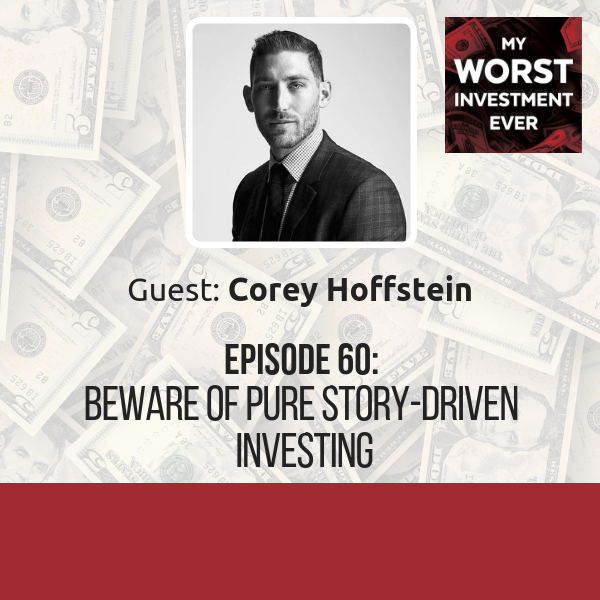
Corey Hoffstein - Beware of Pure Story-Driven Investing
from My Worst Investment Ever Podcast
Guest profile Corey Hoffstein is a co-founder of and chief investment officer at Newfound Research, a firm founded in August 2008, which is a quantitative asset management firm specializing in risk-managed, tactical asset allocation strategies. At Newfound, Corey is responsible for portfolio management, oversight of research and communication of the firm’s views to clients. He received his degree in BS in computer science from Cornell University and finished his MS in computational finance from Carnegie Mellon University. Early investing foray – road to the fall Corey’s tale takes place about a decade ago when he was starting out in investing. He thought he had erased the details of its telling as it was such a painful episode of this life. He believed he was playing his part with considerable research on the world of investing, starting with titles such as Benjamin Graham’s Security Analysis and The Intelligent Investor and anything available by Warren Buffett. From this he became engrossed in the analysis of individual securities and developed the idea that the “real” opportunity was in micro-cap stocks, finding that special stock no one had found and holding it until the market realizes that one is a genius. Green investor’s vision blurred in the Internet’s salad days As an impressionable young investor in the days when the Internet was also young, he was greatly taken by all these investment boards, some prominent and large, some with a dozen or so members, all completely anonymous people sharing ideas with one another. In the sort of blind date equivalent of seeking financial advice, he got to know the people, their investment styles, their stock picks and, eventually, that they could be totally making it all up. But, he built a measure of trust in this hidden little world and on one such board a hot tip was suggested, a pink-sheets, over-the-counter (OTC) stock in a company known as Deep Down Incorporated (DPDW.PK, DPDW.US). DPDW is (still) a deep-sea oil exploration and production-services-related company that builds underwater umbilical cords and submarine drones to explore wells. It either leases or sells such technology to big companies. ‘Underdog target for a buyout’ thesis means ‘gold’ in the offing His thesis was that there was a great R&D operation, a company that is always one big deal away from being “not just profitable, but ultra-profitable” and a sure-thing target for a buyout – The underdog team dealing with big-league industry players. For a time, his “inside scoop” delivered some joy as the stock’s price climbed in a short period, and he took the bait. “People on these web forums are claiming they’re talking to the CEO and they’re sharing the inside scoop and so you really feel like you have your pulse on it. In retrospect, I didn’t have my pulse on anything but I thought I did and so I watched the stock climb from say 40 cents to 80 cents and I think: ‘You wanna know what? This is happening!’ One of those situations where price confirmed my narrative that probably should’ve been a sign, I probably should have dug a little deeper, didn’t even really understand the fundamentals I was getting involved in. This was pure story-driven investing and I bought. I then watched the stock go from about 80 cents to about a US$1.20.” - Corey Hoffstein Early success on half-baked research spells peril Corey believes now that these types of early gains are among the worst things that can happen when an investor has made an ill-conceived investment because it ramps up their overconfidence gene and they become so attached to belief in their own abilities. Corey was no exception. Equating luck with genius, and ignoring his own profit target, he said to himself again: “You wanna know what? The story’s only getting better … now I think we’re going to get to $5”. - Corey Hoffstein His perceived future was getting rosier because the price was supporting all the myths he had built around the stock. So instead of taking some risk off the table, and banking his gains, he ploughed more funds back in. He then saw the stock price decline. Again he interpreted this as other people taking profit, some pain before the big, long-term gain. But it kept sliding. Did he stop? No. Rather, he thought: “You wanna know what, this is a buying opportunity. So not only did I buy at the top, I then doubled down on the way down, which you know, again, in retrospect, is not such a smart move because I really didn’t at all understand what I was buying. And then it just continued to dwindle and it probably got back to around 40 cents and stayed at 40 cents.” - Corey Hoffstein By this time, Corey was so appalled that he stopped checking the price. After three or four years, it was still at 40 cents and he finally let it go. He added that it was not actually his worst investment by dollar value but it was a case in which he made every mistake textbooks say he could have. What is a ‘penny stock trading on a pink sheet’? A pink sheet is a type of stock that is not trading on the main exchanges, such as The New York Stock Exchange or the Nasdaq and therefore it does not meet the regulatory and exchange requirements to be listed on the main courses. It is also OTC traded, which means it is very illiquid (difficult to sell and turn into cash). And if trusting in web-forum strangers’ was not bad enough, Corey invested in a penny stock. Rather than seeing this as a red flag at the start, it was instead was one of the main reasons that the stock seduced him to invest in it. His belief was that such a stock offered more opportunity for upside. But the turn of events proved otherwise. Corey’s Takeaways 1. Invest in a manner that aligns with your personality, both the positives and the negatives. If you are someone who truly enjoys the process of understanding company fundamentals, a more discretionary value approach can be totally warranted and appropriate. For Corey personally, he had to see the negative side, which was that he was quite vulnerable to a stock’s story, which thus put him at risk of being an emotional investor. His takeaway, in essence, was what makes him more successful today in that it drove him to find a way to invest in an unemotional manner. How did he do that? 2. Adopt a fully quantitative methodology. This is one you can control from A to Z and would certainly ensure that you are not going to be drawn in and seduced by your own emotions. “Everything I do today is quant. It’s not quant because I’m a robot. I’m quant because I’m emotional and I need those rules to make sure I stay on the straight and narrow.” - Corey Hoffstein 3. Recognize that mistakes are going to happen with investing. It is impossible to avoid all mistakes, even when you are very knowledgeable and aware of them. You are working without all the information, you cannot know who is necessarily on the other side of a trade. It is very important to always consider that you are going to be wrong, and not just wrong once, but many times. Survival, ultimately, is key. Andrew’s Takeaways The team at A.Stotz investment and Andrew have identified six core mistakes that investors make. Corey made three (although he feels his story could cover them all). 1. Failed to do their own research. We never in the world of investing would invest without doing our own research. 2. Failed to properly assess risk. Risk, as he often says, is a separate item. In this case, there were the risks to liquidity and the structures that were insufficiently put in place and then ignored for the moment that the shares started going down and the investor's response to that moment. 3. Misplaced trust. Corey placed trust in an anonymous forum where people can be releasing different stories for different reasons. They could have neither been investing themselves nor risking anything in what they were proposing and that Corey had no way of knowing it. He pointed out that there are honest people who are sharing their investment experience on the Internet and they are just unable to share it accurately. ...
Embed this episode
Ready to play
Corey Hoffstein - Beware of Pure Story-Driven Investing
No transcript for this episode yet
Similar Episodes
No similar episodes found.