Cosmic Messengers: IceCube's Hunt for Extremely High-Energy Neutrinos episode artwork

EPISODE · Feb 11, 2025 · 14 MIN

Cosmic Messengers: IceCube's Hunt for Extremely High-Energy Neutrinos

from Multi-messenger astrophysics · host Astro-COLIBRI

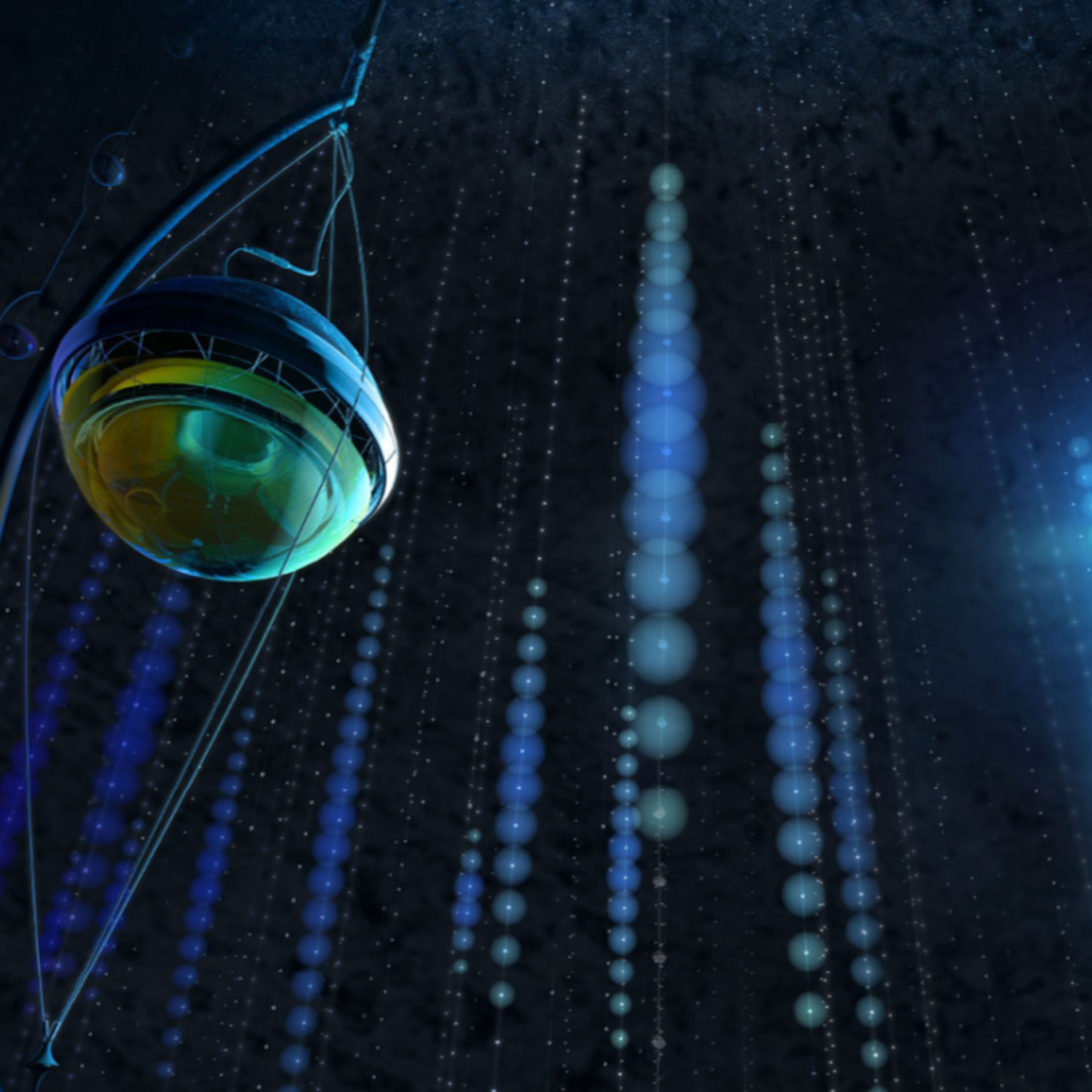
* **Introduction:** This episode discusses the search for extremely-high-energy neutrinos (EHEν) using 12.6 years of data from the IceCube Neutrino Observatory. EHEνs are unique messengers from the distant universe, traveling without being deflected by magnetic fields or attenuated by interactions with background photons.* **IceCube Detector:** The IceCube detector, located at the South Pole, consists of 5160 Digital Optical Modules (DOMs) distributed on 86 strings, instrumenting a cubic kilometer of ice. The detector observes Cherenkov light produced by charged particles from neutrino interactions. A surface array called IceTop measures cosmic-ray air showers.* **EHEν Detection:** EHEν events in IceCube are observed as tracks (from muon or tau neutrinos) or cascades (from all-flavor neutral-current interactions and electron neutrinos). The search focuses on downgoing or horizontal neutrinos because higher energy neutrinos are absorbed by the Earth.* **Backgrounds:** The main background is from downgoing atmospheric muon bundles. Other backgrounds include atmospheric neutrinos, which are divided into conventional and prompt components, and astrophysical neutrinos.* **Analysis:** The analysis uses quality cuts of high-energy events and an IceTop veto to improve the signal-to-noise ratio. The event direction is reconstructed, and energy loss profiles are used to distinguish between single muons and muon bundles.* **Results:** The non-observation of cosmogenic neutrinos places constraints on the cosmological evolution of ultra-high-energy cosmic ray (UHECR) sources. The study constrains the proton fraction of UHECRs above approximately 30 EeV to be less than 70% at a 90% confidence level, assuming that the source evolution is comparable to or stronger than the star formation rate. This result disfavors the "proton-only" hypothesis for UHECRs.* **Significance:** This research complements direct air-shower measurements by being insensitive to uncertainties associated with hadronic interaction models. The study also provides the most stringent limit on cosmogenic neutrino fluxes to date.* **Methodology:** The analysis fits data using a binned Poisson likelihood in the space of reconstructed direction and energy. The study uses the CRPropa package to model cosmogenic fluxes and includes energy losses from photo-pion production and pair production on the cosmic microwave background (CMB) and extragalactic background light (EBL).* **Event Selection:** The event selection involves several steps including: charge and hit cuts, track quality cuts, muon bundle cuts, and IceTop veto.* **Differential Limit**: The differential upper limit on the neutrino flux above 5 x 10^6 GeV is presented in the study and compared to various cosmogenic neutrino models.* **Systematics**: Systematic uncertainties are taken into account through pseudo-experiments. Parameters considered include: the optical efficiency of the DOMs, the neutrino cross section, average neutrino inelasticity, and atmospheric muon and neutrino fluxes.* **Reference:** The research is detailed in the article "A search for extremely-high-energy neutrinos and first constraints on the ultra-high-energy cosmic-ray proton fraction with IceCube".Acknowledements: Podcast prepared with Google/NotebookLM. Illustration credits: NSF, IceCube

* **Introduction:** This episode discusses the search for extremely-high-energy neutrinos (EHEν) using 12.6 years of data from the IceCube Neutrino Observatory. EHEνs are unique messengers from the distant universe, traveling without being deflected by magnetic fields or attenuated by interactions with background photons.* **IceCube Detector:** The IceCube detector, located at the South Pole, consists of 5160 Digital Optical Modules (DOMs) distributed on 86 strings, instrumenting a cubic kilometer of ice. The detector observes Cherenkov light produced by charged particles from neutrino interactions. A surface array called IceTop measures cosmic-ray air showers.* **EHEν Detection:** EHEν events in IceCube are observed as tracks (from muon or tau neutrinos) or cascades (from all-flavor neutral-current interactions and electron neutrinos). The search focuses on downgoing or horizontal neutrinos because higher energy neutrinos are absorbed by the Earth.* **Backgrounds:** The main background is from downgoing atmospheric muon bundles. Other backgrounds include atmospheric neutrinos, which are divided into conventional and prompt components, and astrophysical neutrinos.* **Analysis:** The analysis uses quality cuts of high-energy events and an IceTop veto to improve the signal-to-noise ratio. The event direction is reconstructed, and energy loss profiles are used to distinguish between single muons and muon bundles.* **Results:** The non-observation of cosmogenic neutrinos places constraints on the cosmological evolution of ultra-high-energy cosmic ray (UHECR) sources. The study constrains the proton fraction of UHECRs above approximately 30 EeV to be less than 70% at a 90% confidence level, assuming that the source evolution is comparable to or stronger than the star formation rate. This result disfavors the "proton-only" hypothesis for UHECRs.* **Significance:** This research complements direct air-shower measurements by being insensitive to uncertainties associated with hadronic interaction models. The study also provides the most stringent limit on cosmogenic neutrino fluxes to date.* **Methodology:** The analysis fits data using a binned Poisson likelihood in the space of reconstructed direction and energy. The study uses the CRPropa package to model cosmogenic fluxes and includes energy losses from photo-pion production and pair production on the cosmic microwave background (CMB) and extragalactic background light (EBL).* **Event Selection:** The event selection involves several steps including: charge and hit cuts, track quality cuts, muon bundle cuts, and IceTop veto.* **Differential Limit**: The differential upper limit on the neutrino flux above 5 x 10^6 GeV is presented in the study and compared to various cosmogenic neutrino models.* **Systematics**: Systematic uncertainties are taken into account through pseudo-experiments. Parameters considered include: the optical efficiency of the DOMs, the neutrino cross section, average neutrino inelasticity, and atmospheric muon and neutrino fluxes.* **Reference:** The research is detailed in the article "A search for extremely-high-energy neutrinos and first constraints on the ultra-high-energy cosmic-ray proton fraction with IceCube".Acknowledements: Podcast prepared with Google/NotebookLM. Illustration credits: NSF, IceCube

NOW PLAYING

Cosmic Messengers: IceCube's Hunt for Extremely High-Energy Neutrinos

0:00 14:11

No transcript for this episode yet

We transcribe on demand. Request one and we'll notify you when it's ready — usually under 10 minutes.

The 48 Laws of Power by Robert Greene (Full Audiobook) Robert Greene Amoral, cunning, ruthless, and instructive, this multi-million-copy New York Times bestseller is the definitive manual for anyone interested in gaining, observing, or defending against ultimate control – from the author of The Laws of Human Nature.In the book that People magazine proclaimed “beguiling” and “fascinating,” Robert Greene and Joost Elffers have distilled three thousand years of the history of power into 48 essential laws by drawing from the philosophies of Machiavelli, Sun Tzu, and Carl Von Clausewitz and also from the lives of figures ranging from Henry Kissinger to P.T. Barnum.Some laws teach the need for prudence (“Law 1: Never Outshine the Master”), others teach the value of confidence (“Law 28: Enter Action with Boldness”), and many recommend absolute self-preservation (“Law 15: Crush Your Enemy Totally”). Every law, though, has one thing in common: an interest in t API Intersection Stoplight Building a successful API requires more than just coding. It starts with collaborative design, focuses on creating a great developer experience, and ends with getting your company on board, maintaining consistency, and maximizing your API’s profitability.In the API Intersection, you’ll learn from experienced API practitioners who transformed their organizations, and get tangible advice to build quality APIs with collaborative API-first design.Jason Harmon brings over a decade of industry-recognized REST API experience to discuss topics around API design, governance, identity/auth versioning, and more.They’ll answer listener questions, and discuss best practices on API design (definition, modeling, grammar), Governance (multi-team design, reviewing new API’s), Platform Transformation (culture, internal education, versioning) and more.They’ll also chat with experienced API practitioners from a wide array of industries to draw out practical takeaways and insights you can use.H MTG PodQuest Echoblade Studios Podcast reporting events relating to Magic: The Gathering Puzzle Quest, and specifically covering ”The Gods of Theros” multi-coalition for the online game Magic: The Gathering--Puzzle Quest. Can be enjoyed by any players of MTGPQ or anybody with ears. Maybe.TRIGGER WARNING: A LOT of nerdy stuff. Possibly an occasional vulgarity, though we keep that to a minimum. Passive Investing Podcast The Real Estate Women The Passive Investing Podcast is a round table discussion where we teach you how to create a stream of passive income through Multi Family investing. Crystal, Candy, Colleen & Tamara dive into the classroom, board room and living room on Multi Family real estate investing, with Guests Matt Pichney, Rod Khleif, and Julie Holly pulling up a chair to share stories and insight on their areas of expertise. Whether you’re trying to jump into real estate to free yourself from the grind of the 9-5, to build a stream of passive income or to create generational wealth, join us at the table!

Frequently Asked Questions

How long is this episode of Multi-messenger astrophysics?

This episode is 14 minutes long.

When was this Multi-messenger astrophysics episode published?

This episode was published on February 11, 2025.

What is this episode about?

* **Introduction:** This episode discusses the search for extremely-high-energy neutrinos (EHEν) using 12.6 years of data from the IceCube Neutrino Observatory. EHEνs are unique messengers from the distant universe, traveling without being deflected...

Can I download this Multi-messenger astrophysics episode?

Yes, you can download this episode by clicking the download button on the episode player, or subscribe to the podcast in your preferred podcast app for automatic downloads.
URL copied to clipboard!