General Motors is one of the pillars of not just Detroit's auto industry, but the worlds as well. And now, GM is quite literally shooting for the moon. Why is that? Well, if your battery can work on the moon, it's gonna work in Hymn-Trenic, LaVonia, Garden City, or anywhere else.
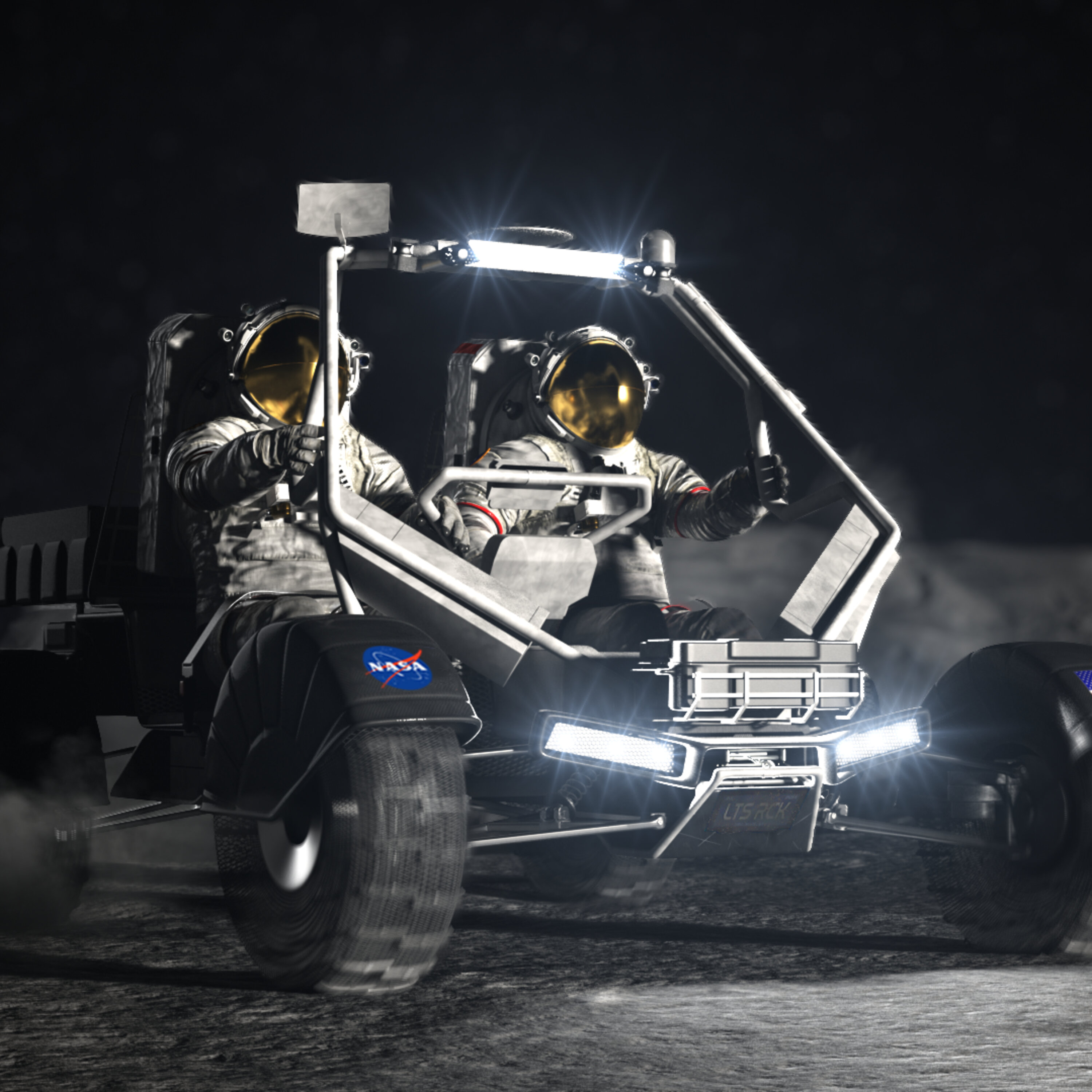
I'm Ryan Fisher, and this is the Daily Jay. General Motors, as part of a team under Lunar Outpost, is among three remaining candidates for a contract from NASA to help build the next lunar terrain vehicle, as America has its eyes set on manned missions to the moon once again. But when I heard GM was in the running to help build this battery-powered buggy, my main question was, why? What does a car manufacturer have to gain by making a vehicle it can't sell to the public?
Well, WWJ's Jeff Gilbert helped to put it in perspective. Well, if your battery can work on the moon, it's gonna work in Hymn-Trenic, LaVonia, Garden City, or anywhere else. What you see is you see a lot of technology development right now. And automotive technology has to be rock solid because it's got to work in some really severe conditions.
Well, magnify that by a factor of whatever to actually work on the moon. So, if GM, and they're talking about developing batteries and autonomous software for this, if GM can develop things that can work on the moon, that, you know, a lunar rover that can run autonomously when there are no astronauts there, that improves their technology here on Earth. Is there maybe to like a marketing aspect to this? I am sure there is.
Okay. Can you indulge me on old man moments? Absolutely. I remember when I was a kid and I was born in 1955.
So I, you know, I was about six years old when Alan Shepard went into space. So I grew up with a space program. Tang, the orange breakfast drink, they advertised everywhere that that was the drink of the astronauts. And it really didn't taste very good.
Boy, you love drinking that because you knew the astronauts drank it. So yeah, I am sure if, you know, GM can say their technology has been tested by NASA and put it in a vehicle, well, that immediately adds some cache. And General Motors may have a leg up on its competition too, as I learned that this isn't their first time building rovers with NASA. Well, the original lunar rover was back in the early 70s and the last three Apollo missions.
And GM was on a team that developed that vehicle. They did the chassis, some of that kind of dynamics along with Boeing. And I believe Lockheed Martin was involved again back then. So it was similar to this in that it's a team approach, but very different because we're talking about late 60s, early 70s technology.
As opposed to 20th century technology. So back then for GM, it was all about the hardware of making a car. Today with GM, it's all about cool software, self-driving, batteries, things like that. Even if GM gets the contract, they will then have to work in tandem with NASA and its partners at Lockheed Martin and Lunar Outpost to make not just this rover, but the mission itself possible.
Yeah, the key is, as I said before, is really understanding the interfaces because obviously there has to be a time when the parts of GM make and the parts that all the other manufacturers and developers make, they all have to come together. And so I think the key element for that is testing. And so that's why it's important to test all of these components here on the earth and to make sure they all work together. An example of that was with the space station.
The space station was all put together on the floor of a giant hangar in Kennedy Space Center in the late 1990s. And it was all connected together and they made sure that everything worked before all those components went into orbit and work together in the space environment. And so that's a key element to making sure that the GM parts and everybody else are working together and harming me. That was Dr.
Don Platt, a professor of space systems at the Florida Institute of Technology, who explains how working with and understanding your partners is imperative for mission success. And Jeff adds, the real difficulty is working together to design something that's reliable in the moon's extreme conditions. Well, the working together part isn't the difficult part because car makers and other companies have joint ventures all the time. So they know how to work together.
But the degree of difficulty in developing something for an area that doesn't have an atmosphere, there's no oxygen up there. You've got extreme heat for however many days and extreme cold for however many days with the lunar day and night. You can't exactly call AAA if you break down. And if astronauts are in there and they break down their lives may depend on it.
So that adds to the degree of difficulty. But okay, say you're an engineer who worked on this and you go back to working on a Buick the next time around boy, you're going to have some credibility there. Make sure you stay in our orbit. We'll be right back with more Daily Jay after this.
The United States hasn't had a manned mission to the moon since 1972. So why is NASA planning to step foot on the lunar surface again after all these years? What's left to learn? Back to Dr.
Platt. Well, we only sent 12 people to actually walk on the surface of the moon and they only walked in very small areas around the equator of the moon. Since the 1970s when we stopped sending humans to the moon, we've learned a lot about the moon. We've learned a lot about the fact that the polar regions of the moon are extremely interesting.
They may actually have frozen water, essentially very hard ice in the bottom of some craters, especially in the South Pole region of the moon. This is something we had no idea about in the 1960s. We also have an interest in eventually sending humans to Mars. But why not learn at a place that's much closer and more easily accessible such as the moon before we go off on that huge ride, which will take years really sending humans to Mars.
We haven't just learned new things about the moon in all this time, but technology has also come a long way these past 50 years, making travel more feasible. Well, certainly we have lots more autonomous technology capability. We see that even in our passenger cars where we have systems that can essentially drive the car pretty much by itself in many situations. And so that whole autonomous and software-related technology is much different now than it was back then in the 60s.
And of course, we also have much more advanced materials now too. We can make a rover that is much lighter, but yet be even stronger than the Apollo rover was in the 60s. Another interesting aspect of the typical rover is on the surface of the moon. The soil on the moon is actually essentially powdered glass.
And so rubber tires don't work. And so you have to have a metal mesh tire in order to safely drive around on the moon. Now, let's flip my earlier question on its head. Rather than why are we going back, instead, why did we ever stop going to the moon?
Here's Dr. Platt one last time. Well, a lot of people joke that the Apollo program was flags and footprints. And so it was to put a flag on the moon and to walk around for a few hours, but it really wasn't sustainable.
It really wasn't going to lead us to a moon base, for instance. There was a lot of development that would have to have taken place. Now, before we kind of took the next step from there, and NASA thought that the next step then would be to, what we really did and that was to better understand how humans can live and work in space and lower Earth orbit and do so with a space station. The problem was that NASA did not have that huge budget that it had in the 1960s to successfully complete the Apollo program.
And so it had to make decisions about priorities. And I thought the first priority was to have a reliable continuous access to Earth orbit. And then use that as a stepping stone to then go deeper in space. So that's why we went to shuttle program and built the space station.
General Motors has set its sights on the moon. And if it can manage to win the contract from NASA, it could be a win for not just GM, but also lead to advancements in space exploration for mankind. Thanks to Jeff Gilbert and Dr. Don Platt for lending their expertise to this episode.
And as always, this podcast wouldn't be possible without WWJ's digital team. Check out www.newsradio.com for the top local news stories on demand 24-7. Make sure you don't miss out on new episodes of The Daily Jay by subscribing using the Odyssey app, or get it wherever you get your podcasts. I'm Brian Fisher, and this is The Daily Jay.
Thanks for listening.