
EPISODE · Mar 28, 2026 · 16 MIN
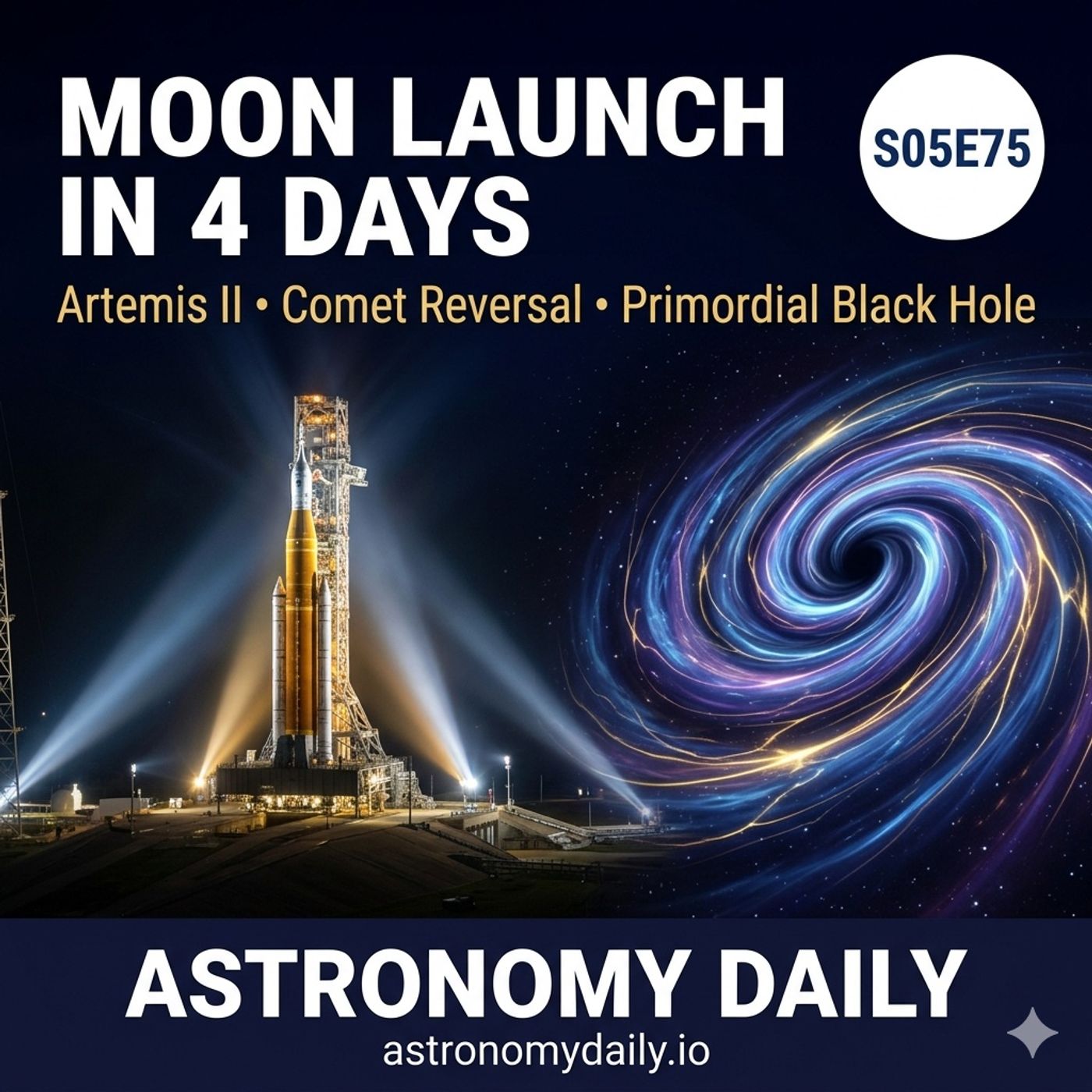
Countdown to the Moon: Artemis II Launch Week Begins | Plus Comet Reversal & ISS Medical Mystery Update
from Astronomy Daily: Space News Updates · host bitesz.com
Episode S05E75 — Saturday, 28 March 2026 | astronomydaily.io | @AstroDailyPod 🚀 Story 1: Artemis II Crew Arrives at Kennedy Space Center The four-person crew of NASA's Artemis II mission — Commander Reid Wiseman, Pilot Victor Glover, Mission Specialist Christina Koch (NASA), and Mission Specialist Jeremy Hansen (CSA) — arrived at Kennedy Space Center on Friday, March 27, 2026, ahead of a planned April 1 launch. The 10-day mission will fly the crew around the Moon and back to Earth — the first crewed lunar mission since Apollo 17 in 1972. Launch window: 6:24 PM EDT, April 1–6, 2026. Sources: NASA.gov, Space.com, AP, Orlando Sentinel ☄️ Story 2: Hubble Detects First-Ever Spin Reversal of a Comet A new study in The Astronomical Journal reveals that comet 41P/Tuttle-Giacobini-Kresák reversed its direction of rotation — a first in observational astronomy. Gas jets acting as thrusters slowed the comet's spin and flipped it into a new direction. The comet's nucleus measures just 1 km across. Researchers warn the rapid new spin could lead to the comet's disintegration. Source: NASA Science / Space Telescope Science Institute, March 26, 2026 🌑 Story 3: LIGO Signal May Be a Primordial Black Hole A November 2025 LIGO detection of a gravitational wave signal from an object with less than one solar mass — impossible through stellar evolution — may be evidence of a primordial black hole formed in the Big Bang's first moments. A new University of Miami study in The Astrophysical Journal finds the detection consistent with primordial black hole models and suggests these objects could help explain dark matter. Source: Universe Today / University of Miami, March 27, 2026 ⭐ Story 4: IXPE Delivers New Portrait of Oldest-Known Supernova NASA's IXPE (Imaging X-ray Polarimetry Explorer) has produced a new X-ray image of supernova remnant RCW 86 (SN 185) — the oldest recorded supernova, first observed by Chinese astronomers in 185 AD. Combined with Chandra and XMM-Newton data, the image reveals the remnant's expansion has slowed at the edge of a low-density cavity, producing a reflected shock. Source: NASA / Phys.org, March 25–27, 2026 🏥 Story 5: Mike Fincke Speaks About His ISS Medical Emergency NASA astronaut Mike Fincke has given his first detailed account of the January 7, 2026 medical event that led to the first-ever medical evacuation from the International Space Station. In an AP interview, Fincke revealed he lost the ability to speak for approximately 20 minutes while eating dinner. Doctors have ruled out a heart attack but the cause remains unknown. The incident ended Crew-11's mission early, returning Fincke, Zena Cardman, Kimiya Yui, and Oleg Platonov to Earth on January 15. Source: Associated Press / Phys.org, March 27, 2026 ☀️ Story 6: Solar Activity — AR4403 Flares, Possible CME March 29 Sunspot region AR4403, which rotated into view on March 26, produced an M3.9 solar flare causing a minor radio blackout over the Indian Ocean. Conditions are quiet on March 28, but space weather forecasters expect a co-rotating interaction region and coronal hole high-speed stream to arrive March 29, bringing unsettled geomagnetic conditions and possible aurora visibility at mid-latitudes. Southern Hemisphere observers in Australia and New Zealand should watch Sunday–Monday nights. Source: EarthSky / The Sun Today, March 27, 2026Become a supporter of this podcast: https://www.spreaker.com/podcast/astronomy-daily-latest-space-news--5648921/support.Sponsor Details:Ensure your online privacy by using NordVPN. To get our special listener deal and save a lot of money, visit www.astronomydaily.io/nordvpn. You'll be glad you did!Get the best secure and private email on the planet. Stop your Government, google and who knows who else spying on every email you write. Do what we did and use ProtonMail. They beleive in privacy and there are no ads in their business model...yet they still provide a free forever service. Check them out and get out special deal at www.astronomydaily.io/protonmailBecome a supporter of Astronomy Daily by joining our Supporters Club. Commercial free episodes daily are only a click way... Click HereThis episode includes AI-generated content.
Embed this episode
Ready to play
Countdown to the Moon: Artemis II Launch Week Begins | Plus Comet Reversal & ISS Medical Mystery Update
No transcript for this episode yet
Similar Episodes
No similar episodes found.
Similar Podcasts
No similar podcasts found.