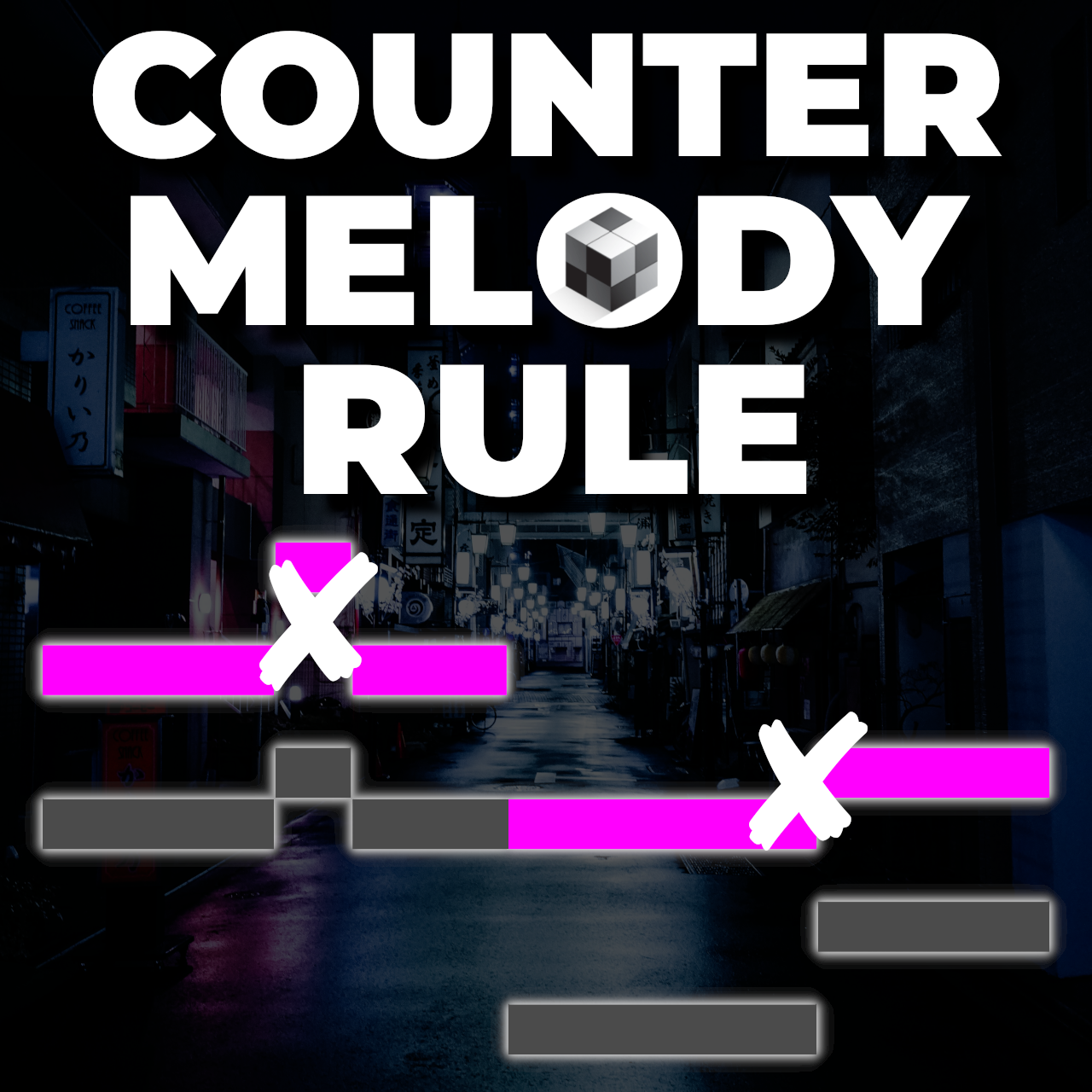
Counter Melody Rule
from Ray Harmony Hosted by Hack Music Theory
Counter Melody Rule Learn how to avoid this common fault many songwriters & producers make in their backing melodies! Hello revolutionary music makers, we are Kate and Ray Harmony (AKA Revolution Harmony), and welcome to Hack Music Theory, the fast, easy and fun way to make music! If you’re new to theory, or if you just want a refresher, then read our free book "12 Music Theory Hacks to Learn Scales & Chords". It’ll give you a super solid music theory foundation in just 30 minutes. The free download is below. Enjoy! The Fault To clarify. A fault is not a mistake! Music is an art, so if you’re making music from your heart, then there cannot be any mistakes. But, when songwriters and producers don’t understand theory, which is the grammar of music, they’re not able to fully express themselves. Just like if someone was trying to write a poem in a language they didn’t speak. The resulting work of art will undoubtedly have weaknesses. And a fault is defined as a weakness. So, what’s the fault in this backing melody? Well, in order to answer that question, we first need to ask another question: What’s the purpose of a backing melody? You see, once we understand what a backing melody is supposed to be adding to the music, we’ll understand why this backing melody is weak. In other words, why it is not fulfilling its purpose. So, backing melodies are most often used in hooks and choruses, when producers want to add depth to the music, which also thickens the sound. The idea is that this addition will make the section stand out. But, in order for a backing melody to add depth, it needs to be perceived by our ears as a new musical layer. Otherwise, it’ll merely be the lead melody’s shadow, which our ears will ignore. In the same way that when we’re walking down the street, our eyes ignore people’s shadows. And that brings us to our backing melody’s fault: It’s shadowing our lead melody, which is just a polite way of saying that it’s copying our lead melody. And nobody likes a copycat, especially lead melodies! The result of our backing melody being nothing more than a shadow, is that it does not fulfill its purpose: to add depth. The Fix Right, so now you’re probably thinking: How can I write backing melodies that will be perceived as new musical layers, so they actually add depth? Easy! You write your backing melodies using counterpoint. What’s counterpoint? Well, counterpoint is the technique of adding musical layers by writing melodies with countering contours. For example, if we take the first bar of our section, and instead of having our backing melody copy the contour of our lead melody, we change our backing melody so it counters the contour of our lead melody. Now, there’s numerous ways to counter a melody, but the best way is to literally go in the opposite direction. We do that here when our lead melody goes from B down to G, while our backing melody goes in the opposite direction, from A up to B. And we do it again when our lead goes from G up to A, while our backing goes from C down to B. And by the way, our example is in the key of A minor, which is all the white notes from A to A, and the tempo is 95 BPM. When a lead melody and backing melody move in opposite directions, that’s called contrary motion, and it’s just one of the ways to write counterpoint. If you wanna learn all the ways and how to use them to write countering melodies, then check out the counterpoint hack in our Songwriting & Producing PDF, which also includes all our other essential music making hacks, as well as MIDI examples. Finally, to add even more musical depth, play around with countering your lead melody’s rhythm, too. You’ll notice in our example, there’s a few times where our backing melody plays a different rhythm to our lead melody. The most obvious example of this is in the beginning of our second bar (see MIDI below), where the lead melody plays one long note, and the backing melody counters that with four short notes. And remember, you don’t have to always have both melodies playing at the same time. You’ll hear in our final example that there’s a couple of places where our backing melody has a rest, in order to give our lead melody some space. Lastly, we love the life lesson that counterpoint teaches us. One melody can be completely and utterly opposite to another melody, yet they coexist in beautiful harmony. And not only do they coexist peacefully, but the music would be weaker without both melodies. In these extremely polarized times we’re living in, we find this lesson so helpful when encountering people with drastically different views to ours. They counter us to create communal counterpoint, and together our different ways make society stronger. The only caveat to this, though, is that both melodies need to be in key, otherwise they’ll create dissonance against the underlying harmony. So as long as both people’s ways are in key, in other words, they’re not creating dissonance against nature’s harmony (like racism does, and sexism does, and so on), then the world is a better place thanks to that societal counterpoint. The Rule Right, to conclude. Our Counter Melody Rule is that your backing melody should add depth to your music, by countering the contour of your lead melody. And the way you do that, is by using the magic technique known as counterpoint. Thanks for being here in the Hack Music Theory community, we really appreciate you, and we'll see you next time. Until then, we're sending you good vibes and gratitude :) Free Download Wooohooo!!! You’re a mere 30 minutes away from being even smarter than you already are. Just head on over to your inbox now for your free download. There was an error submitting your subscription. Please try again. “The most brilliant, fast, easy & fun music theory book I’ve ever seen!” DEREK SIVERS, CD Baby founder We use this field to detect spam bots. If you fill this in, you will be marked as a spammer. DOWNLOAD FREE BOOK /* Layout */ .ck_form { /* divider image */ background: #EAE9EA url(data:image/gif;base64,R0lGODlhAQADAIABAMzMzP///yH/C1hNUCBEYXRhWE1QPD94cGFja2V0IGJlZ2luPSLvu78iIGlkPSJXNU0wTXBDZWhpSHpyZVN6TlRjemtjOWQiPz4gPHg6eG1wbWV0YSB4bWxuczp4PSJhZG9iZTpuczptZXRhLyIgeDp4bXB0az0iQWRvYmUgWE1QIENvcmUgNS41LWMwMTQgNzkuMTUxNDgxLCAyMDEzLzAzLzEzLTEyOjA5OjE1ICAgICAgICAiPiA8cmRmOlJERiB4bWxuczpyZGY9Imh0dHA6Ly93d3cudzMub3JnLzE5OTkvMDIvMjItcmRmLXN5bnRheC1ucyMiPiA8cmRmOkRlc2NyaXB0aW9uIHJkZjphYm91dD0iIiB4bWxuczp4bXA9Imh0dHA6Ly9ucy5hZG9iZS5jb20veGFwLzEuMC8iIHhtbG5zOnhtcE1NPSJodHRwOi8vbnMuYWRvYmUuY29tL3hhcC8xLjAvbW0vIiB4bWxuczpzdFJlZj0iaHR0cDovL25zLmFkb2JlLmNvbS94YXAvMS4wL3NUeXBlL1Jlc291cmNlUmVmIyIgeG1wOkNyZWF0b3JUb29sPSJBZG9iZSBQaG90b3Nob3AgQ0MgKE1hY2ludG9zaCkiIHhtcE1NOkluc3RhbmNlSUQ9InhtcC5paWQ6MUQ5NjM5RjgxQUVEMTFFNEJBQTdGNTQwMjc5MTZDOTciIHhtcE1NOkRvY3VtZW50SUQ9InhtcC5kaWQ6MUQ5NjM5RjkxQUVEMTFFNEJBQTdGNTQwMjc5MTZDOTciPiA8eG1wTU06RGVyaXZlZEZyb20gc3RSZWY6aW5zdGFuY2VJRD0ieG1wLmlpZDoxRDk2MzlGNjFBRUQxMUU0QkFBN0Y1NDAyNzkxNkM5NyIgc3RSZWY6ZG9jdW1lbnRJRD0ieG1wLmRpZDoxRDk2MzlGNzFBRUQxMUU0QkFBN0Y1NDAyNzkxNkM5NyIvPiA8L3JkZjpEZXNjcmlwdGlvbj4gPC9yZGY6UkRGPiA8L3g6eG1wbWV0YT4gPD94cGFja2V0IGVuZD0iciI/PgH//v38+/r5+Pf29fTz8vHw7+7t7Ovq6ejn5uXk4+Lh4N/e3dzb2tnY19bV1NPS0dDPzs3My8rJyMfGxcTDwsHAv769vLu6ubi3trW0s7KxsK+urayrqqmop6alpKOioaCfnp2cm5qZmJeWlZSTkpGQj46NjIuKiYiHhoWEg4KBgH9+fXx7enl4d3Z1dHNycXBvbm1sa2ppaGdmZWRjYmFgX15dXFtaWVhXVlVUU1JRUE9OTUxLSklIR0ZFRENCQUA/Pj08Ozo5ODc2NTQzMjEwLy4tLCsqKSgnJiUkIyIhIB8eHRwbGhkYFxYVFBMSERAPDg0MCwoJCAcGBQQDAgEAACH5BAEAAAEALAAAAAABAAMAAAICRFIAOw==) repeat-y center top; font-family: 'Montserrat'; line-height: 1.5em; overflow: hidden; color: #000000; font-size: 16px; border-top: none; border-top-color: #666666; border-bottom: none; border-bottom-color: #3d3d3d; -webkit-box-shadow: none; -moz-box-shadow: none; box-shadow: none; clear: both; margin: 0px 0px; } .ck_form, .ck_form * { -webkit-box-sizing: border-box; -moz-box-sizing: border-box; box-sizing: border-box; } #ck_subscribe_form { clear: both; } /* Element Queries — uses JS */ .ck_form_content, .ck_form_fields { width: 50%; float: left; padding: 5%; } .ck_form.ck_horizontal { } .ck_form_content { border-bottom: none; } .ck_form.ck_vertical { background: #fff; } .ck_vertical .ck_form_content, .ck_vertical .ck_form_fields { padding: 10%; width: 100%; float: none; } .ck_vertical .ck_form_content { border-bottom: 1px dotted #aaa; overflow: hidden; } /* Trigger the vertical layout with media queries as well */ @media all and (max-width: 499px) { .ck_form { background: #fff; } .ck_form_content, .ck_form_fields { padding: 10%; width: 100%; float: none; } .ck_form_content { border-bottom: 1px dotted #aaa; } } /* Content */ .ck_form_content h3 { margin: 0px 0px 0px; font-size: 0px; padding: 0px; } .ck_form_content p { font-size: 14px; } .ck_image { float: left; margin-right: 5px; } /* Form fields */ .ck_errorArea { display: none; } #ck_success_msg { padding: 10px 10px 0px; border: solid 1px #ddd; background: #eee; } .ck_label { font-size: 14px; font-weight: bold; } .ck_form input[type="text"] { font-size: 16px; text-align: center; margin-top: 20px; margin-bottom: 0px; padding: 8px 8px; width: 100%; border: 1px solid #d6d6d6; /* stroke */ -moz-border-radius: 4px; -webkit-border-radius: 4px; border-radius: 30px; /* border radius */ background-color: #fff; /* layer fill content */ height: auto; } .ck_form input[type="email"] { font-size: 16px; text-align: center; margin-top: 0px; margin-bottom: 15px; padding: 8px 8px; width: 100%; border: 1px solid #d6d6d6; /* stroke */ -moz-border-radius: 4px; -webkit-border-radius: 4px; border-radius: 30px; /* border radius */ background-color: #fff; /* layer fill content */ height: auto; } .ck_form input[type="text"]:focus, .ck_form input[type="email"]:focus { outline: none; border-color: #aaa; } .ck_checkbox { padding: 10px 0px 10px 20px; display: block; clear: both; } .ck_checkbox input.optIn { margin-left: -20px; margin-top: 0; } .ck_form .ck_opt_in_prompt { margin-left: 4px; } .ck_form .ck_opt_in_prompt p { display: inline; } .ck_form .ck_subscribe_button { width: 100%; color: #fff; margin: 0px 0px 0px; padding: 8px 8px; font-size: 18px; background: #c83232; -moz-border-radius: 4px; -webkit-border-radius: 4px; border-radius: 30px; /* border radius */ cursor: pointer; border: none; text-shadow: none; } .ck_form .ck_guarantee { color: #626262; font-size: 12px; text-align: center; padding: 5px 0px; display: block; } .ck_form .ck_powered_by { display: block; color: #aaa; } .ck_form .ck_powered_by:hover { display: block; color: #444; } .ck_converted_content { display: none; padding: 5%; background: #fff; } /* v6 */ .ck_form_v6 #ck_success_msg { padding: 0px 10px; } @media all and (max-width: 403px) { .ck_form_v6.ck_modal .ck_close_link { top: 30px; } } @media all and (min-width: 404px) and (max-width: 499px) { .ck_form_v6.ck_modal .ck_close_link { top: 57px; } } Podcast Listen below, or on any podcast app.
Embed this episode
No transcript yet.