
EPISODE · Feb 22, 2024 · 5 MIN
Counterfactual Regret Minimization (AGT 26)
from Higher Signal: Get Smarter. Faster. · host Higher Signal
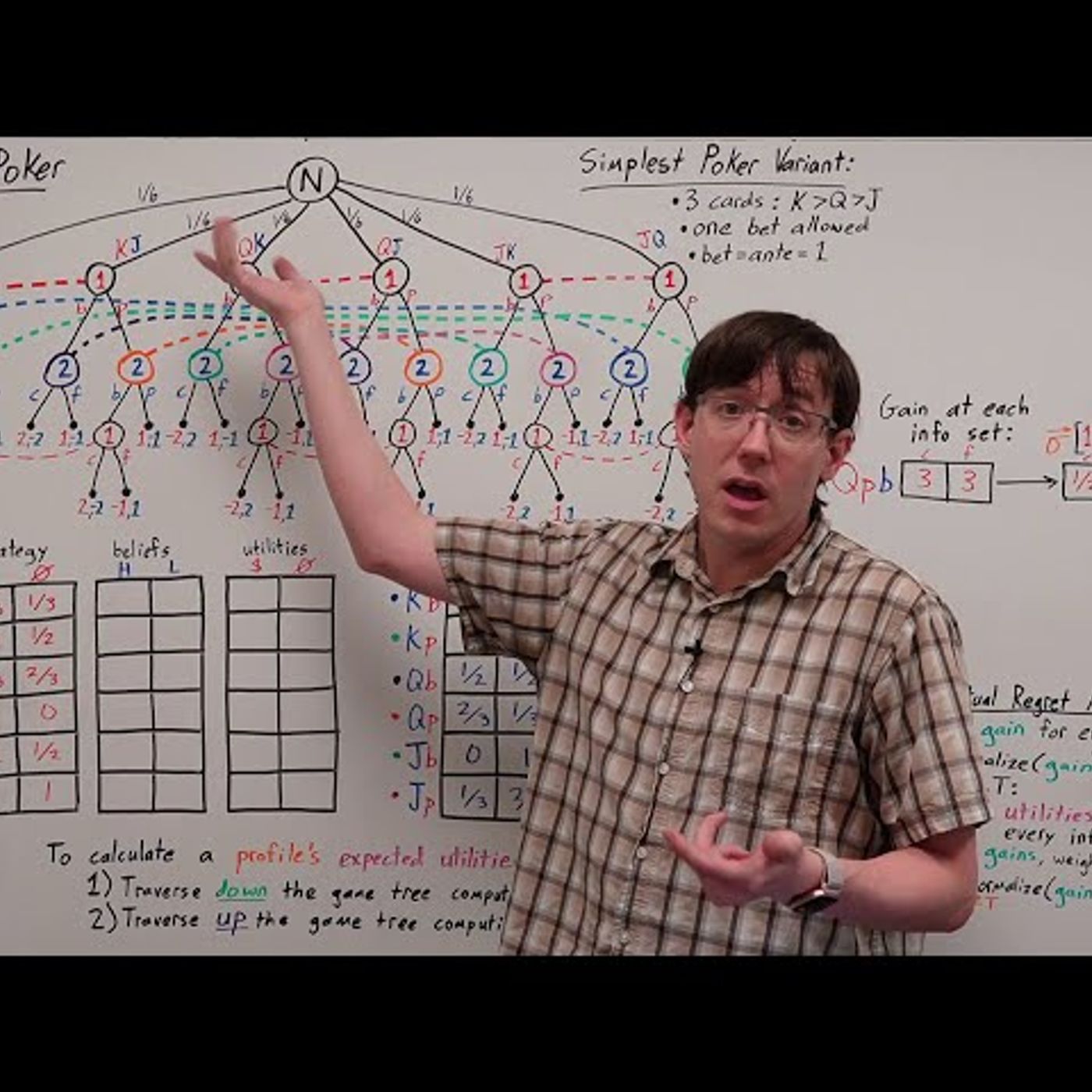
1. The transcript discusses Counterfactual Regret Minimization (CFR), an algorithm designed to solve games with sequential actions and incomplete information, specifically focusing on small to medium poker variants like Kuhn Poker, and extending to other two-player zero-sum games.2. It explains the structure of Kuhn Poker, describing the initial deal, betting rounds, and how the winner is determined, as well as the concept of information sets and game tree representation.3. The behavioral strategy for players is shown as a table of probabilities for taking certain actions within the specific information sets.4. The core idea of CFR is introduced as updating strategies at every information set, by keeping track of cumulative gains for actions, and normalizing the gains into strategies.5. It is explained that in extensive form games, before adding the gains to the cumulative total, they need to be weighted by the probability that the information set will be reached if the player was attempting to do so.6. The process for calculating gains involves comparing the utility of each possible action to the utility of following the current strategy, and then traversing the game tree to calculate beliefs and expected utilities for every action at each information set.7. Gains for actions are determined by their deviation from the current strategy, and must be weighted and normalized before being added to the cumulative gains used to update the player's strategy for the next iteration.8. The transcript concludes by stating that CFR has been proven to converge to a Nash equilibrium in two-player zero-sum games and also acts as a foundation for dealing with larger-scale games through its extensions.Key questions the transcript answers:How does Counterfactual Regret Minimization solve games with sequential actions and incomplete information? - CFR solves these games by iteratively updating strategies at each information set based on cumulative gains for actions, which are compared to the outcomes of a player's current strategy. By calculating expected utilities and gains for every action, adjusting them based on the likelihood of reaching those information sets, and normalizing, the CFR algorithm converges towards an optimal strategy or Nash equilibrium in two-player zero-sum games.What is the game structure of Kuhn Poker? - Kuhn Poker involves two players, each paying an ante and being dealt one card from a three-card deck. There's a single round of betting, after which the player with the higher card, or the player whose opponent folded, wins the pot.How are behavioral strategies represented in Kuhn Poker?- Behavioral strategies in Kuhn Poker are represented as tables where each row corresponds to an information set and columns represent possible actions, with the probabilities of taking those actions when in that specific set.Why must gains be probability-weighted before adding to cumulative gains in extensive form games?- Probability-weighting gains ensures that updates in the strategy are more significant for commonly visited parts of the game tree and maintains a relationship with overall strategy gains necessary for analyzing the algorithm's convergence.What are the steps involved in CFR's algorithm?- CFR involves: (1) getting a current strategy by normalizing cumulative gains, (2) traversing the game tree from top to bottom for beliefs and bottom to top for utilities, (3) calculating and probability-weighting gains, (4) updating cumulative gains, and (5) obtaining new strategy profiles for subsequent iterations.What ensures the effectiveness of CFR in games that are not zero-sum or have more than two players?- Even though there's no guarantee of convergence to Nash equilibrium for non-zero-sum or multiplayer games, CFR acts as a heuristic algorithm that could sometimes reach equilibrium. It is also the foundation for advanced versions that tackle larger games through random sampling and abstraction techniques.Core Takeaway:The core problem described is solving two-player zero-sum games like poker variants with incomplete information and sequential actions. If left unsolved, players may use suboptimal strategies that could result in consistent losses or missed opportunities for maximizing their winnings.The consequences for not understanding or solving the problem include poor decision-making in game play and inability to develop automated systems that can compete at a high level in complex strategic environments, such as online poker platforms.To address the problem, the key new ideas presented are:1. CFR algorithm: It adapts strategies by using probabilistic models to assess the regret associated with not taking certain actions and normalizes these regrets to update the player's strategy iteratively.2. Game tree analysis: By traversing the game tree and calculating expected utilities and beliefs, the algorithm determines the best actions to take at different information sets.3. Extensions and improvements: The basic CFR algorithm can be modified with advanced techniques like random sampling or abstraction to manage larger-scale and more complex games effectively.Tags here: Counterfactual Regret Minimization, Kuhn Poker, two-player zero-sum games, game tree, betting, Nash equilibrium, strategy profiles
Embed this episode
NOW PLAYING
Counterfactual Regret Minimization (AGT 26)
No transcript for this episode yet
Similar Episodes
No similar episodes found.
Similar Podcasts
No similar podcasts found.