
EPISODE · Jun 14, 2026 · 20 MIN
Course 37 - Building Web Apps with Ruby On Rails | Episode 1: From Ruby Basics to Web Development Conventions
from CyberCode Academy · host CyberCode Academy
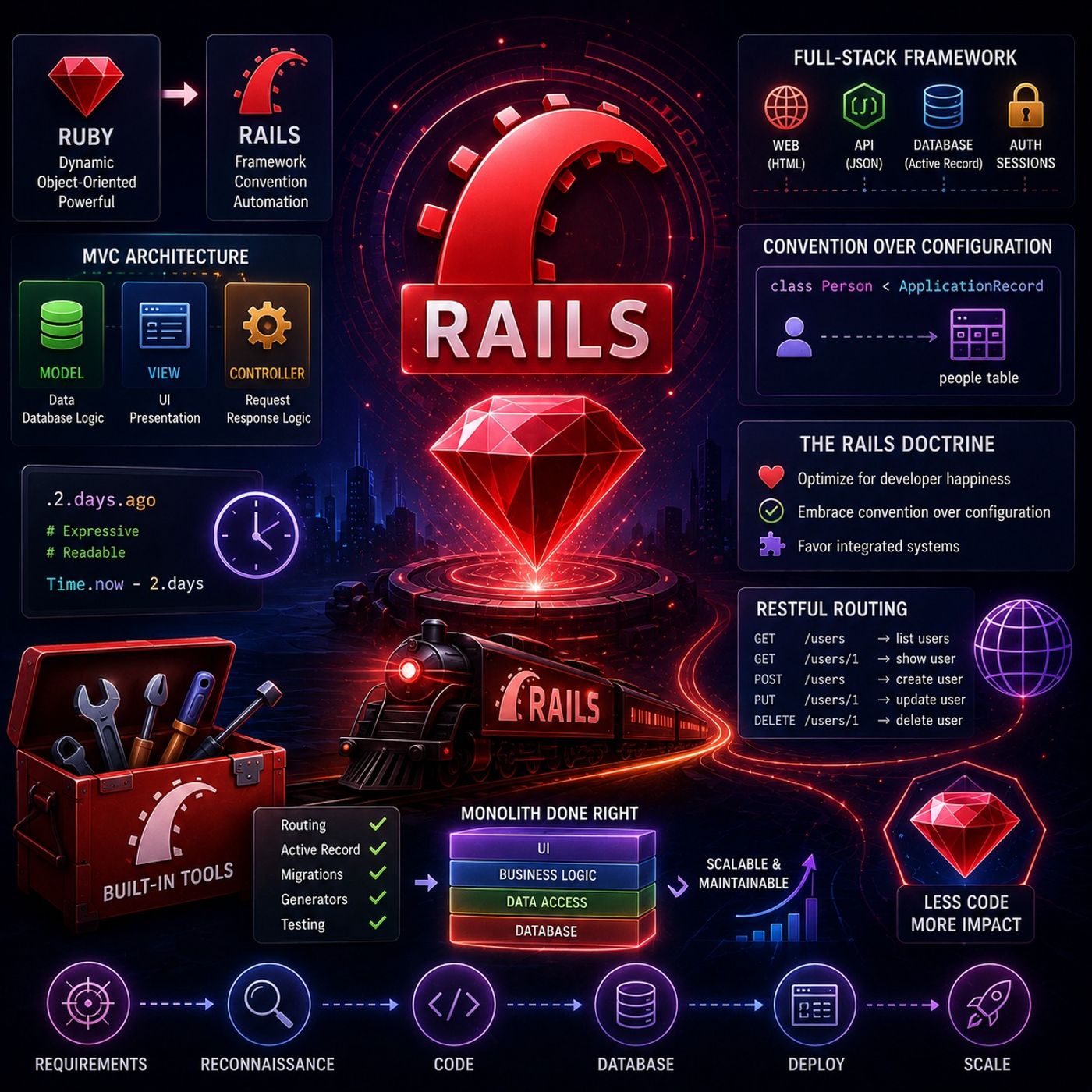
In this lesson, you’ll learn about: Ruby on Rails, its architecture, philosophy, and how it simplifies modern web development 1. What Is Ruby on Rails? Ruby on Rails is a full-stack web framework used to build:Web applicationsAPIsDatabase-driven platforms🔹 Key IdeaRails is a complete development toolkit that handles everything from backend logic to routing and database interaction. 2. Ruby vs Rails (Core Difference) 🔹 RubyA dynamic, object-oriented programming language🔹 RailsA framework built on top of Ruby👉 Key InsightRuby provides the power, Rails provides the structure and automation 3. MVC Architecture (Core Design Pattern) 🔹 MVC stands for:Model → Handles data and database logicView → Handles UI and presentationController → Handles request/response logic👉 Key InsightMVC separates responsibilities, making applications easier to manage and scale. 4. Rails as a Full-Stack Framework Rails can:Render HTML pages (server-side)Serve JSON APIsHandle routing, sessions, and authentication👉 Key InsightRails acts like a multi-tool for building complete applications 5. The Power of Ruby (Why Rails Feels “Magic”) 🔹 Ruby features:Highly expressive syntaxObject-oriented designFlexible and dynamic behavior🔹 Example:.2.days.ago → human-readable time calculation👉 Key InsightRuby allows Rails to write less code while doing more work 6. Convention Over Configuration 🔹 What it means:Rails follows predefined conventions instead of requiring manual setup🔹 Example:Person model → automatically maps to people table👉 Key InsightDevelopers don’t waste time making small decisions—Rails handles them 7. The Rails Doctrine Created by David Heinemeier Hansson 🔹 Core principles:Optimize for developer happinessEmbrace convention over configurationFavor integrated systems👉 Key InsightRails is opinionated to make development faster and more enjoyable 8. Routing and RESTful Design 🔹 Rails automatically generates:Predictable URLsREST-based routes🔹 Example:/users → list users/users/1 → show user👉 Key InsightRouting becomes standardized and easy to understand 9. Monolith vs Microservices 🔹 Rails philosophy:Prefer monolithic architecture (everything in one app)🔹 Real-world usage:Companies like GitHub and Shopify scaled successfully using Rails👉 Key InsightA well-structured monolith can scale efficiently without microservices complexity Key TakeawaysRails is a full-stack framework built on RubyMVC architecture organizes application structureRuby enables expressive and powerful codeConvention over configuration speeds up developmentRails favors integrated systems over complexityBig Picture Rails helps developers: 👉 Build applications faster with less code👉 Focus on logic instead of configuration👉 Scale applications using structured conventions Mental Model Ruby language → Rails framework → MVC structure → conventions applied → rapid web developmentYou can listen and download our episodes for free on more than 10 different platforms:https://linktr.ee/cybercode_academy
Embed this episode
Ready to play
Course 37 - Building Web Apps with Ruby On Rails | Episode 1: From Ruby Basics to Web Development Conventions
No transcript for this episode yet
Similar Episodes
Jan 27, 2024 ·12m
Jan 19, 2024 ·9m
Jan 18, 2024 ·5m
Jan 14, 2024 ·6m
Jan 5, 2024 ·7m
Dec 29, 2023 ·7m