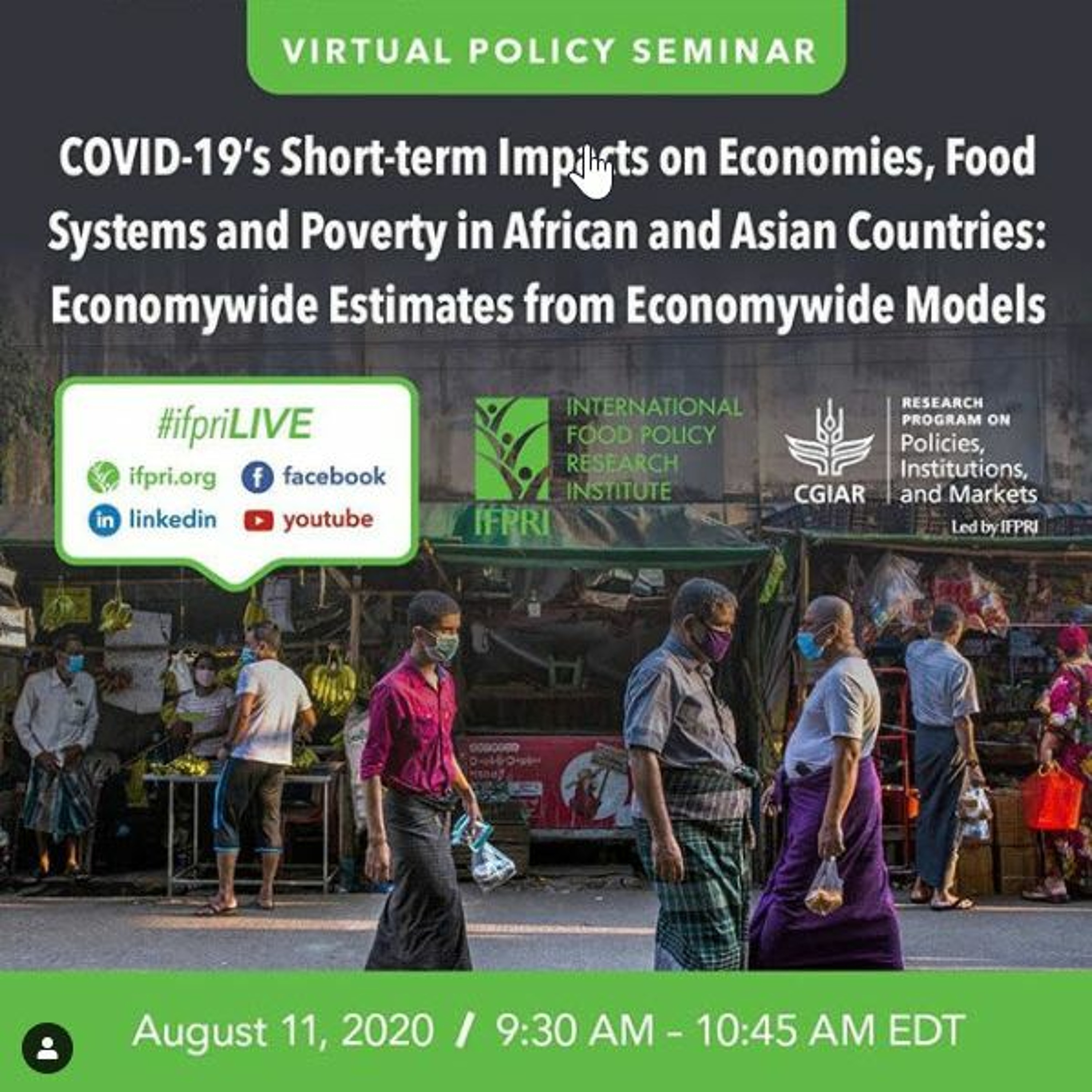
COVID-19’s Short-term Impacts on Economies, Food Systems and Poverty in African and Asian Countries episode artwork

EPISODE · Aug 10, 2020 · 1H 16M

COVID-19’s Short-term Impacts on Economies, Food Systems and Poverty in African and Asian Countries

from IFPRI Podcast · host International Food Policy Research Institute

Virtual Event - COVID-19’s Short-term Impacts on Economies, Food Systems and Poverty in African and Asian Countries: Economywide Estimates from Economywide Models Co-Organized by IFPRI and the CGIAR Research Program on Policies, Institutions, and Markets (PIM) This seminar was recorded on August 11, 2020. Developing countries responded to COVID-19 by implementing social distancing measures and limiting non-essential business operations. Agrifood systems and food supplies—although generally exempt from restrictions—have been exposed to policy disruptions and global market instability. To measure the impacts of COVID-19 on economies and food systems, IFPRI researchers worked alongside partners in several African and Asian countries to conduct economywide multiplier analysis, tracing direct and indirect spillover effects along and across supply chains. Results reveal substantial but varying levels of GDP losses during lockdowns, depending on policy design and implementation and countries’ exposure to global markets. Despite policy exemptions, impacts on food systems account for about one quarter of GDP losses on average. Income losses are felt by all segments of the population. Negative impacts persist, but gradually weaken as restrictive measures are lifted. Our results call for targeted social protection interventions in the short term, balanced with longer-term planning and investing in the economic recovery. This IFPRI-PIM seminar presented the modeling approach and results from three case studies—Nigeria, Myanmar, and Sudan. Presenters highlighted how differences in policy design, implementation, and economic structure affect the experience with COVID-19, specifically for food systems and poverty, in these countries. Opening Remarks: Frank Place, Director, CGIAR Research Program on Policies, Institutions, and Markets (PIM) Presenters: Kwaw Andam, Research Fellow, IFPRI Xinshen Diao, Deputy Division Director, Development Strategy and Governance Division, IFPRI Karl Pauw, Senior Research Fellow, IFPRI Mariam Raouf, Senior Research Associate, IFPRI Discussant: Chris Hillbruner, Division Chief, Analysis and Learning Division, Office of Policy, Analysis, and Engagement; Bureau for Resilience and Food Security; United States Agency for International Development (USAID) Paul Dorosh, Director, Development Strategy and Governance Division, IFPRI Closing Remarks: John McDermott, Director, CGIAR Research Program on Agriculture for Nutrition and Health (A4NH) Moderator: Katarlah Taylor, Events Manager, IFPRI LINKS: Book: COVID-19 And Global Food Security: https://www.ifpri.org/interactive/covid Websites: IFPRI Resources And Analyses Of COVID-19 Impact: https://www.ifpri.org/covid-19 CGIAR Research Program On Policies, Institutions, And Markets (PIM): http://pim.cgiar.org/ Book: COVID-19 and Global Food Security: https://www.ifpri.org/publication/covid-19-and-global-food-security More on the seminar: https://www.ifpri.org/event/virtual-event-covid-19s-short-term-impacts-economies-food-systems-and-poverty-african-and Subscribe IFPRI Insights newsletter and event annoucements at www.ifpri.org/content/newsletter-subscription

Virtual Event - COVID-19’s Short-term Impacts on Economies, Food Systems and Poverty in African and Asian Countries: Economywide Estimates from Economywide Models Co-Organized by IFPRI and the CGIAR Research Program on Policies, Institutions, and Markets (PIM) This seminar was recorded on August 11, 2020. Developing countries responded to COVID-19 by implementing social distancing measures and limiting non-essential business operations. Agrifood systems and food supplies—although generally exempt from restrictions—have been exposed to policy disruptions and global market instability. To measure the impacts of COVID-19 on economies and food systems, IFPRI researchers worked alongside partners in several African and Asian countries to conduct economywide multiplier analysis, tracing direct and indirect spillover effects along and across supply chains. Results reveal substantial but varying levels of GDP losses during lockdowns, depending on policy design and implementation and countries’ exposure to global markets. Despite policy exemptions, impacts on food systems account for about one quarter of GDP losses on average. Income losses are felt by all segments of the population. Negative impacts persist, but gradually weaken as restrictive measures are lifted. Our results call for targeted social protection interventions in the short term, balanced with longer-term planning and investing in the economic recovery. This IFPRI-PIM seminar presented the modeling approach and results from three case studies—Nigeria, Myanmar, and Sudan. Presenters highlighted how differences in policy design, implementation, and economic structure affect the experience with COVID-19, specifically for food systems and poverty, in these countries. Opening Remarks: Frank Place, Director, CGIAR Research Program on Policies, Institutions, and Markets (PIM) Presenters: Kwaw Andam, Research Fellow, IFPRI Xinshen Diao, Deputy Division Director, Development Strategy and Governance Division, IFPRI Karl Pauw, Senior Research Fellow, IFPRI Mariam Raouf, Senior Research Associate, IFPRI Discussant: Chris Hillbruner, Division Chief, Analysis and Learning Division, Office of Policy, Analysis, and Engagement; Bureau for Resilience and Food Security; United States Agency for International Development (USAID) Paul Dorosh, Director, Development Strategy and Governance Division, IFPRI Closing Remarks: John McDermott, Director, CGIAR Research Program on Agriculture for Nutrition and Health (A4NH) Moderator: Katarlah Taylor, Events Manager, IFPRI LINKS: Book: COVID-19 And Global Food Security: https://www.ifpri.org/interactive/covid Websites: IFPRI Resources And Analyses Of COVID-19 Impact: https://www.ifpri.org/covid-19 CGIAR Research Program On Policies, Institutions, And Markets (PIM): http://pim.cgiar.org/ Book: COVID-19 and Global Food Security: https://www.ifpri.org/publication/covid-19-and-global-food-security More on the seminar: https://www.ifpri.org/event/virtual-event-covid-19s-short-term-impacts-economies-food-systems-and-poverty-african-and Subscribe IFPRI Insights newsletter and event annoucements at www.ifpri.org/content/newsletter-subscription

NOW PLAYING

COVID-19’s Short-term Impacts on Economies, Food Systems and Poverty in African and Asian Countries

0:00 1:16:10

No transcript for this episode yet

We transcribe on demand. Request one and we'll notify you when it's ready — usually under 10 minutes.

That Hoarder: Overcome Compulsive Hoarding That Hoarder Hoarding disorder is stigmatised and people who hoard feel vast amounts of shame. This podcast began life as an audio diary, an anonymous outlet for somebody with this weird condition. That Hoarder speaks about her experiences living with compulsive hoarding, she interviews therapists, academics, researchers, children of hoarders, professional organisers and influencers, and she shares insight and tips for others with the problem. Listened to by people who hoard as well as those who love them and those who work with them, Overcome Compulsive Hoarding with That Hoarder aims to shatter the stigma, share the truth and speak openly and honestly to improve lives. The Small Business Startup School – Business Notes | Financial Literacy | Retail Psychology – For Professionals & Entrepreneurs The Small Business Startup School Inc. Starting or buying a small business? While personal circumstances may vary, business patterns remain timeless. On The Small Business Startup School, we explore strategies, insights, and practical solutions to help entrepreneurs confidently navigate their journey.Hosted by Ola Williams—a retail entrepreneur, fintech founder, and financial coach with over two decades of experience—this podcast marries financial awareness and retail psychology with optimism to deliver actionable takeaways.Join us to learn, grow, and connect as we uncover the keys to business success.Let’s continue to learn together and be encouraged to keep on connecting! DIOSA. Carolina Sanper This podcast is a sacred space created by Carolina Sanper where you connect with your inner wisdom and embody your magnetic feminine power.It is the realization that the mystical realm is where you plant the seeds of your desired reality.It is a portal to your true essence: awareness, presence, and receiving with ease. Welcome home, DIOSA. 🖤 XXX Tech by SOVRYN Dr. Brian Sovryn The crossroads between technology, sensuality, and metaphysics - and the longest running anarchist podcast in the world! Brought to you by Dr. Brian Sovryn.

Frequently Asked Questions

How long is this episode of IFPRI Podcast?

This episode is 1 hour and 16 minutes long.

When was this IFPRI Podcast episode published?

This episode was published on August 10, 2020.

What is this episode about?

Virtual Event - COVID-19’s Short-term Impacts on Economies, Food Systems and Poverty in African and Asian Countries: Economywide Estimates from Economywide Models Co-Organized by IFPRI and the CGIAR Research Program on Policies, Institutions, and...

Can I download this IFPRI Podcast episode?

Yes, you can download this episode by clicking the download button on the episode player, or subscribe to the podcast in your preferred podcast app for automatic downloads.
URL copied to clipboard!