
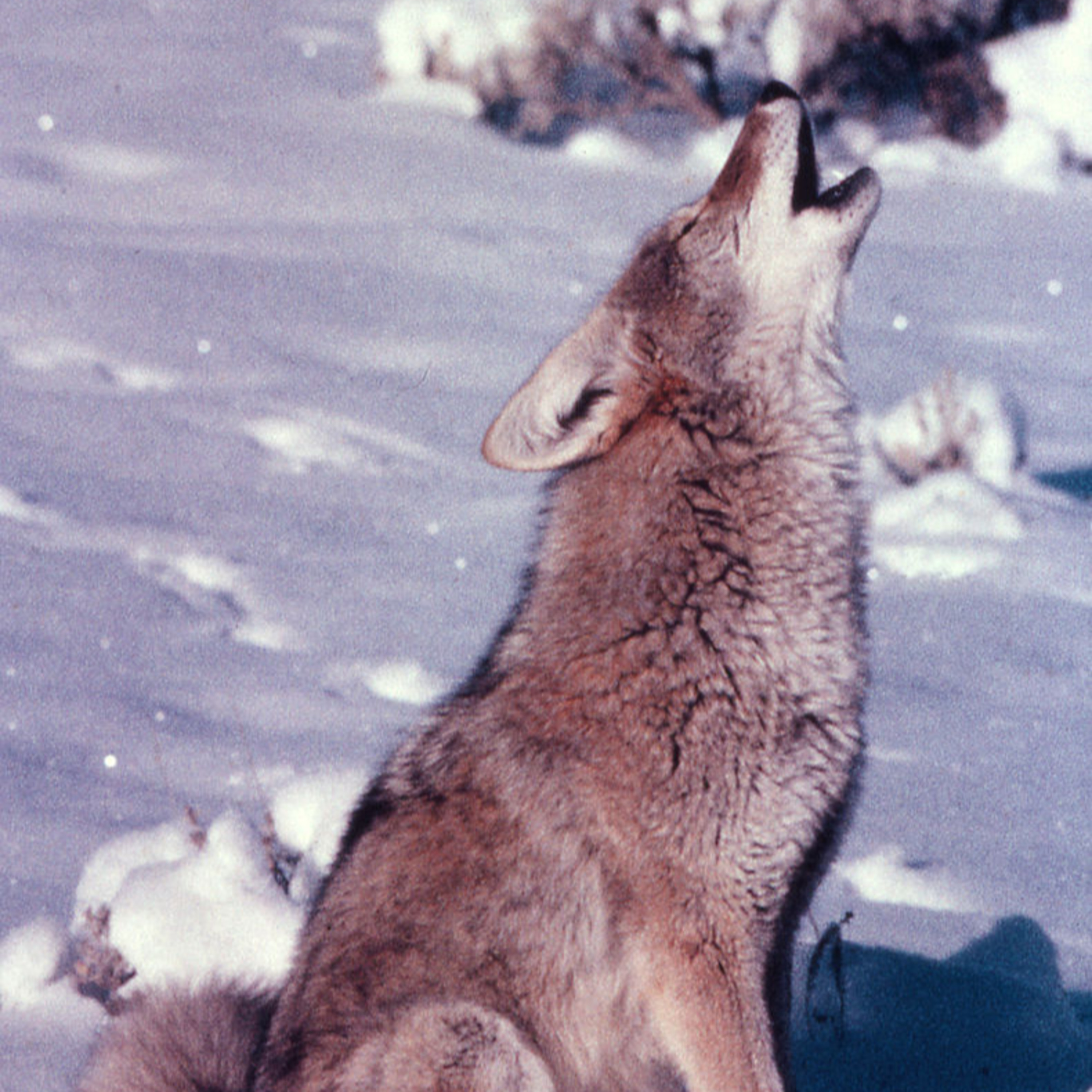
This episode of waiting in is going to be about coyotes, an animal you could probably see or hear without having to try too hard. Originally called the prairie wolf by Lewis and Clark in 1804, they're unique to North America and they inhabit virtually the entire continent. At three to four feet long and about 20 to 40 pounds on average, they're about the size of a cockers manual, and often the largest predator a person might see or hear in the wild throughout much of the United States. Coyotes are often perceived as pests, livestock killers, and maybe even a little dangerous.
Their yipping and howling is a common sound that can be heard at night in the countryside and in many suburbs. Personally, I've lost quite a few chickens to coyotes and my parents have also lost many cats, birds, and a couple of small dogs. I would wager they take a fair amount of pets nationwide in the given year. According to the USDA, coyotes account for over half the predator deaths on sheepwrenches, which can be a financial burden.
I still remember the first time I ever really saw or heard coyotes as a kid. Kid me just felt a weird sense of wonder and realness at the thought of these miniature wolves wandering around in the woods and fields next door that we used to go play in. I vividly recall sitting in the truck with my dad and my brothers and trying to spotlight into a field where you could really see their eyes and the civil rights of their bodies moving around in the dark. Without having the mentality of these things as pests, you know as a kid just thinking about them as you know these really cool miniature wolves, I always hoped I'd get to see one as it ran across the road or something in the daylight.
And on the rare chance that I did, I would actually be kind of starstruck. Wow, look at this little cool looking wolf dog running around. I mean what kid doesn't think a German shepherd or some kind of cool predator looking dog is just one of the coolest things in the world. But as an American, when I think of unique wildlife, I don't tend to think about North American animals.
They just all seem normal. Wolves, bear, deer, rabbits, all things we have in common with most of the rest of the world. So I generally tend to think about tigers, cheetahs, kangaroos, the bonobos of the Congo, those are the real unique animals. But here's the coyote, right in our own backyards, getting very little tension from modern society in this regard.
And in many ways, no respect for the species that it is today. You don't find coyotes anywhere but North America. It wasn't always this way though. Many of the Native American peoples revered the coyote for his cunning.
In fact, the spelling of coyote is a riff on the name used by the Aztec language people. As I mentioned earlier, they were initially called the prairie wolf by the early American sellers. But coyote would win out in long haul. Through many generations, from godlike stories of creation, slapstick comedies, to borderline pornography, the coyote is the star in these Native American tales.
Serving as a stand-in for the full range of human emotions in the human experience, he appears both as an actual coyote and quite frequently as old man coyote. The latter, really reaffirming in my mind, the coyote as this symbol for certain aspects of our own minds. So let me paraphrase some of the stories that I come across to help paint this picture. These won't all necessarily be the complete stories, but I'll start with the more supernatural variety.
In the beginning, the creator god fashions the world, and ultimately people and all of the creatures from clay. Some of the creatures though, are too big and too dangerous, and if left unchecked, will destroy all of the people on earth. The creator god sends the coyote to fight the monsters and to help teach the people how to be more successful. In a similar tale, it's old man coyote who created the world with the input of a few animal characters.
And then an actual coyote comes up and starts gaslighting him into giving people additional things. They start with things you might think are obviously fire, tools, shelter, and then eventually weapons they can hunt with and defend themselves from animals with teeth and claws, but then he talks him into separating people so that the people can fight wars so that the men can find glory. So here you have coyote as maybe a little bit less benevolent figure. In another story that seemed kind of on the surface similar to something like Noah or Gilgamesh, you have a creator god who makes the universe, and then his second in command sets out and is helping people and people really like him.
And then coyote learns that there's going to be this big world-changing flood, and so he tells this guy, hey man, you need to build this really big canoe, otherwise this flood's going to come and it's going to wipe you out, and the people aren't going to know what to do afterwards. So coyote and this guy both build these big canoes and they survive this flood, and then after the waters recede, they sort of start the earth over again. In my favorite tale of this variety though, coyote is the inventor of death, and it actually reminds me of Thanos in the Avengers series quite a bit. It goes like this.
In the beginning there was no death. A council of elders got together and discussed whether or not people should be allowed to die. The earth was getting too full. One man decided people should be allowed to die, but that they'd come back after some time had passed, so no one would have to miss them too much.
People would sort of take turns being gone for just a little while. So the coyote jumped up and suggested that people should die for eternity and never come back, because even if some people died temporarily, they would still eventually overrun the earth and run out of resources. So the council objected to coyote's suggestion and opted for the first suggestion. A special house was then built by the council, so that when people died, their spirits would be called to the house and they would be brought back to life, and a special ceremony that would take place inside.
However, when the first man dies, coyote sees his spirit and rushes over to the house. When the council men inside are distracted, coyote shuts the door before the first spirit arrives, and the spirit passes by the house, remaining dead forever and ultimately passing into the spirit realm beyond existence, and thus coyote invent a death and all the grief that goes along with it. More familiar tales involve the coyote as a trickster, not unlike the fox in European stories or maybe the Norse god Loki. Sometimes these stories carry a message and sometimes they just seem to be entertainment.
I kind of think of some of them as bedtime stories that they might have told kids or jokes that adults might tell to each other. A lot of them under this description might even serve as the inspiration for cartoons like Wily Coyote in the Roadrunner, where the coyote sometimes outsmarts himself but to his own detriment. So here's one. One morning, the coyote woke up feeling particularly good about himself.
He saw a badger lumbering along nearby. He challenged the badger to a race to see who could catch the most rabbits the quickest, confident that he could outrun the badger. So the race starts and the coyote takes off after a jackrabbit. The badger is a little bit stressed out about the coyote being so much faster than him, but he just finds a rabbit down nearby and he digs into it and catches all the rabbits in the den.
So when the coyote comes back and he's exhausted and he's not his one rabbit, he's dumbfounded. The badger's sitting here, been hanging out for a while and he's got like a dozen rabbits. So the coyote comes up with this grand idea and it just really backfires on him. Another story has the coyote standing in for the moon while the moon is away for whatever reason.
From the coyote's lofty perch, he can't resist the temptation but to shout out to everybody, all the embarrassing things he sees people doing and laughing hysterically about it. So hey everybody, look what the badger's doing behind the bush or look what Susie's doing down by the river. There really wasn't even a point to that story. It was just kind of, here's an obnoxious coyote.
So a more benevolent story has the frog people owning all the water. And so the coyote is very thirsty, so he asks them if he can drink from behind their dam. They agree and so the coyote starts drinking, but he keeps drinking and drinking and drinking. The frogs are wondering how he's drinking so much, but the coyote reassures them that he's just very thirsty.
Little do they know that when he sticks his head in the water, he's busy digging underneath the dam and ultimately undermines the dam and then runs away shouting, good day, it's not right for everybody to have, you know, to come here and get all the water. You guys should know all the water anyway. And then that's the end of that story. There's some other tales, like I mentioned earlier, that almost seem to kind of border on pornography or at the least very dirty adult jokes.
So in one, there's, well, not one, there's several where the coyote poses as a medicine man. In one way or another, he's luring women and young girls into his medicine house to do you know what. There's another one where he buries all but one particular part of himself in a strawberry field just before some young girls show up to start looking for some fruit. So you can see that no matter what kind of tale it is that we find a coyote in, you can see that he usually represents some part of the human will.
From a sense of responsibility to the world, just as a trickster, somebody seeking gratification, or in some of the more godlike stories is this kind of pseudo-savior figure that teaches people things. So the point is that just the coyote's cunning, you know, both where he gets in his own way or where he accomplishes something useful, was something that these native peoples were very aware of and they saw when they looked at the coyote. So in many ways it really is kind of amazing that we don't view coyotes more like that. I mean because, you know, here in this continent, there was a whole lot of people that viewed coyote in one way or another as an important figure.
So if we go to the natural story of coyote as the animal, we really kind of have to go back to the Pleistocene. A time period we more commonly refer to as the Ice Age. The world was a very different place then. In North America, massive animals like the woolly mammoth, masted on, 20 foot long, 4 ton ground sloths like Megatharium, and the ancestors of today's bison elk and moose dominated the landscape.
They were hunted by even more terrifying animals like the saber-toothed tiger, packs of dire wolves twice the size of modern gray wolves, and not the least of all the short-faced bear, which may well be the largest mammalian predator to ever live in North America. The short-faced bear was a staggering 6 feet tall on all fours. He could stand on his hind legs at over 10 feet tall and had an arm reach of 14 feet. Some scientists today even suggest that the short-faced bear might be partially responsible for the inexplicably slow progression of man into North America during this time period, along with all these predators with more rugged ancestors of the modern gray wolf in the coyote as well.
To go along with all these massive wild animals, during this time period was a climate that was just as wild, so vast parts of North America are covered in glaciers. They're always moving, you know, a lot of those big boulders you see standing around in planes, you know, those are left over from this time period. But all that would change in a short period of time. One period of massive upheaval near the end of the Pleistocene, that you could look up to get a better idea of some of these changes is referred to as the Younger Dry.
It occurred roughly 12,000 years ago. There were wild temperature swings over the course of mere decades, which ultimately led to massive deglaciation and lots of flooding. No one's really quite sure what ended the Pleistocene, but there were as many ideas as you could think of, from slow climate change, you know, that led to slow environmental changes. There's evidence of common impacts or airbursts, volcanic eruptions, there's theories out there about massive solar flares, and even ideas about some supernova that might have caused massive swings in climate that led to all this flooding.
All these rapid changes lead to a marked decline in the megafauna of this time period, you know, all the massive animals. You could also add the expansion of humans into North America and the hunting that they brought to this as well. So amidst all of this change in competition with animals like the short-faced bear, the dire wolf, and the mastodon, how does a small pet-sized dog manage to make it out not only seemingly unscathed, but increasingly successful? Dire wolves in short-faced bear are thought to have relied on the large herbivores of the Ice Age for prey.
As the herbivores disappeared, the large predators were not able to adapt quickly to the quickly changing world and compete with more efficient killers and scavengers of a bigger variety of smaller game like the grey wolf in the coyote. Wolves have proven themselves to be a very adaptable species, able to live in a variety of environments and prey on anything from elk to mice. The pack nature of wolves also allows them to protect the territory from solitary predators like cougars and even coyotes. This prey variability, along with a pack mentality, seems to have set the wolves up for success long-term.
A study on wolves in coyotes in Yellowstone National Park published in the Canadian Journal of Zoology in January 2009 documented the interactions of wolves in coyotes for a decade. 79% of the time it was wolves chasing coyotes, followed by 7% of the time wolves killing coyotes, and only 1% of the time did the coyotes harass the wolves. Three-quarters of the interactions took place around carcasses, and only about 20% took place in neutral territory. Clearly the wolves nominated these interactions, and clearly the coyote knows its place amongst the larger predator.
Another point I found interesting was the wolves only seemed to kill the coyote when more wolves were present, although on average the difference in the number of wolves present was not statistically significant. I think it would be fair to assume that this type of engagement has been happening long before humans documented it, demonstrating the reasons wolves are so successful, but maybe it also shows that the wolves were so successful. But maybe it also shows how coyotes are a little bit successful in their own way. During all this time as the bottom dog, the coyote was perfecting a rare behavior that has more in common with humans than it does with wolves.
Vision fusion, or vision fusion society, is the name given to this behavior. A ring of tans, elephants, and humans exhibit this behavior, wolves do not. A coyote pack is dynamic, the group can break apart, individuals can go their own way, alone, and maybe join a different pack later on. They can really be lone wolves and function successfully, or just join a pack when it suits them.
Any pack. Coyotes take this behavior seriously. Alone coyote can survive just fine, preying on rodents and rabbits, but a pack of coyotes will take down deer if it wants to. It just depends on the environment and the situation the coyotes find themselves in.
Maybe this isn't the best example, but it's one that in my mind gets the point to cross. Imagine a pack of wolves, or even dire wolves, challenging a pack of coyotes over a kill or a territory. The wolves chase the coyotes, but the coyotes split up and leave the area and don't necessarily regroup. One or two coyotes might get killed staying put, but the others live to fight another day, and move to a new territory, find new prey animals, and eventually form a new pack and the process repeats itself.
This response to pressure allows the small coyote, half the size of the wolf, to adapt to more environments in short order, and seek new prey that are suited to the new lone coyote or the new pack. So when man enters the picture, and in particular, cultures with roots in Europe that had a very poor historical opinion of predators, and an emphasis on livestock and fences, the behavior that made the wolves successful became the very same thing that almost led to their complete extinction in a very short period of time. New settlers viewed wolves as almost a sort of competition, that would even become an argument for their extermination in the halls of the American government in the late 1800s and early 1900s. In this wasn't new, Europe had been fighting wolves for centuries, wolves were an easy enemy, and even kids could understand a wolf and a wolf pack.
A pack of wolves could be wiped out in short order, as the pack behavior was often predictable. Sent baiting, poison food, and carcasses that they leave behind, distress calls, kill one wolf and you can likely kill them all. Eliminating the predators would make it safer for livestock was the argument, and it would increase the game opportunities for animals like deer and elk to be hunted. People would replace the predators and serve as the balance makers, at least that was the idea.
Coyotes ultimately received the same treatment from the settlers, they were prairie wolves after all, but the coyotes behavior, molded by centuries, if not thousands of years of conflict, and they were prey animals. If not thousands of years of competition from larger predators with physical and group advantages in an ever-changing landscape, continuously proved that this treatment, which arguably lasted this day through unregulated coyote hunting and even bounties, is a little bit more like pouring water on a grease fire than a solution. Coyotes are more comfortable moving to new territory, alone, as a lone survivor, and they are comfortable being in a pack when it suits them. When coyotes experience stress, their fission fusion behavior kicks into overdrive.
So when the large game goes, they can split up a new smaller game, cut down the forest or the woods and then move to the fields, turn the fields into farms, and they just start eating whatever they can find, even things like mulberries and watermelons. There's even some evidence to suggest that fertility and litter size in female coyotes is directly related to the stress within a population. Food availability, the number of coyotes in a given range, all seem to play a role. Start killing the coyotes and destroying dens, and the pack starts spreading out and having more pups.
But that doesn't mean they leave the initial area, it just means the initial coyote might leave, and another might show up later with its own behavior and give it a try. If you start poisoning the coyotes, the thinking is that maybe the ones who breed are the better hunters. The coyote is perfectly suited to thriving in an environment that challenges it at every turn. In fact, that is the normal everyday life experience for the coyote, since before people were really even here.
Since the colonization of America, coyotes have spread from a predominantly western US-Canadian range, and now exist throughout the entire continent of North America, and are even threatening to push into South America, confirmed in Panama with no shortage of stories online about coyotes on the other side of the canal. Coyotes are increasingly common in urban and suburban areas. In 1999, a coyote was captured in Central Park in New York City, right smack in the middle of one of the most urbanized areas on the planet. To them, it's just another new area and another new challenge.
Small bands of trees and small bands of bushes are things that coyotes are used to having to live out of, thanks to an entire genealogy based on competition. So if you want resiliency and survival of the fittest in both body and mind, the coyote is really one of the best living examples you can find, especially in North America. I think they deserve a little bit more respect, or at least acknowledgement, and could, and maybe even should be at the forefront when you think of unique North American wildlife. After all, they're one of the most prominently American mammals that we have.
And they embody a lot of admirable traits, too, like toughness, adaptability, and some good old American stubbornness. The rattlesnake is often depicted as a symbol for America's spirit of rebelliousness and independence and for standing your ground. But maybe it ought to be the coyote, and its incredible ability to adapt and overcome, and then succeed at an even higher level than it was before that we should consider. Coyote the myth gets in the way of his own reputation much of the time, not unlike the real coyote, but often enough he succeeds when it counts.
The coyote has demonstrated a remarkable ability to have flexible behavior, but still be at its core, the same old coyote. The many Native American tales seem to capture this all-encompassing spirit of coyote, whose journey to today is really not so different from our own. So the more I looked into coyotes, and the more I looked into the Native American stuff, the more I kind of thought, maybe the natives had something figured out. I mean, it took us all this time to scientifically realize why the coyotes are unique and what makes them different from wolves.
And while a lot of the Native tales, they don't call it fission fusion society, and they don't document all these little specific behaviors, the tales sure do seem to do a good job of capturing the spirit of the coyote, as this sort of rugged survivor who can create things out of nothing, right? So in one of the first stories that I read, you have the coyote taking on all these beasts and managing to survive, and people seeing how the coyote survives and thinking, hmm, well, how is this animal doing it? Maybe this is what we need to do. So you have the coyote fulfilling that role, and then you also see the coyote as sort of like the dumb trickster, right?
He's just trying something. It doesn't necessarily work all the time, but it's doing something. And of course, you also get the stereotypical coyote behavior, where he really is like the malicious trickster, or he's up to new good, or he's being devious, right? He's stealing your chickens and your cats and your dogs.
So some of the material that I looked at that I thought was interesting before I did this podcast was American Indian myths and legends, selected and edited by Richard Aedos and Alfonso Ortiz, which is available on Amazon. That has a really broad collection of Native American myths and legends and stories, and it's not really a narrative style either. It's just, you know, here's this tribe, and here's this story. It's sort of roughly organized based on, you know, creation stuff, coyote, the trickster stuff, and it's not all about coyotes, you know, everything, but there's a lot of coyotes, there's in it.
Another one that I really liked was Understanding the Coyote, which is available in the Kansas State University Extension Services website. It's free online, you can Google it and find it. It's really good, has a lot of good information on coyotes. Another one that kind of captures all these things was Coyote America by Dan Flores.
That book is really fascinating to check out, especially if you're into the evolution stuff. He really gets into that, and that was really cool. But that's all I have for now, so I hope you guys enjoyed this episode of Waiting In, and I'll see you next time. Music in this episode in order of occurrence, the descent, Sky of our ancestors, Shadowlands 7 Codex, and Sneaky Snitch by Kevin McQuillard.
If you like lore and legends, consider supporting the show at BuyMeACoffee.com slash Lore and Legends, with a one-time gift that will cost less than a cup of coffee. You can also follow on Instagram, where my handle is at Lore and Legends 1, and on Twitter, at Lore and Legends 3. You can also subscribe to the Lore and Legends YouTube channel, which features video versions of all your favorite episodes. And of course, the official website, LoreandLegends.net.
Thanks for checking out Lore and Legends. See you next time.