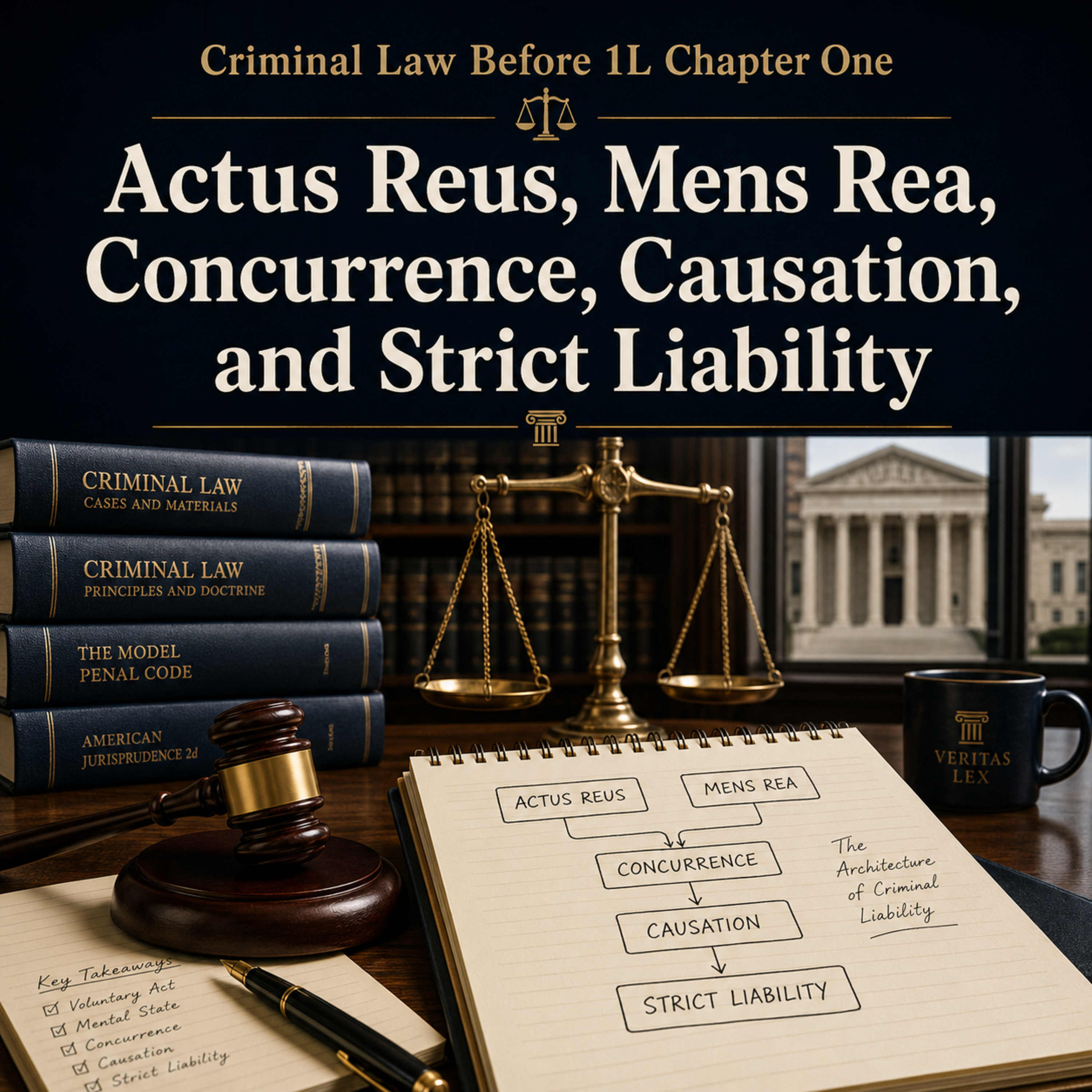
Criminal Law Before 1L: Actus Reus, Mens Rea, Concurrence, Causation, and Strict Liability episode artwork

EPISODE · Jun 16, 2026 · 1H 4M

Criminal Law Before 1L: Actus Reus, Mens Rea, Concurrence, Causation, and Strict Liability

from Law School · host The Law School of America

➔ 📘VIEW THE COMPANION STUDY GUIDE📘 [💡FREE💡]▬▬▬▬▬▬▬▬▬▬▬▬▬▬▬▬▬▬▬▬▬▬▬▬▬▬▬EPISODE SUMMARYBuilding Blocks of Criminal Liability — Deep Dive into Criminal Law FundamentalsThis episode offers a comprehensive breakdown of the core elements that underpin criminal liability, essential for law students, exam takers, and anyone interested in understanding how criminal responsibility is precisely established. From the physical act to mental states, causation, and defenses, the discussion sheds light on the disciplined architecture that prevents moral outrage from becoming unjustified punishment.Most people instinctively believe that a terrible outcome automatically means someone must pay. But criminal law isn’t about morality alone—it demands a highly structured proof—physical act plus the right mental state—before holding someone truly culpable. In this episode, we dissect the core building blocks of criminal liability, revealing how justice is carefully calibrated to prevent punishing mere bad luck or mere thoughts.You’ll discover why the law doesn’t punish thoughts alone, how voluntary acts and legal duties shape responsibility, and the crucial differences between purpose, knowledge, recklessness, and negligence—and why they matter profoundly. We break down complex concepts like actus reus, mens rea, concurrence, causation, and strict liability with crystal clarity, giving you a blueprint to analyze any criminal case or exam problem with confidence.Most importantly, we explore how modern technology might challenge these foundational ideas—brain interfaces, autonomous systems, and AI decision-making—raising urgent questions about responsibility and blameworthiness in the 21st century.Whether you’re a law student aiming for mastery or a legal professional sharpening your reasoning, this deep dive will help you see the architecture behind criminal justice—and how understanding its precise parts can unlock your ability to argue, decide, and uphold the rule of law effectively.Why this works: This episode hooks with the promise of revealing the precise framework that underpins criminal responsibility, appealing to listeners seeking clarity amid complexity. It offers concrete insights into essential concepts, designed to transform how they analyze legal problems, while teasing future challenges posed by emerging technology—creating curiosity and a sense of importance that compels clicking “play.”Main topics covered:The significance of actus reus: voluntary acts vs. involuntary movements like sleepwalking or seizuresOmissions and legal duties: statutory, contractual, special relationships, and creation of riskPossession: actual and constructive possession, shared spaces, and awareness requirementsMental states under the MPC: purpose, knowledge, recklessness, negligence, and strict liabilityConcurrence: timing of mental state and physical act in establishing liabilityCausation: actual cause and proximate cause, intervening causes, and foreseeabilityLegal interpretation: how ambiguous statutes influence criminal analysisFuture challenges: technology, brain interfaces, autonomous vehicles, and their impact on traditional concepts of voluntary acts

➔ 📘VIEW THE COMPANION STUDY GUIDE📘 [💡FREE💡]▬▬▬▬▬▬▬▬▬▬▬▬▬▬▬▬▬▬▬▬▬▬▬▬▬▬▬EPISODE SUMMARYBuilding Blocks of Criminal Liability — Deep Dive into Criminal Law FundamentalsThis episode offers a comprehensive breakdown of the core elements that underpin criminal liability, essential for law students, exam takers, and anyone interested in understanding how criminal responsibility is precisely established. From the physical act to mental states, causation, and defenses, the discussion sheds light on the disciplined architecture that prevents moral outrage from becoming unjustified punishment.Most people instinctively believe that a terrible outcome automatically means someone must pay. But criminal law isn’t about morality alone—it demands a highly structured proof—physical act plus the right mental state—before holding someone truly culpable. In this episode, we dissect the core building blocks of criminal liability, revealing how justice is carefully calibrated to prevent punishing mere bad luck or mere thoughts.You’ll discover why the law doesn’t punish thoughts alone, how voluntary acts and legal duties shape responsibility, and the crucial differences between purpose, knowledge, recklessness, and negligence—and why they matter profoundly. We break down complex concepts like actus reus, mens rea, concurrence, causation, and strict liability with crystal clarity, giving you a blueprint to analyze any criminal case or exam problem with confidence.Most importantly, we explore how modern technology might challenge these foundational ideas—brain interfaces, autonomous systems, and AI decision-making—raising urgent questions about responsibility and blameworthiness in the 21st century.Whether you’re a law student aiming for mastery or a legal professional sharpening your reasoning, this deep dive will help you see the architecture behind criminal justice—and how understanding its precise parts can unlock your ability to argue, decide, and uphold the rule of law effectively.Why this works: This episode hooks with the promise of revealing the precise framework that underpins criminal responsibility, appealing to listeners seeking clarity amid complexity. It offers concrete insights into essential concepts, designed to transform how they analyze legal problems, while teasing future challenges posed by emerging technology—creating curiosity and a sense of importance that compels clicking “play.”Main topics covered:The significance of actus reus: voluntary acts vs. involuntary movements like sleepwalking or seizuresOmissions and legal duties: statutory, contractual, special relationships, and creation of riskPossession: actual and constructive possession, shared spaces, and awareness requirementsMental states under the MPC: purpose, knowledge, recklessness, negligence, and strict liabilityConcurrence: timing of mental state and physical act in establishing liabilityCausation: actual cause and proximate cause, intervening causes, and foreseeabilityLegal interpretation: how ambiguous statutes influence criminal analysisFuture challenges: technology, brain interfaces, autonomous vehicles, and their impact on traditional concepts of voluntary acts

NOW PLAYING

Criminal Law Before 1L: Actus Reus, Mens Rea, Concurrence, Causation, and Strict Liability

0:00 1:04:58

No transcript for this episode yet

We transcribe on demand. Request one and we'll notify you when it's ready — usually under 10 minutes.

The Small Business Startup School – Business Notes | Financial Literacy | Retail Psychology – For Professionals & Entrepreneurs The Small Business Startup School Inc. Starting or buying a small business? While personal circumstances may vary, business patterns remain timeless. On The Small Business Startup School, we explore strategies, insights, and practical solutions to help entrepreneurs confidently navigate their journey.Hosted by Ola Williams—a retail entrepreneur, fintech founder, and financial coach with over two decades of experience—this podcast marries financial awareness and retail psychology with optimism to deliver actionable takeaways.Join us to learn, grow, and connect as we uncover the keys to business success.Let’s continue to learn together and be encouraged to keep on connecting! The 48 Laws of Power by Robert Greene (Full Audiobook) Robert Greene Amoral, cunning, ruthless, and instructive, this multi-million-copy New York Times bestseller is the definitive manual for anyone interested in gaining, observing, or defending against ultimate control – from the author of The Laws of Human Nature.In the book that People magazine proclaimed “beguiling” and “fascinating,” Robert Greene and Joost Elffers have distilled three thousand years of the history of power into 48 essential laws by drawing from the philosophies of Machiavelli, Sun Tzu, and Carl Von Clausewitz and also from the lives of figures ranging from Henry Kissinger to P.T. Barnum.Some laws teach the need for prudence (“Law 1: Never Outshine the Master”), others teach the value of confidence (“Law 28: Enter Action with Boldness”), and many recommend absolute self-preservation (“Law 15: Crush Your Enemy Totally”). Every law, though, has one thing in common: an interest in t Guardians Of Innocence Guardians Of Innocence Guardians of Innocence is a powerful and informative podcast designed to equip parents, teachers, and communities with the knowledge and tools needed to protect children from the growing threat of trafficking. Each episode dives deep into the tactics traffickers use to target vulnerable children—both online and in real life—and provides actionable advice on how to recognize the warning signs.Through expert interviews with cyber safety professionals, law enforcement, and survivors, we uncover the latest grooming methods, share real-world stories, and empower listeners to become vigilant guardians of innocence in their own families and communities.Guardians of Innocence is more than just a podcast; it’s a call to action to safeguard our children, raise awareness, and foster a united front against trafficking.Listen. Learn. Protect. The Laura Ingraham Show Laura Ingraham The most-watched woman in the history of cable news brings her no-holds-barred political and cultural commentary to podcasting with The Laura Ingraham Show. A bestselling author, breast cancer survivor, and mother of three internationally adopted children, Laura was the most listened-to woman in talk radio before launching her own podcast. A trailblazer across media platforms, she brings a unique perspective to this twice-weekly show, drawing on her experience as a white-collar criminal defense litigator and a Supreme Court law clerk.New episodes drop twice a week—delivering the clarity, courage, and common sense America needs.

Frequently Asked Questions

How long is this episode of Law School?

This episode is 1 hour and 4 minutes long.

When was this Law School episode published?

This episode was published on June 16, 2026.

What is this episode about?

➔ 📘VIEW THE COMPANION STUDY GUIDE📘 [💡FREE💡]▬▬▬▬▬▬▬▬▬▬▬▬▬▬▬▬▬▬▬▬▬▬▬▬▬▬▬EPISODE SUMMARYBuilding Blocks of Criminal Liability — Deep Dive into Criminal Law FundamentalsThis episode offers a comprehensive breakdown of the core elements that underpin...

Can I download this Law School episode?

Yes, you can download this episode by clicking the download button on the episode player, or subscribe to the podcast in your preferred podcast app for automatic downloads.
URL copied to clipboard!