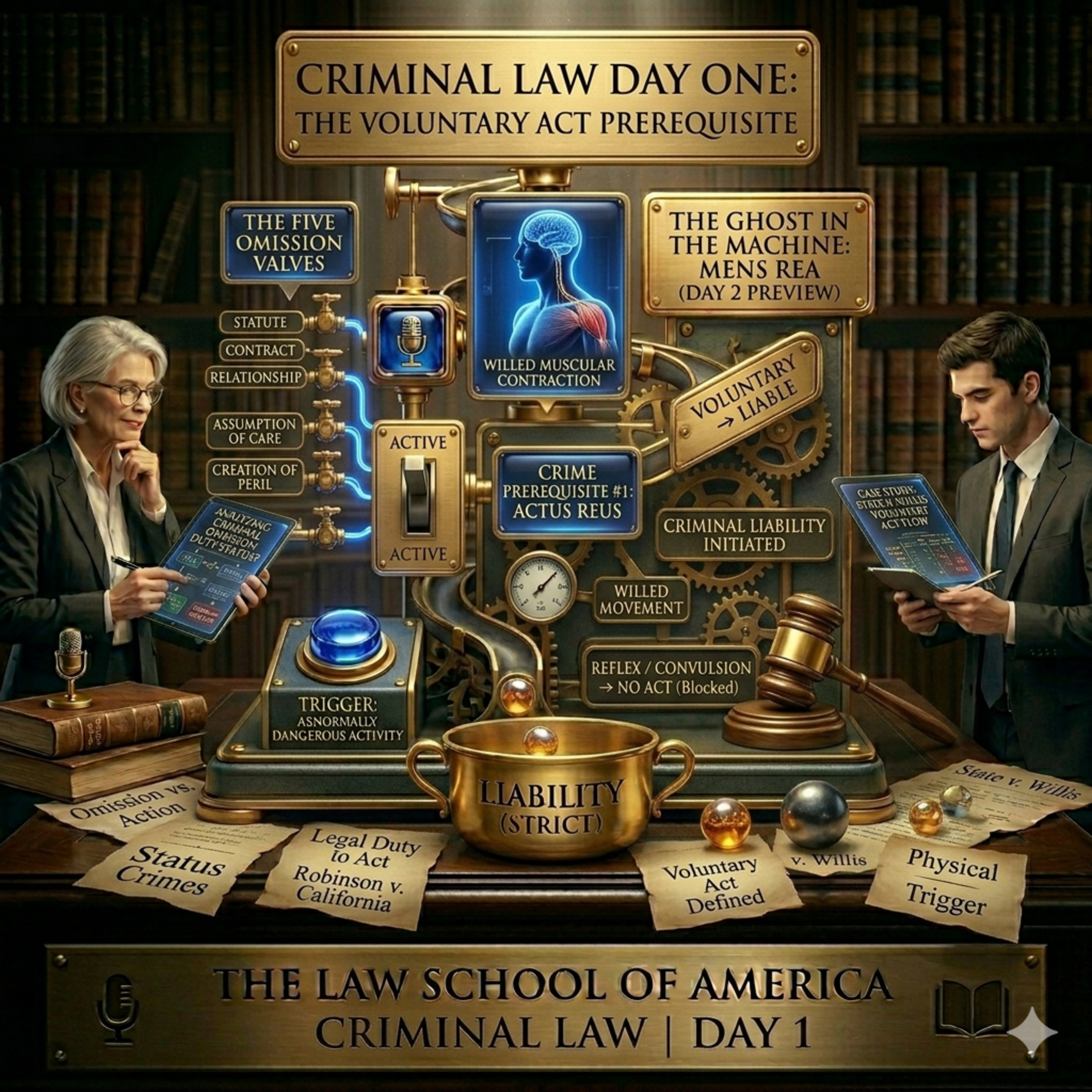
Criminal Law Day One: The Mechanics of Actus Reus - The Voluntary Act Trigger episode artwork

EPISODE · Apr 20, 2026 · 59 MIN

Criminal Law Day One: The Mechanics of Actus Reus - The Voluntary Act Trigger

from Law School · host The Law School of America

This episode dives deeply into the core principle of criminal law: actus reus, the voluntary act that underpins criminal responsibility. We explore how the law distinguishes between voluntary and involuntary actions, the intricate pathways for omissions, and the constitutional limits on punishing personal status. Whether you're a student prepping for exams or a legal professional seeking a clearer framework, this discussion clarifies how society’s most fundamental legal safeguards operate and how emerging technology might challenge them.When do words or thoughts turn into a crime? This episode pulls back the curtain on the foundational actus reus—the crucial "guilty act"—that determines criminal liability. If the law is designed to punish harmful deeds, then understanding what counts as a voluntary human act is essential. You’ll uncover how the law distinguishes between willed actions, involuntary reflexes, and mere outcomes set in motion by external forces, all through compelling examples like subway accidents, seizures, and even sleepwalking scenarios.We break down the core doctrine: a voluntary act requires a willed muscular contraction—a biological and psychological link between your conscious decision and physical movement. You'll discover how this principle applies across a spectrum of situations, from intentional pushes on a platform to involuntary seizures during a car crash, and how courts interpret complex states like sleepwalking or reflex responses. The conversation reveals the importance of timing, highlighting the powerful concept of time-shifting—how a defendant's prior voluntary act can be legally linked to a harmful consequence long after the original decision.The episode also exposes common exam pitfalls—like confusing a reflex with a willed action, or misunderstanding the boundaries of involuntary conduct during sleep, hypnosis, or seizures. Plus, you'll explore the legal fiction that treats possession as an act—either by time-shifting voluntary acquisition or through the doctrine of constructive possession. And we confront a provocative question: what happens when emerging brain-computer interfaces bypass the muscular act entirely, threatening the very concept of manifest criminality?Designed for law students, exam takers, and anyone interested in the mechanics of criminal liability, this episode clarifies the rules that protect individual liberty while enabling prosecution. Understanding these principles is your first step in mastering day-one criminal law—and recognizing the towering importance of actus reus as the gatekeeper of justice.Whether you’re prepping for finals or exploring the ethical and practical limits of law, this episode arms you with a clear, powerful framework—analyzing human behavior through the lens of biological action, legal fiction, and constitutional boundaries.In this episode:The visualization of actus reus through the subway scenario and the concept of physical force as a non-criminal actThe essential role of willed muscular contraction and the significance of conscious controlDifferentiating voluntary acts from reflexes, convulsions, automatism, sleepwalking, and hypnosisHow the law treats unconscious or involuntary movements, referencing the Model Penal CodeThe importance of timing and the DeSina case in linking voluntary acts to subsequent harm, even when incapacitatedThe constitutional prohibition against punishing status — exemplified by Robinson v. CaliforniaThe legal fiction of “possession” as an act via knowledge and control, including actual vs. constructive possessionThe five specific valves—statute, relationship, contract, assumption of care, creation of peril—that transform mere inaction into criminal conductThe theoretical challenges posed by neural interfaces and AI—how they question the very definition of a “human act”

This episode dives deeply into the core principle of criminal law: actus reus, the voluntary act that underpins criminal responsibility. We explore how the law distinguishes between voluntary and involuntary actions, the intricate pathways for omissions, and the constitutional limits on punishing personal status. Whether you're a student prepping for exams or a legal professional seeking a clearer framework, this discussion clarifies how society’s most fundamental legal safeguards operate and how emerging technology might challenge them.When do words or thoughts turn into a crime? This episode pulls back the curtain on the foundational actus reus—the crucial "guilty act"—that determines criminal liability. If the law is designed to punish harmful deeds, then understanding what counts as a voluntary human act is essential. You’ll uncover how the law distinguishes between willed actions, involuntary reflexes, and mere outcomes set in motion by external forces, all through compelling examples like subway accidents, seizures, and even sleepwalking scenarios.We break down the core doctrine: a voluntary act requires a willed muscular contraction—a biological and psychological link between your conscious decision and physical movement. You'll discover how this principle applies across a spectrum of situations, from intentional pushes on a platform to involuntary seizures during a car crash, and how courts interpret complex states like sleepwalking or reflex responses. The conversation reveals the importance of timing, highlighting the powerful concept of time-shifting—how a defendant's prior voluntary act can be legally linked to a harmful consequence long after the original decision.The episode also exposes common exam pitfalls—like confusing a reflex with a willed action, or misunderstanding the boundaries of involuntary conduct during sleep, hypnosis, or seizures. Plus, you'll explore the legal fiction that treats possession as an act—either by time-shifting voluntary acquisition or through the doctrine of constructive possession. And we confront a provocative question: what happens when emerging brain-computer interfaces bypass the muscular act entirely, threatening the very concept of manifest criminality?Designed for law students, exam takers, and anyone interested in the mechanics of criminal liability, this episode clarifies the rules that protect individual liberty while enabling prosecution. Understanding these principles is your first step in mastering day-one criminal law—and recognizing the towering importance of actus reus as the gatekeeper of justice.Whether you’re prepping for finals or exploring the ethical and practical limits of law, this episode arms you with a clear, powerful framework—analyzing human behavior through the lens of biological action, legal fiction, and constitutional boundaries.In this episode:The visualization of actus reus through the subway scenario and the concept of physical force as a non-criminal actThe essential role of willed muscular contraction and the significance of conscious controlDifferentiating voluntary acts from reflexes, convulsions, automatism, sleepwalking, and hypnosisHow the law treats unconscious or involuntary movements, referencing the Model Penal CodeThe importance of timing and the DeSina case in linking voluntary acts to subsequent harm, even when incapacitatedThe constitutional prohibition against punishing status — exemplified by Robinson v. CaliforniaThe legal fiction of “possession” as an act via knowledge and control, including actual vs. constructive possessionThe five specific valves—statute, relationship, contract, assumption of care, creation of peril—that transform mere inaction into criminal conductThe theoretical challenges posed by neural interfaces and AI—how they question the very definition of a “human act”

NOW PLAYING

Criminal Law Day One: The Mechanics of Actus Reus - The Voluntary Act Trigger

0:00 59:36

No transcript for this episode yet

We transcribe on demand. Request one and we'll notify you when it's ready — usually under 10 minutes.

The Small Business Startup School – Business Notes | Financial Literacy | Retail Psychology – For Professionals & Entrepreneurs The Small Business Startup School Inc. Starting or buying a small business? While personal circumstances may vary, business patterns remain timeless. On The Small Business Startup School, we explore strategies, insights, and practical solutions to help entrepreneurs confidently navigate their journey.Hosted by Ola Williams—a retail entrepreneur, fintech founder, and financial coach with over two decades of experience—this podcast marries financial awareness and retail psychology with optimism to deliver actionable takeaways.Join us to learn, grow, and connect as we uncover the keys to business success.Let’s continue to learn together and be encouraged to keep on connecting! The 48 Laws of Power by Robert Greene (Full Audiobook) Robert Greene Amoral, cunning, ruthless, and instructive, this multi-million-copy New York Times bestseller is the definitive manual for anyone interested in gaining, observing, or defending against ultimate control – from the author of The Laws of Human Nature.In the book that People magazine proclaimed “beguiling” and “fascinating,” Robert Greene and Joost Elffers have distilled three thousand years of the history of power into 48 essential laws by drawing from the philosophies of Machiavelli, Sun Tzu, and Carl Von Clausewitz and also from the lives of figures ranging from Henry Kissinger to P.T. Barnum.Some laws teach the need for prudence (“Law 1: Never Outshine the Master”), others teach the value of confidence (“Law 28: Enter Action with Boldness”), and many recommend absolute self-preservation (“Law 15: Crush Your Enemy Totally”). Every law, though, has one thing in common: an interest in t Guardians Of Innocence Guardians Of Innocence Guardians of Innocence is a powerful and informative podcast designed to equip parents, teachers, and communities with the knowledge and tools needed to protect children from the growing threat of trafficking. Each episode dives deep into the tactics traffickers use to target vulnerable children—both online and in real life—and provides actionable advice on how to recognize the warning signs.Through expert interviews with cyber safety professionals, law enforcement, and survivors, we uncover the latest grooming methods, share real-world stories, and empower listeners to become vigilant guardians of innocence in their own families and communities.Guardians of Innocence is more than just a podcast; it’s a call to action to safeguard our children, raise awareness, and foster a united front against trafficking.Listen. Learn. Protect. The Laura Ingraham Show Laura Ingraham The most-watched woman in the history of cable news brings her no-holds-barred political and cultural commentary to podcasting with The Laura Ingraham Show. A bestselling author, breast cancer survivor, and mother of three internationally adopted children, Laura was the most listened-to woman in talk radio before launching her own podcast. A trailblazer across media platforms, she brings a unique perspective to this twice-weekly show, drawing on her experience as a white-collar criminal defense litigator and a Supreme Court law clerk.New episodes drop twice a week—delivering the clarity, courage, and common sense America needs.

Frequently Asked Questions

How long is this episode of Law School?

This episode is 59 minutes long.

When was this Law School episode published?

This episode was published on April 20, 2026.

What is this episode about?

This episode dives deeply into the core principle of criminal law: actus reus, the voluntary act that underpins criminal responsibility. We explore how the law distinguishes between voluntary and involuntary actions, the intricate pathways for...

Can I download this Law School episode?

Yes, you can download this episode by clicking the download button on the episode player, or subscribe to the podcast in your preferred podcast app for automatic downloads.
URL copied to clipboard!