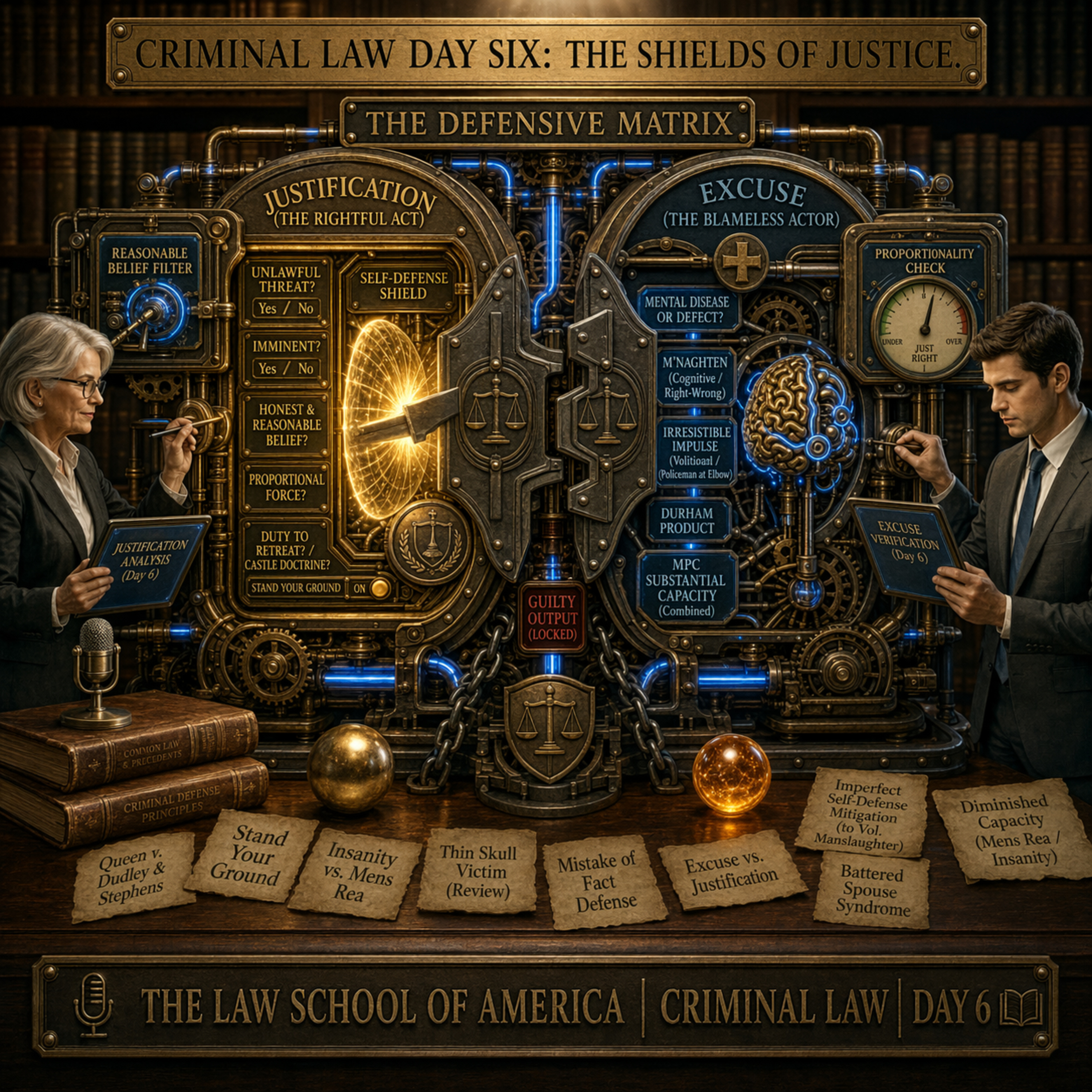
Criminal Law Day Six: The Shields of Justice (Justification and Excuse) episode artwork

EPISODE · Apr 25, 2026 · 1H 13M

Criminal Law Day Six: The Shields of Justice (Justification and Excuse)

from Law School · host The Law School of America

Understanding the Shields of Justice: When Law Balances Morality and RealityThis episode delves into the foundational distinctions in criminal law—justification vs. excuse—and how they affect real-world justice. Whether you're prepping for law school or seeking a clearer view of how society handles moral dilemmas, this discussion unpacks complex doctrines with clarity and practical insights.Most legal defenses hinge on challenging the act or the intent—that is, until you understand the profound difference between justification and excuse. In this episode, we take you behind the scenes of criminal law’s most powerful shields—those built on morality, context, and human complexity. Whether you’re caught in a life-or-death self-defense scenario or grappling with the gray areas of mental illness, understanding when and how the law forgives or absolves you can change everything.Imagine walking down a dark street and facing an attacker; your instinct to strike may be justified if your life is at immediate risk. But what if your response is based on a skewed perception brought on by paranoia? Or consider helping someone in a life-threatening situation—when do acts of aid become protected defenses, and when do they turn into reckless crimes? We break down key legal mechanisms—justification defenses like self-defense, necessity, and defense of others—and see how the law evaluates these scenarios through objective standards, psychological realities, and societal priorities.You’ll discover how the law’s sharp focus on objective facts can clash with the complex internal realities of human psychology—especially when mental illness or external coercion are involved. We explore groundbreaking shifts, such as the evolving standards for insanity—from the rigid McNaughton rule to the nuanced Model Penal Code—highlighting how neuroscience and brain imaging threaten to rewrite these ancient lines of responsibility. We also dissect the controversial boundary where necessity stops and murder begins, illustrated by the infamous lifeboat case where moral and legal claims collide.This episode is perfect for students, legal professionals, or anyone invested in the moral heartbeat of justice. It reveals how society’s laws are not just rules but reflections of shared moral choices—balancing the chaos of human instinct with the need for order and responsibility. As neuroscience pushes into uncharted territory, ask yourself: when the hardware of the brain is broken, how responsible can we really be? Think about the future of culpability, and prepare to see justice—and yourself—through a sharper lens.In this episode:The core difference between justification and excuse defenses, and why it matters both in court and in moral philosophyHow objective circumstances can turn a criminal act into a socially endorsed act through justification defenses like self-defense and necessityThe internal, psychological focus of excuse defenses including insanity, duress, and intoxication, and their legal standardsDetailed exploration of the four major insanity tests—McNaughton, irresistible impulse, Durham, and MPC—and their evolutionThe procedural mechanics of shifting burdens of proof in affirmative defenses and expert psychiatric testimony's roleCritical assessments of legal thresholds, from imminent threats in self-defense to the line dividing culpability and lack of control via neuroscience prospectsWhy law emphasizes that some behaviors—like killing innocents—are unacceptable regardless of circumstances, illustrated through famous cases like Dudley and Stevens' lifeboat dilemma

Understanding the Shields of Justice: When Law Balances Morality and RealityThis episode delves into the foundational distinctions in criminal law—justification vs. excuse—and how they affect real-world justice. Whether you're prepping for law school or seeking a clearer view of how society handles moral dilemmas, this discussion unpacks complex doctrines with clarity and practical insights.Most legal defenses hinge on challenging the act or the intent—that is, until you understand the profound difference between justification and excuse. In this episode, we take you behind the scenes of criminal law’s most powerful shields—those built on morality, context, and human complexity. Whether you’re caught in a life-or-death self-defense scenario or grappling with the gray areas of mental illness, understanding when and how the law forgives or absolves you can change everything.Imagine walking down a dark street and facing an attacker; your instinct to strike may be justified if your life is at immediate risk. But what if your response is based on a skewed perception brought on by paranoia? Or consider helping someone in a life-threatening situation—when do acts of aid become protected defenses, and when do they turn into reckless crimes? We break down key legal mechanisms—justification defenses like self-defense, necessity, and defense of others—and see how the law evaluates these scenarios through objective standards, psychological realities, and societal priorities.You’ll discover how the law’s sharp focus on objective facts can clash with the complex internal realities of human psychology—especially when mental illness or external coercion are involved. We explore groundbreaking shifts, such as the evolving standards for insanity—from the rigid McNaughton rule to the nuanced Model Penal Code—highlighting how neuroscience and brain imaging threaten to rewrite these ancient lines of responsibility. We also dissect the controversial boundary where necessity stops and murder begins, illustrated by the infamous lifeboat case where moral and legal claims collide.This episode is perfect for students, legal professionals, or anyone invested in the moral heartbeat of justice. It reveals how society’s laws are not just rules but reflections of shared moral choices—balancing the chaos of human instinct with the need for order and responsibility. As neuroscience pushes into uncharted territory, ask yourself: when the hardware of the brain is broken, how responsible can we really be? Think about the future of culpability, and prepare to see justice—and yourself—through a sharper lens.In this episode:The core difference between justification and excuse defenses, and why it matters both in court and in moral philosophyHow objective circumstances can turn a criminal act into a socially endorsed act through justification defenses like self-defense and necessityThe internal, psychological focus of excuse defenses including insanity, duress, and intoxication, and their legal standardsDetailed exploration of the four major insanity tests—McNaughton, irresistible impulse, Durham, and MPC—and their evolutionThe procedural mechanics of shifting burdens of proof in affirmative defenses and expert psychiatric testimony's roleCritical assessments of legal thresholds, from imminent threats in self-defense to the line dividing culpability and lack of control via neuroscience prospectsWhy law emphasizes that some behaviors—like killing innocents—are unacceptable regardless of circumstances, illustrated through famous cases like Dudley and Stevens' lifeboat dilemma

NOW PLAYING

Criminal Law Day Six: The Shields of Justice (Justification and Excuse)

0:00 1:13:34

No transcript for this episode yet

We transcribe on demand. Request one and we'll notify you when it's ready — usually under 10 minutes.

The Small Business Startup School – Business Notes | Financial Literacy | Retail Psychology – For Professionals & Entrepreneurs The Small Business Startup School Inc. Starting or buying a small business? While personal circumstances may vary, business patterns remain timeless. On The Small Business Startup School, we explore strategies, insights, and practical solutions to help entrepreneurs confidently navigate their journey.Hosted by Ola Williams—a retail entrepreneur, fintech founder, and financial coach with over two decades of experience—this podcast marries financial awareness and retail psychology with optimism to deliver actionable takeaways.Join us to learn, grow, and connect as we uncover the keys to business success.Let’s continue to learn together and be encouraged to keep on connecting! The 48 Laws of Power by Robert Greene (Full Audiobook) Robert Greene Amoral, cunning, ruthless, and instructive, this multi-million-copy New York Times bestseller is the definitive manual for anyone interested in gaining, observing, or defending against ultimate control – from the author of The Laws of Human Nature.In the book that People magazine proclaimed “beguiling” and “fascinating,” Robert Greene and Joost Elffers have distilled three thousand years of the history of power into 48 essential laws by drawing from the philosophies of Machiavelli, Sun Tzu, and Carl Von Clausewitz and also from the lives of figures ranging from Henry Kissinger to P.T. Barnum.Some laws teach the need for prudence (“Law 1: Never Outshine the Master”), others teach the value of confidence (“Law 28: Enter Action with Boldness”), and many recommend absolute self-preservation (“Law 15: Crush Your Enemy Totally”). Every law, though, has one thing in common: an interest in t Guardians Of Innocence Guardians Of Innocence Guardians of Innocence is a powerful and informative podcast designed to equip parents, teachers, and communities with the knowledge and tools needed to protect children from the growing threat of trafficking. Each episode dives deep into the tactics traffickers use to target vulnerable children—both online and in real life—and provides actionable advice on how to recognize the warning signs.Through expert interviews with cyber safety professionals, law enforcement, and survivors, we uncover the latest grooming methods, share real-world stories, and empower listeners to become vigilant guardians of innocence in their own families and communities.Guardians of Innocence is more than just a podcast; it’s a call to action to safeguard our children, raise awareness, and foster a united front against trafficking.Listen. Learn. Protect. The Laura Ingraham Show Laura Ingraham The most-watched woman in the history of cable news brings her no-holds-barred political and cultural commentary to podcasting with The Laura Ingraham Show. A bestselling author, breast cancer survivor, and mother of three internationally adopted children, Laura was the most listened-to woman in talk radio before launching her own podcast. A trailblazer across media platforms, she brings a unique perspective to this twice-weekly show, drawing on her experience as a white-collar criminal defense litigator and a Supreme Court law clerk.New episodes drop twice a week—delivering the clarity, courage, and common sense America needs.

Frequently Asked Questions

How long is this episode of Law School?

This episode is 1 hour and 13 minutes long.

When was this Law School episode published?

This episode was published on April 25, 2026.

What is this episode about?

Understanding the Shields of Justice: When Law Balances Morality and RealityThis episode delves into the foundational distinctions in criminal law—justification vs. excuse—and how they affect real-world justice. Whether you're prepping for law...

Can I download this Law School episode?

Yes, you can download this episode by clicking the download button on the episode player, or subscribe to the podcast in your preferred podcast app for automatic downloads.
URL copied to clipboard!