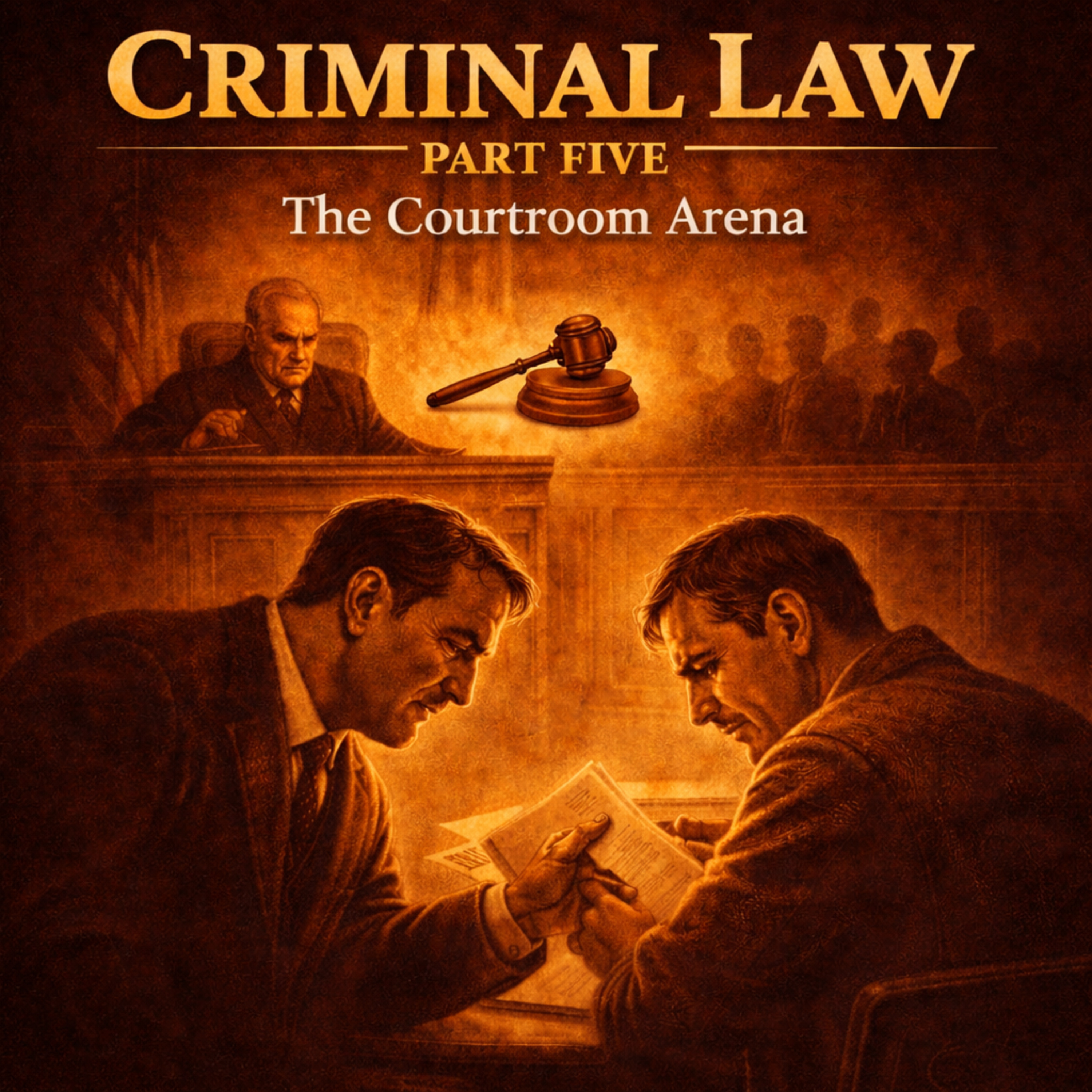
Criminal Law Part Five: The Courtroom Arena episode artwork

EPISODE · Jan 9, 2026 · 44 MIN

Criminal Law Part Five: The Courtroom Arena

from Law School · host The Law School of America

The American Criminal Justice System: A Deep Dive into Failure and ReformThis conversation delves into the foundational issues of the American criminal justice system, focusing on over-criminalization, plea bargaining, and the systemic failures that lead to a net loss of liberty. It critiques the current practices and proposes a liberty balancing approach to restore fairness and individual rights. The discussion highlights the coercive nature of plea deals, the implications of proxy crimes, and the challenges posed by procedural barriers and the presumption of regularity. Ultimately, it questions the efficacy of the jury trial system and the concept of legal formalism in ensuring justice.In today's exploration, we delve into the intricate and often flawed mechanisms of the American criminal justice system. This isn't just about the high-profile trials that capture public attention; it's about the underlying structures and procedures that shape outcomes long before a jury is seated.The Systemic Failures: The American criminal justice system is plagued by over-criminalization and a reliance on plea bargaining, which bypasses the constitutional design of our courts. With 95% of felony convictions resulting from guilty pleas, the adversarial trial system is more theoretical than practical. This administrative workaround, driven by overwhelming caseloads and limited resources, raises ethical and constitutional concerns about coercion and fairness.The Liberty Balancing Approach: A proposed reform is the Liberty Balancing Approach (LBA), which seeks to redefine criminal laws as protectors of fundamental rights and liberties. This framework demands rigorous scrutiny of laws that restrict freedom, ensuring they are justified and proportionate. The LBA aims to narrow the application of criminal law, focusing on preserving individual liberties.The Role of Proxy Crimes: Proxy crimes, such as illegal firearm possession, serve as placeholders for more serious offenses. These laws often lead to intrusive enforcement methods that infringe on individual liberties, particularly in marginalized communities. The effectiveness of these laws in reducing crime is questionable, with evidence suggesting they may even increase violence by shifting conflict resolution to unregulated channels.The Burden of Proof: The allocation of the burden of proof in criminal procedure is inconsistent, creating disparities in constitutional protections. The presumption of regularity, which assumes public officials act legally, shifts the burden to defendants to prove misconduct. This presumption is often factually unsupportable, particularly in the context of indigent defense and racial bias in prosecutorial decisions.Conclusion: The American criminal justice system is at a crossroads, with systemic pressures threatening its foundational principles. Reforms like the Liberty Balancing Approach and a reevaluation of proxy crimes are essential to restoring balance and protecting individual liberties. As we navigate these challenges, the question remains: do we have the political and institutional will to enact meaningful change?Subscribe now to stay informed on the latest discussions and reforms in the criminal justice system.TakeawaysThe American criminal justice system is fundamentally flawed.Over-criminalization affects 70% of Americans.Plea bargaining is a coercive mechanism in the justice system.The liberty balancing approach seeks to restore individual rights.Proxy crimes create legal traps for marginalized communities.Procedural barriers often prevent justice from being served.The presumption of regularity shifts the burden unfairly to defendants.Jury trials are declining, impacting democratic justice.American criminal justice, over-criminalization, plea bargaining, liberty balancing approach, proxy crimes, procedural barriers, jury trials, legal formalism, presumption of innocence

The American Criminal Justice System: A Deep Dive into Failure and ReformThis conversation delves into the foundational issues of the American criminal justice system, focusing on over-criminalization, plea bargaining, and the systemic failures that lead to a net loss of liberty. It critiques the current practices and proposes a liberty balancing approach to restore fairness and individual rights. The discussion highlights the coercive nature of plea deals, the implications of proxy crimes, and the challenges posed by procedural barriers and the presumption of regularity. Ultimately, it questions the efficacy of the jury trial system and the concept of legal formalism in ensuring justice.In today's exploration, we delve into the intricate and often flawed mechanisms of the American criminal justice system. This isn't just about the high-profile trials that capture public attention; it's about the underlying structures and procedures that shape outcomes long before a jury is seated.The Systemic Failures: The American criminal justice system is plagued by over-criminalization and a reliance on plea bargaining, which bypasses the constitutional design of our courts. With 95% of felony convictions resulting from guilty pleas, the adversarial trial system is more theoretical than practical. This administrative workaround, driven by overwhelming caseloads and limited resources, raises ethical and constitutional concerns about coercion and fairness.The Liberty Balancing Approach: A proposed reform is the Liberty Balancing Approach (LBA), which seeks to redefine criminal laws as protectors of fundamental rights and liberties. This framework demands rigorous scrutiny of laws that restrict freedom, ensuring they are justified and proportionate. The LBA aims to narrow the application of criminal law, focusing on preserving individual liberties.The Role of Proxy Crimes: Proxy crimes, such as illegal firearm possession, serve as placeholders for more serious offenses. These laws often lead to intrusive enforcement methods that infringe on individual liberties, particularly in marginalized communities. The effectiveness of these laws in reducing crime is questionable, with evidence suggesting they may even increase violence by shifting conflict resolution to unregulated channels.The Burden of Proof: The allocation of the burden of proof in criminal procedure is inconsistent, creating disparities in constitutional protections. The presumption of regularity, which assumes public officials act legally, shifts the burden to defendants to prove misconduct. This presumption is often factually unsupportable, particularly in the context of indigent defense and racial bias in prosecutorial decisions.Conclusion: The American criminal justice system is at a crossroads, with systemic pressures threatening its foundational principles. Reforms like the Liberty Balancing Approach and a reevaluation of proxy crimes are essential to restoring balance and protecting individual liberties. As we navigate these challenges, the question remains: do we have the political and institutional will to enact meaningful change?Subscribe now to stay informed on the latest discussions and reforms in the criminal justice system.TakeawaysThe American criminal justice system is fundamentally flawed.Over-criminalization affects 70% of Americans.Plea bargaining is a coercive mechanism in the justice system.The liberty balancing approach seeks to restore individual rights.Proxy crimes create legal traps for marginalized communities.Procedural barriers often prevent justice from being served.The presumption of regularity shifts the burden unfairly to defendants.Jury trials are declining, impacting democratic justice.American criminal justice, over-criminalization, plea bargaining, liberty balancing approach, proxy crimes, procedural barriers, jury trials, legal formalism, presumption of innocence

NOW PLAYING

Criminal Law Part Five: The Courtroom Arena

0:00 44:15

No transcript for this episode yet

We transcribe on demand. Request one and we'll notify you when it's ready — usually under 10 minutes.

The Small Business Startup School – Business Notes | Financial Literacy | Retail Psychology – For Professionals & Entrepreneurs The Small Business Startup School Inc. Starting or buying a small business? While personal circumstances may vary, business patterns remain timeless. On The Small Business Startup School, we explore strategies, insights, and practical solutions to help entrepreneurs confidently navigate their journey.Hosted by Ola Williams—a retail entrepreneur, fintech founder, and financial coach with over two decades of experience—this podcast marries financial awareness and retail psychology with optimism to deliver actionable takeaways.Join us to learn, grow, and connect as we uncover the keys to business success.Let’s continue to learn together and be encouraged to keep on connecting! The 48 Laws of Power by Robert Greene (Full Audiobook) Robert Greene Amoral, cunning, ruthless, and instructive, this multi-million-copy New York Times bestseller is the definitive manual for anyone interested in gaining, observing, or defending against ultimate control – from the author of The Laws of Human Nature.In the book that People magazine proclaimed “beguiling” and “fascinating,” Robert Greene and Joost Elffers have distilled three thousand years of the history of power into 48 essential laws by drawing from the philosophies of Machiavelli, Sun Tzu, and Carl Von Clausewitz and also from the lives of figures ranging from Henry Kissinger to P.T. Barnum.Some laws teach the need for prudence (“Law 1: Never Outshine the Master”), others teach the value of confidence (“Law 28: Enter Action with Boldness”), and many recommend absolute self-preservation (“Law 15: Crush Your Enemy Totally”). Every law, though, has one thing in common: an interest in t Guardians Of Innocence Guardians Of Innocence Guardians of Innocence is a powerful and informative podcast designed to equip parents, teachers, and communities with the knowledge and tools needed to protect children from the growing threat of trafficking. Each episode dives deep into the tactics traffickers use to target vulnerable children—both online and in real life—and provides actionable advice on how to recognize the warning signs.Through expert interviews with cyber safety professionals, law enforcement, and survivors, we uncover the latest grooming methods, share real-world stories, and empower listeners to become vigilant guardians of innocence in their own families and communities.Guardians of Innocence is more than just a podcast; it’s a call to action to safeguard our children, raise awareness, and foster a united front against trafficking.Listen. Learn. Protect. The Laura Ingraham Show Laura Ingraham The most-watched woman in the history of cable news brings her no-holds-barred political and cultural commentary to podcasting with The Laura Ingraham Show. A bestselling author, breast cancer survivor, and mother of three internationally adopted children, Laura was the most listened-to woman in talk radio before launching her own podcast. A trailblazer across media platforms, she brings a unique perspective to this twice-weekly show, drawing on her experience as a white-collar criminal defense litigator and a Supreme Court law clerk.New episodes drop twice a week—delivering the clarity, courage, and common sense America needs.

Frequently Asked Questions

How long is this episode of Law School?

This episode is 44 minutes long.

When was this Law School episode published?

This episode was published on January 9, 2026.

What is this episode about?

The American Criminal Justice System: A Deep Dive into Failure and ReformThis conversation delves into the foundational issues of the American criminal justice system, focusing on over-criminalization, plea bargaining, and the systemic failures that...

Can I download this Law School episode?

Yes, you can download this episode by clicking the download button on the episode player, or subscribe to the podcast in your preferred podcast app for automatic downloads.
URL copied to clipboard!