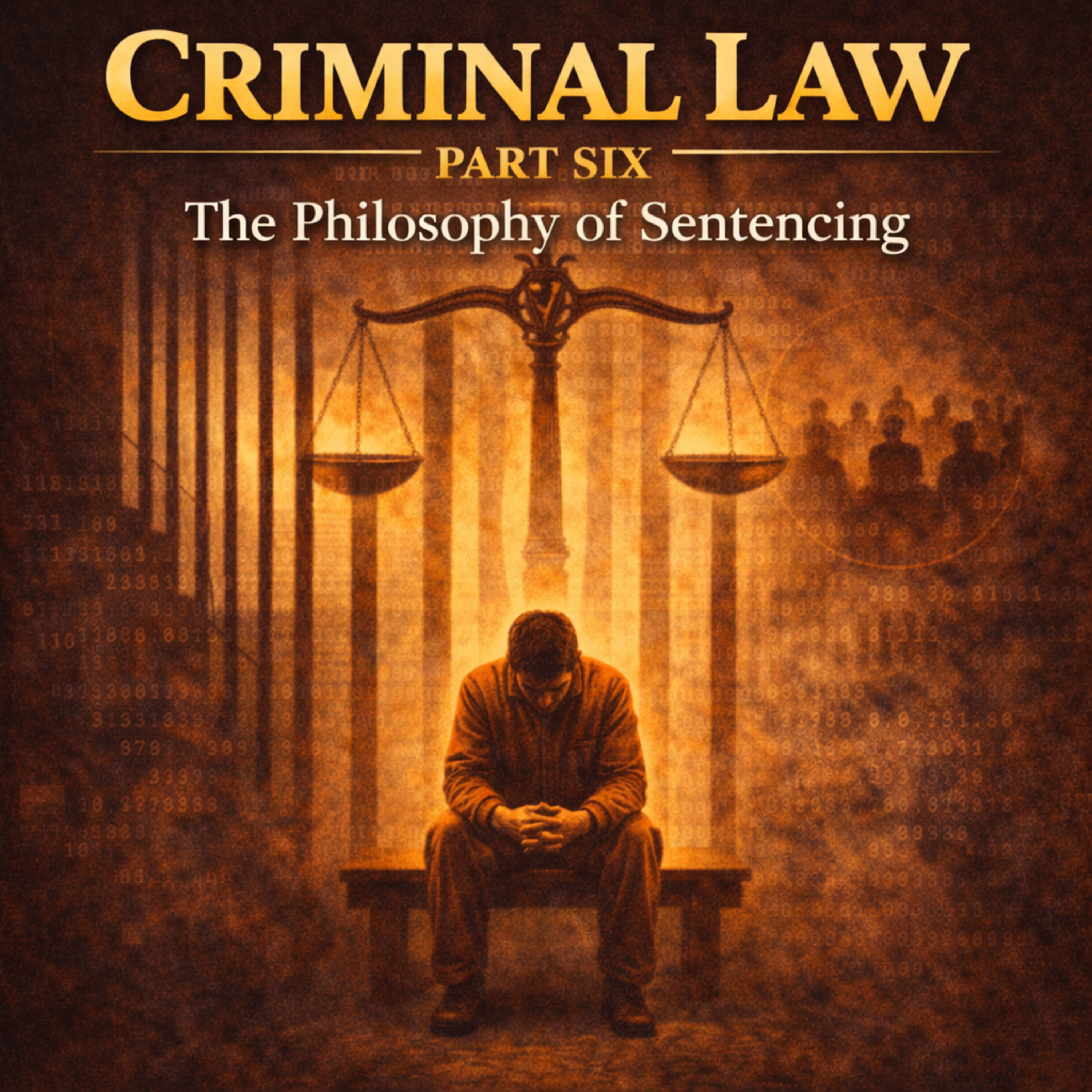
Criminal Law Part Six: The Philosophy of Sentencing episode artwork

EPISODE · Jan 10, 2026 · 50 MIN

Criminal Law Part Six: The Philosophy of Sentencing

from Law School · host The Law School of America

The Complex Landscape of Sentencing: Balancing Justice and RedemptionThis conversation delves into the complexities of sentencing in criminal law, exploring the philosophical foundations of punishment, the shift from rehabilitation to retribution, and the implications of mass incarceration. It examines the effectiveness of deterrence and incapacitation, the challenges of parole, and the debate surrounding life without parole. The discussion also highlights the role of algorithmic risk assessments and emerging paradigms like restorative justice, ultimately questioning the future of justice and the potential for redemption.In the realm of criminal law, the question of why we punish is as philosophical as it is practical. This exploration delves into the heart of sentencing, examining the four core philosophies: retribution, deterrence, rehabilitation, and incapacitation. Each philosophy offers a unique lens through which to view justice, yet they often collide with the messy realities of judicial discretion and sentencing reform.Retribution: A Look BackwardRetribution is rooted in the past, focusing on settling a moral score for actions already committed. It demands that punishment fit the crime, emphasizing proportionality to ensure fairness. However, the challenge lies in achieving perfect proportionality, as the subjective experience of punishment can vary widely among individuals.Deterrence: The Forward-Looking ApproachDeterrence aims to prevent future crimes by making punishment a deterrent. It operates on the assumption that potential offenders will weigh the costs and benefits of their actions. Yet, research shows that the certainty of punishment, rather than its severity, is what truly deters crime. This highlights a significant policy paradox, as lawmakers often focus on increasing sentence lengths rather than improving the likelihood of apprehension.Rehabilitation: The Noble IdealRehabilitation seeks to reform offenders by addressing the root causes of their behavior. While historically dominant, this approach faced criticism for its perceived ineffectiveness. However, a resurgence of interest in evidence-based corrections offers hope for more targeted interventions that address criminogenic needs, such as cognitive behavioral therapy and vocational education.Incapacitation: The Brute Force SolutionIncapacitation physically prevents offenders from committing further crimes by removing them from society. While effective in the short term, its long-term efficacy is debated, particularly when considering the replacement effect in market-driven crimes.The Path Forward: Embracing ComplexityAs we navigate the complexities of sentencing, the challenge remains to balance competing values: fairness versus freedom, certainty versus discretion. The rise of restorative and community justice offers a promising alternative, focusing on repairing harm and integrating social services into the justice system. Ultimately, the quest for a just response to crime requires embracing the complexity of human lives and prioritizing redemption over retribution.Conclusion: A Call to ActionFor those studying law, understanding these philosophies is crucial. Yet, beyond academic analysis, the broader question persists: What does a truly just response to crime look like? As future legal professionals and citizens, grappling with this question will shape the future of our justice system.TakeawaysSentencing is a critical juncture in criminal law.The philosophical goals of sentencing include retribution, deterrence, incapacitation, and rehabilitation.The shift from rehabilitation to a punitive system has led to mass incarceration.Deterrence relies more on the certainty of punishment than its severity.Incapacitation may not effectively reduce crime rates due to the replacement effect.sentencing, criminal law, retribution, rehabilitation, deterrence, incapacitation, mass incarceration, justice system, parole, redemption

The Complex Landscape of Sentencing: Balancing Justice and RedemptionThis conversation delves into the complexities of sentencing in criminal law, exploring the philosophical foundations of punishment, the shift from rehabilitation to retribution, and the implications of mass incarceration. It examines the effectiveness of deterrence and incapacitation, the challenges of parole, and the debate surrounding life without parole. The discussion also highlights the role of algorithmic risk assessments and emerging paradigms like restorative justice, ultimately questioning the future of justice and the potential for redemption.In the realm of criminal law, the question of why we punish is as philosophical as it is practical. This exploration delves into the heart of sentencing, examining the four core philosophies: retribution, deterrence, rehabilitation, and incapacitation. Each philosophy offers a unique lens through which to view justice, yet they often collide with the messy realities of judicial discretion and sentencing reform.Retribution: A Look BackwardRetribution is rooted in the past, focusing on settling a moral score for actions already committed. It demands that punishment fit the crime, emphasizing proportionality to ensure fairness. However, the challenge lies in achieving perfect proportionality, as the subjective experience of punishment can vary widely among individuals.Deterrence: The Forward-Looking ApproachDeterrence aims to prevent future crimes by making punishment a deterrent. It operates on the assumption that potential offenders will weigh the costs and benefits of their actions. Yet, research shows that the certainty of punishment, rather than its severity, is what truly deters crime. This highlights a significant policy paradox, as lawmakers often focus on increasing sentence lengths rather than improving the likelihood of apprehension.Rehabilitation: The Noble IdealRehabilitation seeks to reform offenders by addressing the root causes of their behavior. While historically dominant, this approach faced criticism for its perceived ineffectiveness. However, a resurgence of interest in evidence-based corrections offers hope for more targeted interventions that address criminogenic needs, such as cognitive behavioral therapy and vocational education.Incapacitation: The Brute Force SolutionIncapacitation physically prevents offenders from committing further crimes by removing them from society. While effective in the short term, its long-term efficacy is debated, particularly when considering the replacement effect in market-driven crimes.The Path Forward: Embracing ComplexityAs we navigate the complexities of sentencing, the challenge remains to balance competing values: fairness versus freedom, certainty versus discretion. The rise of restorative and community justice offers a promising alternative, focusing on repairing harm and integrating social services into the justice system. Ultimately, the quest for a just response to crime requires embracing the complexity of human lives and prioritizing redemption over retribution.Conclusion: A Call to ActionFor those studying law, understanding these philosophies is crucial. Yet, beyond academic analysis, the broader question persists: What does a truly just response to crime look like? As future legal professionals and citizens, grappling with this question will shape the future of our justice system.TakeawaysSentencing is a critical juncture in criminal law.The philosophical goals of sentencing include retribution, deterrence, incapacitation, and rehabilitation.The shift from rehabilitation to a punitive system has led to mass incarceration.Deterrence relies more on the certainty of punishment than its severity.Incapacitation may not effectively reduce crime rates due to the replacement effect.sentencing, criminal law, retribution, rehabilitation, deterrence, incapacitation, mass incarceration, justice system, parole, redemption

NOW PLAYING

Criminal Law Part Six: The Philosophy of Sentencing

0:00 50:23

No transcript for this episode yet

We transcribe on demand. Request one and we'll notify you when it's ready — usually under 10 minutes.

The Small Business Startup School – Business Notes | Financial Literacy | Retail Psychology – For Professionals & Entrepreneurs The Small Business Startup School Inc. Starting or buying a small business? While personal circumstances may vary, business patterns remain timeless. On The Small Business Startup School, we explore strategies, insights, and practical solutions to help entrepreneurs confidently navigate their journey.Hosted by Ola Williams—a retail entrepreneur, fintech founder, and financial coach with over two decades of experience—this podcast marries financial awareness and retail psychology with optimism to deliver actionable takeaways.Join us to learn, grow, and connect as we uncover the keys to business success.Let’s continue to learn together and be encouraged to keep on connecting! The 48 Laws of Power by Robert Greene (Full Audiobook) Robert Greene Amoral, cunning, ruthless, and instructive, this multi-million-copy New York Times bestseller is the definitive manual for anyone interested in gaining, observing, or defending against ultimate control – from the author of The Laws of Human Nature.In the book that People magazine proclaimed “beguiling” and “fascinating,” Robert Greene and Joost Elffers have distilled three thousand years of the history of power into 48 essential laws by drawing from the philosophies of Machiavelli, Sun Tzu, and Carl Von Clausewitz and also from the lives of figures ranging from Henry Kissinger to P.T. Barnum.Some laws teach the need for prudence (“Law 1: Never Outshine the Master”), others teach the value of confidence (“Law 28: Enter Action with Boldness”), and many recommend absolute self-preservation (“Law 15: Crush Your Enemy Totally”). Every law, though, has one thing in common: an interest in t Guardians Of Innocence Guardians Of Innocence Guardians of Innocence is a powerful and informative podcast designed to equip parents, teachers, and communities with the knowledge and tools needed to protect children from the growing threat of trafficking. Each episode dives deep into the tactics traffickers use to target vulnerable children—both online and in real life—and provides actionable advice on how to recognize the warning signs.Through expert interviews with cyber safety professionals, law enforcement, and survivors, we uncover the latest grooming methods, share real-world stories, and empower listeners to become vigilant guardians of innocence in their own families and communities.Guardians of Innocence is more than just a podcast; it’s a call to action to safeguard our children, raise awareness, and foster a united front against trafficking.Listen. Learn. Protect. The Laura Ingraham Show Laura Ingraham The most-watched woman in the history of cable news brings her no-holds-barred political and cultural commentary to podcasting with The Laura Ingraham Show. A bestselling author, breast cancer survivor, and mother of three internationally adopted children, Laura was the most listened-to woman in talk radio before launching her own podcast. A trailblazer across media platforms, she brings a unique perspective to this twice-weekly show, drawing on her experience as a white-collar criminal defense litigator and a Supreme Court law clerk.New episodes drop twice a week—delivering the clarity, courage, and common sense America needs.

Frequently Asked Questions

How long is this episode of Law School?

This episode is 50 minutes long.

When was this Law School episode published?

This episode was published on January 10, 2026.

What is this episode about?

The Complex Landscape of Sentencing: Balancing Justice and RedemptionThis conversation delves into the complexities of sentencing in criminal law, exploring the philosophical foundations of punishment, the shift from rehabilitation to retribution,...

Can I download this Law School episode?

Yes, you can download this episode by clicking the download button on the episode player, or subscribe to the podcast in your preferred podcast app for automatic downloads.
URL copied to clipboard!