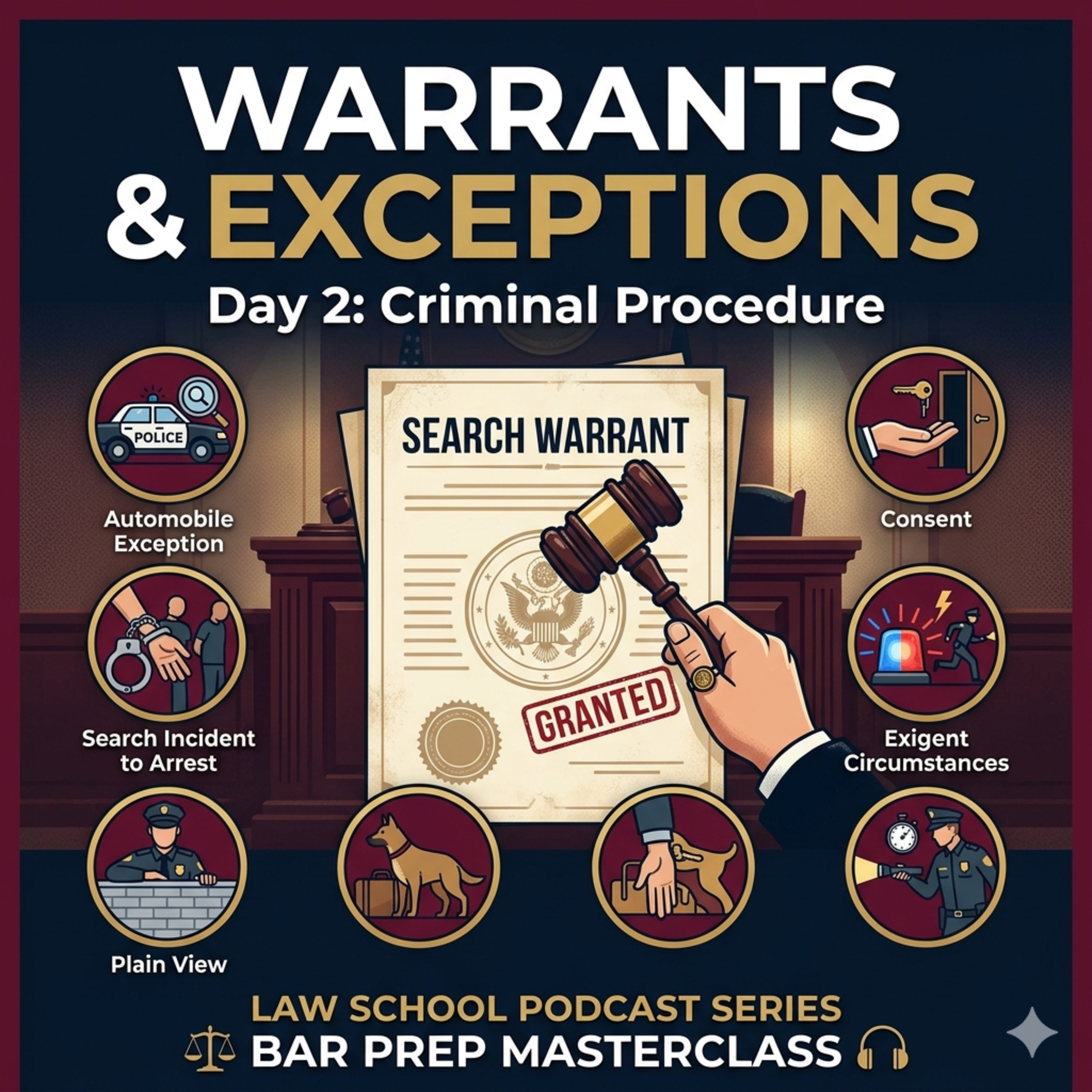
Criminal Procedure Day 2: Warrants and the Warrant Exceptions episode artwork

EPISODE · Apr 28, 2026 · 56 MIN

Criminal Procedure Day 2: Warrants and the Warrant Exceptions

from Law School · host The Law School of America

Study Guide: Day 2 The Core Requirements and the Categorical BypassMastering Fourth Amendment Searches and Warrants: Key Principles and ExceptionsThis episode offers a comprehensive guide to the Fourth Amendment’s warrant requirement and its critical exceptions, providing clarity on complex legal doctrines with practical applications for exams and real-world analysis. Whether you're a law student, bar candidate, or just keen to understand your rights, this breakdown sharpens your legal instinct.Most law students and legal professionals underestimate just how murky the world of search and seizure law has become — especially with the rise of digital technology. This episode reveals how the once clear-cut Fourth Amendment rules have fractured into a landscape of gray areas, traps, and nuanced exceptions that could make or break your exam or court case.Imagine a legal diagnosis — as straightforward as a broken arm — but suddenly slipping into a complex battlefield of competing interests, shifting contexts, and case law that constantly pushes the boundaries. You’ll learn why warrantless searches are presumed unreasonable, and how history’s fight against colonial arbitrary power shaped today’s stringent requirements. From the infamous British writs of assistance to modern digital privacy, this episode explores the core principles that still underpin constitutional protections — but in a digital age that’s rewriting the rules.We break down the key doctrines that law students and practitioners must master: what exactly makes a warrant valid? How do the exceptions like search incident to lawful arrest (SILA), the automobile exception, plain view, and exigent circumstances truly work — especially when they overlap? You’ll discover handy frameworks, such as the “wingspan” rule from Chimel, and learn why the scope of a search can collapse with the wrong timing or context. Ever wondered why courts scrutinize movements like flipping a stereo or manipulating a phone? We clarify the difference between mere observation and unconstitutional manipulation, with real-world cases from Riley and Arizona v. Hicks.Why does modern technology threaten to drown these old rules in confusion? Because new devices like smartphones, encrypted files, and digital data fundamentally alter privacy expectations. You’ll understand how courts are redefining what constitutes a “plain view,” and why digital privacy is the next frontier of Fourth Amendment law. The episode highlights how law enforcement’s need for quick action must be balanced against constitutional safeguards — especially during emergency pursuits or in the Digital Ether of the 21st century.Perfect for law students studying for exams, bar candidates synthesizing dense doctrines, or citizens eager to know their rights, this episode equips you with a clear, logical approach to analyzing complex search scenarios. Every doctrine is a piece of a puzzle — if you understand their core principles, you’ll unlock the ability to dissect any real-world encounter or exam question.With expert insights into the evolution of Fourth Amendment law, we guide you beyond memorization into strategic mastery. This is your chance to see how the foundational protections established centuries ago are being challenged and reshaped by today’s technological revolution. Stay disciplined, apply the right framework, and master the art of constitutional analysis — because when the waters get murkiest, clarity is your greatest asset.Main insights:The Fourth Amendment's core principle: searches without a warrant are per se unreasonable, with specific exceptions.The historic distrust of broad government searches—rooted in colonial grievances—shapes modern warrant protections.Fundamental components of a valid warrant: issuance by a neutral magist

Study Guide: Day 2 The Core Requirements and the Categorical BypassMastering Fourth Amendment Searches and Warrants: Key Principles and ExceptionsThis episode offers a comprehensive guide to the Fourth Amendment’s warrant requirement and its critical exceptions, providing clarity on complex legal doctrines with practical applications for exams and real-world analysis. Whether you're a law student, bar candidate, or just keen to understand your rights, this breakdown sharpens your legal instinct.Most law students and legal professionals underestimate just how murky the world of search and seizure law has become — especially with the rise of digital technology. This episode reveals how the once clear-cut Fourth Amendment rules have fractured into a landscape of gray areas, traps, and nuanced exceptions that could make or break your exam or court case.Imagine a legal diagnosis — as straightforward as a broken arm — but suddenly slipping into a complex battlefield of competing interests, shifting contexts, and case law that constantly pushes the boundaries. You’ll learn why warrantless searches are presumed unreasonable, and how history’s fight against colonial arbitrary power shaped today’s stringent requirements. From the infamous British writs of assistance to modern digital privacy, this episode explores the core principles that still underpin constitutional protections — but in a digital age that’s rewriting the rules.We break down the key doctrines that law students and practitioners must master: what exactly makes a warrant valid? How do the exceptions like search incident to lawful arrest (SILA), the automobile exception, plain view, and exigent circumstances truly work — especially when they overlap? You’ll discover handy frameworks, such as the “wingspan” rule from Chimel, and learn why the scope of a search can collapse with the wrong timing or context. Ever wondered why courts scrutinize movements like flipping a stereo or manipulating a phone? We clarify the difference between mere observation and unconstitutional manipulation, with real-world cases from Riley and Arizona v. Hicks.Why does modern technology threaten to drown these old rules in confusion? Because new devices like smartphones, encrypted files, and digital data fundamentally alter privacy expectations. You’ll understand how courts are redefining what constitutes a “plain view,” and why digital privacy is the next frontier of Fourth Amendment law. The episode highlights how law enforcement’s need for quick action must be balanced against constitutional safeguards — especially during emergency pursuits or in the Digital Ether of the 21st century.Perfect for law students studying for exams, bar candidates synthesizing dense doctrines, or citizens eager to know their rights, this episode equips you with a clear, logical approach to analyzing complex search scenarios. Every doctrine is a piece of a puzzle — if you understand their core principles, you’ll unlock the ability to dissect any real-world encounter or exam question.With expert insights into the evolution of Fourth Amendment law, we guide you beyond memorization into strategic mastery. This is your chance to see how the foundational protections established centuries ago are being challenged and reshaped by today’s technological revolution. Stay disciplined, apply the right framework, and master the art of constitutional analysis — because when the waters get murkiest, clarity is your greatest asset.Main insights:The Fourth Amendment's core principle: searches without a warrant are per se unreasonable, with specific exceptions.The historic distrust of broad government searches—rooted in colonial grievances—shapes modern warrant protections.Fundamental components of a valid warrant: issuance by a neutral magist

NOW PLAYING

Criminal Procedure Day 2: Warrants and the Warrant Exceptions

0:00 56:02

No transcript for this episode yet

We transcribe on demand. Request one and we'll notify you when it's ready — usually under 10 minutes.

The Small Business Startup School – Business Notes | Financial Literacy | Retail Psychology – For Professionals & Entrepreneurs The Small Business Startup School Inc. Starting or buying a small business? While personal circumstances may vary, business patterns remain timeless. On The Small Business Startup School, we explore strategies, insights, and practical solutions to help entrepreneurs confidently navigate their journey.Hosted by Ola Williams—a retail entrepreneur, fintech founder, and financial coach with over two decades of experience—this podcast marries financial awareness and retail psychology with optimism to deliver actionable takeaways.Join us to learn, grow, and connect as we uncover the keys to business success.Let’s continue to learn together and be encouraged to keep on connecting! The 48 Laws of Power by Robert Greene (Full Audiobook) Robert Greene Amoral, cunning, ruthless, and instructive, this multi-million-copy New York Times bestseller is the definitive manual for anyone interested in gaining, observing, or defending against ultimate control – from the author of The Laws of Human Nature.In the book that People magazine proclaimed “beguiling” and “fascinating,” Robert Greene and Joost Elffers have distilled three thousand years of the history of power into 48 essential laws by drawing from the philosophies of Machiavelli, Sun Tzu, and Carl Von Clausewitz and also from the lives of figures ranging from Henry Kissinger to P.T. Barnum.Some laws teach the need for prudence (“Law 1: Never Outshine the Master”), others teach the value of confidence (“Law 28: Enter Action with Boldness”), and many recommend absolute self-preservation (“Law 15: Crush Your Enemy Totally”). Every law, though, has one thing in common: an interest in t Guardians Of Innocence Guardians Of Innocence Guardians of Innocence is a powerful and informative podcast designed to equip parents, teachers, and communities with the knowledge and tools needed to protect children from the growing threat of trafficking. Each episode dives deep into the tactics traffickers use to target vulnerable children—both online and in real life—and provides actionable advice on how to recognize the warning signs.Through expert interviews with cyber safety professionals, law enforcement, and survivors, we uncover the latest grooming methods, share real-world stories, and empower listeners to become vigilant guardians of innocence in their own families and communities.Guardians of Innocence is more than just a podcast; it’s a call to action to safeguard our children, raise awareness, and foster a united front against trafficking.Listen. Learn. Protect. The Laura Ingraham Show Laura Ingraham The most-watched woman in the history of cable news brings her no-holds-barred political and cultural commentary to podcasting with The Laura Ingraham Show. A bestselling author, breast cancer survivor, and mother of three internationally adopted children, Laura was the most listened-to woman in talk radio before launching her own podcast. A trailblazer across media platforms, she brings a unique perspective to this twice-weekly show, drawing on her experience as a white-collar criminal defense litigator and a Supreme Court law clerk.New episodes drop twice a week—delivering the clarity, courage, and common sense America needs.

Frequently Asked Questions

How long is this episode of Law School?

This episode is 56 minutes long.

When was this Law School episode published?

This episode was published on April 28, 2026.

What is this episode about?

Study Guide: Day 2 The Core Requirements and the Categorical BypassMastering Fourth Amendment Searches and Warrants: Key Principles and ExceptionsThis episode offers a comprehensive guide to the Fourth Amendment’s warrant requirement and its...

Can I download this Law School episode?

Yes, you can download this episode by clicking the download button on the episode player, or subscribe to the podcast in your preferred podcast app for automatic downloads.
URL copied to clipboard!