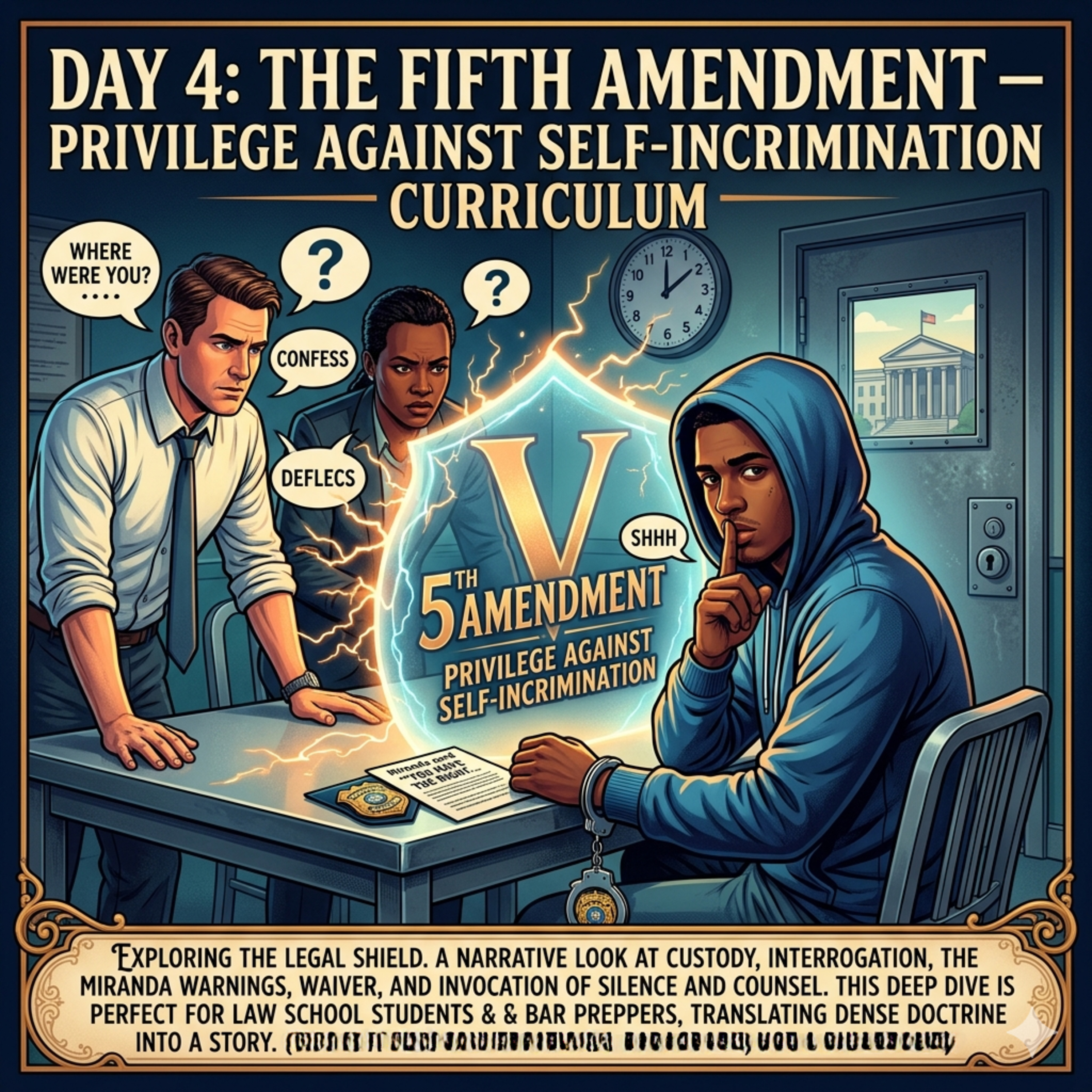
Criminal Procedure Day 4: The Fifth Amendment—Privilege Against Self-Incrimination episode artwork

EPISODE · Apr 30, 2026 · 1H 7M

Criminal Procedure Day 4: The Fifth Amendment—Privilege Against Self-Incrimination

from Law School · host The Law School of America

Reference Material: Day 4 Privilege Against Self-Incrimination and Miranda DoctrineUnderstanding the Fifth Amendment's Protections in Police InterrogationsThis episode unpacks the complex landscape of the Fifth Amendment, focusing on the psychological battleground of police interrogations. It explores how constitutional protections evolved from physical boundaries to safeguarding the mind during coercive police practices, with case law illuminating critical concepts.Most people believe their Fifth Amendment rights protect their thoughts and words only inside courtroom walls—or in the blatant face of police brutality. But what if the real threat is happening behind the scenes, in the subtle, psychological traps police set during interrogation? This episode reveals how constitutional protections evolved from physical boundaries into a high-stakes mental battleground.We break down how the Fifth Amendment shields your mind—not just your body—by dissecting the origins of the privilege against self-incrimination, from oppressive English courts to modern police tactics. You’ll discover why the Supreme Court declared police interrogations inherently coercive, and how that led to the creation of the Miranda warnings as a safeguard against psychological manipulation.We explore crucial questions: When does custody begin? How do courts differentiate between routine questions and genuine interrogation? What exactly constitutes an unambiguous request for a lawyer? You'll learn how nuanced circumstances—like a traffic stop or a secret conversation—can turn a routine encounter into a constitutional minefield. Plus, we analyze key cases like Rhode Island v. Innis and Berghaus v. Tompkins, revealing how the courts interpret seemingly simple actions that can dramatically alter your rights.Avoid costly mistakes—misunderstanding the rules of invocation and waiver can jeopardize your case. We examine the narrow loopholes police use—public safety exceptions, undercover agents, and the timing of rights "re-activation"—that threaten to erode your protections. Most importantly, we clarify the delicate balance courts strike between effective law enforcement and safeguarding human dignity in the face of psychological coercion.Whether you’re a law student, legal professional, or just a concerned citizen wanting to understand your rights, this episode guides you through the invisible yet powerful rules governing police interrogations. Equip yourself with the knowledge to see through psychological tactics, recognize constitutional triggers, and understand the true limits of the Fifth Amendment in the modern age. This is essential listening for anyone eager to see beyond the surface and grasp the profound complexity of protecting the human mind from state coercion.In this episode:The origins of the privilege against self-incrimination rooted in English historyHow the modern understanding of custody and interrogation shapes Fifth Amendment protectionsThe significance of the Miranda warnings as a prophylactic safeguardDifferentiating custody from mere seizure using objective tests like Berkemer v. McCartyThe functional equivalent test to determine what constitutes interrogation, referencing Rhode Island v. InnisThe critical distinction between invoking rights and waiver, highlighted through Burghaus v. TompkinsThe importance of unambiguous requests for counsel under Edwards v. Arizona and the exceptionsWhen the protections reset: the Schatzer 14-day rule for returning to normal life after invocationEmergency exceptions, such as New York v. Quarles, and their limitsThe unique status of undercover agents in Illinois v. PerkinsThe fruit of the poisonous tree doctrine's limits as shown in United States v. PataneThe ongoing challenge of balancing police needs with constitutional safeguards

Reference Material: Day 4 Privilege Against Self-Incrimination and Miranda DoctrineUnderstanding the Fifth Amendment's Protections in Police InterrogationsThis episode unpacks the complex landscape of the Fifth Amendment, focusing on the psychological battleground of police interrogations. It explores how constitutional protections evolved from physical boundaries to safeguarding the mind during coercive police practices, with case law illuminating critical concepts.Most people believe their Fifth Amendment rights protect their thoughts and words only inside courtroom walls—or in the blatant face of police brutality. But what if the real threat is happening behind the scenes, in the subtle, psychological traps police set during interrogation? This episode reveals how constitutional protections evolved from physical boundaries into a high-stakes mental battleground.We break down how the Fifth Amendment shields your mind—not just your body—by dissecting the origins of the privilege against self-incrimination, from oppressive English courts to modern police tactics. You’ll discover why the Supreme Court declared police interrogations inherently coercive, and how that led to the creation of the Miranda warnings as a safeguard against psychological manipulation.We explore crucial questions: When does custody begin? How do courts differentiate between routine questions and genuine interrogation? What exactly constitutes an unambiguous request for a lawyer? You'll learn how nuanced circumstances—like a traffic stop or a secret conversation—can turn a routine encounter into a constitutional minefield. Plus, we analyze key cases like Rhode Island v. Innis and Berghaus v. Tompkins, revealing how the courts interpret seemingly simple actions that can dramatically alter your rights.Avoid costly mistakes—misunderstanding the rules of invocation and waiver can jeopardize your case. We examine the narrow loopholes police use—public safety exceptions, undercover agents, and the timing of rights "re-activation"—that threaten to erode your protections. Most importantly, we clarify the delicate balance courts strike between effective law enforcement and safeguarding human dignity in the face of psychological coercion.Whether you’re a law student, legal professional, or just a concerned citizen wanting to understand your rights, this episode guides you through the invisible yet powerful rules governing police interrogations. Equip yourself with the knowledge to see through psychological tactics, recognize constitutional triggers, and understand the true limits of the Fifth Amendment in the modern age. This is essential listening for anyone eager to see beyond the surface and grasp the profound complexity of protecting the human mind from state coercion.In this episode:The origins of the privilege against self-incrimination rooted in English historyHow the modern understanding of custody and interrogation shapes Fifth Amendment protectionsThe significance of the Miranda warnings as a prophylactic safeguardDifferentiating custody from mere seizure using objective tests like Berkemer v. McCartyThe functional equivalent test to determine what constitutes interrogation, referencing Rhode Island v. InnisThe critical distinction between invoking rights and waiver, highlighted through Burghaus v. TompkinsThe importance of unambiguous requests for counsel under Edwards v. Arizona and the exceptionsWhen the protections reset: the Schatzer 14-day rule for returning to normal life after invocationEmergency exceptions, such as New York v. Quarles, and their limitsThe unique status of undercover agents in Illinois v. PerkinsThe fruit of the poisonous tree doctrine's limits as shown in United States v. PataneThe ongoing challenge of balancing police needs with constitutional safeguards

NOW PLAYING

Criminal Procedure Day 4: The Fifth Amendment—Privilege Against Self-Incrimination

0:00 1:07:24

No transcript for this episode yet

We transcribe on demand. Request one and we'll notify you when it's ready — usually under 10 minutes.

The Small Business Startup School – Business Notes | Financial Literacy | Retail Psychology – For Professionals & Entrepreneurs The Small Business Startup School Inc. Starting or buying a small business? While personal circumstances may vary, business patterns remain timeless. On The Small Business Startup School, we explore strategies, insights, and practical solutions to help entrepreneurs confidently navigate their journey.Hosted by Ola Williams—a retail entrepreneur, fintech founder, and financial coach with over two decades of experience—this podcast marries financial awareness and retail psychology with optimism to deliver actionable takeaways.Join us to learn, grow, and connect as we uncover the keys to business success.Let’s continue to learn together and be encouraged to keep on connecting! The 48 Laws of Power by Robert Greene (Full Audiobook) Robert Greene Amoral, cunning, ruthless, and instructive, this multi-million-copy New York Times bestseller is the definitive manual for anyone interested in gaining, observing, or defending against ultimate control – from the author of The Laws of Human Nature.In the book that People magazine proclaimed “beguiling” and “fascinating,” Robert Greene and Joost Elffers have distilled three thousand years of the history of power into 48 essential laws by drawing from the philosophies of Machiavelli, Sun Tzu, and Carl Von Clausewitz and also from the lives of figures ranging from Henry Kissinger to P.T. Barnum.Some laws teach the need for prudence (“Law 1: Never Outshine the Master”), others teach the value of confidence (“Law 28: Enter Action with Boldness”), and many recommend absolute self-preservation (“Law 15: Crush Your Enemy Totally”). Every law, though, has one thing in common: an interest in t Guardians Of Innocence Guardians Of Innocence Guardians of Innocence is a powerful and informative podcast designed to equip parents, teachers, and communities with the knowledge and tools needed to protect children from the growing threat of trafficking. Each episode dives deep into the tactics traffickers use to target vulnerable children—both online and in real life—and provides actionable advice on how to recognize the warning signs.Through expert interviews with cyber safety professionals, law enforcement, and survivors, we uncover the latest grooming methods, share real-world stories, and empower listeners to become vigilant guardians of innocence in their own families and communities.Guardians of Innocence is more than just a podcast; it’s a call to action to safeguard our children, raise awareness, and foster a united front against trafficking.Listen. Learn. Protect. The Laura Ingraham Show Laura Ingraham The most-watched woman in the history of cable news brings her no-holds-barred political and cultural commentary to podcasting with The Laura Ingraham Show. A bestselling author, breast cancer survivor, and mother of three internationally adopted children, Laura was the most listened-to woman in talk radio before launching her own podcast. A trailblazer across media platforms, she brings a unique perspective to this twice-weekly show, drawing on her experience as a white-collar criminal defense litigator and a Supreme Court law clerk.New episodes drop twice a week—delivering the clarity, courage, and common sense America needs.

Frequently Asked Questions

How long is this episode of Law School?

This episode is 1 hour and 7 minutes long.

When was this Law School episode published?

This episode was published on April 30, 2026.

What is this episode about?

Reference Material: Day 4 Privilege Against Self-Incrimination and Miranda DoctrineUnderstanding the Fifth Amendment's Protections in Police InterrogationsThis episode unpacks the complex landscape of the Fifth Amendment, focusing on the...

Can I download this Law School episode?

Yes, you can download this episode by clicking the download button on the episode player, or subscribe to the podcast in your preferred podcast app for automatic downloads.
URL copied to clipboard!