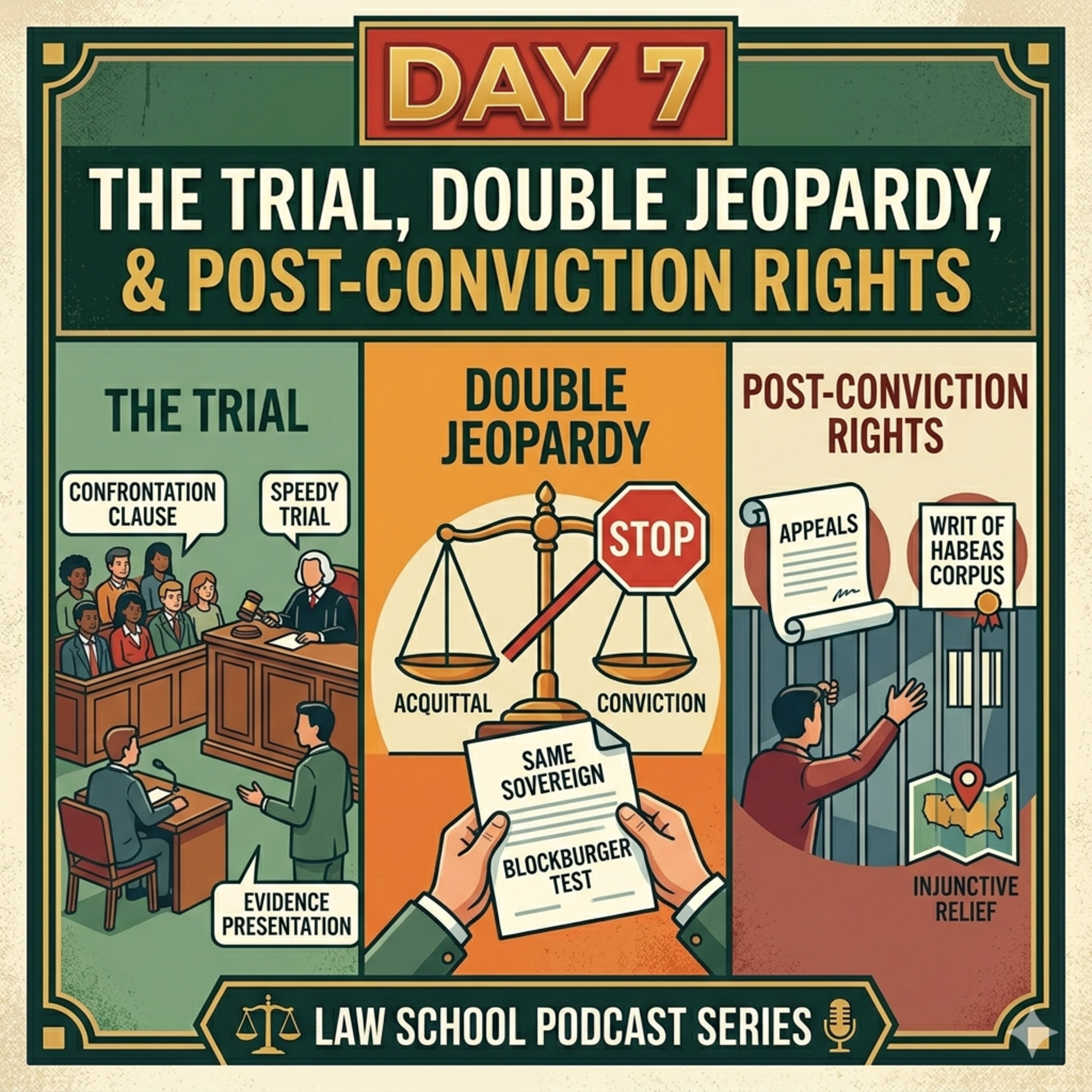
Criminal Procedure Day 7: The Trial, Double Jeopardy, and the Final Review episode artwork

EPISODE · May 3, 2026 · 47 MIN

Criminal Procedure Day 7: The Trial, Double Jeopardy, and the Final Review

from Law School · host The Law School of America

Reference Material: Day 7 Confrontation, Double Jeopardy, and Habeas CorpusCriminal Procedure Final Exam Prep — Mastering Justice and FairnessThis episode offers a comprehensive walkthrough of core criminal procedure concepts, essential for law students and exam takers alike. From the nuances of the Sixth Amendment's rights to speedy trial, impartial jury, and confrontation clause, to the complexities of double jeopardy and evidentiary rules—every doctrinal pillar is analyzed with clarity and practical insight.Most students overlook one crucial fact: in criminal procedure, the rules governing fairness often overshadow the pursuit of truth itself. This episode extracts the core doctrine from seven days of dense law—clarifying when procedural protections fail or succeed—and reveals why the system sometimes sacrifices facts to safeguard liberty.Step into the courtroom of constitutional criminal procedure as we unravel deeply interconnected protections: the speedy trial clock, the impartial jury mandate, the confrontation rights, and double jeopardy barriers. We break down Barker’s four-factor test—showing how vague notions of “speedy” become a precise legal balancing act—and reveal the major trap students always miss: confusing statutory deadlines with constitutional standards. You’ll discover how a constitutional violation rarely just results in a do-over; it often leads to outright dismissal with prejudice, emphasizing finality over accuracy.We explore the recent explosion of jury-selection rules, from voir dire challenges to systemic exclusions, culminating in Ramos v. Louisiana’s victory for unanimity—an unmissable landmark. You’ll learn how the Supreme Court shifted against non-unanimous verdicts and how the Batson challenge exposes the subtle dance of race- and gender-neutral jury strikes.Beyond the jury, we dissect the landmark Crawford doctrine—showing how testimonial hearsay, even highly reliable lab reports, can be excluded if cross-examination isn’t possible. The episode reveals the high stakes of assigning “testimonial” labels and how the entire evidence landscape hinges on simple, but often misunderstood, definitions.Finally, we reveal how the double jeopardy protection, once thought absolute, hinges on exact timing—when jeopardy “attaches” and what makes two offenses the “same” under the strict Blockburger test—exposing the legal boundaries that stop endless prosecution. Always emphasized: the importance of understanding when the protections activate, and how exceptions like dual sovereignty or mistrials reshape the landscape.This episode isn’t just a review; it’s a blueprint for understanding the procedural fences that protect liberty and ensure a fair fight, even at the expense of factual certainty. Perfect for exam prep, inspired litigators, or anyone who needs to see how procedural rules serve a higher purpose: safeguarding individual rights against the immense power of the state.Are you ready to see the courtroom through a lawyer’s most powerful doctrinal lens? Hit play and master the procedural pillars that uphold justice—because in the courtroom, the lines are never as clear as they seem.In this episode:Understand the constitutional standards for a speedy trial under Barker v. Wingo, including the four-factor balancing testClarify when and how the Sixth Amendment's right to a jury trial attaches, and the significance of Ramos v. Louisiana on jury unanimityLearn how the challenge process works during jury selection, especially Batson challenges and peremptory strikesGrasp the framework for analyzing testimonial statements under Crawford v. Washington and the importance of cross-examination for admissibilityDive deep into the double jeopardy protections, including when jeopardy attaches and the blockburger test for same offensesExplore the differences between harmless and structural errors on appeal, and the broader question of procedural fairness versus justice

Reference Material: Day 7 Confrontation, Double Jeopardy, and Habeas CorpusCriminal Procedure Final Exam Prep — Mastering Justice and FairnessThis episode offers a comprehensive walkthrough of core criminal procedure concepts, essential for law students and exam takers alike. From the nuances of the Sixth Amendment's rights to speedy trial, impartial jury, and confrontation clause, to the complexities of double jeopardy and evidentiary rules—every doctrinal pillar is analyzed with clarity and practical insight.Most students overlook one crucial fact: in criminal procedure, the rules governing fairness often overshadow the pursuit of truth itself. This episode extracts the core doctrine from seven days of dense law—clarifying when procedural protections fail or succeed—and reveals why the system sometimes sacrifices facts to safeguard liberty.Step into the courtroom of constitutional criminal procedure as we unravel deeply interconnected protections: the speedy trial clock, the impartial jury mandate, the confrontation rights, and double jeopardy barriers. We break down Barker’s four-factor test—showing how vague notions of “speedy” become a precise legal balancing act—and reveal the major trap students always miss: confusing statutory deadlines with constitutional standards. You’ll discover how a constitutional violation rarely just results in a do-over; it often leads to outright dismissal with prejudice, emphasizing finality over accuracy.We explore the recent explosion of jury-selection rules, from voir dire challenges to systemic exclusions, culminating in Ramos v. Louisiana’s victory for unanimity—an unmissable landmark. You’ll learn how the Supreme Court shifted against non-unanimous verdicts and how the Batson challenge exposes the subtle dance of race- and gender-neutral jury strikes.Beyond the jury, we dissect the landmark Crawford doctrine—showing how testimonial hearsay, even highly reliable lab reports, can be excluded if cross-examination isn’t possible. The episode reveals the high stakes of assigning “testimonial” labels and how the entire evidence landscape hinges on simple, but often misunderstood, definitions.Finally, we reveal how the double jeopardy protection, once thought absolute, hinges on exact timing—when jeopardy “attaches” and what makes two offenses the “same” under the strict Blockburger test—exposing the legal boundaries that stop endless prosecution. Always emphasized: the importance of understanding when the protections activate, and how exceptions like dual sovereignty or mistrials reshape the landscape.This episode isn’t just a review; it’s a blueprint for understanding the procedural fences that protect liberty and ensure a fair fight, even at the expense of factual certainty. Perfect for exam prep, inspired litigators, or anyone who needs to see how procedural rules serve a higher purpose: safeguarding individual rights against the immense power of the state.Are you ready to see the courtroom through a lawyer’s most powerful doctrinal lens? Hit play and master the procedural pillars that uphold justice—because in the courtroom, the lines are never as clear as they seem.In this episode:Understand the constitutional standards for a speedy trial under Barker v. Wingo, including the four-factor balancing testClarify when and how the Sixth Amendment's right to a jury trial attaches, and the significance of Ramos v. Louisiana on jury unanimityLearn how the challenge process works during jury selection, especially Batson challenges and peremptory strikesGrasp the framework for analyzing testimonial statements under Crawford v. Washington and the importance of cross-examination for admissibilityDive deep into the double jeopardy protections, including when jeopardy attaches and the blockburger test for same offensesExplore the differences between harmless and structural errors on appeal, and the broader question of procedural fairness versus justice

NOW PLAYING

Criminal Procedure Day 7: The Trial, Double Jeopardy, and the Final Review

0:00 47:42

No transcript for this episode yet

We transcribe on demand. Request one and we'll notify you when it's ready — usually under 10 minutes.

The Small Business Startup School – Business Notes | Financial Literacy | Retail Psychology – For Professionals & Entrepreneurs The Small Business Startup School Inc. Starting or buying a small business? While personal circumstances may vary, business patterns remain timeless. On The Small Business Startup School, we explore strategies, insights, and practical solutions to help entrepreneurs confidently navigate their journey.Hosted by Ola Williams—a retail entrepreneur, fintech founder, and financial coach with over two decades of experience—this podcast marries financial awareness and retail psychology with optimism to deliver actionable takeaways.Join us to learn, grow, and connect as we uncover the keys to business success.Let’s continue to learn together and be encouraged to keep on connecting! The 48 Laws of Power by Robert Greene (Full Audiobook) Robert Greene Amoral, cunning, ruthless, and instructive, this multi-million-copy New York Times bestseller is the definitive manual for anyone interested in gaining, observing, or defending against ultimate control – from the author of The Laws of Human Nature.In the book that People magazine proclaimed “beguiling” and “fascinating,” Robert Greene and Joost Elffers have distilled three thousand years of the history of power into 48 essential laws by drawing from the philosophies of Machiavelli, Sun Tzu, and Carl Von Clausewitz and also from the lives of figures ranging from Henry Kissinger to P.T. Barnum.Some laws teach the need for prudence (“Law 1: Never Outshine the Master”), others teach the value of confidence (“Law 28: Enter Action with Boldness”), and many recommend absolute self-preservation (“Law 15: Crush Your Enemy Totally”). Every law, though, has one thing in common: an interest in t Guardians Of Innocence Guardians Of Innocence Guardians of Innocence is a powerful and informative podcast designed to equip parents, teachers, and communities with the knowledge and tools needed to protect children from the growing threat of trafficking. Each episode dives deep into the tactics traffickers use to target vulnerable children—both online and in real life—and provides actionable advice on how to recognize the warning signs.Through expert interviews with cyber safety professionals, law enforcement, and survivors, we uncover the latest grooming methods, share real-world stories, and empower listeners to become vigilant guardians of innocence in their own families and communities.Guardians of Innocence is more than just a podcast; it’s a call to action to safeguard our children, raise awareness, and foster a united front against trafficking.Listen. Learn. Protect. The Laura Ingraham Show Laura Ingraham The most-watched woman in the history of cable news brings her no-holds-barred political and cultural commentary to podcasting with The Laura Ingraham Show. A bestselling author, breast cancer survivor, and mother of three internationally adopted children, Laura was the most listened-to woman in talk radio before launching her own podcast. A trailblazer across media platforms, she brings a unique perspective to this twice-weekly show, drawing on her experience as a white-collar criminal defense litigator and a Supreme Court law clerk.New episodes drop twice a week—delivering the clarity, courage, and common sense America needs.

Frequently Asked Questions

How long is this episode of Law School?

This episode is 47 minutes long.

When was this Law School episode published?

This episode was published on May 3, 2026.

What is this episode about?

Reference Material: Day 7 Confrontation, Double Jeopardy, and Habeas CorpusCriminal Procedure Final Exam Prep — Mastering Justice and FairnessThis episode offers a comprehensive walkthrough of core criminal procedure concepts, essential for law...

Can I download this Law School episode?

Yes, you can download this episode by clicking the download button on the episode player, or subscribe to the podcast in your preferred podcast app for automatic downloads.
URL copied to clipboard!