
EPISODE · Dec 3, 2025 · 29 MIN
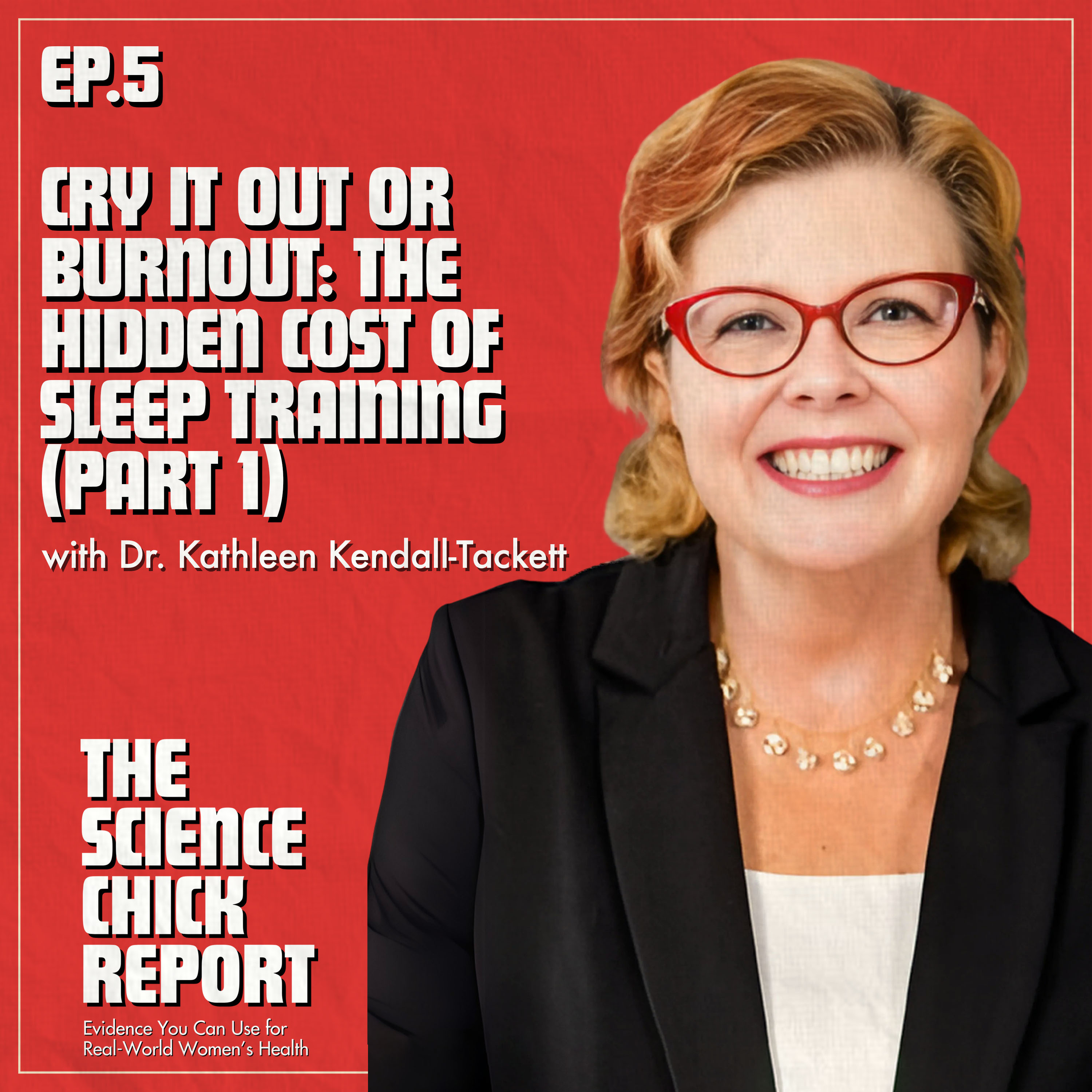
Cry It Out or Burnout: The Hidden Cost of Sleep Training (Part 1)
from The Science Chick Report: Evidence You Can Use for Real-World Women's Health · host Kathleen Kendall-Tackett
What if everything you’ve been told about infant sleep is rooted in a century-old theory that dismissed love as unscientific? Are “cry-it-out” techniques really helping families, or just fueling a billion-dollar parenting industry built on exhaustion and guilt?In this eye-opening episode of The Science Chick Report, the first of a special two-part series, Dr. Kathleen Kendall-Tackett takes a clear, evidence-based look at the world of sleep training, challenging both the parenting industry and the pediatric establishment. She traces its origins to the behaviorist movement of the 1920s, which urged parents not to comfort or emotionally engage with their babies in the name of “science.”Dr. Kendall-Tackett contrasts this outdated view with attachment theory and evolutionary biology, showing that responsive caregiving is not spoiling—it is essential for survival and healthy development. Through a critical review of multiple studies, she asks whether sleep training truly helps babies sleep better or simply teaches them to stop signaling distress.If you are a new parent, healthcare provider, or anyone who has ever been told to let a baby “cry it out,” this episode will empower you to question conventional wisdom and make informed, compassionate choices for your family.In This Episode:(00:00) Introduction: why sleep training needs a second look(01:06) The business of baby sleep and the modern parenting dilemma(02:13) Pediatricians and the promotion of cry it out(03:23) Historical and theoretical foundations: Behaviorism(05:30) Parenting without emotion: lessons from John B. Watson(06:32) The rise of attachment theory after World War II(08:31) Why infant crying is evolutionary, not manipulative(10:37) What the latest research really says about cry it out(12:55) Do babies really sleep better or just cry less?(15:34) When cry it out backfires: findings from Canada and beyond(18:20) Why ignoring babies raises cortisol and risks brain development(21:10) The hidden costs of “successful” sleep training(23:02) What studies from China and Australia reveal about sleep and maternal mood(26:17) The two-way relationship between maternal depression and infant sleep(28:22) Final reflections: toward a more responsive approachNotable Quotes:(01:17) “Infants crying at night is probably one of the hardest things to deal with when you're dealing with a newborn.” – Dr. Kathleen Kendall-Tackett(11:38) “Excessive crying is associated with maternal depression, anxiety, and parental exhaustion, but it also can possibly disrupt attachment and increase the risk of abuse.” – Dr. Kathleen Kendall-Tackett(22:31) “These poor little mute babies, still distressed, but they've learned not to signal.” – Dr. Kathleen Kendall-TackettResource and LinksThe Science Chick ReportThe Science Chick Report Dr. Kathleen Kendall-TackettWebsiteLinkedInXFacebookResearchGate (upcoming paper)Mentioned Breaking the Silence" by Mariette HartleyBathory & Thomas Paulus (2017) – Pediatric Sleep RecommendationsWolke (2017) – Infant Crying and Parental SensitivityBuild & Invoke (2020) – Cry It Out in First-Time MothersDavis & Kramer (2021) – Ecological Critique of Cry It OutMiddlemiss et al. (New Zealand Study) – Cortisol Synchrony in Sleep TrainingSapolsky (1996, Science) – Cortisol and Brain HealthChinese Meta-Analysis (2020) – Infant Sleep InterventionsAustralian Cohort Study – Maternal Depression and Infant Sleep
Embed this episode
NOW PLAYING
Cry It Out or Burnout: The Hidden Cost of Sleep Training (Part 1)
No transcript for this episode yet
Similar Episodes
No similar episodes found.
Similar Podcasts
No similar podcasts found.