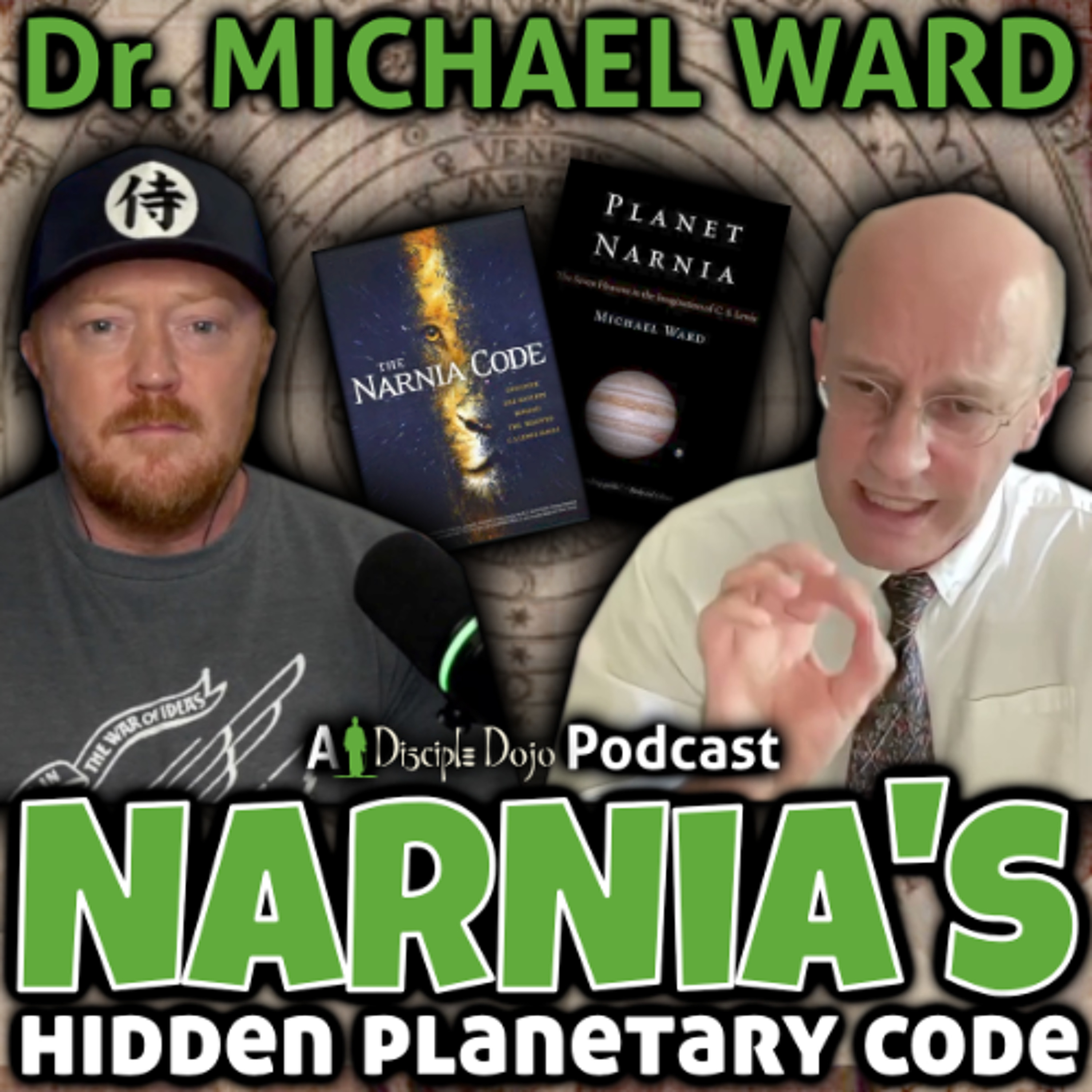
I have been looking forward to this interview for the past few weeks. While I was over in Oxford, I got a chance to meet, and this is not hyperbole, this is legit, the foremost C.S. Lewis scholar in the world. That's not just my judgment. This is a known thing. Dr. Michael Ward, he's a professor at Oxford. His dissertation called Planet Narnia was on the planetary imagery, the seven heavens imagery in the Narnia series. And a condensed version of it, a more popular level came out called The Narnia Code. There's also a documentary that the BBC did.
of the same title, the Narnia code. So this is the kind of the beginner version. If somebody wants to get at the argument, but maybe need some training wheels, whereas planet Narnia is the full literary study. But this book is absolutely fascinating because what Ward has done is cracked a code. Now that obviously, whenever people start talking about codes in works of literature or art or whatever, you start thinking about Da Vinci code and all this foolishness out there that basically it's just people making stuff up. That's not what Michael has done.
his thesis has been pretty much universally accepted by Lewis literary scholars. And that almost never happens in academia. But what he showed was that rather than being haphazard and a just fun, you know, boisterous amalgamation of all of these random elements just to tell a good story, that C.S. Lewis was very intentionally crafting the seven Narnia books with a much deeper and very much hidden unifying rubric, which was based on one of his favorite aspects of the medieval mind. In fact, he wrote the book, The Discarded Image.
all about this thing, which is the medieval planetary model. Now we mentioned that before here on the channel when I've discussed the planetary model in relation to C.S. Lewis's Ransom Trilogy, which is my favorite of all his works. And in that video, I made mention of Planet Narnia. Lo and behold, a year or so after making that video, I get to go to Oxford and meet the author of Planet Narnia, Dr. Michael Ward himself. And even more so, lo and behold, he agreed to come on.
and talk about it here in the dojo. I could not have been more excited. This was truly a Lewis nerd dream come true. And I am super excited for you guys to hear the discussion that I had with Dr. Michael Ward about the hidden symbolism of the seven Chronicles of Narnia.
So if you appreciate and enjoy this type of long-form discussion with scholars like Dr. Ward or any of the others that we've had here on the channel, if you appreciate that and you want us to be able to do more of it, we would invite you to subscribe to the channel if you haven't done so already. Our goal this year is to reach 100,000 subscribers, and it's getting within range. We are coming up on 80,000 very soon. So help us get to the next level. When we do, we're going to do a big celebration. We're going to be giving away a bunch of books and resources and commentaries and study Bibles, all the stuff that we do here on The Cyber Dojo. But we need your help to get there. So go ahead and tap that subscribe button, like, share, comment.
Let folks know about it. Yeah, no more talking from me. Let's get into Planet Narnia and the Narnia Code with Dr. Michael Ward. Folks, we are here with Dr. Michael Ward. You, if you're watching Disciple Dojo, if this is not your first time, you've heard me mention Dr. Ward's work before, or Michael as he goes by, and it is some of the most fascinating work that I've come across. I came across it a couple of years ago in his book. Well, I've got two, I've got these on Kindle, so I'm going to hold the first one, which is Planet Narnia, and then he has a more popular version, which is what we're going to talk about a little bit more, The Narnia Code, and I'll let him explain in just a minute what these books are and why they're important. I think they're very important, but...
Michael, welcome to disciple dojo. It is truly an honor for me to be here talking to you. Thank you for coming on and chatting with us. My pleasure. Thanks, Jim, for having me. Glad to be with you. Yes, and I pray that this interview gives you a respite from the heat that's over there because currently, as you told me, Oxford is in the midst of a heat wave. So we will all be praying for you guys without central air conditioning because that can be rough. But for viewers who are, we do get a few viewers who come on and maybe this is the first video they've seen of us or this is the first time they've heard me mention you. What's your title? What's your role at Oxford? And then I want you to give the nutshell version of what the Narnia code is. And then I'm going to really pick your brain on it some.
So I work in the Faculty of Theology and Religion here at the University of Oxford. I'm what is called an associate member, and that means I can give tutorials and lectures, and I mostly just supervise doctorates. That's my main responsibility. And as for Planet Narnia and its thesis, its argument, well, there are seven Narnia books, and my argument is, my belief is, that C.S. Lewis structured the seven Narnia books out of the seven heavens.
the seven planets of medieval cosmology, which he as a medieval scholar knew all about and described as spiritual symbols of permanent value that were especially worthwhile in his own generation. That's a brilliant nutshell encapsulation. We're going to get into that viewers and we're going to tease out each of those things mentioned, including what is the seven heavens or the medieval model that Lewis referred to the discarded image in the name of his famous book on it. But first of all, when you talk about, so most many viewers have read Narnia. I mean, we even over here in the U S we grew up reading Narnia. I'm actually a little bit of an outlier. I didn't read it until college. So my first introduction to Narnia was as someone who was in the midst of theological training and it just blew me away. It became my favorite, one of my favorite series.
But I, like most of us, would never have connected it to the seven medieval planets. And you up front in your book in the Narnia Code, which is the popular version of Planet Narnia, you make a caveat right up front. You say when someone claims to have found a hidden code, it nearly always turns out to be a lot of nonsense. The Da Vinci Code is the most famous fictional example of this kind of far-fetched silliness. So the skeptical viewer would say, okay, Planet Narnia, medieval model, this seems like far-fetched silliness. You put that right up front for a reason. What's your response to that?
Yeah. Thank you for foregrounding that, because it is a very bold claim that I'm making. C.S. Lewis never told anybody that he was doing this, and nobody before me had argued that he was doing this. But quite a lot of Lewis scholars and critics had said that Lewis was so interested in complexity and intricacy that there must be more going on in Narnia than meets the eye, because the books don't seem to have any very obvious patterning, any imaginative scheme or blueprint that Lewis is following. The books are quite various, to put it politely.
Indeed, this is a complaint, a criticism that has sometimes been brought against Narnia, that they seem to be a bit of a hodgepodge. Tolkien, Lewis's great friend, Tolkien, was the first to complain that Narnia seemed to be assembled out of very disparate, even incompatible mythological and literary traditions. And you can't really dispute that. There are English children. There are characters from Greek and Roman mythology. There are kangaroos. There's Father Christmas. There's this white witch character fresh from the pages of a Hans Anderson fairy tale. It doesn't seem to have much logic to it. And yet Lewis said that the whole Narnia series is about Christ. Okay, so people then immediately look at all the biblical allusions, the biblical parallels and connotations. But the only problem with that is that Aslan, the Christ figure, is very obviously reenacting
Christological episodes in three of the chronicles. So Aslan saves Narnia in The Lion, the Witch and the Wardrobe, he creates Narnia in The Magician's Nephew, and he judges Narnia in The Last Battle. So the Gospels, the Book of Genesis, the Book of Revelation seem to be very clearly lying behind those three chronicles. But when you look at the other four chronicles, what scriptural basis is Lewis drawing upon there? It's not so clear. And yet we do know that Lewis indeed loved complexity and intricacy of all kinds. He said that...
For instance, his own poetry. The poems which look as if they're in free verse are often in the most complicated meters of all. As a literary historian, he talked about medieval writers who, he said, love to present us with something which at first looks planless, though all is planned. And in his novel Perilandra, he talks about the darkened mind who can't perceive God's plan in creation because there are more plans than it looked for. There seems to be no plan because it is all planned.
Furthermore, Lewis was very keen on this thing called enjoyment consciousness, as opposed to contemplation consciousness. This is a distinction he writes about in his autobiography, Surprised by Joy. And he said it was an absolutely indispensable tool of thought. So when you contemplate something, you look at it from the outside, you inspect it at a distance, and it's an object of your attention. But when you look along something from the inside, when you enjoy it, when you exercise this different kind of consciousness...
then there is inevitably a sort of hiddenness or invisibility that accompanies it. He uses this image of looking at or looking along a beam of light. You can see a strip of light glancing down through a dusty, dark shed, and that's contemplating something from the outside. But when you look along the beam of light, the tool shed vanishes, and so does the beam of light itself. Because you now look along it, and light, he says, is not so much something we see as it is something we see by. Light itself is invisible. Now, if Christ is the light of the world, as he says he is in John's Gospel,
And if in God's light we see light, according to Psalm 36, I think it is, and if the whole Narnia series is about Christ, how is Lewis going to depict the universal, the ubiquitous light that Christ drenches the universe with, but which we... cannot see because it is what we see by. It's not the object of our vision. It's the medium of our vision. Christ is the all-pervasive principle of cohesion whereby the universe holds together, Lewis writes in one of his books. Paraphrasing a verse from Colossians about all things are made in Christ and for Christ and in Christ all things hold together. So there's a lot more going on to Narnia than meets the eye. And I think Lewis is trying to convey something about the Christ-saturated nature of the universe.
by using a spiritual symbol, seven spiritual symbols, in fact, one per chronicle, but never telling us about it so that we don't look at these symbols. We just experience the whole Narnian world through these symbols. And Aslan sums them up in his own person. And this, I think, is absolutely genius on Lewis's part because it gives each chronicle a sense of unity, a sense of differentiated flavor and color and tone. which we can intuit, we can sense that there's somehow a unity and an integrity to the Narnian world that we encounter in each chronicle, but we never are told it. It's never held up for our external examination. And this, I think, is probably the main reason why Lewis would have done such a thing, because it speaks to his own experience of faith. In his atheistical years, he called himself an atheist for about 20 years, he looked at the universe and he just saw a lot of apparent chaos.
In his first book of Christian apologetics, The Problem of Pain, he begins the book by saying, not many years ago when I was an atheist, if anyone had asked me, why do you not believe in God? My answer would have run something like this. Look at the universe we live in. The greater part of it is cold and empty. And he goes on for a couple of pages describing all the seeming randomness and cruelty and chaos of creation. And he concludes by saying, you know, you ask me to conclude from this universe that it's the work of an all loving, all powerful God. I tell you all the evidence points in exactly the opposite direction.
But then when he became a Christian, he began talking about not the cruelty and chaos of empty space, black and cold and inhospitable to man. He talks about the heavens that are telling the glory of God, Psalm 19. And he talks about not space, but the heavens repeatedly throughout his work. And indeed, the seven heavens of the medieval cosmos are, in his view, spiritual symbols of permanent value, which are especially worthwhile in his own generation. He wrote about them historically and academically in the discarded image. He wrote about these seven heavens poetically in a long poem. He wrote about them...
directly and obviously in his ransom trilogy of novels. But when he came to Narnia, if I'm right, he wrote about them again, but this time secretly, implicitly making us look not at them, but along them. It's a brilliant hypothesis. And when you, when I, again, I read the book, Planet Narnia years ago. And at first I was, I was like, okay, this, you know, when something almost sounds too good to be true, like, could this really be? So then you go through in Planet Narnia and folks, Planet Narnia, again, it's, it's Michael's dissertation published. That's correct. Or yes. So it is a work of academic scholarship of Lewis scholarship. If that's above your pay grade, but you're interested in this discussion and you want to kind of edge your way into it, then the Narnia code.
is a good entryway into the arguments that he's making, a good summary. But what fascinated me so much about it, one is the Ransom Trilogy is my favorite of all Lewis's works. We're going to be doing it as a book club here in the coming months here on the channel. I absolutely love it. Planets in Peril was a great study that helped see the imagery in it. Deeper Heaven, Christiana Hale's book, again, explores these themes. So I was already, the pump was primed for me to accept exactly what you're saying, but I wanted to be, okay, let me not be overeager. Let me still read it with a little bit of skepticism. It was gone by the end. I think you've explained the things that
or were up until then inexplicable. Why does Santa Claus show up in the middle of Narnia? You know, why, why is there such a, the water imagery in the silver chair or the woods so prevalent in Prince Caspian, the Dawn Treader, sunlight, gold, all of these things you've showed. I mean, it's the only, there's no other explanation that would make sense of it all. And I think that's why your work, I tell people, because I've discussed this when I was getting ready to go to Oxford, I said, oh, we're going to actually get a chance to meet and hear from Dr. Michael Ward. I tell people, it's not often that someone puts forward a new hypothesis in academia that
pretty much gets universal acceptance fairly quickly. Uh, but, but you've, I think you've done that. And that's a testament to you. You're not reading something into, you're not eisegeting Lewis. I really do think you're exegeting him. And it's, and it's when all the pieces come into place, it's really beautiful. Um, and you had a quote in, in Narnia code, there's a quote you gave by Owen Barfield that talked about Lewis and what he thought about everything was secretly present in what he said about anything. And so knowing the other works Lewis has done about the planets and the model and, and, you know, how,
the reverence he had for Dante and the particularly, I think Paradiso was his favorite of, of the divine comedy, but you just, you start to see, of course he, this stuff would infuse his work. Um, okay. So, but we have a problem. The problem is that a lot of viewers have not read the started image, aren't keen on Dante. And so they may not know what is, what do you mean the seven planets? First of all, there aren't seven planets. There's Mercury, Venus, Earth, Mars, Jupiter, Saturn, Uranus, Neptune, maybe, maybe not Pluto. That's the planets we learned. So, but you,
Lewis, the planets would include, if your hypothesis is correct, the sun and the moon. Uranus is not in there, certainly not Neptune. So how would you, you did a brilliant job of encapsulating your book very succinctly. We challenge you again, can you do that for viewers to introduce them to the medieval model, to the planets and the seven heavens and how, yeah, just tie the strings together for the chronicle. What are the planets, how they relate to the specific chronicles, if you don't mind. Yeah, well, the best way to think about the seven heavens is to think about the names of the days of the week. You know, there are seven days in the week.
and they're named after the seven planets. And it's obvious that Saturday is Saturn day, and that Sunday is Sunday, and Monday is Moon day. The Sun and the Moon, according to the pre-Copernican model of the cosmos, were planets. The Sun and Moon were planets. They revolved around Earth. It was believed. And that's what a planet literally is. A planet is a wanderer. And all the other celestial objects are not planets, but stars. They're fixed in the constellation. They don't wander.
So you have Saturn, Sun and Moon for Saturday, Sunday and Monday. And then, okay, Tuesday, Wednesday, Thursday, Friday. How do they relate to the planets? Well, for some odd reason, in English, we use the Norse names for the planetary deity and not the Roman name. But if you think in French or Spanish or Italian or quite a lot of other languages, it's a bit clearer how the planet connects to the day. So Tuesday, Tew, in Norse mythology, is Mars, the God of War. So think in Spanish, Martes, or in French, Mardin.
And then Wednesday, Woden or Odin is the Norse equivalent of the Roman Mercury. So, Myércoles or Mércidi in Spanish and French. Then Jupiter in Norse mythology is equivalent to Thor, Fours Day. But in Spanish and French, Jöves, Job's Day and Jödi. And then Friday, Friar or Frigg is the Norse equivalent of the Roman Venus. So think Viennes in Spanish, Vondredi in French.
So all seven days of the week connect to one of these seven planets. And the Earth, of course, is not a planet, according to the Sol Scheme, because the Earth is fixed and central. It's static at the middle of everything, and all the planets in their heavens rotate in concentric spheres around the static and central Earth. And then when you get beyond the seventh heaven, when you get beyond Saturn, you are into the realm of the fixed stars. And eventually, if you go far enough, you emerge into the uncreated realm of God. So that was how the universe was thought to be structured, according to...
astronomers up until the 16th century when Copernicus came up with this Copernican revolution in astronomy and said no think about the universe not with the earth at the center but with the sun at the center a heliocentric cosmos not a geocentric cosmos and that was you know one of the biggest revolutions that has ever been in the history of human thought and C.S. Lewis being a medieval renaissance scholar studied the impact of the Copernican Revolution very closely. The biggest book he ever wrote was entitled English Literature in the 16th Century Excluding Drama. Snappy type, if there was one. And it starts out with a long discussion of the new astronomy that was brought in in that period. Because Lewis wanted to see how it would play out in the literature of that century. Because, of course, the kind of cosmos you believe yourself to be living in will sooner or later have a major impact upon the kind of literature and art you produce.
So, I mean, nowadays in the 21st century, we typically refer to Einstein, Einsteinian physics. He developed his general theory of relativity. And so that idea of everything being relative has trickled down into other areas of art and culture. So that, you know, we now think of values of morality as, oh, everything's relative. Your truth is your truth and my truth is my truth. There's no fixed and objective and absolute standard of right and wrong, truth and falsehood anymore. And that is in large part attributable to this revolution in physics that Einstein brought about. It's not a necessary or logical conclusion from Einstein, but it's one of the impact of Einstein.
And so Lewis will say that there's a mythology that follows in the wake of science. He says this in his book, The Discarded Image. There are all sorts of non-scientific or unscientific results and consequences of scientific progress. We can see it with Einstein. And Lewis wants to sort of look at how it also played out in the 16th and 17th centuries, which he studied particularly closely. So that's the seven heavens in an astronomical sense. But Lewis calls them spiritual symbols.
And he's interested in their symbolic qualities. So what are they? Well, let's go through them very quickly. So starting with the sun, Sunday is the first day of the week. Think of the sun, golden, radiant, illuminating. And each planet was associated with a particular metal. And so, of course, the sun was thought to turn base metal into gold. Now think of the Dawn Treader, the Voyage of the Dawn Treader, and how it's a journey towards the dawn, the place of rising sun, and how, just to name a couple or three things, the royal party come to a magic pool that turns things to gold.
And they begin to squabble over this because they think, oh, we can become fabulously rich if we take ownership of this island. And then all of a sudden on the hillside, they see Aslan. And we're told that Aslan is shining as if in bright sunlight, though the sun had in fact gone in. Interesting. So Lewis in this book is depicting his Christ figure, Aslan, in solar terms. And we see at the end of the book that Aslan scatters light from his mane at the eastern edge of the world. Those are just two very brief and summary points about the solar theme in that book.
Then we come on to the, well, let me talk about the famous books, The Lion, the Witch and the Water, which is the Jupiter book. Aslan in this book is constantly referred to in kingly terms. The children don't know who he is in his first book. They think he might just be a regular man. And they're told he's not a man. He's the king. He's the king of the works. He's the king of the beasts. He's not safe, but he's good. He's the king. He's the true king, Father Christmas says. And he has a royal standard, a royal pavilion, all these royal accoutrements. And we're constantly told about his father, who's the emperor over the sea. And there are more references to the emperor in this book than in the rest of the chronicles put together. There's this emphasis upon all things regal and imperial because Jupiter was above all things that a kingly planet. But we must think, Lewis says, of a king at peace, enthroned, taking his leisure, serene, festive.
tranquil magnanimous these are the sorts of kingly attributes that Jupiter personified and that's what Aslan represents in his own person in this story and the children as they relate to Aslan become kings and queens themselves. You remember how when they put on the fur coats in the wardrobe, we're told they looked more like royal robes than the coat they put them on. And that's an indication that the children are themselves going to be enthroned and hailed and sceptered and crowned at the end of the book when they become royal. Once a king in Narnia, always a king in Narnia. Once a queen in Narnia, always a queen in Narnia. We're told that repeatedly. So they live up into Aslan's royal nature, just as in the Voyage of the Dawn Treader, the children
can look into the sun with their eagle's eyes they can drink water which is more like drinking light than it is like drinking water and they begin to glow with the same sort of um radiance that aslan personifies in in that book so i mean i could go through all seven but i don't want to labor the point the point is simply that aslan personifies the spiritual symbol um and you might say well isn't this unbiblical how is lewis going to make this sort of orthodoxy christian and that's where you know it helps to talk about uh scriptural texts, like, I am the light of the world, Jesus sets in John's Gospel. And Jesus is the King of Kings and Lord of Lords in the book of Revelation. So there we can very easily see solar and jovial attributes there in the scriptures. And likewise, Mercury. Mercury is the Lord of language, according to Lewis's poem on the planets. What is Jesus? But the word of God, living and active. And then think of Mars. Mars is the god of war.
associated with all things military and martial, and who is God in the Bible, the Lord of hosts, mighty in battle. And the Christian life is depicted as a fight, fight the good fight, be a good soldier of Christ Jesus, burn on the whole armour of God, according to the New Testament. So repeatedly, time after time, what looks like a purely sort of medieval and indeed classical spiritual symbol turns out to have a root or an equivalence in the Bible, which makes it entirely orthodox. Lewis, he saw, he was, so help me with my chronology to make sure I'm right. Before his faith, before his coming to faith, he saw that he was enraptured by the beauty of the medieval imagery and the symbols and the myths. And, you know, he'd say, well, you know, Baldar is dead. I don't even know what that meant, but Baldar the Beautiful said, I don't know what that meant, but it moved me. So it's like, he's resonating with this world. And then it was, I think it was a Tolkien and Dyson on Addison's walk. They kind of helped him solidify. Hey, the reason that stuff touches you so deeply is because there's truth to it. Now it's a distorted truth in the various.
myths and pagan forms throughout the world in literature, but it is, there's something there. And that is, you know, I would say maybe a fingerprint of God or a residue of, of the original creator. It's like echoes or hints or like the monument to the unknown God that Paul pointed the Areopagus crowd to and said, Hey. you're almost there. Let me tell you what you actually are worshiping. Let me tell you about this unknown God. So using a bridge to it, I see that is what Lewis is, to me, that's what Lewis is doing with the medieval model. Is that fair? Is that accurate? Would you tweak any of that? Yeah, I think that's absolutely right. And I'm glad you referred to Paul, the Apostle Paul on the Areopagus in the book of Acts, where he talks about the unknown God and says, what you worship is unknown. Let me proclaim to you. But he also, interestingly, in that very same address, quotes.
Greek poets, as even some of your poets have said, for we are indeed God's offspring, in him we live and move and have our being. And Paul is there quoting, I think, Eratos and Epimenides, two Greek poets, both of whom have written poems about Zeus, the king of the Greek pantheon. In Zeus we live and move and have our being, is what the original said, and we are indeed Zeus's offspring. And Saul quotes these. But of course, he's not wanting the Athenians to worship Zeus. He's just meeting the Athenians where they already have some knowledge of the divine nature. And he says, you're right. We live and move and have our being in God. You're right. We're God's offspring, but you're wrong in calling him Zeus. He's not Zeus. He's the God and father of our Lord Jesus Christ. But he meets the Athenians where they are and works with their very incomplete, insufficient knowledge of God and adds to it and corrects it and supplements it and tweaks it.
After all, how can you meet? How can you talk to people about God unless you bother to acquaint yourself with what they already believe or understand about God? Almost nobody is without some belief in what is of ultimate importance, about what is ultimately significant in the universe. I mean, even atheists who say, I don't believe in God, will, if you press them, very often say, well, I believe in justice, or I believe in love, or, you know, those are of ultimate importance to atheists. And so you can say, well, all these love. We know this from the Bible. God is just. So...
Lewis will interestingly say at one point that the only possible basis for Christian apologetics is a proper respect for paganism. That's a very interesting phrase. The only possible basis for Christian apologetics is a proper respect for paganism. And by paganism, I think he just means anything which is a non-Christian worldview. And you have to respect it. You have to look back at it. That's what respect literally means. You look it in the eye and you begin to hopefully determine what those pagans, what those non-Christians mean when they use the word God. It's very often when they say, I don't believe in God, what they're saying is, I don't believe in...
something which you as a Christian wouldn't believe in either. A very distorted and half-hearted and maybe positively diabolical understanding of God, which they've somehow managed to imbibe and they rightly reject. But only if you listen to them and respect them and begin to try to understand what they mean when they say they don't believe in X, can you begin to show them something different. It's not like humanity has not been thinking about these existential questions throughout all of history. And it's not like the only intelligent people are those who are within the Christian faith. And there's so much that can be, I think, in a good way appropriated. Appropriation has a negative connotation in modern discourse. But I think that...
That's exactly what you do with any culture is if there's something good in it, if all truth is God's truth, then yes, you appropriate. We have the book of Proverbs appropriates wisdom from the ancient world and casts it within. Yes, this is what God has revealed to the world and given to the world. And it's part of our common heritage. Jesus affirmed it. God sends rain on the wicked and on the righteous. I love, I think what's so refreshing to me about reading Lewis ever since I discovered him again, I didn't discover C.S. Lewis until college. What's refreshing to me is that he helps me put on new lenses to see old truths.
He, I was staying after I left Oxford, I spent two days over in Birmingham with a friend and they had, they had just had a baby, a little baby boy. And so I wanted to give a gift for them for letting me stay at their house. And so I went and bought a copy at the bookshop bookshop up the street of the line, the witch and the wardrobe, the illustrated copy. And I just, I wrote a note in the front of it just to the child when he gets older that maybe he'll read someday. But I gave it to him and his mom, she, she said, Oh my gosh, I read this growing up. I had this, I remember these pictures. Like she was just flooded with nostalgia. And I said, this is.
to this day, one of my favorite books. And when he gets a little older, you know, you guys can read it together. And so she asked me, she said, why is this one of your favorite books? Because for her, it was just something that she read in the nursery as a kid and then never really revisited, I'm sure. And I said, because it takes the truths of the gospel and the Christian faith and puts them into a way that absolutely captures the imagination, that disarms you so you don't picture, you know, whatever view you have of Jesus in your head from icons or artwork or whatever. Aslan is this entirely new being.
But yet it is communicating the same truth. So it has such a disarming effect and an unfamiliarizing effect that is exactly what we need. Familiarity breeds contempt. And so many people, especially Western cultures, think they know the gospel. So I love Lewis couching it in the medieval image. I think it's absolutely brilliant. It's absolutely brilliant. Just to recap, we don't have to go in depth on the planets.
why the witch in the wardrobe that is the jove or jupiter book whatever they say by jove that's not accidental um the so prince caspian is the marshal mars That's why there's so much battle in it. There's so much weaponry and armies. The next one is, we're going to talk about order in just a minute. Don Treader is the sun, as you've said. Then comes Silverchair. Now, Silverchair is the moon. That is correct, yes. Real quick, just give a tease for viewers. How is the Silverchair? What does that have to do with lunar, Luna, the moon? Yeah, well, in medieval thought, the moon was the boundary point between the translunary realm of certitude and permanence and fixity, where everything was perfect and immutable.
and the sublunary realm where you came down from ether into air and you were now in the earth's atmosphere where everything was subject to doubt and uncertainty and confusion and indeed one of the one of the negative impacts of the moon is that uh it would make you lunatic it would make you mad it would confuse your mind so much you would lose your wits So in The Silver Chair, it's very interesting that Aslan is only encountered at the very beginning, in his own high country above the clouds, and at the very end, again, in his own high country above the clouds. And the rest of the book, everything from chapter two up until the penultimate chapter, is set in Narnia, down where the air is thick. Aslan tells Jill and Eustace, take care that your minds are not confused. Things will not look to you down there like they look on my mountain.
And they go down into Narnia and then they go down even further into the underworld where they encounter the lost prince that they're looking for. And we're told that he, one hour in 24, is tied to this silver chair and he's raving like a lunatic. Again, not accidental. Not accidental. And again, there are many, many, many more reasons why it is the lunar story, but that will have to do. Yep. And then horse and his boy. Mercury. Yeah.
So I think Aslan in that book is mistaken for two lines or possibly three lines and no, he says there was only one line that he was swift of foot. Aslan is dashing about this story so rapidly that he's mistaken for multiple lines. But Mercury is symbolically associated with language. And think of the word of God living and active. The activity of the word dashing this way and that informing everything, sweetly informing the whole of creation from one end to the other.
That's just again one very simple way in which the material symbolism makes itself present. Yeah way more running to in well, exactly Are dashing about run run always run what Shasta is told in order to get his message to the king of Archenland And to be honest of all the seven chronicles as I began to see this planetary scheme the one that staggered me most was the force and his boy Because there are so many brilliant ways, sophisticated but subtle ways, in which Lewis infuses that story with mercurial imagery. I almost had my jaw on the floor. Because I'd been reading Narnia for about 30 years by this point. I was in my mid-30s when I had this idea. And I already knew the Narnia books very well. I'd been reading them repeatedly. And I'd been studying Lewis for many years. And then this whole new dimension of complexity reveals itself in front of me. And I was just godsmacked. And I thought, Lewis, I already thought you were a great writer. Now I think you're just stratospherically genius that you can do all this.
and not tell anybody about it. That's the brilliant thing. But then, of course, he couldn't tell anybody about it because the whole purpose of this scheme is that he wanted to communicate to our imaginations, not to our intellect. It's okay for me as a literary critic to spill the beans, as it were, but it's not an end in itself. This explanation that I'm giving is not an end in itself. The purpose of literary criticism is to enable future readings that are more
informed, better informed, so that you can more intelligently read the work in question. You can put more in and therefore you can get more out. You know, when I talk about the Narnia code as if it's, some people think, oh, so you mean it's just a kind of clever crossword clue that you can crack, or it's a cipher that you can decipher with your Enigma code machine. And then once you've cracked the code, then you just, you proceed with the new meaning and you throw away the old. No, no, no, it's not that kind of code. It's much more like...
a genetic code that is hardwired into every cell of the human body. And you can't get rid of that from the body without destroying the body. It's just an explanation of how the body is put together. It's not some sort of alternative meaning of the body to be preferred. So I hope that people don't misunderstand the title, the Narnia code. I prefer to talk about...
symbolism, metaphor, and as I mentioned earlier, what Lewis calls enjoyment consciousness. You'll look on the thing experiencing from within. That's because after all, that's, I think what Lewis is trying to communicate in fiction, because he believes it to be a spiritual truth in the Christian life, that we come to know God, not just by looking at him and bowing before him. I mean, of course, that is part of Christian belief, but much more resonantly, God is incarnate. God is one of us. God is Emmanuel with us in the person of Jesus Christ. He is alongside us and through the Holy Spirit, the third person of the Trinity, God can get inside us, receive the Holy Spirit, Jesus says to his disciples when he breathes upon them. And St. Paul repeatedly in the New Testament talks about being in Christ. So there's this idea of sort of somehow,
being inside God or God being inside us. God is not just some big personality out in the universe that we have to bow before. It's an inscrutable distant deity. No, he comes close. He knows us better than we know ourselves. In him we live and live and have our being. And how do you communicate that enjoyment except by keeping something secret?
That's why Lewis had to keep it to himself and didn't tell anybody, not even close friends, like Tolkien. Yeah, that was, I wanted to ask you personally, as someone who studied this, it seems like of all the people in the world, like to keep it a secret from everyone and have the fun, I can't imagine why the one person he wouldn't have told was his fellow who delighted, I mean, the thing that brought them together was their love of Norse, northerness and their delight in ancient. It just, and then knowing that Tolkien was not the biggest fan of Narnia, it just seems like he might've pulled him aside Tyler's career for a minute. Let me, let me let you in on that. Don't tell anyone. But do you think in more serious, do you think it's by the time Lewis was writing Narnia, their friendship had, they had a complex friendship and they had drifted to a degree. Do you think that actually played a role in why he wouldn't have ever shared any of that with him?
No, I don't actually think that that was a factor. You're right that the relationship was a little less intimate after the Second World War than it had been before the war. They were really, really close in the late 20s and 30s. But then, for various reasons, which Tolkien refers to in a letter or two, he says their intimacy... lessened. We've got to be careful not to overstate that, as if they sort of fell out with each other. That was never the case. They remained good friends right up until Lewis's death. But it's true that they were not so much in each other's pockets in those years when Lewis was writing Darnia. But I don't myself think that actually is a factor. The whole point of this scheme, this imaginative scheme, is that it speaks to the imagination, not to the intellect. And although Tolkien reacted against the first few chapters of The Lion, the Witch and the Water, and didn't much like it.
I don't think that would have been sufficient for Lewis to say, yeah, but there's more going on than you're seeing. Because, well, first of all, Tolkien was a very hard man to please, and he disliked nearly everybody's room. Lewis would not have been especially taken aback by a critical reaction from Tolkien. But secondly, and much more importantly... The art is in concealing the art. I use that old Latin tag. The art is in concealing the art. You don't show you're working. And if Lewis felt, oh, well, I better tell him, then that would have been to frustrate the very thing he was trying to achieve. And let me bring it back to this larger point about faith. You know, you might, I think this is probably what is working away in Lewis's mind. This is my best guess anyway. You know, you might say, as a believer, you might say to God, God,
you're there, I know you're there, why don't you make yourself more obvious? Why don't you reveal yourself unmistakably to all these non-believers that I'm praying for so desperately? Why did you leave it so long to reveal yourself to me? In the case of someone who's converted mid-life, doesn't God want every man to be saved and come to a knowledge of the truth? Well, he does, yes, but, and this is absolutely crucial, God wants a relationship with us of love and freedom, not one of power and coercion.
So of course God could make himself manifest in ways which would be undeniable to everybody and we'd be almost sort of obliterated. Nobody can see the face of God and live. But how would that be a relationship of love and freedom? And that's why God has to hide himself to a certain extent. He reveals himself enough to allow for a relationship of love and freedom, but it's a relationship of faith. We walk by faith, not by sight. And that's absolutely crucial to the whole religious life. If you don't understand that, you don't really understand what you're talking about. This is one of the reasons why we must respect our non-believing friends, because from their point of view, what we see...
is not obvious. If it were obvious, they would see it too. But you have to want it. You have to want it in the phrase of that sort of slogan. If you don't want it, you don't find it. But to him who knocks, it will be opened. And if you seek it, you will find. And that's why I think Lewis in Nalia is not making it obvious because he's wanting to replicate in fiction the spiritual reality which obtains in the real universe.
It's, it's so brilliant. It's so brilliant. And it's, it's again, Lewis is an author that you can, Lewis is an author you can give to someone regardless of their belief system, regardless of their religion, their faith. And unless they are the most hardened, annoying internet atheist, they will probably recognize this is, there's, there's some real depth and genius here. And, and I think that's why Lewis has been so instrumental in so many people starting to explore the things of faith, even if they aren't converted, like they don't, they read mere Christianity and say, okay, well, it's good, but I'm not buying it. They, they will read screw tape letters and go.
There's something here. This is brilliant. This is genius. And I'm hoping that viewers that are, I mean, most of our viewers are believers, but certainly not all. We have viewers from different religious backgrounds that watch. And I'm hoping that after reading this one, I want you to go, viewers, I want you to pick up Michael's book. Either if you're new to thinking about literary criticism and academic work is a little challenging, start with Narnia Code. But if you want the meat of his argument,
check out Planet Narnia. You can get an Audible, you can get a Kindle, you can get an old-fashioned hard copy. It really is absolutely brilliant. We didn't mention The Last Battle. These are homework viewers. See which planetary deity, planetary figure, semi-deity, however you want to say it, which sphere of heaven The Last Battle is based on. And you have a hint because we've gone through the others. But as you're reading, so here's the question, and we were going to start with this, but I think it's better to end with this. My pet peeve about C.S. Lewis' publication is no one anymore prints the Narnia books in the correct order.
They print them in the chronological order. They, they, they appeal to a letter where Lewis apparently said, Oh yes, you can read them in that order. I think Lewis didn't remember all that he said. I don't want to say that. I just disagree with Lewis on his answer on that. And I was happy to read at the beginning, right up front you before the book even starts.
You said most Lewis scholars agree that The Lion, the Witch, and the Wardrobe should be read first because it was written first and published first and takes special care to introduce the character of Aslan. The magician's nephew should therefore not be read first. Even though it deals with the earlier stage in Narnia history, it is better to read it as a flashback or a prequel. Introductory note that you put right at the beginning of The Narnia Code. I was so glad to see that. So tell viewers why it matters. And when you buy your one-volume Narnia edition here in America, I even look over in England. I didn't see any other versions as well. Why is that the wrong way to read Narnia?
Well, in The Lion, the Witch and the Wardrobe, which was wrote first and published first, when Aslan's name is first mentioned, the children say, Aslan, who's that? So they don't know him. But at the first hearing of his name, they respond in certain ways. Peter feels brave and adventurous, and Lucy feels like a marvellous, fragrant phrase of music has wafted past her, or that she feels like it's the beginning of summer or the beginning of the holidays. They didn't know who Aslan was any more than you do, the narrator says. But they had these responses. Now, if you've already read The Magician's Nephew, you do know who Aslan is, and therefore that whole passage is wasted. It looks stupid. Why would Lewis say to the reader, you don't know Aslan if you've already read a whole book about Aslan? Right.
Lewis wrote that letter to a kid who, a child reader wrote to Lewis and said, thank you for the Narnia Chronicles. I think they should be read in this order. And then the child listed the books in the chronology of Narnian history, beginning with creation and going through to the last judgment. And Lewis, writing back to this kid, probably one of 30 or 50 letters he wrote before breakfast in the morning. Oh, what a good idea. I think that's very nice. I approve of that.
numerous encouraging and avuncular letters that he wrote that day, and he didn't know that that letter was going to survive and be printed and held up as evident against him, as it were, and then credulously given much more authority than it deserves by stupidly boneheaded, literal-minded publishers who think that the only way you can tell a story is by beginning at the beginning. Have they never heard of immediate rays in the middle of things? You plunge readers into the middle of a story very often, and then you go back later and explain how you got there. And that's exactly how The Magician's Nephew should be read. Like you say, a flashback or a prequel, it does not work as the first book of the seven. And publishers should listen to nine-year readers and nine-year enthusiasts and nine-year scholars, and they should take these numbers off the spines of the books. And if they have to publish the seven books in a single volume, then they should list, they should produce the books, starting with Lion and having Magician's Nephew sixth, not first.
I could not agree more. I've been tooting this horn for 20 years now, and it's endlessly frustrating. I want to buy a nice deluxe copy of the Narnia Chronicles in one volume. I'd love that, but I will not buy one until they publish it in the right order. I will die on this hill. I'm glad to hear the foremost Lewis scholar today agrees, and so, Dojo viewers, this is not just my little idea. It makes a difference. And if we may bring it back to the planet for a moment, there is further evidence in support of this belief when you realize that the Lion, the Witch, and the Wardrobe...
is written not just first, not just published first, but is written to embody and express the symbolism of Jupiter. Because Jupiter is the best planet. Of the seven heavens, Jupiter was the king. He was Fortuna Major, the greater fortune. And so Lewis had a particular reason to...
to want to use this symbol in a piece of Christian fiction because it lent itself very naturally to the greatest story ever told, the story of Jesus Christ. But then more personally, Lewis jokingly used to say in his lectures here at the University of Oxford that he himself had been born under Jupiter. He used to pause in the middle of his lecture and say, those born under Jupiter are apt to be loud-voiced and red-faced and jolly. And then he would add, it is obvious under which planet I was born. which apparently always got people laughing because he himself was very jovial. Lots of his friends describe Lewis in that way, not always understanding the great significance that joviality had for him. So that's another reason why The Lion in the Witch and Warwick is the first book. And by the way, some critics of this thesis say, well, how can Lewis be writing seven books for seven planets when he didn't have all seven in mind at the start? And that's true, he didn't. He only had one book in mind to begin with, the Jupiter book.
But he wanted to write that because Jupiter was the best planet, the planet he was particularly associated with personally. And also there are much more complicated reasons that I tried to unpack in chapter 10 of Planet Narnia as to why Lewis was particularly interested in jovial imagery. I won't go into that now. But he began with a Jupiter book, not with all seven in mind, just one. But then after he'd written one, he thought, oh, I enjoyed doing that. Let's do another. And then another. And then another. And in fact, he had written four of the books before The Lion, the Witch and the Wardrobe was even published.
So he did have a chance to go back and make adjustments for the sake of the series once he knew there was going to be a series. And there are all sorts of interesting cross-references, lookings ahead and lookings back across the seven books. The fact that he only started with one in mind, I think has no impact at all upon the planetary understanding. It just shows that the planetary understanding was incremental. It grew as the series grew. And it's interesting that it stopped after seven books. Lewis could have written eight or more, but he stopped after seven. And interestingly, this is perhaps the closest he ever came to giving away the secret. He once told a former student of his that he had an idea in his mind for the Narnia stories. And having worked it out to the full after seven books, it was time to stop. But he didn't explain what this idea was, nor why seven was the number of completion.
But obviously, once you see the planetary scheme, it's absolutely clear why you did so. It makes sense of all the data. A good hypothesis makes sense of all the data, explains things and has predictive value. And so I think that, yeah, I think Planet Arnia has ticked all of those boxes. It's very, it's just, it's amazing to get to sit here and chat with you. We also, I'm thinking we didn't mention Magician's Nephew is the Venus imagery.
And so viewers, if you want to look more into that as well as The Last Battle, check out Michael's books. I'm going to link them in the video description below. I'm also going to link to, while we were over there, Michael gave us a fantastic presentation on The Lord of the Rings, switching gears from Lewis to Tolkien. And it was on the true climax, at least in Tolkien's mind, of The Lord of the Rings. Even the scene that he cried as he wrote and the teardrop on the actual page.
It was a brilliant presentation. I'm going to put a link to the online version of that in the video description below. So viewers, go check out Michael's books. Check out that link as well. If you're a Lord of the Rings fan, you will be very interested in that. And I'm also going to include a couple of links below to videos we've done here about the, focusing on the Ransom Trilogy, but still about how important the medieval model was to C.S. Lewis and examples of it within that. So if this is the kind of stuff that, you know.
gets you interested, then be sure to tap the description and see what all we have down there. Michael, I'm so grateful. The price of the entire trip to Oxford was worth it just to be able to connect with you and chat. Please reach out with... anything you're working on that you would like to discuss. You have carte blanche here in the dojo. Uh, I want to echo Gwen fair who said that you should turn that presentation into a book. I absolutely think you should. And when you do, I want you to come back on here so that we can talk about Lord of the Rings and Tolkien in the field of Cormelan, but that will be for another time. Hopefully God willing. Um, yeah. Is there, is there anything we didn't cover? I always like to ask guests, uh, two questions. One, is there anything that we didn't cover? And two, is, is there a way that viewer or what is the best way viewers can either follow you? Or maybe if somebody had wanted to invite you for a speaking engagement at a.
church or school or something. How is the best way, what's the best way for people to follow up to keep abreast of what you're doing? Yeah. Well, one thing we didn't mention is that it's not just the long, complicated planet Narnia, nor just the shorter, simpler, more accessible Narnia code book, but there's a third way in which you can, as it were, get on board with the planetary scheme of Narnia, and that's by watching a one-hour documentary, which is also called The Narnia Code, and that was screened on the BBC here in this country a few years ago. It's a one-hour documentary made by the director Norman Stone, who, made the original Shadowlands movie. Oh, fantastic. The BBC Shadowlands. So he's got a long-standing interest in C.S. Lewis, Norman Stone. So you can get that documentary on DVD if you still use DVDs. I don't know if it's available on streaming services. It probably is, but I've never looked. I will look, and if it is available online, I'll drop that link in the video description. And if it's only available for purchase, I'll put a link to where people can track that down, or at least the IMDb.
page for it for people interested for sure yeah thank you for mentioning that i that was in the back of my head but i it's been so while since i'd seen that it was available perfect and then to answer your other question uh you can follow me on facebook um and i have a website michaelward.net uh where you there's a contact button i think that works um anyway you can easily track me down on my oxford university page or various other emails I have. Well, I will link, I'll put the link to your website and as well as your Oxford faculty page as well. And yeah, thank you. Thank you for just being a delight. This is, this is an interview I've been looking forward to for since we chatted about it in Oxford. And I, again, it's worth the price of the whole trip just to be able to do this. So thank you so much, Michael. Stay as cool as you're able over there in the summer heat wave. And yeah, I keep doing what you're doing. We love it. And we're big fans here at Disciple Dojo. So thank you.
Thank you, Jim. Glad to be with you. And here's to the next time. Cheers. I am so thankful that Michael gave some time this afternoon to join us here in Disciple Dojo. His work is absolutely groundbreaking. If you have not read it yet, the links will be in the video description below. And if you have read the Chronicles of Narnia before, and you're fairly familiar with them, but this is new to you, go reread them. Look for the things that he's pointed out. And it'll be like having grown up with a black and white TV all your life and finally seeing something in high definition color. Like it really makes a tremendous amount of difference.
in entering into the world, the beauty, the symbolism, the powerful imagery that's already powerful in the world of Narnia, this gives it a cohesive framework to view it through. And it's just, yeah, it makes such a huge difference. So go check it out. Rediscover the world of Narnia. Stay tuned for more here at Disciple Dojo. And if you appreciate us being able to have conversations like this, once again, help us do more of them by subscribing, liking, sharing, commenting, all those things that support a YouTube channel. That'll do it for now. Thanks for watching. We'll see you next time back here at Disciple Dojo. In the meantime, as always.
Keep training.