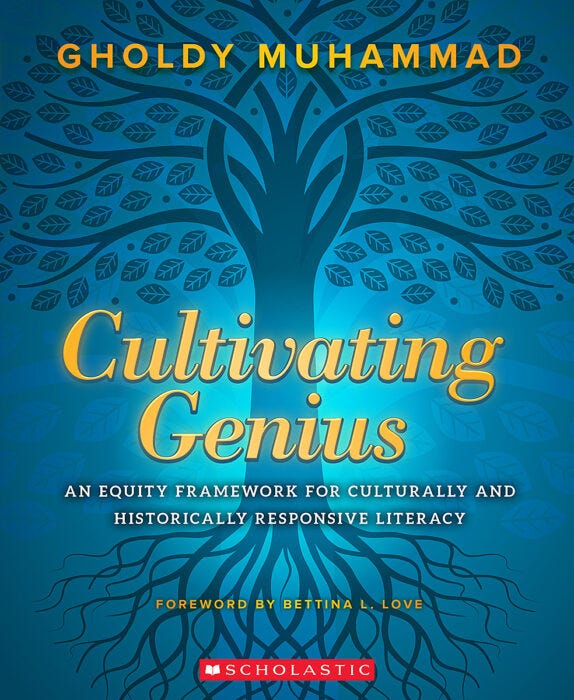
Cultivating Genius Book Discussion #1
from Read by Example Hosted by Matt Renwick
In this special episode, I am joined by Gen Arcovio and Rhonda Precourt in a conversation around this summer’s book study selection: Cultivating Genius: An Equity Framework for Culturally and Historically Responsive Literacy by Dr. Gholdy Muhammad. We used the following three questions to guide our conversation: * What resonated with you? * What surprised you? * What questions do you have? This kicks off the book study. We hope you can join us for the month of July as we read and respond in writing to this excellent and essential resource. Relevant Resources * Audio + Transcript * Also Listen on Apple Podcasts (and Give It a Rating!) * Order Cultivating Genius from Scholastic * Dr. Muhammad’s Website * Dedicated Page for Book Study Full Transcript Matt Renwick (00:04): We are here for a discussion around the book, Cultivating Genius, our book study for this summer. And I've got two colleagues with me here today, if you want to introduce yourselves. Rhonda Precourt (00:20): I'm Rhonda Precourt. I am a teacher in the upstate New York area. I have been for a big chunk of years previously been teaching in the literacy area, but this year I am teaching kindergarten Matt Renwick (00:40): And Rhonda, you've been blogging with us for a couple of years now, too. Rhonda Precourt (00:45): Yeah, we blog at literacypages.wordpress.com and that is also our Twitter handle @literacypages. We also have a Facebook group as well. Matt Renwick (01:01): And you brought along your esteemed colleague, Gen. Gen Arcovio (01:05): Hello, I'm Gen and I am a K through 2 literacy specialist also in upstate New York. I work with Rhonda and both of us are trained in Reading Recovery, active reading recovery teachers typically, although not this year. And like she mentioned, we blog together and we extend our learning together in all kinds of ways. Matt Renwick (01:33): Everyone's doing different positions this year, or it's just adding on new roles. I had our art teacher teaching second grade, our phy ed teacher teaching fifth, just to make these new times work. So it's great to have you both join the discussion and I found three questions that I think will start to get our thinking going about around the book, Cultivating Genius by Dr. Goldy Muhammed. And the first one is, what resonated with you? If anyone wants to start us off, otherwise I'm happy to chime in. Rhonda Precourt (02:17): I think what is resonating with me the most is just how far we haven't come in a long period of time. And it's a little bit depressing read it. I love reading about the history. I think it's so powerful, but then it just strikes you about how similar the times are that they're talking about to where we are right now. Matt Renwick (02:46): Yeah. She even mentioned the expectations were higher back then, back in the 1800s, at least for these literary groups. And the other thing that resonated for me was just how they combined everything and it wasn't, here's your reading, and then we're going to do some writing here, and we'll practice some speaking and listening. It was all integrated toward a kind of purpose, which was to empower themselves and cause change. So that was just something that resonated with me. It makes it easier for us to teach reading here and writing there, but it's not always conducive for kids, especially from what I understand from the book, students of color. It can make it more challenging. Well, what about you, Gen? What did you find just compelling? Gen Arcovio (03:43): I was thinking two things. One of them along the lines of what you were saying, and what Rhonda was saying, that the history that I'm reading in this book, a lot of it's new to me and that's astonishing to me and it's causing a significant amount of self-reflection. I think that's one of the more important pieces of this book, is the amount of self reflection that it causes you to do in your own teaching and everything they've done up till this point and what you want to be as a teacher starting today. And then also the integrated approach that Rhonda and I write about all the time, but to see it laid out in this way and how significant it is to teach literacy in that way, so that you have a way of teaching that is empowering everybody. Rhonda and I work in a district that is predominantly white, but when you reading, this has really brought to light the fact that if you teach in this way, you are preventing discrimination in the future for everybody that you teach. This is such an important read. I love it. Matt Renwick (05:15): And you and Rhonda, that's one thing I like about Reading Recovery. With my last school, we had it and it takes an integrated approach, right? I mean, you're doing some reading, some writing, you are doing word work and so you have some of that background. But even with your extensive background, you still found it surprising and caused you to really rethink some of your practices. Gen Arcovio (05:40): I think the purpose, having a purpose for what you're reading and writing is what stood out to me. And it's making me think a lot about what I've done and what I'm going to do. What is the significant purpose for the reading and writing that makes it engaging for them and helps them to grow in their own identities? Matt Renwick (06:03): Yeah, what's the why. Matt Renwick (06:05): The second question, as I mentioned was, what surprised you? I could go here. Tt didn't really surprise me, but I guess I realized how much I didn't know about how persons of color were prevented from, even in the Northern states, prevented from engaging in literacy practices. It was like an editorial, I think, or a column, an essay about, he was a free man, but he wasn't really a free man, because of all these limits that had been put on them because of their race. We have, at least in the elementary level, a kind of a simplistic view of history, like "In the Northern states, they did not have slavery and then the Southern did," but it's more complex than that. They had to contend with those challenges throughout. So that's one thing, I guess that surprised me just like you were saying, Gen, how much I didn't know. So glad we picked this book. Gen Arcovio (07:33): It's almost what's surprising is not necessarily how much you didn't know, but what you thought you did know that isn't aligned or lining up with what's really happened. You know, I think that's something we need to take a good, hard look at in our curriculum across the board. Because I think a lot of us walked away from our education with a different view of where we are in education, in equality, in everything. Matt Renwick (08:15): Okay. Rhonda Precourt (08:19): I was familiar with the term literacy societies, but honestly I had no idea about black literacy societies and how they grew from just a small number of people to these huge groups of hundreds of members. And I was looking at, I just kept reading those 10 lessons from black literacy society. I just was so blown away. I mean, these things that we can learn from them are just so amazing. Like there was the one about how we teach each other, how then they came together, they taught each other how to read. They taught each other how to become better writers. It was just such a collaborative environment. And we do try for that, but I think especially as kids move up in grades, the way our schools schools are set up in education is very competitive. You're always trying to get in the top 10, or you're trying to get the best grade there. It's not like this where you're, where you're looking out for each other, trying to teach each other so you can better each other. Matt Renwick (09:36): Yeah. It's definitely something to aspire to with our classrooms and school. Questions that you had? Rhonda Precourt (09:53): I keep asking myself, because there's a lot of examples so far of how to apply this. I picture more of a middle school or high school setting. So I keep questioning, how can I bring this down to the younger students that I work with? What would that… This is a public episode. If you'd like to discuss this with other subscribers or get access to bonus episodes, visit readbyexample.substack.com/subscribe
Embed this episode
No transcript yet.