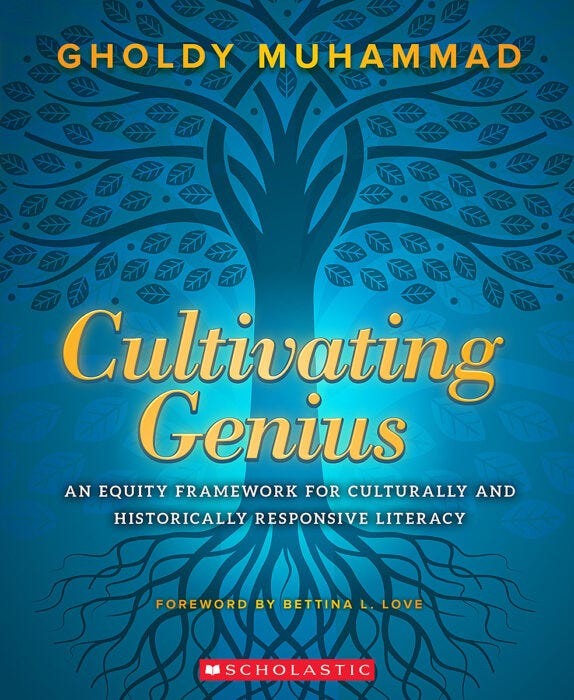
Cultivating Genius Book Discussion #2
from Read by Example Hosted by Matt Renwick
We follow up on our previous conversation for Cultivating Genius: An Equity Framework for Culturally and Historically Responsive Literacy by Dr. Gholdy Muhammad, I am joined by contributors Gen Arcovio, Ryanne Deschane, Rhonda Precourt, and Carrie Thomas. We used the following three questions to guide our conversation: * What takeaways did you gain from this book? * What questions do you still have? * How have you changed after reading this book? This wraps up the book study. Thank you for your readership and leadership! Relevant Resources * Listen on Apple Podcasts (and Give a Rating!) * Order Cultivating Genius from Scholastic * Dr. Muhammad’s Website * Dedicated Page for Book Study Full Transcript Matt Renwick: So, I want to welcome everyone to the second of two book discussions around Cultivating Genius by Gholdy Muhammad, and I have several guests with us today. We're just going to go around the room and introduce yourselves, and we'll start with Ryanne. Ryanne Deschane: My name is Ryanne Deschane, and I am a first grade teacher in northern Wisconsin. Rhonda Precourt: I can go next. I am Rhonda Precourt, and I am a reading recovery teacher/K-2 literacy interventionist, although this past school year, I did teach kindergarten, and I teach in upstate New York. I also blog with Gen at literacypages.wordpress.com, and we also have a Facebook group. You can search Literacy Pages. And we also have a Twitter. You can follow us on Twitter @literacypages, too. Gen Arcovio: I think it makes sense for me to go next. I'm Gen Arcovio, and I am also a literacy specialist interventionist and trained reading recovery teacher in upstate New York. I work in the same district as Rhonda, and I am the co-creator of the Literacy Pages blog. Carrie Thomas: Hi, and I'm Carrie Thomas. I am a reading specialist/literacy coach in a small, private school outside of Philadelphia, Pennsylvania. Matt Renwick: Well, I am excited to be with Ryanne, Gen, Carrie, and Rhonda here. They've already posted their posts at this point, and they've been well-received by readers. In response to the book, Cultivating Genius... seemed like just such a timely text. I realize it came out last year, but it's been very helpful for me as I think about preparing for the 2021-2022 school year. So, I thought we'd just go around the room and just everyone share one response to each of the three questions around the book. The first one is what are one, two, or three key ideas that you took away from Cultivating Genius? And we'll start with Ryanne. Ryanne Deschane: Okay. So for me, it's a very complex text, but think my biggest takeaway is the histories of marginalized people are important for us to understand our present educational system as well as a path forward. If we don't understand the history, then we don't understand maybe where some of those systemic inequities have came from and what we need to do to move forward in a new direction. So, that was my big takeaway. Matt Renwick: I would concur with that. Gen Arcovio: I'll go next, because what I was going to say connects to what Ryanne was talking about. I think you can't read this book without taking away the fact that White educators need to do more research themselves. And I think it's been a few years in the making for me, culminating now with reading this book, to really understand how inequitable my own education was, except I was the one that benefited from it and didn't even realize that it was at the expense of other people. And it kind of brings up some anger to be at this point in my life and only just be realizing how inequitable it was in so many ways. Gen Arcovio: And then, when I read Cultivating Genius, to realize how much history there is in Black culture regarding literacy and learning that I am only just now knowing. So, it's my responsibility now to kind of redefine my own identity as an educator and do more research in that regard. Matt Renwick: I appreciate the honest perspective, Gen. Carrie or Rhonda, do you want to share kind of key ideas here? Carrie Thomas: I'll go next. One of the things I took away and I thought was really fascinating... So, Gen, you brought up the literary... and how Black folks have a history of these literary societies. And actually, Philadelphia has a ton... has such a rich history of Black literary societies. And me being right outside of Philadelphia, and I teach students who come to my school from Philadelphia schools and in the city, and so it just kind of is like this natural way to connect the students with literacy history and be like, "No, actually, there is a rich history." Carrie Thomas: And I think it's like you said. I'm a White educator, and I teach mostly Black and Brown students. And so, to have this history of these literary societies that now I know about, and it is my responsibility to be like, "Oh, here is this fantastic history, and here are things we've learned from these literary societies that we can take into schools now and really lift up and celebrate what all of our students have to bring to the table." Matt Renwick: Yeah. You're well positioned, Carrie, within this context of the book, as well as where you're located. Rhonda Precourt: Something I really took away was just this whole idea of teaching kids how to have a positive identity about themselves, because that's not just for people of a different color. There're so many different things within identity that serve a minority like women, like homosexuals, students who are learning English for the first time. All of these groups really could serve to have this focus on knowing who they are as people and understanding their culture and background. It leads to more acceptance of yourself and others being accepting of you and feeling like you belong and have a place in the classroom and in your world. So, I found myself reading that part about identity over and over again, because it just really, really made me think. Matt Renwick: Yeah. For myself, I appreciate the distinction that the author made between culturally-relevant and culturally-responsive literacy instruction. I don't think anyone that I've read yet has differentiated between the two. I mean, culturally-relevant seemed more like more on the curriculum side of things, and culturally-responsive more on the instruction side of things. But like you said, Rhonda, I need to reread it to make sure I'm understanding it correctly. But yeah, a lot of rich ideas that you've all illuminated. Matt Renwick: And you talk about identity. Thinking about one or two changes that you might want to make or you've already made since you've read this, I'll just kind of throw out for the whole group. I can certainly go first. I think I've always... I teach in a predominantly White area, and I've always thought I need to make sure that I'm representing in our texts and our instruction a lot of diverse representations, I guess, but it really hit home for me that even if this is what our population is, how critical it is for those one or two or three kids that do come in our schools. I mean, I wouldn't say it's more important, but it's just really important for those kids to see themselves when they live in an area like I live in. Other thoughts on that, and just changes you've made or you're planning to make? Carrie Thomas: So, I'll speak. I actually just submitted my post about this today, but I thought of two... And it's funny, because I actually picked up this book right when it came out. I saw it, and I was like, "Oh my gosh, I'm going to get this. It's going to be great for my students. It's going to be great for my school. And so, I have... On the cover, it says "An Equity Framework," and I have literally used this book for the framework to design the literacy program at my school. Before I got there, there was no real comprehensive, cohesive literacy program, so I was kind of tasked with building one from the ground up. And so, I had to do a lot of digging into, what had already been there? What materials are we using? What does… This is a public episode. If you'd like to discuss this with other subscribers or get access to bonus episodes, visit readbyexample.substack.com/subscribe
Embed this episode
No transcript yet.