
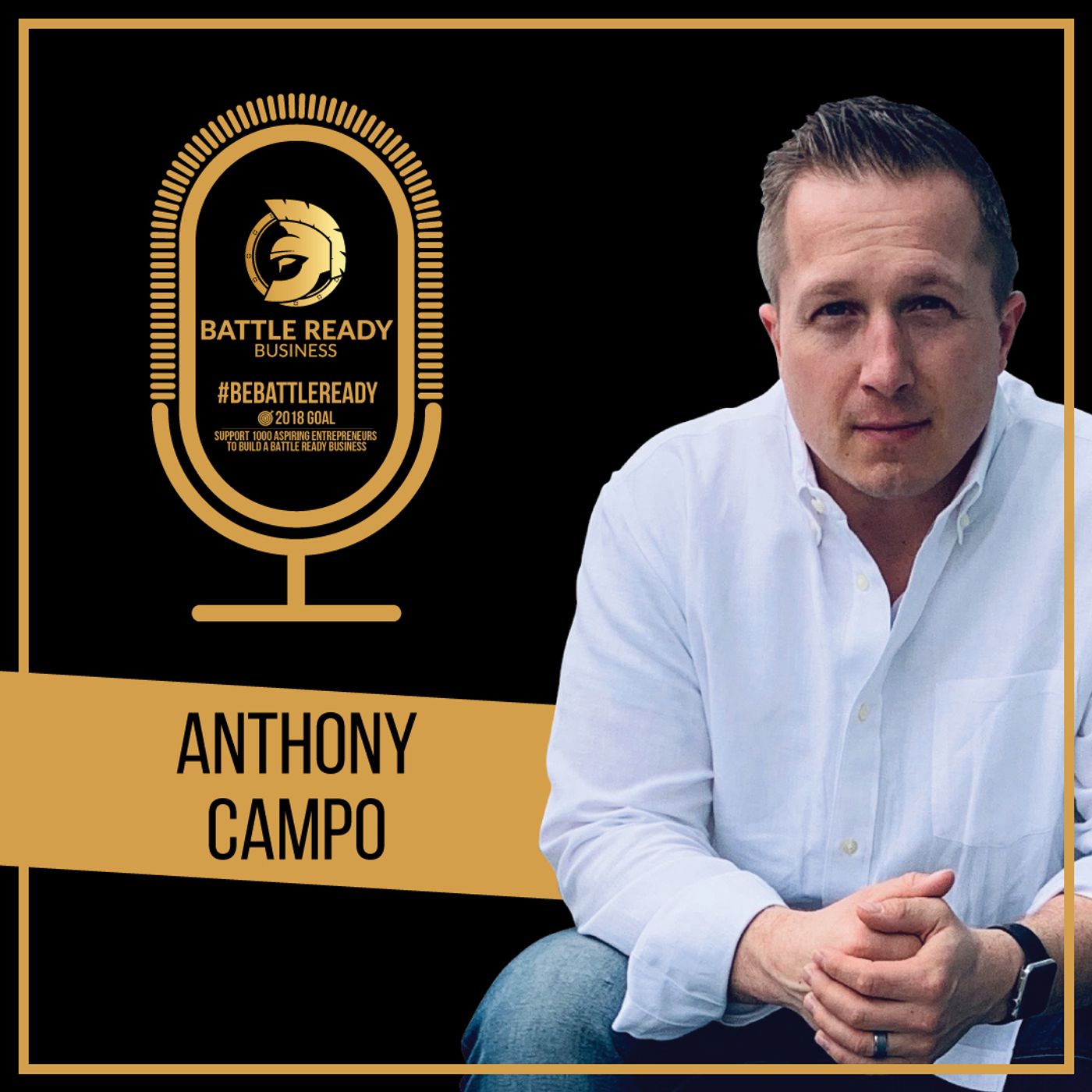
What's going on everybody? Anthony Campo here, your coach and host of the Be Battle Ready podcast. And I want to know, are you battle ready in how you deal with your stress? The question is, what does it take to build a battle ready business?
What does it take to value your marketing, sales, fulfillment, and leadership so that you can get a war in the marketplace anyway? My name is Anthony Campo, your host and chief coach at Battle Ready Business. This is the Be Battle Ready podcast, daily battle edition. And on a daily basis, we're going to take a deep dive and look at what it takes to win in the marketplace.
So sit back, relax, and I'll see you on the other side. All right, all right, all right. So today I want to know, are you battle ready in how you deal with your stress? Are you battle ready in controlling how much stress you are exposing yourself to?
Now, are you valuing your recovery as much as your productivity? So I was actually listening, I started David Goggins' new book, You Can't Hurt Me, and he started talking about toxic stress. And I understand that toxic stress has to do with child development, but it really got me to think of how much stress we as business owners, we as those people that just forge forward towards our goals, do what it takes, do it at all costs, stay up late, what we do, stay up late, deal with adversity, and what do we do to manage our stress? Because there is a hustle culture out there that just tells you this is the only way that you're able to get what you are setting out to get, right?
To fulfill your dream, to fulfill your purpose, to make that impact that you're looking to make. But how much is talked about in how much you're dealing with stress? If the hustle culture tells you to go out and, you know, work your face off and grind and do whatever, and you think you need to do that to get ahead, and you find yourself staying up late, working until two o'clock in the morning, right? Not being able to put your phone down.
All this is stress. You're constantly thinking about what's happening in your business, what's happening, you know, if, what's happening with the project that you're working on. If you're constantly picking up your phone, you're always in this state of stress. You're jumping from one tab.
I mean, I'm not any, I'm not the best at keeping minimal tabs, but, you know, having 15 tabs open, and that's not an exaggeration, but, you know, you are constantly stimulated with what is, what is happening. And for us as, you know, the entrepreneur type, the one that is always thinking of new ways and what could happen and what could be, and, you know, all these little shiny objects keep popping up. You know, we're already stimulated. We're already in that state of creativity.
We thrive in that place. And now we add in this other, this other, uh, other stimulus, demands of, you know, uh, demands of your, uh, your family life, your kids, your, your spouse, the other people around you, and then what your business requires of you. And the first person we are able to neglect is ourselves. That's, that's the first person we sacrifice.
And, you know, to build momentum at times, if you're going from nothing to something, you got to get some momentum and I get it. And, you know, looking up and we have, this comes down to distress because if you don't ever get out of that phase, you get into this state of chronic stress and there's three types of stress, right? There's positive stress, right? You can experience positive stress when you go to the gym, as long as you're not too stressed out and your, your hormones aren't messed up and all that stuff.
You've already been working out. You haven't used it up for 44 days. I'm being exaggerating, but that wouldn't be good stress. But let's say you're, you're well-rested and you go to the gym, you go to the gym.
That is positive stress. That's an example of positive stress. Okay. Now the other, the other type of stress is tolerable stress.
Tolerable stress is something that's very uncomfortable. It shouldn't be happening. You know, maybe you, you got an offender bender and you know, once that, once you get past the initial shock and you get all the information and you send the car off to the auto body store, pay deductible, everybody's flying, Danny, you go back to normal once you get your car back. That's a tolerable stress.
It's very acute stress. Okay. But this idea of chronic stress, as they talk about with child development, I don't want to pull that away from the talk about toxic stress, but it's a good framework. It's a good mind to, to really, a good way to really think about it is toxicity of stress.
If stress is too chronic, you're going to burn out. You're going to wear down. You're going to literally like, if you're adding on top of that, like stimulants and all this other stuff, like your neuro, your, your neuro receptors and your nervous system is just going to be too stimulated. And I found this, I find it, I start feeling in my eyeballs.
I start feeling in my temple. Like when I've been like thinking too much, trying to deal with too many things. And it's a lot of mental because what you're doing as a business owner is very mental. It'll show up physically, but the initial is through the mental.
And if you live in this state of stress, you know, you'll find yourself to be less, less, like less quick, right? If you're not doing things to counteract that. So I want to know, like, what are you doing to bounce that off? And if you were neglecting yourself, actually ask yourself that story is, do I really need to do that?
And if it's a money thing, if you're saving money because you think it's an expense to go ahead and pull things off your plate, I have you consider that's not really an expense. It's an investment because once you get that, once you get into that investment and invest into that, then you will have the capacity to do more because now you've turned yourself into, you've started to duplicate yourself, build your team. And sometimes it doesn't have to happen inside your business. You could use, uh, you know, resources from your business to help support you at home.
And that's not tax strategy, but however you can get there. So here's a couple ways to get yourself to de-stress, okay? To get your mind, you know, to take yourself out of this toxic stress. I know that, you know, I remember when meditation was, uh, taboo because I went to a Christian school.
That was, that was a taboo. That was evil. And I know that now meditation is pretty common practice, but if you're not currently meditating, this isn't spiritual. It's, it's a time to step out, to shut down your mind and learn how to shut down your mind.
Meditation is, would be the first place to start. The other part of this would be a little bit of exercise. Okay. And I said earlier about, you know, if you're already stressed, you know, exercise isn't a place to go, but this is where it starts.
It starts with a walk, right? Walk, low state, steady state cardio will build your cardiovascular, uh, capacity, you know, not high in capacity, but over a course of a long duration, uh, multiple, multiple things. This will build you, uh, build up your capacity and it'll, it'll help get your blood flowing, get everything moving and, uh, start bringing, having, having your body be more resilient to the stress you that you bring onto it. You build more capacity.
Other thing is journaling. Okay. So one of the things that, you know, if you're dealing with stress and this is how I dealt with it, like, look, I mean, for the longest time of stress and adversity and all this other stuff, I took it, like I was getting hit in the face and like, you know, scripture says, turn the other cheek. Like I just took it, boom, allow it to hit me.
And I internalized it. And if you're that person, uh, you know, emotion comes with that. And you also not just internalize that you suppress the emotion. So getting out the emotion through a journal, through a video blog, you don't have to share this with anybody, uh, talking with somebody.
That's why like having a coach is so important because, you know, when you talk to somebody that understands these things, um, is that you get to, that person gets to see, already sees outside of you. And that's one of the things that, you know, we need to learn how to do better is seeing outside of ourself and our situation to see a vantage point, to have that situation awareness. So a coach can help you, you know, step out of that, but they also can help you walk through the, the, the stuckness of where you're currently at. But the principle here is really getting it out, getting out what you're experiencing, what you're feeling, no judgment about it, no judgment about how you feel.
You know, if you're being too emotional, this, or you're being like any of that, like I've gone through that, like, uh, and you know, you need to just sit back and allow it to get out. This will help you de-stress. And one of the last things, there's a number of ways we could do this, but you know, obviously a couple more things, like one, taking time away, right? Getting away and shutting it down, uh, is a way to move forward and get away from the stress, get away from it, get away from your phone, put it away, put some boundaries upon that.
And then the other last thing is what I like helping out. And what's worked for me is putting what I do in containers, right? And when I say containers, it's, it's like, look, I know when I do my stuff and my personal habits and I know when I do my business habits and having a system to manage that, having, uh, you know, people to help me out with that, that have come in and do, I offload pieces and delegate pieces of that, uh, in both areas, my, my personal life, my family life, and, uh, sorry, all three areas, personal, family, and business, um, and having a system to manage that and taking the guesswork out of it. So, um, yeah.
So what I want to know from you is how are you managing your stress? What are you currently doing? And are you, are you in this state of chronic stress and what would be possible if you were able to gain space, gain clarity, gain situational awareness, put yourself, build a system so that it works for you. And you know, like that you can have your ideal scenario.
You can have your ideal time to work on the things that you personally want to work on. Learn, learn languages and look at learning to cook, whatever that might be, the hobby that might be. And inside your personal, you know, with your family life, your community, what does that look like? Cause you know, you could have a story that says, you know, I have to, uh, you know, this is how it is.
It's just, this is what I need to do to get there. You know, what would it look like if you ditched the how to just what would it look like? All right. If you're needing help and you're, you're, you know, you're, you're kind of feeling like, you know, your schedule, your time, your business, your family life, your personal life, it's just got the best of you.
And it's just like kicking your butt a little bit and you need some support. You need a system so that you can contain all the things in your life into an effective, efficient system. And you need some coaching to identify the areas you were stuck and work through those and, and to get some situational awareness and, and get some strategies and tactics that are really going to transform what you're doing. Go ahead and head over to campocall.com to book a call with me.
Uh, I would love to jump on the phone and see if we're a good fit. If we are great, if we're not, I'm connecting a lot of other people, a lot of other programs that would be a good fit. So I hope you have an amazing day and I'll talk to you soon. This concludes another episode of the Be Battle Ready podcast, Daily Battle Edition.
If you're a business owner with three to 20 people and you want to build a battle ready business so that you go to war in the marketplace and win, head over to battlereadybusiness.com forward slash go to get the conversation started. Other than that, I'll see you next time.