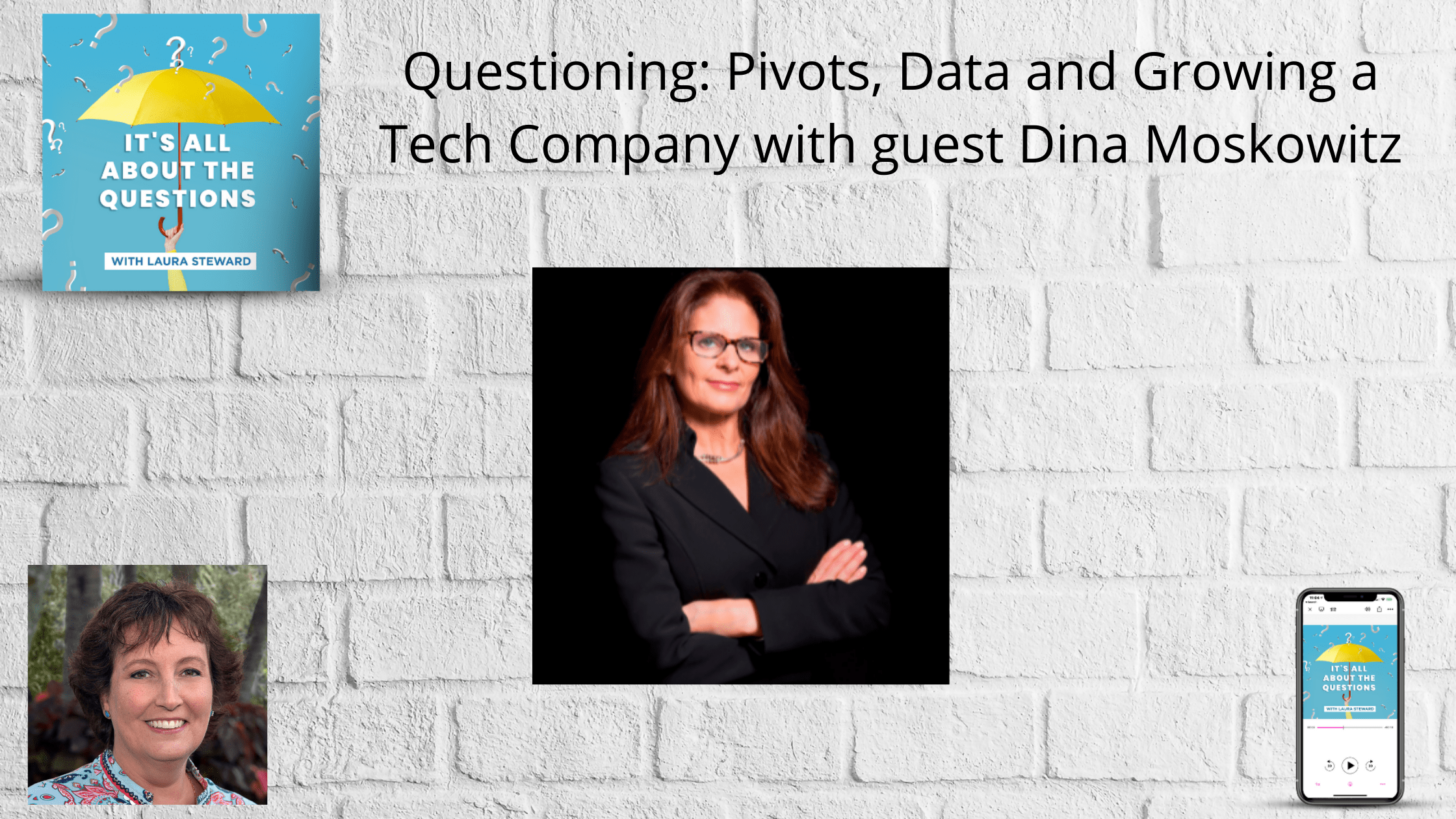
Welcome to It's All About the Questions, where learning to ask the right questions can help you achieve lifelong success. Now, here to help you ask all the right questions is award-winning author, international speaker, and business strategist, Laura Stewart. morning afternoon and evening everyone and welcome welcome welcome to the show on a different day because you know that's the beauty of no longer being on broadcast I can choose the day of the week although normally we are live every Tuesday from 11 to noon eastern and that's when we typically do the show but sometimes we have a very special guest and for whatever reasons we can't make it work on a Tuesday so I get to do it whenever I want because it's my show it's my show for you but it's my show so I get to do things when they work out the best for everybody involved and today I am so pleased to be able to bring a dear gosh dear dear friend of mine a woman in tech but beyond that one of the key people in tech that has really started to transform the way that people think about their ideal partner, their ideal customer and how they gather that data. She has been a mentor of mine for years. I've admired her forever with everything that she has done to grow her own business, transform her own business while changing the way people think about business. So please welcome to the show, my dear friend and the CEO and founder of SAS Max, Dina Moskowitz. Hey, Laura, how are you?
Good. It's so good to have you here. I know it's been a crazy week this week for you, for me, for everybody pretty much in the world. Yes. Yes. But I'm grateful to be here and so thankful for your friendship and for your support and for your mentorship. I think it's been a mutual relationship. I love your show. I love what you stand for. I love having you work with our team when we need you to. And, you know, I'm super grateful to be here.
Well, thank you. That means so much to me. You know, we met at an event right after my book launched because of Clint Gatewood. He's on the team at the time back then he was not working with you. And I remember Clint goes, you must meet Dina. How do you not know Dina? And this was like 10 years ago or something like that. And I'm like, I don't know. And he brings me over and that was it. You and I became instant friends. And one of the things that I remember so much about that moment we met was how great the questions were you asked, which.
I don't always see in business, especially when you're just meeting somebody for the first time and there's lots of other things going on. And then throughout your career, you are willing to re-examine the foundation or the core ideas behind your business. That's not something that a lot of founders and CEOs are willing to look at. They go on a path and they're like, well, this is the product. This is the thing that I'm going to do. And I'm just going to keep doing that.
But you look at data and you say, well, you know what? I thought that's what our customers wanted or that's what the world needed. In this particular case, technology channel, meaning vendors and partners who resell things. What is it do you think that enables you, Dina, to be able to say, whoa, stop, wait, let's look. Let's analyze this.
yeah i think it's it's a combination of things part of it's my nature but other part is probably this imposter syndrome thing where i don't want to do the wrong thing and i don't want to do things without having enough facts to be able to walk the walk and you know talk the talk at the same time so you know i don't come at things with a I try to lead by example as opposed to lead with, I don't have a born charisma. But for me, it's more about how do I navigate the world and this business I want to build by making sure that we're productizing the right way and that we're making sure that others' input, which maybe is more expert than I have myself, are incorporated. Well, that's interesting because you know that I consult for a number of companies and all of my listeners, I hear this stuff all the time.
I've never heard people use imposter syndrome quite the way you just use that. And from my perspective, I would say that's almost the opposite of imposter syndrome, right? Because you're so secure in who you are and what you're trying to do that you're willing to. be out there and reverse course, perhaps, if need be. So I just find that interesting because the last thing I would ever think about. I don't know how you interpret it that way, but yeah, that's how I envision it is, you know, you want to make sure that everything you're doing is fully right and correct, maybe to a flaw, but where if you don't get it right, you know, you want to keep going and get it correct. I guess probably one of the differences is that I don't put a strong of a timeline.
on my needs to get there, right? It's maybe more of a, I studied Mandarin Chinese and a lot of East Asian studies. And I think there's a longer term perspective to life and business that maybe I take on. And so there's time to continually tweak and reinvent and improve. And so that's just part of my fiber, I guess. And I love that about you. And I want to explore that a little bit because I never thought about your Mandarin studies and some of those other stuff things, but that long-term view is
I feel like it's something very different than what a lot of entrepreneurs are expecting since the world of Shark Tank, right? The TV show Shark Tank. They're like, I have an idea and it's just going to explode. I'm going to get on Shark Tank and my product, my service, whatever it is, is going to go from making $10 to making $10 million, right? And it's that rare case that they talk about in the Shark Tank. Can you give my listeners perhaps some advice on...
on timelines and the idea of longer-term thinking because we've become a world of such immediacy. And I had a guest on a few weeks ago, Joe Serio. His latest book was Vodka Hookers and the Russian Mafia. And he spent a lot of time in Russia helping analyze the Russian Mafia in the 80s and the 90s and stuff. And he's like, he came to America.
And he couldn't handle our grocery stores because there were so many options. And right now with COVID, I mean, you're in California, you see the container ships sitting off the coast, right? All of that insanity. We live in a world of immediate gratification, but that's not always what happens in business. No, it doesn't. And it takes a lot more than an idea to make a company successful, especially if you're building one for the long haul. And it takes, you know, we all, we know it's, you know, it's product of people and processes as well.
And patience. The other P is patience. So you may think you have the best idea in the world, but you can't always make that product up front. You have to start somewhere. And it's like that in the world of software and technology, it's called using like lean startup methods and building out an MVP, which is a minimum viable product. And then from there, you learn from users and the customers, and then you tweak and you add so that you're perfecting what they're doing over time. And in some cases, maybe if it's a B2C product, you can get that feedback and respond immediately. But in other situations, when you're doing something that's, you know,
maybe building and bringing something new that's a way of doing business like in our case of creating a basically a partner discovery and insights engine about partnerships you need time to get feedback from your customers and from the users and from the industry and you also have to be adjusting as the industry is adjusting to new technology so it's about the biggest one i would say it's about patience and sustainability and figuring out ways to um you know keep keep excited about it as you're iterating I like that. Keep excited about it while you're iterating. So how have you maintained being excited? I mean, I know, but my listeners don't. And sometimes I wonder because being a woman founder in tech can be one of the most exhilarating and one of the most frustrating things ever. So how do you maintain that excitement for yourself and for your company while all of that's going on?
So it's about staying in front of the customers, even as CEO, because then you're hearing what they like and what they don't like. And when you hear that you're actually hitting the nail on the head, that's exciting. It's like if you're on a golf course and you get a really good shot, it keeps you going. Even if you never get a good shot for another 50 strokes, you remember that good shot. As long as you are putting yourself in the place where you know that what you're doing is solving needs that customers want, that's how you keep it going. And then as you talk to more and more customers and you're solving, you hear even further, you see the momentum. Then it's like you can take that back to the team and you can continue to iterate.
and build and continue to grow and that that energy and the excitement of what you're bringing what you're building bringing value um and and therefore in the future profits right and revenue and all those things um you bring that to the team and the team gets energized so that's all part of the part of the formula With great people. When I was in my 20s, I had a lunch with a woman who was the CEO of a PR agency in San Diego. She was a very well-known, very well-respected. And her advice to me was that when you're building your own businesses, make sure to only surround yourself with people that are going to bring you up and that you like working with and never settle for less. If there's bad energy in the mix, you have to cut that cord immediately. And it's not worth it. Life is too short. So in that regard, surrounding myself with people that I admire, that know more than me, that I respect and that I have a good time with is another great piece of that formula.
And you have a team all around the world in all sorts of time zones. I mean, I can't even imagine how you keep all of those people who have very different backgrounds excited and manage to keep your sanity and get some sleep at the same time. I mean, most people have enough trouble managing themselves when it comes to running a business. And here you are managing teams all over the world. How do you do that?
Well, you have a core team, and then obviously there's a pyramid structure. And so certain developers will get together without me at 9 p.m. at night. I don't need to be there. I trust that they know more than me to do what they're doing. And just like in most companies, you have to cherry pick. You do want to make sure that you show up. That's another great piece of advice for entrepreneurs that my grandfather always said, which is there's no such thing as absentee management.
Making sure you know the people that you're working with, whether they're at the bottom or at the top, is really important. And having them know that you are caring about them beyond just the job that they're doing, which is a hard thing to do as a CEO is to stay on top of that all. But it's something I think is pretty important. Unless you get to thousands of employees, how can you do that? I look at what you just said. I hear what you just said in your grandfather's wisdom, which is always so much fun to hear wisdom pass down from generation to generation. I mean, my dad said to me when I...
was still in high school. And he said, if you're going to get ahead in business, you need to learn how to play golf, talk sports and drink scotch. And he said, because more business deals are closed outside of the office than anywhere else. And I was like, well, why scotch? Because of course in high school, I really wasn't drinking. And if I had thought of anything, it was like rum and Hawaiian punch because that's like the gateway, right? With the alcohol. And he said, because scotch, number one, every man will be totally impressed that a woman is drinking scotch. This is back in the early eighties, you know? And he said, and you can sip scotch.
Well, they're all pounding away their beers and all their other things. So you'll be totally sober while everybody else is drunk. So really great wisdom coming from different generations nowadays. Some women may be upset that my father ever said that, but it's like, okay, well, you just learn to work with what you have at the time. Has there been something since when you started your business career? Okay. Not just SAS Max or partner optimizer by SAS Max that you had to let go.
because you've realized that it really doesn't work, say, for you and your style or because those ideas or tenants or structures of business really don't need to continue. When you say something to let go, what do you mean? Like a principle or a piece of advice or whatever? Principle, a piece of advice you were ever given, a way of doing business, something that you realized, well, you started out doing that and then said, yeah, that doesn't really work for me or for my company. And there may not be, you know, I haven't thought about it that way. There always are. I think that I'm continually growing and trying to educate myself. I think when I got started, I wasn't concerned about leadership. I just went for it. Then I realized as we were growing that leadership was an important part about how, you know, how I come across in order to bring teams forward. And so I started to focus on that and process and project management, things that you and I have talked about extensively in the past became more elevated because when you're starting and you're fairly young in businesses, you just think.
It just all comes together and happens. But a lot of time and investment go into building the processes to create the efficiencies and to enable people to work together and get things done. And so what I think has been great is that as my career has moved forward, so has technology. So being in the SaaS sector and promoting SaaS and bringing SaaS to channel partnerships and vice versa, at the same time, all of these products have been evolving that make the way of doing business and the use of business and project management so much easier and better and frictionless. And you said the word SaaS, so I'm just going to educate some of my listeners who may not know it, or you can as well explain what SaaS is. The SaaS is spelled S-A-A-S, and it stands for Software as a Service. So it's software that we consume online by going and logging in. So if you use QuickBooks Online or a customer management software or even online banking, whatever it may be, even a dating app is online software, right? So it's just the premise of now software is available through online means where you're not storing it on your computer.
And I remember when I first started out, you got everything on disks, everything went in your computer, and you may have a server in your office and everybody connected into that. And then the internet took hold and then things started going offline. And that's when I think cybersecurity really became as big a concern as it is now. It wasn't as big a concern back then because there was no access to the outside world. It was all just inside your office. And let's take a little shift from where our conversation was going since you mentioned SaaS and the change to business and how you have to do things.
One of the big things that SAS Max does, from where it originally started out focusing on people at companies like mine that were in the trenches that went to customers, sold them products, sold them services and sold them software to now you're working with those vendors that create those software, that services, the software as a service, those cloud applications, helping them find their perfect partners inside the channel, as we call it, the channel being the vendor and the reseller who then deals with their clients. When you started creating that product, there was this idea of data can make a massive difference in how we look at it. I mean, anybody who watches Short Tank or watches any of the shows around the world on building business, one of the big things they talk about is customer acquisition costs. They talk about, you know, who are you targeting? How are you finding those customers? And the product partner optimizer I've always loved since day one when we were all sitting in a restaurant in Fort Lauderdale and you were talking to me about this data stuff.
What is it about finding your ideal partners slash clients with data versus the old way of sitting down with just a piece of paper and saying, my partner hangs out here. My partner reads these books. They may shop in these stores. They have this much income. How is it different from writing that down to the end result? I mean, why is it so important? Because I think this is revolutionary.
So, yeah, so I guess I would put it back to you like there's a few areas or a few good analogies, right? And if you've seen the movie called Moneyball, right, where they use data to select the right players for the team. They strictly, they removed that player as a person and they just basically turned it into a widget in order to say this is what that player's stats were. And this is how that player played. And this is how it will make our team better. They were able to do that. And think about...
you know, if you're in online dating, right? Imagine if you type in all your favorite things about what you think your ideal mate is, and then it gives you back someone completely different, right? Imagine how much that would suck if you spend all this time putting in what you think and then you get back something totally different. You go to meet them and everyone over and over again is the wrong one. And think about time you would waste dating, but also hoping and expecting for it to be the right one. And so in channel partnerships, if you have the wrong partners and you start off with the wrong partners, you're going to waste a lot of time. You're going to waste a lot of money. You're going to potentially even lose really good people on your team because you're having them chase after the wrong types of partners. So that's really what we did is said, how do we take qualitative
characteristics and quantify them so that we can turn it into a really powerful data-driven experience so that at the very beginning of recruiting a partner, you're starting out with more of the right ones. Yeah, I just love that because Yeah, I've had several companies and in every iteration, whether I worked corporate or whether I had my own business, I always hated it when you pick up the phone, the phone rings, you pick it up. This is way before caller ID and even now with caller ID, right? You just answer the phone because it might be a client or somebody and they start pitching you. And for this show, I get pitches regularly. I mean, from my website, in email, however, I just get tons of pitches and I will read them. And I'm just in shock, Dina.
They obviously know nothing about me. They know nothing about my show. They know nothing about my company. They know nothing about my clients. Yet they are, in their words, the perfect fit. And I should not consider anybody else. I should transfer all of my business over to them. And we are not talking about spammers or whatever that might be trying to do harm. We're just talking about serious companies that think they are the bee's knees and I should not consider anybody else. Shifting that mindset.
from both ends of it is so different, right? That phone call that comes in based on using partner optimizers data that you just talked about, the analytics part with the AI and all that, I would imagine that that massively changes. the, hi, Laura Seward, how may I help you? And the other end of the phone is somebody, how does that change that conversation from that get-go? Yeah, well, for our customers that are successful in leveraging it, it's game-changing. It's really improving conversations. You know, it's, again, it's like hitting a hole in one because you're actually getting the right person on the phone and you have things in common that are real and authentic. And so instead of having to have a salesy conversation or people who are talking at you,
They're calling because they know already more about you and your company and they care because they realize that you could be a very important piece of their business and vice versa. So it changes the authenticity, it changes the quality, and it changes the ability to engage with you because you hear something in their talking, in their scripts, in their talk tracks, whatever it is, that opens it up for a better conversation. And you don't waste your time either. Yeah, that's true. I'll never forget, especially now with COVID and so many events are starting to reopen for every industry.
There was how do we get customers? How do we even know if our existing partners are the right partners? I remember talking to, I don't even remember who it was at this point. I was having a conversation with somebody in the middle of COVID and they said, our business is busier than it's ever been. And I said, well, what do you attribute that to? And he said, well, we got really clear on who we should be talking to. And because of being clear on who we were talking to, we refined our offerings.
so that it actually hit what they wanted it wasn't just a partial hit it was a bigger hit now and their numbers went through the roof and they expected to continue going through the roof unlike some businesses that once the world reopens some of the business models may not hold true like mass manufacturers you know it may not continue down down the road but so you know this i had a really great conversation a week ago i was at a cloud girls retreat and i was talking to one of another woman who's in uh she works with channel partner programs at a cyber security company but on the side she was also doing a cosmetics business that she's launching and she loves it and is passionate and she was talking about it and i and i said you know who is your ideal customer in that area and she said well it's it's most you know women who need this kind of product and i'm like well you know both in here as well as in cyber security it's so important to clearly define who is your ideal customer right because only once you can define your ideal customer is it that you can do the messaging to them correctly and that you can spend you know put all your resources in the right place because if you try to be everything to everyone you know no one's going to get it and i know that's an age-old lesson but sometimes as entrepreneurs and as new startups or as new uh you know when you when you get into a new company and you're all excited you forget how important it is to focus and it's okay to not be everything to everyone and by letting go of the everyone and just focusing on your ideal customer or your ideal partner you're going to be way way more successful with the ones that you care about that can actually drive you revenue
And yet it seems so hard for companies, Dina, to say, well, my product isn't for everyone. It's not for every, in the case of SAS Max, it's not for every channel vendor. It's going to be for certain channel vendors that maybe do business this way or have this kind of product lines. For somebody selling pens, it may be. That's probably a bad analogy because most people really can use pens. Red pens, right? Red pens are more for teachers and for college professors, right? Who in real day were using pen to mark things up. But yeah, there is differentiation and honing in. Product marketing is critical to it. One of the things I could recommend for entrepreneurs is to put together what we call a customer playbook so that in your customer playbook, you start that definition of who your customer is. Where are they?
Who are the purchasers? And what do they look like? And what stage are they in their careers or in their personal lives? And age range. And it's basically profiling who your ideal customer is. And by having that playbook that you can always go back and reference, you can share that with your stakeholders and make sure that everyone on your team, as well as your outside advisors, is putting your marketing together and your sales together and your prospecting all based upon the same roadmap.
You mentioned stakeholders, and I know that you clarified that a little bit, but can you explain what stakeholders really mean to a typical business? Yeah, stakeholders are those people in your business who are typically responsible for different parts of your business, whether it's putting design product, putting your marketing together, advising you on sales. Everybody is a stakeholder in your company, whether it's the employees in your company or it's the investors in your company. or it's your strategic advisors, or even your customers are ultimately a stakeholder. And I think it is at Amazon, for example, in Amazon Web Services, they always leave a space at the table for the customer because the customer is a stakeholder. So whenever you're having a meeting, if you're always thinking about where you're coming from, but also where that customer is, which is an important stakeholder, you will have better outcomes and everything you're doing will be aligned with the end goal. That makes so much sense because I remember when my mom was still alive.
and she her arthritis was getting really really bad but my mom loved to crochet and I never knew that ergonomic crochet hooks were available and mom didn't either because everybody you know using the same crochet hooks she used from her childhood when she learned how to knit and crochet and the rheumatologist said well why don't you get your mom some ergonomic crochet hooks and I did some research and it was kind of hard to find and then all of a sudden I put some correct search terms in and they popped up and I was talking to the owners of the companies and they said they realized through talking to their stakeholders that they needed to focus on they could just hit every crochet person but they refined their niche their customer base to those who had arthritis or were older and it made it easier for them to crochet and their business increased 80 percent with just that slight adjustment of actually looking at who was, as you said, refining their customers and what their needs were, and then changing with their stakeholders, the marketing terms. And they immediately popped up once I put in arthritis crochet hooks. Yep. That's a really simple, but amazing example. It really is. Yeah. Okay. So thinking through this idea of ideal partner and data driven. Now, not every industry has access to the tools that partner optimizer has created for somebody that doesn't have access to it.
Is it possible for how do they go about doing some of this? It would probably be similar principles to the foundation of it, where you start with what is your ideal customer and knowing what that ideal customer is. And then then you get to think about who are your ideal partners who reach and sell to those customers. Right. So you think about all the business attributes or all of maybe it's a personal attributes, depending on what you know what your product or solution is so that you can then write it all down. But make sure you think through every qualification.
in order to match up that that partner is selling to the right customer and your ideal customer because otherwise you're wasting time that's that's the key so for example let's say that i was partnering with a um a company that sold to the same customer that i wanted like let's say i both we both want like my partner was selling to pepsi and i wanted to sell to pepsi but if my partner is selling to the cyber security team and i needed to reach the marketing team it's not really a good fit because the marketing team doesn't know this partner the marketing team won't trust this partner about a marketing solution so you have to really refine and say well who are the partners who are actually marketing consultants or advisors who the marketing team at my end customer will know and trust and how do you find them That's why putting those attributes down and trying to really hone in and refine up front. Sometimes it's hard to do and it seems grueling, but it's not that. If you have a partner or two that are great already, go look up online their website and look at what they talk about on their website and how they're talking to their customers. And once you see how that partner is looking at and talking to their customers, you'll get a good feel for how other partners should probably, you probably want partners who are doing the same thing.
And so building your ideal partner profile can be much more simple by looking at and studying and researching and interviewing those partners that you have that you know are ideal and then finding more that look like that. Now, we're hoping to help more and more industries as we move forward. So hopefully, if there's additional use cases, come to me, maybe we can help do it more quickly than you can do it on your own. But that was the premise that started this whole thing is there's tons of data about partners that they're trying to put forward in how they market to customers. You can find that all in my net. Yeah, I think that's a good clarification because the question sounded different in my head than when it came out of my mouth.
So I... We've talked quite a bit about the questions you need to ask, what you need to write down about the partners. The big issue becomes for a lot of businesses, okay, I know what that looks like, but I don't know who they are when they're looking for partners or looking for clients. The beauty of Partner Optimizer in the tech industry with SaaS products and other products is you've built up this massive data repository, right? So that when somebody takes an ideal customer profile, an ideal partner profile, you can then input that in.
And then the system goes out and crawls through and says, here it is. Or they can give you their list of all of their existing partners with the profile that they've created and go through and say, well, you've got 10,000 partners or you've got a thousand partners, but you know what? There's only three that fits your ideal. So maybe you need to let go some that are not, or you need to redefine or refine whatever is going on. Typically it's the opposite though, where they find thousands. And the reality is there aren't thousands. You want to keep on over-targeting. Yeah. Okay.
So you keep, so if you don't have the data driven method where you can get. That's why we don't partner optimize because there was no easy way otherwise except from. There isn't. going through the web or hiring other people perhaps in other countries to try to go sort through the web. And they don't have the domain expertise that you do to be able to pinpoint or collect as much data to make it as meaningful. So unfortunately, for us, we've been building this tool and it's taken a lot of time and investment in R&D and tech in order to create it. But otherwise, that's why we created it. We couldn't find a way for us to find those partners easily and scalably.
You know, I just I just love it because I get so frustrated. I can always tell when somebody's bought a list. Yeah. And somehow personally or business wise, my name is on the list. And I'm like, OK, where did they get that list from and how out of date is it? Right. Yep. But yet that's the traditional way that a lot of businesses think they have to get new partners, new clients is by buying lists. I mean, you revolutionized the way people think about.
partner relationships during that process for for your business for sasmax how did that blue ocean way of thinking change, change anything in yourself when you realize that, or didn't it? I don't know. I've never asked you that question. You know, we want to drink your real Kool-Aid, right? So as we realized that we needed to find these kinds of, you know, create this tool that we were creating, it's helped us to very much refine who our ideal customer is and our ideal partner. And we do the same things and we try to leverage our engine to help us to be more successful as well. And we try to be focused. And, you know, when we get, we get a lot of inbound inquiries from
from software companies around the world and some of them if they're not our ideal customer we can't spend too much time and energy on them um but we get a lot of that and we have to deflect or figure out ways to either send them to other resources but but to say no because i can't have my team wasting time on the wrong the wrong customers when i need them to be focused on the right customers so it was basically you know it's kind of hits you on the head you know if you don't do as i do as i say not as i do i have to do as i do you know and uh so that's been leading to our success as well and i can't tell you how as soon as we put that mantra in place um the customers we started talking to were more of the right fit and the um conversations got so much better the sales process turned into a you know a light bulb for the customer and the friction reduced and you know we were off to the races i love that you also recently underwent and i think this is just a really good lesson for my listeners Or rebranding, website, logos, colors, everything. What drove that change? And what was that experience like for you? Because another friend, client of mine, who I think I've mentioned to you before, Marcella Allison, she has this incredible mentoring platform out there and a community of women that are all there to just lift each other up. It used to be called Titanites. And it's rebranded as Mentorist Collective now.
complete, I mean, from the word Titanites from the Greek to Mentorist Collective, still a little bit of a Greek thing in there, but a completely different rebranding, name change, look, feel. It's not an easy thing to do, but yet it can have such a massive impact. And I'd love to know your thoughts on that and share with my listeners that process that went through your mind. What were you asking yourself that you decided to do that? Well, a couple of things. We wanted to modernize and make sure that we communicated in iconography and colors and feeling the process of what we deliver, which is finding that ideal partner and gaining data-driven insights. And our older brand...
was not effectively communicating that. It was effectively communicating more of a channel partner program in relationship. But that wasn't enough of what we do, which is really forward thinking and modernizing and bringing new technology. And so we knew that we needed for our own stakeholders to be able to bring that look and feel forward. And then the other thing is that we had more. We now have a lot of stakeholders, whereas before we had a few. So when we had it originally built up and branded, it was based upon a much smaller community or with less stakeholders. And now that we've been more clearly defined, we were able to go through a process that involves
customers, advisors, employees, industry people, and get their feedback. Even your feedback was invaluable at the time. And to be able to take everyone's input and add it to the formula created a much better outcome. Well, I have to say that the rebranding that you did and the team that you had, it made it easy to give feedback because so much of the work had already been done. And then it just becomes, hey, what do you think?
I know when I started doing my website several years ago and somebody was trying to create a logo for me, even when I had Guardian Angel Computer Services, they're like, can you describe to me what you want? And I'm redoing my book cover and it's the same thing. And I'm like, no, I can't. You know, I really I don't even know. I don't know how to give words to what I'm looking for. And it's evident where that customer playbook is so important, because if you put that down and you have it there.
Every time you add a new marketing person or a new salesperson or a new outsourced designer or a logo person, it gives you that ability to share that and have everyone be on that same page. So because I was able to communicate a lot of those attributes that define our ideal customer and also define, well, who else is in our space, right? So what are some of the other adjacent products and solutions look like? What are the consulting firms? It allowed and opened up my creative people to then...
The lawnmower guys next door just decided to come. So forgive me. I'm going to mute while you keep talking. Yeah. So when you have those creative people, you can now give them the quantitative information they need so they can do the research that they care about. And they came back because we were more specific in what our ideal customer is. They were able to go look at what's going on in the industry, what's going on outside the industry that might be.
comparable in a different you know but but doing things in another area and then came back with these really cool analyses and matrix and showed where your colors are me too where your colors could stand out how these colors are part of the industry but yet if you add a gradient or if you add something different it makes it pop and so the creative talent is able to take your customer playbook that means your who's your ideal customer who you try to reach and and everything about it and and create and it's amazing when you allow others to take back your feedback and give it back in new ways as long as you're open to it you can do great things I absolutely love that. And we're getting really close to the end of our time together. So I want to offer two things. One, your last thought that you'd like to leave my listeners with and how people can reach out to you. And if they are in the tech world, they're in the channel and want to find out more about a partner optimizer, how they can do that. Well, the last thought is to never just be satisfied with where you're at. Always look at how you could be doing things better and faster and more efficiently and in a way that's going to make you happier and your team happier. Right. So that's just in everything.
And then you can reach out to me, of course, directly. I'm Dina Moskowitz, and you can find me on LinkedIn. And my name is on this thing right here in case you can't spell it. And my email is Dina, D-I-N-A at sasmax.com, which is S-L-I-S-M-A-X.com. And yeah, I'd be happy to talk to you about helping you build your partner program through starting by finding partners that are the right fit for you so that you can spend more time in the right areas of growing your business.
And that's for those in the tech channel versus just any industry. Because you can't at this point, I know that you just mentioned that it's on a future thing is maybe helping other industries doing this as well. But I encourage partners, right? If you're selling to tech partners, then it can be any product, but primarily it's technology. Expand a little bit just until this guy goes around the corner. Is it a leaf blower guy?
Yeah, I know. Now, that's a product I would invite everybody to try to reinvent because the noise on that can't just be annoying for us as, you know, passersby. But the people who are using those leaf blowers have to be, you know, it's really bad for their ears. So I think there's a someone wants to invent that. I would help fund it. I know that there is a push in certain areas of the world to make lawnmowers all electric because they're completely quiet. It's really amazing. But that's a big expense for a lot of the companies here that do that. I don't know if you can hear everything that's going on right now.
But I want to thank you so much for being here with me today, Dina, and sharing your experiences. I know that I didn't exactly say to you, hey, this is definitely what I wanted to talk about, but you have so much to share with my listeners. And I'm so grateful always for you in my life and for you here today. Thank you, The Feelings Mutual. And I love your program. And for those of you who are just getting familiar with Laura, please listen to some of her other podcasts. She's incredible. She asks all the right questions, which is what extracts the great value out of people and makes these podcasts so interesting. So when you're on a walk, when you are, you know, before bed or when you just have a little bit of extra time and want to hear something new and learn something at the same time, these are great podcasts. Congratulations on such a great show.
Thank you. Thank you so much. I just found out the other day it is now in the top 3% globally of all podcasts. That's awesome. That's so awesome. That's great. Thank you. Thank you. So thank you again for being here. And I'm always grateful. Happy Thanksgiving, everyone.
All right, everybody, hopefully you can hear me over the insanity that is going on next door. But that's what happens with live. Sometimes you can't do anything about it. I hope you got a lot out of what Dina was talking about today. It doesn't matter whether you're in the tech channel or not. Getting clear about who your customers are and what their needs are can make all the difference to the success of your products, as well as asking the right questions. Because remember, the right questions can change your life. So what are you asking today? Have a great day, everyone.
You've been listening to It's All About The Questions, starring Laura Stewart. Connect with Laura at itsallaboutthequestions.com and download a free workbook that will help you ask better questions starting today. There's a science to natural gas safety. Signs of a gas leak, testing your carbon monoxide alarms, keeping your gas meter and vents properly maintained. But you don't need to be a scientist. You just need to know what to do. Learn more at embergegas.com slash safety.