this podcast is an audio recording of a live event it may reference visual material that cannot be represented in this recording it may also contain strong language and adult themes the opinions expressed in this podcast do not necessarily reflect those of acme All righty. Earning him the grand sum of £30, a 20-year-old David Bowie made what is widely regarded as his screen debut in the late 1960s in Michael Armstrong's silent horror short The Image. This 14-minute short film seems striking today for its simplicity, but aside from being a fascinating horror film, it's also a really significant visual artefact for a whole bunch of other reasons. Not only is it Bowie's first movie role, it was also one of the earliest short films to receive a notorious X certificate from the British Film Ratings Board for its horror-themed violence.
Now the image is a stark experimental short and its horror stems as much from its formal instability as it does its basic plot. The image is about a painting that comes to life to torment its creator, played by Michael Byrne. Bowie has since described the film as follows. My first true film appearance was in a movie called The Image, an underground black and white avant-garde thing done by some guy. He wanted to make a film about a painter doing a portrait of a guy in his teens and the portrait comes to life and, in fact, turns out to be the corpse of some bloke. I can't remember all the plot, if indeed it even had a plot, but it was a 14-minute short and it was awful.
Bowie isn't the only person to remember the film dismissively. The NME said when the image was released on home video in 1984 to cash in on Bowie's superstar status. Gasp with horror as your hero gets murdered not once, not twice, but five times. Gasp with astonishment as he gets up entirely unharmed. Wonder with puzzlement how his acting career ever survived the carnage. The film's action is obviously really simple. The painter keeps trying to kill off his disturbingly reanimated creation. But each time he succeeds, Bowie's character comes back to life. This scenario loops at an increasingly frantic rate, peaking with its final revelation.
So this is a 14-minute film, as I've already said. I obviously don't have time for you to play the whole thing because I've only got 15 minutes to talk. Math says no. Just out of curiosity, this is freely available online. How many of you guys have seen the image?
Filmed across three days in 1967, the image was not released until 1969. One needs only the most cursory knowledge in Bowieology to know why these dates are significant. In musical terms, I guess 1967 is the year of the Laughing Gnome. 1969, space oddity. A lot of changes going on in the world of David Bowie across these years. The author of Heroes, David Bowie in Berlin, Tobias Rutter, calls the image a poor man's Dorian Gray, while Peter Doggett, who wrote The Man Who Stole the World, David Bowie in the 1970s, has also noted traces of Henry James' story of a masterpiece. My co-panelist, Dennis, will be speaking shortly. Those all things Henry James. I'm sure if you call him afterwards, he can tell it's interesting.
things that overlap. Doggert's also crucially flagged the subtext of gay self-loathing acting out within the image, and I'd say it's virtually impossible to watch the film without reading it from this perspective. It's very conscious of its homoerotic overtones. Even in the short segment that we saw, I think my favourite bit is the erect paintbrush with the white paint dripping onto a picture of David Bowie. What could it mean, film scholars? I don't know. From interviews with people involved in the production, this queer aspect was certainly palpable on set. Michael Armstrong in an interview has said, David was a terrible flirt.
in the way which he dealt with you. He did that with me. He was flirtatious. It's a part of him and who he is. He always seemed to be playing a cat and mouse game with you. I said that he would either end up being a great star or make a lot of money in the Piccadilly men's toilets.
Now Michael Armstrong was only 21 years old when he made the image and today he's a director renowned mostly for his incredible 1970 film Mark of the Devil, a horror movie with Udo Kier and Herbert Long that clearly sought to cash in on the success of Michael Reeves' 1968 film The Witchfinder General with Vincent Price. This was a West German film and the intensity of its violence might be indicated by a translation of its original German title, Witches Tortured Until They Bleed. This is the film that famously had sick bags given out to its audience at screenings that you could until very recently buy online from Fab Press in the UK. I admit this is a tenuous link to David Bowie, but I'm... This is the only chance I've got to talk about sick bags at the Australian Centre for the Moving Image. I'm going to put that on my CV, whether you guys like it or not. All right, we're done. I've talked about bomber bags. We can move on back to Boeing.
Armstrong also did a great horror anthology in 1969, the image was finally released, called The Haunted House of Horror. And despite of 30-year-old Frankie Avalon playing a teenager, it's actually a pretty fun movie. Aside from Mark of the Devil, Armstrong's cultural reputation today probably expands as much from his script writing as it does from his directing. He wrote Pete Walker's House of the Long Shadows from 1983, and co-wrote Tobe Hooper's unheralded masterpiece Life Force for Canon in 1985. Armstrong certainly earned his horror stripes, and you can really get a sense of him trying to tease out the parameters of the genre in a really fundamental and inquisitive way with Bowie in the image.
Now, it wasn't his random luck that found Bowie in this short film. In fact, Armstrong may have possibly been amongst the first people to utter that now ubiquitous war cry of a cultural capital starved music fan, I was into early Bowie. Bowie only had a very small number of fans at this stage, and Armstrong was proudly one of them. The story goes that Armstrong saw Bowie's self-titled debut album in a shop window and was instantly starstruck. He bought it straight away and was determined to work with Bowie. He contacted his manager, Ken Pitt, and again in an interview, he said, I spent two or three hours with David and Ken, and I fell in love with David. He was absolutely amazing and did a wonderful Elvis impersonation.
He'd previously discussed collaborating with Bowie on an earlier feature called A Floral Tale. And by some accounts, Bowie's written up to seven songs that are still yet to be released from that, although there's a debate about whether they exist, whether they still exist, whether they were ever written. That project didn't eventuate, but the image did. In 1964, a fellow student at London's Royal Academy of the Dramatic Arts asked Armstrong to write him a script for a short film. The result was the image. This director was Tony Malam, and while he didn't end up making the image, he would go on to direct a number of films, including the notorious and perhaps surprisingly beautiful and subversive slasher film The Burning in 1981. By 1967, circumstances led Armstrong himself to receive funding for a short film from Border movies, Border film, sorry, and thus the image was born. Filmed just off Harrow Road in London, the shoot was apparently freezing, so cold that at one point the water that drenched Bowie in the rain scene that we just saw at the start of this film turned him blue. Apparently there were people rushing in all too much.
enthusiasm to dry him off. Everybody was so in love with him while they were making this film. So legend holds anyway. The shoot was not a smooth one and only half the original screenplay was filmed before they ran out of money. Jumping a few other hurdles, the 14 minute version was finally shown at JC Cinema in Piccadilly Circus in 1969 alongside Pierre Estang's sexploitation film Teenagers.
I'm sure you're all familiar with, because you all look like perverts. Bowie's interest in performance as a young man is, of course, quite well documented, and his fascination with mine and Japanese Butoh arguably inform his mute, eerie performance in the image. A major influence on Bowie from this perspective was Lindsay Kemp, who's already been mentioned a few times today, an influential choreographer and mine. Now, he founded a dance company in the 1960s, and while Kemp himself was a student of people of the caliber of Marcel Marceau, his own students included people like Kate Bush and David Bowie. Now, Kemp is a really important figure because it is in large part from him that Bowie's signature flair for adopting different characters was inspired. On the front of the script for the image that we saw on the last screen, director Michael Armstrong described the film as a study of the illusionary reality world within the schizophrenic mind of the artist at his point of creativity. It's virtually impossible to hear this description in the context of a 2015 exhibition celebrating David Bowie's remarkable career and not consider that somewhat prophetic.
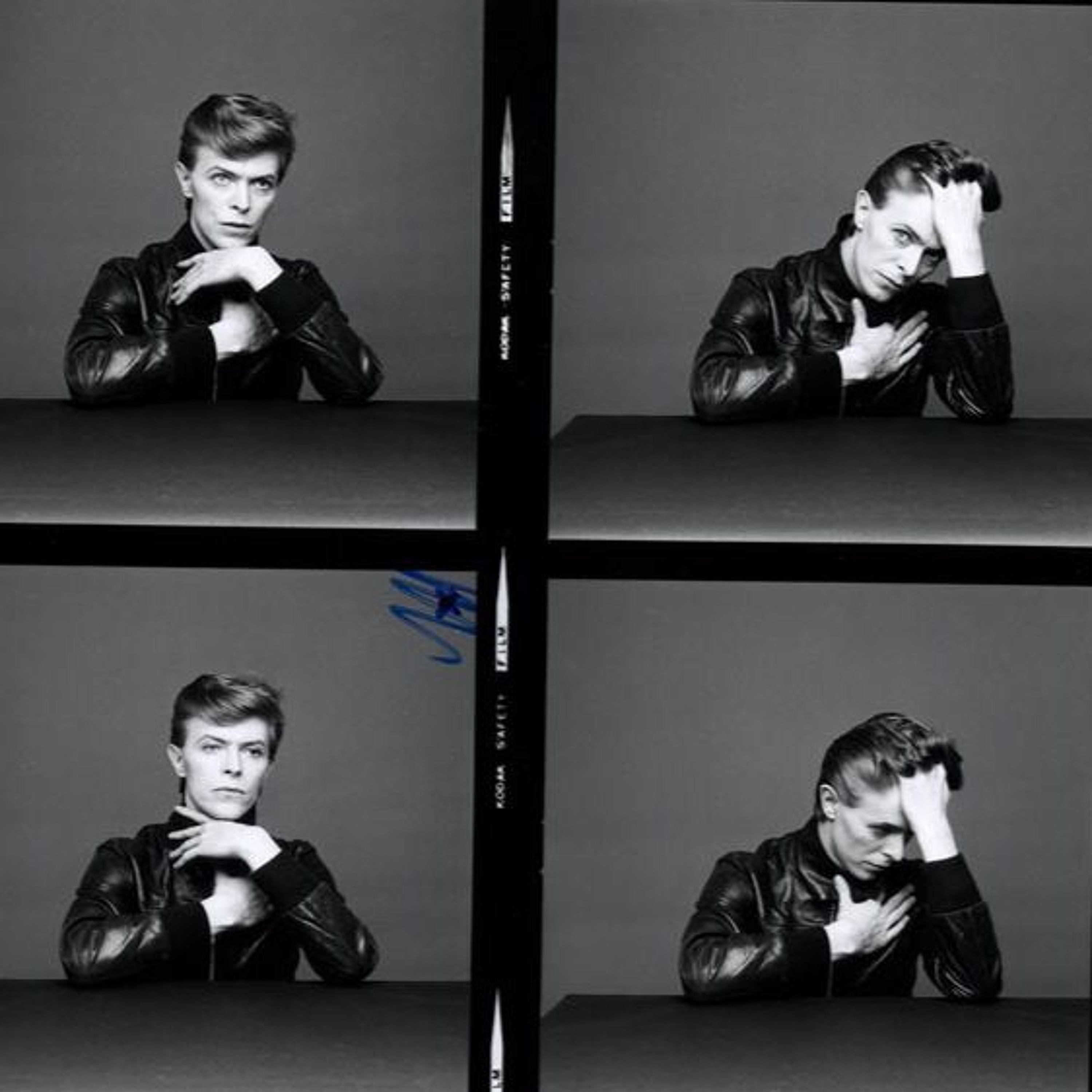
To this we can probably add the fact that Armstrong was so besotted with Bowie's performance that he supposedly offered him the lead in another film project he was working on that never came to fruition, based on Offenbach's opera, Orpheus and the Underworld, updated to focus on a pop singer who was torn apart by his fans. The echoes here of the Ziggy Stardust mythos are probably worthy of note. Added to this, of course, is Bowie's own personal interest in painting. I find it hard to watch the image and its story of a painting coming to life and not think of Eric Heckel's painting Rock and Roll from 1917. Heckel was a German painter and printmaker and a founding member of the De Brucke group of German expressionist artists. Bowie's explicitly stated this painting was a huge influence on the cover for his 1977 album Heroes. You may also be able to see traces of it in other projects that Bowie was involved in.
But the pop cultural significance of the image lies primarily in who was in front of the camera, with the pre-famed Bowie as a character from a painting who comes to life. Watching the image today, I find it really difficult to quarantine it from Bowie's broadest star persona. His performance manifests at the intersection of violence, eroticism and immortality, elements that of course would come to the fore later in the cult horror film The Hunger by Tony Scott in 1983. The Hunger follows Catherine Deneuve's vampire Miriam Blaylock and her vampire lover John Bowie, who, after 200 years together, discovers that Miriam's promise of eternal life did not necessarily entail eternal youth. As John's ageing begins to accelerate, Miriam's attentions are drawn to gerontologist Sarah Roberts, played by Susan Sarandon, with sexy results. I was going to play a clip from that, but I'm running out of time, and I'm assuming everybody has seen The Hunger a thousand times, so we'll just have a micro-look at Pete Murphy's cheekbones and move on.
Like The Hunger 15 years earlier, immortality, horror, art and sexuality manifest in the image in really fascinating ways. That we watch the image with the knowledge that this is a pre-famed Bowie allows us unique insight into how deep these leanings towards these kinds of uncanny, almost temporarily perverse characters were embedded in Bowie as a performer from a young age. It suggests that this was really in tune with his own artistic vision on a really fundamental level. Even turning our gaze beyond these two films towards Nicholas Rhodes' The Man Who Fell to Worth. There's something about Bowie's on-screen persona in these movies that pivots essentially on a really compelling intersection of the bizarre, the dark and the sensual. It's no revelation at a conference such as this to emphasise the importance of transformation to Bowie's public persona. And I think the image, in a way, is a really useful starting point to start thinking through the darker aspects of these shifting identities. Thanks. You have been listening to an ACMI podcast. For more recordings, go to soundcloud.com slash ACMI online or the ACMI website.