
EPISODE · Mar 23, 2026 · 49 MIN
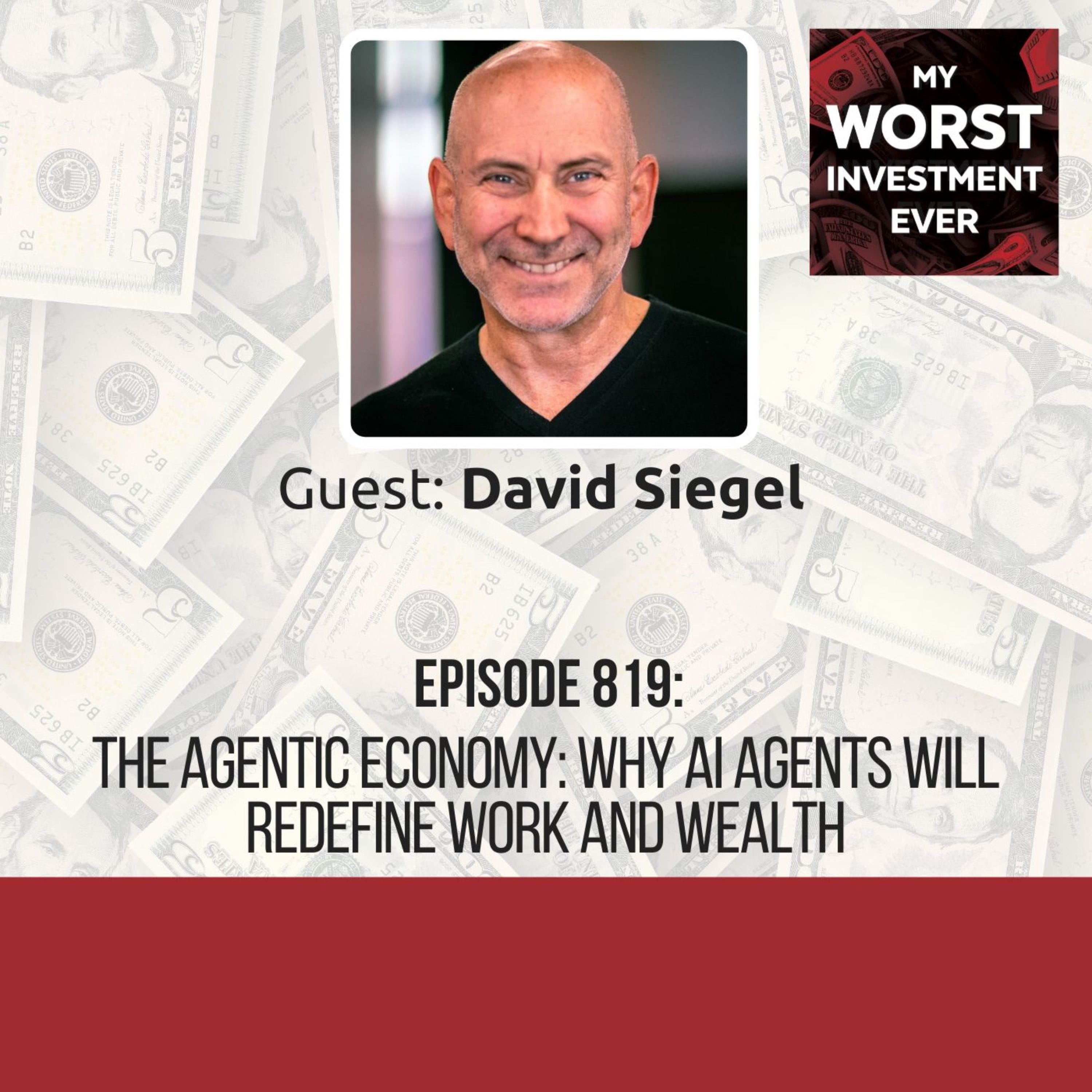
David Siegel – The Agentic Economy: Why AI Agents Will Redefine Work and Wealth
from My Worst Investment Ever Podcast
BIO: David Siegel is a Silicon Valley entrepreneur who has founded more than a dozen companies. He has written five books on technology and business, was once a candidate for the dean of Stanford Business School, and is now an AI thought leader leading an AI startup he hopes will pave the way for the agentic economy.STORY: Nine months after David's last appearance on the podcast, the conversation has shifted from "what are LLMs?" to agents that act. 60-65% of NYSE trades are already fully machine-to-machine—a preview of where all commerce is headed.LEARNING: You don't need to know exactly how AI works, but you need to get in the game. "The biggest investment mistake everyone is making right now is not appreciating the exponential nature of what we're in and what is coming. The next 12 months will be nothing like any 12 months that have ever happened in human history."David Siegel David Siegel is a Silicon Valley entrepreneur who has founded more than a dozen companies. He has written five books on technology and business, was once a candidate for the dean of Stanford Business School, and is now an AI thought leader leading an AI startup he hopes will pave the way for the agentic economy.David joins the podcast for the fourth time and discusses his latest progress in AI with Andrew.The health reset before we beginBefore diving into AI, David opened with an invitation that even Andrew found surprising: a free online water-fasting event starting on April 20, 2026, with a preliminary strategy session on April 12.What is a water fast? David explains that it's not a diet or a weight-loss tool; it's a physiological reset. For three to six days, your body enters ketosis and "cleans house," activating suppressed systems and energizing you. David does this three to four times per year, emphasizing it's not a monthly practice but a strategic reset aligned with your health journey.The coaching program makes fasting easier and more fun through group accountability, with no obligation, just information to help anyone at any point in their health journey. Learn about fasting, or just join a group of people doing the same thing at the same time. It's designed for people from the West Coast to Europe. Please register for the event and feel free to invite anyone: https://us02web.zoom.us/meeting/register/Tk-zp9ZERomWb0643Sypmw.The agentic economy: what's coming in 20 yearsDavid's core message centers on a profound shift: we're entering the agentic economy, where machine-to-machine communication replaces human-to-website interaction. He notes that in 20 years, you won't shop on Amazon. There won't be advertising or marketing for humans. All those "Cialdini mind tricks" of urgency, storytelling, and Russell Brunson funnels will vanish. Everything will be machine-to-machine, just like the stock market today, where 65% of NYSE trades open and close in less than one second.Even driving will be prohibited because human reaction times cannot match the frequency of machine communication. We're in an awkward transitional period where humans and machines must coexist. Nobody likes it, but it's taking us toward a future where drudge work is automated.What is an AI agent?David clarified a critical distinction that many miss: LLMs (Large Language Models) talk back, type responses, and generate images and videos—but don't do anything outside your interaction.AI Agent, on the other hand, is an LLM connected to APIs that can actually take action: send emails, order meals, book travel, make purchases, and run ads. Think of it as a virtual remote assistant working 24/7 while you sleep.OpenClaw: The framework powering the revolutionOpenClaw (CLAW = agents, inspired by lobsters from a forward-thinking fiction book) is an open-source framework created by Peter Steinberger on GitHub. It connects LLMs (the thinking entities) to APIs (the conduits for doing).This is revolutionary because it allows AI to take real-world actions. Previously, AI was confined to conversation. It can now execute tasks across systems. David strongly warns that OpenClaw is highly technical and requires API configuration. It's not designed for humans to use directly. It's for engineers building agent infrastructure.The security risks nobody is talking aboutDavid explains that agents introduce entirely new cybersecurity vulnerabilities that differ from traditional threats, such as social-engineering attacks against agents. For instance, impersonation via spoofed emails: "David wants a trip to Phoenix, book a flight," or multi-day, persistent attacks in which bots repeatedly try to extract secrets.David's approach with Claw Studio is to use APIs rather than scraping. Wherever possible, he attaches LLMs to official APIs with guardrails. This is safer and more sustainable than screen scraping, which violates Terms of Service and risks a shutdown.How to get started (without blowing yourself up)David's advice is clear: Don't do it yourself. That's suicide. With great power comes great responsibility. An agent can do almost anything, including deleting its own installation, wiping your disk clean, or draining your bank account. You want it to do almost nothing initially, then gradually widen the guardrails.The Redshift Labs/Claw Studio approach:Done-for-you setup like Red Hat for LinuxDedicated Chief of Staff agent with its own phone numberOnboarding period of 1-2 weeks, where you download your life into the agent:Birthday, family members' emails, and daily routinesIt can research you online to build context.Separate setups for personal and businessForever memory, unlike standard LLM context windows that forget:Every Zoom call transcript gets piped in word-for-word.Searchable memory: "Who was I talking to about Tahoe skiing in November?"Agent retrieves exact conversations and can follow up.Reverse prompting—the paradigm shift:Instead of you telling the agent what to do, it tells you.Morning briefing: what happened overnight, what's coming up, what's changedManages your calendar, project management, and prioritiesBreaks long-term goals into daily deliverablesYou're no longer the to-do list keeper.Security architecture:Virtual Private Server (VPS) hosting, not local machinesTwo-account system: one for operations, one for immutable backupsAll logs are piped to a one-way backup account."Go back six hours" restore button, in case things go wrong.Humans in the loop for critical actions (e.g., agent queues payments, human approves)The biggest investment mistake everyone is makingTo conclude, David talked about the biggest investment mistake everyone is making right now: not appreciating the exponential nature of what we're in and what is coming. He noted that the next 12 months will be unlike any 12 months in business history. He stated that we're entering a recursive self-improvement phase, in which software will write the next generation of itself. The singularity isn't theoretical; it's happening now.David's advice is to stop thinking six months ahead. The pace is too fast. Instead:Take baby steps to position yourself.Prepare to accelerate like never beforeInvest in agent infrastructure now, while it "doesn't suck too bad", it will...
Embed this episode
Ready to play
David Siegel – The Agentic Economy: Why AI Agents Will Redefine Work and Wealth
No transcript for this episode yet
Similar Episodes
No similar episodes found.