
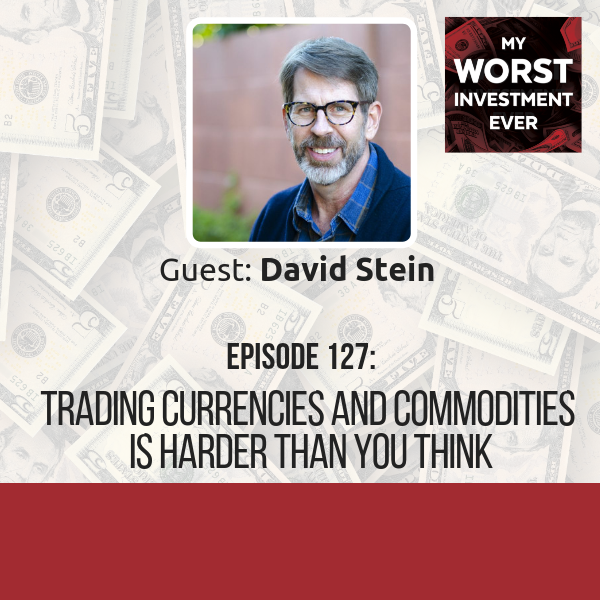
EPISODE · Jul 24, 2019 · 32 MIN
David Stein - Trading Currencies and Commodities is Harder Than You Think
from My Worst Investment Ever Podcast
David Stein helps individuals to become more confident investors via audio, video, and books. For the past five years, he has hosted the weekly personal finance podcast, Money For the Rest of Us. The show has more than 250 episodes and more than 10 million downloads. David’s upcoming book, Money For the Rest of Us: 10 Questions to Master Successful Investing, will be published by McGraw-Hill in October 2019. Previously, David was chief investment strategist and chief portfolio strategist at Fund Evaluation Group a US$70 billion institutional investment advisory firm, where he co-headed the 21-person research group. David’s former institutional clients include The Texas A&M University System, the University of Puget Sound, and the Sierra Club Foundation. He lives in Phoenix and Idaho. “And so I started trading and quickly found that it’s not that easy.” David Stein Support our sponsor Today’s episode is sponsored by the Women Building Wealth membership group, the complete proven step-by-step course to guide women from novice to competent investor. To learn more, visit: WomenBuildingWealth.net. Worst investment ever David’s worst investment occurred during the transition period after he had quit the investment business and was trying to decide what he wanted to do in “retirement”. He had set up then shut down a few websites and had reached the point where he thought that even though he had retired, he could be a trader. He was experienced. At his prior firm, he was joint chief of investment researchers and money managers and trading was just part of what he and his team did, which included hedge funds and private equity. As his group’s head strategist, he would go to New York once a year and meet hedge fund managers, because he liked to see what they were thinking, to learn from their successes and mistakes and to see their take on the world. Visit to hedge fund piques interest in trading About a year or before he retired, he went to a commodities trading hedge housed in a Connecticut mansion. He met the founder and went to the trading floor. It grabbed his attention immediately. The floor was separated, with quantitative traders on one side and discretionary traders on the other. He said you could tell where the quants sat and where the discretionary traders say because the latter were messier and their desks less organized, but it looked like a fun and cool place to work. Then once he saw them at their desks trading, David got the idea that trading wasn’t that hard as he had had 15 years of investment experience. Trading turns out to be a lot harder than he had thought So a year after he quit his job, he decided to be a trader in commodity futures, currencies, options just to see how it would go. He knew enough to know that he would not be risking all his money into it, because he had known many people who had suffered huge losses in trading commodities. But he thought with his experience that he knew enough. He had economic models to use, and other investing tools, so he started trading and quite quickly found that it was not nearly as easy as he had suspected it would be. Some of the trades went well, and some didn’t. The problem he found mainly with commodities and foreign exchange (Forex), gold, silver, and other precious metals was the volatility. They trade almost 24 hours a day but it is extremely volatile, and there is no rhyme nor reason for that the volatility. Decides to stop trading but forgets to close one trade So he realized that there were things happening that were not at all like the investing he was used to. He had done fine, if fine is losing a little bit of money, but nevertheless he decided to stop trading. What he forgot was that he still had one trade in silver left open. It was a stop-buy order set up so that when silver fell to a certain price, the system would buy an open contract on silver that would go long on silver. He had neglected to close the position, so the trade went as intended: silver fell to the resistance point and the system trading bought him silver (set up to bet that silver would increase in value), but then silver kept falling. Before he realized what had happened, he had lost around US$25,000 in this particular silver contract. Good decisions are so due to processes not outcomes At this point in his story, David is reminded of Annie Duke, who in her book, Thinking in Bets, makes a distinction between decision outcomes and decision processes. A good decision, certainly a good investment decision, doesn’t happen because it has a good outcome, a good decision is the result of a good process, he related, para-phrasing Duke’s argument. He had not had a good process for buying commodity futures and trading because he didn’t understand what the market was like. He thought he knew enough about investing, how commodities work and economic trends, but he admits that he really didn’t. ‘You must know who’s buying or selling and the volume’ He also recalled a professional trader telling him that no one can successfully invest unless they have “border-flow information”. In other words, that the investor knows who’s buying, who’s selling, and how much they’re buying. Even today, the other thing one must ask when they invest: “Who’s on the other side of the trade?” “Who am I trading with?” Benjamin Graham wrote in his classic, The Intelligent Investor, that he was trading with individuals, and that most individual stocks were held by individuals, and so he could get some type of informational insight. In David’s commodities trading career, he said, he was up against institutions, and mostly quantitative “bots”, algorithms that can act very quickly. Sting comes from the fact he should have known better David also recalls a quote from The Wall Street Journal that if a hedge fund that trades in commodities thinks that their competitive edge is that they have a network of people who know what’s going on in terms of order flow, it’s a bit like saying you can deliver a package faster than Amazon. Like maybe you could at one point, but now you’re competing against robots, which excel extremely well in an environment in which there is no rhyme or reason to why things are moving. That’s what David learned. He came out of trading a little wiser, and kept his remaining $25,000. The sting certainly came from losing the money, but in some ways knowing that he should have known better stung more. “(US$25,000) That’s not a huge loss, but it stung because of how I lost it. Annie Duke in her book, Thinking in Bets, distinguishes … a good investment decision isn’t so because it has a good outcome, a good decision is the result of a good process. And I did not have a good process for buying commodity futures and trading because I didn’t understand what the market was like.” David Stein Some lessons No one should be trading commodity futures or Forex <span...
Embed this episode
Ready to play
David Stein - Trading Currencies and Commodities is Harder Than You Think
No transcript for this episode yet
Similar Episodes
No similar episodes found.