
EPISODE · Jul 28, 2025 · 18 MIN
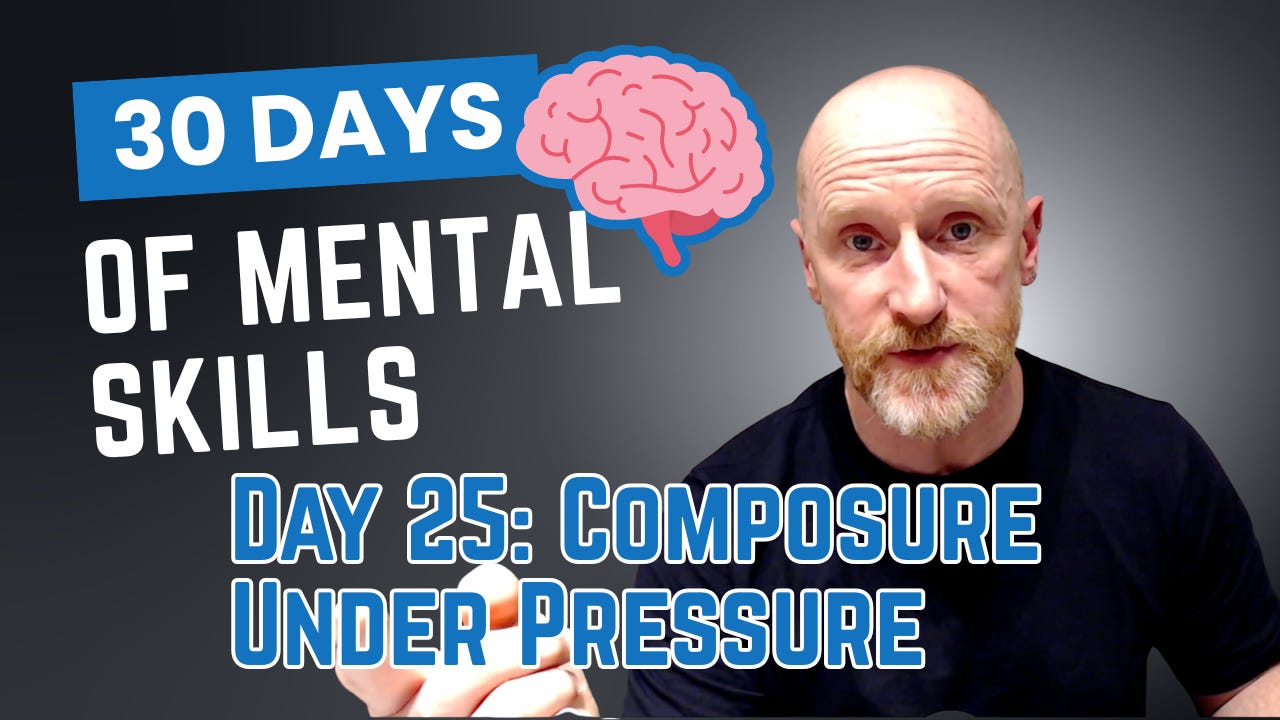
Day 25: Composure Under Pressure
from Peak Performer · host Larry G Maguire | Psychologist
I’m discussing composure today, on Day 25 of the 30 Days of Mental Skills series. In the heat of performance—whether delivering a speech, competing in sports competition, or leading a high-stakes meeting—emotions can either enhance or sabotage our efforts. Emotional regulation, the ability to manage emotional responses in ways that support performance goals, is one of the most vital mental skills for success.Based on Dr. Jack Lesyk’s work at the Ohio Centre for Sport Psychology, this article explores how performers can build emotional resilience and regulate their internal states to perform at their best under challenging conditions.Understanding Emotional Regulation in PerformanceStrong emotions, such as excitement, frustration, nervousness, or even joy, are not your enemy. In fact, they are a natural part of the performance experience. But unmanaged, and despite our best preparation, they can lead to distraction, poor decision-making, and self-sabotage.Emotional regulation is not about suppressing feelings. Instead, it involves recognising, accepting, and using that emotional energy constructively. According to Lesyk, successful performers “accept strong emotions such as excitement, anger, and disappointment as part of the sport experience” and “are able to use these emotions to improve, rather than interfere with high-level performance.”This mindset is central to success across domains of human activity, from sport to surgery, from public speaking to competitive business.Mental Skills that Support Emotional RegulationAs we have discussed over the past three or four weeks, and as Lesyk identifies, there are nine core mental skills that every peak performer must develop. Several of these directly support the process of managing emotions under pressure. These skills are not innate traits. That is to say, it’s not a case of having them or not having them. The nine mental skills are learnable and trainable; let’s review them now.Self-Talk:Negative self-talk often triggers emotional spirals. Doubt, fear, and critical inner dialogue can amplify anxiety, frustration and anger. Successful performers in all walks of life and work use positive self-talk to maintain perspective and composure. They speak to themselves the way they would to a trusted friend: encouraging, realistic, and compassionate. Coupled with deep breathing exercises, you might say to yourself, “I’ve prepared for this, I’ve been here before, and I have the right response”. “I have the skills and ability.” “This feeling will pass.” This self-directed conversation helps shift the emotional tone from panic to a state of presence. However, don’t wait for the event; instead, practice it regularly.Mental Imagery:Mental imagery and rehearsing calmness prime the brain and body to act with control under pressure. When you visualise your desired process executed to near perfection—especially while you’re in a relaxed state—you build neurological readiness for the real event. Your organism knows what to expect without your conscious effort. Emotional regulation improves because the mind has “seen” this situation before and has developed familiarity. A typical imagery routine might involve the following:* Finding a quiet space where you won’t be disturbed* Relaxing your body through conscious attention to your breathing* Create vivid, multisensory images of the event* See yourself play or perform as you desire* See yourself encountering a challenge and responding with calmness, clarity, and effectiveness.* Follow this same process for other members of your teamManaging Anxiety:Emotional regulation is closely tied to anxiety control. Lesyk notes that some anxiety can enhance performance—what matters is how you interpret the experience. For example, accept anxiety as a normal part of the experience. Don’t mistake nerves for fear. Use deep breathing techniques to control your nervous system and regulate automatic responses. Reframe the situation. Thoughts like “This pressure means I care” can help convert anxiety into motivation. By managing your arousal levels, you can maintain emotional control without losing energy or drive.Concentration (we’ll be visiting this in a later session):Distractions, both internal (e.g., worry, frustration) and external (e.g., noise, people), often disrupt your emotional control. Consider your capacity to focus the gatekeeper of emotion. When you stay anchored in the present moment and attend to the task, you are less vulnerable to emotional flooding. Pay attention to what matters most in the moment. Redirect focus when it drifts (especially during high-stress phases). Use controlled breathing and word cues, such as “focused, tuned in, ready, prepared,” to refocus your attention on the task at hand. Again, it’s essential to practice before the situation arises.Emotional Regulation Before, During, and AfterBefore the Event* Accept emotional arousal: Nervous energy is a physiological cue that the body is preparing to perform.* Visualise calm confidence: Use imagery to rehearse emotionally composed responses.* Arrive early: Avoiding time pressure lowers stress.* Warm up fully: Physical readiness helps emotional settling. During the Event* Stay process-focused: Think about the task, not the outcome. * Interrupt negative spirals: Use breath, a cue word, or even a forced smile to reset. * Adopt a playful mindset: When things feel too serious, pressure builds. Relax into the moment by reminding yourself that “you get to play,” regardless of outcomes.After the Event* Debrief with balance: Focus on what went well emotionally—not just tactically. Ask yourself, what went well and what can I/we improve upon?* Reinforce success: Finish by recalling moments of calm, composure, and control. Finish with things you did well.* Mistakes are hot stones: What would you do if you were holding a hot stone? You’d drop it, of course.Emotional regulation is not about being emotionless or suppressing our feelings. Instead, it’s about channelling emotional energy into constructive action. Developing skills such as supportive self-talk, imagery, anxiety management, and concentration enables performers to remain composed, focused, and effective—even in the most demanding situations.Mental Skills Basics CourseSuffering stress and anxiety is not a prerequisite for success in self-employment–there's a better way. Mental skills provide you with the means of coping effectively with difficulty and achieving your goals. I created the Mental Skills Basics Course to introduce business leaders, self-employed individuals, freelancers, consultants, and small business owners to the psychological and emotional skills associated with success. This is a public episode. If you would like to discuss this with other subscribers or get access to bonus episodes, visit peak.humanperformance.ie
Embed this episode
Ready to play
Day 25: Composure Under Pressure
No transcript for this episode yet
Similar Episodes
No similar episodes found.