
EPISODE · Mar 29, 2023 · 30 MIN
De-extinction: The Why and the How
from cc: Life Science Podcast · host Chris Conner
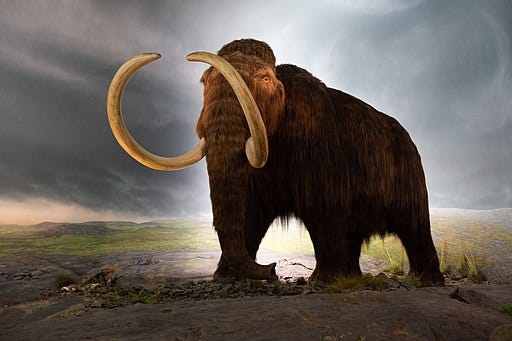
My first reaction when I heard that George Church wanted to bring back the wooly mammoth was, “Uh, why don’t we stop trashing the environment and save the species we have left?” Later on, I learned that I may have missed the point. It turns out that as engineers of the environment, wooly mammoths might enhance the carbon storage capacity of the tundra and help us all chill out a bit (slow climate change). That covers part of the why question but not all of it. This is a BIG science project so there is a lot more to it.I talked to Alexander Titus (he goes by Titus) from Colossal Biosciences to learn what it will take to de-extinct the mammoth, what we’ll learn along the way, and how you fund a project like this when the final product is not for sale. You’ll have to listen to the pod to get all the details but here is the TL:DR. Mammoths from elephantsThe Asian elephant is the closest living relative of the mammoth. There is some ancient mammoth DNA available but it’s incomplete. It’s not a matter of injecting it into an elephant egg and hoping you get some hybrid. This is a massive genome engineering project that starts with figuring out which genes contribute, for example, to the wooliness and cold tolerance of the mammoth and engineering those into an elephant to produce a mammoth.How does that happen? So many technical challenges! Can CRISPR technology be used to make multiple (hundreds?) of genome changes in one cell? Then there is the challenge of somatic nuclear transfer, etc. Probably a couple more things…. And if you successfully get a mammoth after all of that, what kind of environment will they need to thrive and expand the population enough to be eventually reintroduced into the Arctic? After that, it’s a question for science and society of accepting and protecting them.Not subscribed yet? Really? Let’s fix that. Next week we’re talking about manufacturing drugs in space. After that, who knows?Bioinformatics, AI and the business modelFiguring out which genetic variations matter and aren’t just neutral changes along with understanding the elephant genome including regulatory sequences no doubt, is an enormous bioinformatics project. That brings me to the business model. Titus says that analogies to the space program may be overused, but in this case, it seems appropriate. There are many technologies and capabilities to be developed along the way that could be commercialized to support the core mission. One example: Colossal recently spun out a company, Form Bio, based on their bioinformatics technology that will help the cell and gene therapy industry.We chatted briefly about an AI component of this project. How do you identify all the elements of the target environment? One way is by listening and identifying specific sounds. That’s tedious and time-consuming for a human being but…My team in particular developed an interesting way to use machine learning, unsupervised, and actually read through and listen through audio. And instead of having a manual annotator, someone who goes through and listens to something and puts a little mark in their digital notebook, we can actually have an algorithm go through and say, “There is a point of interest.”Then a human can go directly to the annotations and try to identify the source of those sounds in the environment. Given all the tech needed to make these projects happen and the biology learned as a result, more spinoffs seem likely. But wait! There’s more.The mammoth isn’t the only animal on the bring-back list. Scientists at Colossal are also working on the dodo (not long extinct) and the Tasmanian tiger, which I learned is not actually a cat. The thylacine, although it has stripes that make it somewhat resemble a tiger, looks more like a dog and is actually a carnivorous marsupial, as is (fun fact) the Tasmanian devil. The last one in captivity died in 1936. Each of these is significant for restoring their native ecosystems. As you can tell, while there are lots of questions to be answered yet, I’ve become a fan of this project for its sheer boldness and the joy of discovery. We’ll cover another bold project in the next episode: manufacturing drugs in space. More why and how questions. Make sure you subscribe and share. And let me know what you think about all of this in the comments. The interviews with my guests are the highlight of my week. Listeners seem to enjoy them too.Conversations are fun and your deepest insights are your best branding. I’d love to help you share them. Chat with me about custom content for your life science brand. This is a public episode. If you would like to discuss this with other subscribers or get access to bonus episodes, visit cclifescience.substack.com
NOW PLAYING
De-extinction: The Why and the How
No transcript for this episode yet
Similar Episodes
Mar 26, 2026 ·1m
Mar 19, 2026 ·34m
Feb 18, 2026 ·11m
Feb 11, 2026 ·45m