
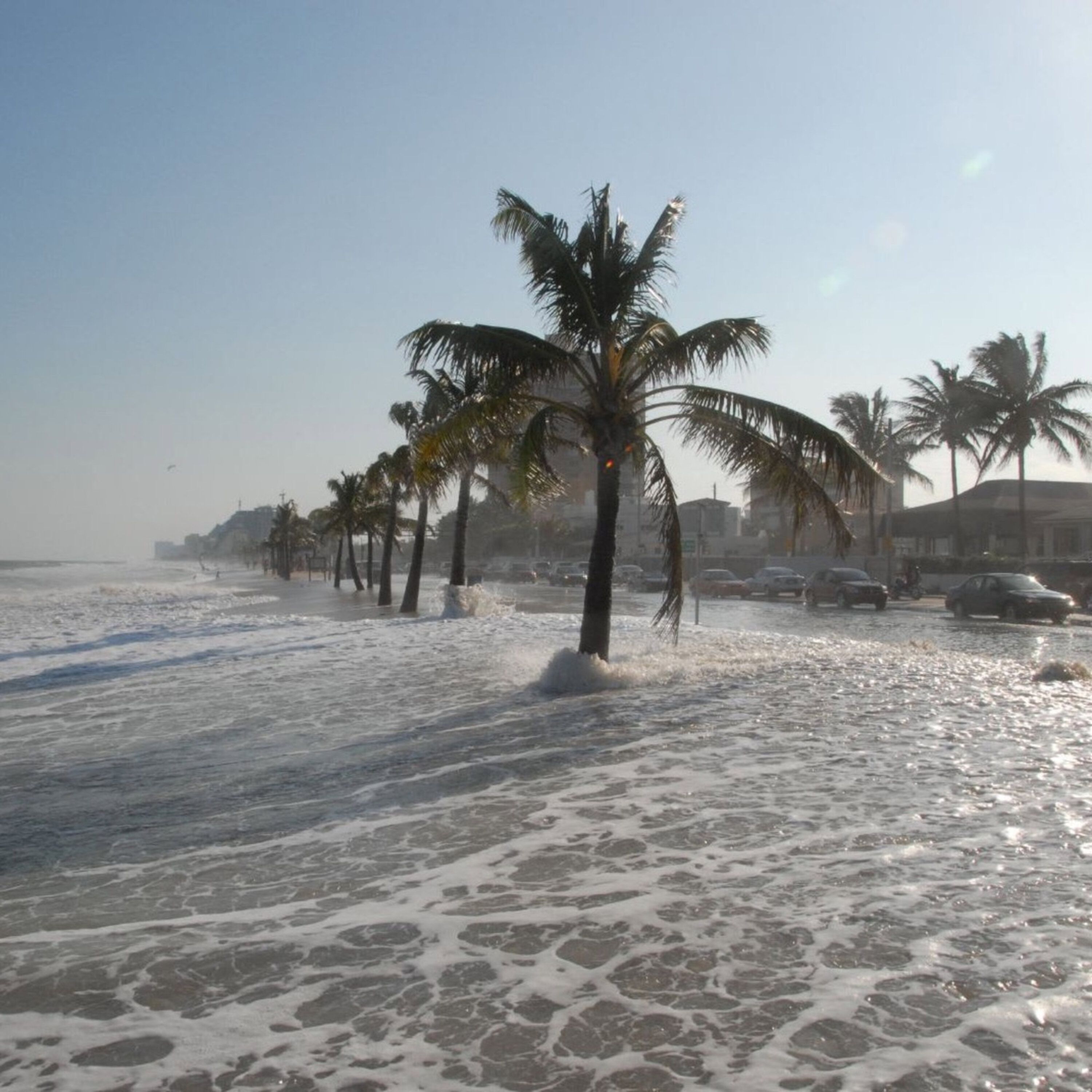
Hey everyone, it's Natalia Reagan for StarTalk All-Stars. I am a primatologist and co-founder of the anthropology nonprofit Boaz Network. And here joining me is Tim Alexander, comedian extraordinaire. And today we're going to talk about a hot button subject that's not going to cool down anytime soon.
Climate change. What we want to talk about is how climate change has been caused by humans and affected humans and also other species out there. And joining us in studio today, we have both biological anthropologist Dr. Todd DeSital of New York University.
Hey Natalia. Hey. And Dr. Ian Tatter-Sall, paleoanthropologist at the American Museum of Natural History and author of the Natural History of Wine.
Hello. Thank you so much for joining me, guys. So climate change. It's obviously on everybody's lips.
And we want to talk a little bit about how climate change is something that is not new to the world. There's been multiple events of climate changing. But what makes this different? Well, we have a very good record of climate change that goes really back as far as the human family goes, the human ancestry goes.
And it's very clear that we've always lived in a world of unsettled environments. And environments have regularly changed on a quite short-term basis. And it's never really mattered before, because for most of our evolution, we've been hunter gatherers who could just move around. If the shoreline moved inland, our ancestors could just move right there along with it.
And it wouldn't perturb their way of life too much. Now we have this enormous amount of infrastructure which we created and installed along the seaboard and which really is threatened by the latest around sea level rise due to climate change. So it kind of painted us into a corner with our advancements as a civilization in a way? That's exactly right.
We have established a way of life that depends on a stable geography. And a stable geography is what we have not had in the past. Yeah, it would be nice if we could just take up, you know, take kids, put them in the station wagon and just go somewhere and be like, yeah, I'm going to sit down roots here and, you know, pick some berries and shrubs, what else? Yeah, not quite that easy.
No, no. What about you, Todd? We're also contributing ourselves to it, which is something that's been very different than in the past. In the past, the Earth has actually been transformed by different kinds of life forms.
So it's not unheard of for a species or a group of organisms to actually change the Earth, even change its geology and its geography. Like cows and farts that we often talk about. Or having bacteria. Sure.
And getting an atmosphere, getting oxygen from them. But what we're now pouring into the atmosphere is accelerating what's probably a natural trend. And I worry about a tipping point. And once we reach certain tipping points, we're going to see rapidly accelerated climate change.
I would definitely go down that path. That's really what we want to talk about. But are there other animals besides bacteria that have like a major impact around themselves and bacteria that have a major impact on climate that we can actually see? I would say in some regions, the type of damage you see elephants do in some regions when they become overpopulated and more or less deforested.
Deer here on the east, well, actually nationwide, but on the east coast. The lack of predators in some regions causing an entire ecological change, which actually changes the courses of rivers and all sorts of things. Absolutely. Beaver.
Beaver too. Yeah. That's a big one. And an interesting one is a gorillas, as a matter of fact.
We're all familiar with the gorilla display where males charge around being there, just tearing up alarms of vegetation around them. And what this is actually doing, it's not just social display. In fact, what it's doing is returning the vegetation to a lower level of succession so that the plants will push out new shoots, which is what the gorillas like to eat. See, no anger management classes for those guys.
We want to keep them mad. You can piss it off. That's amazing. Yeah.
Well, no, it's just even I studied spider monkeys and them as sea dispersers is a big deal. They actually eat the fruit. And when they defecate, when they take their dump, they basically redistribute those seeds. And hopefully knock on wood.
We get more spondia growing in different places, which they love to eat. So the cycle continues. Where else would you get your coffee beans from? Okay, I'm on this box.
Monkey butt coffee. I'm going to trademark that. It seems like that's a good thing. That's a good thing.
Exactly. Let's get on it, guys. But we've talked about how humans have been a part of affecting the climate. How are we going to suffer aside from our cities, but things like, for instance, pathogens that might not be spread in North America or coming North because as temperatures are rising, mosquitoes carrying these pathogens are affecting us.
That's really scary. I actually teach a course on emerging diseases. And we're going to be watching with just, again, tipping points, just a few degrees of change in winter temperatures and stuff can allow certain species to survive through all year. And so I think I predict we're going to watch Chukungunya and Dengue and Zika creep Northward.
So out of the Florida Keys, out of the Miami area, eventually into Georgia and Virginia. And I mean, there was a time when New York was practically uninheminable because it was a malaria yellow fever swamp. Tens of thousands of people died in Philadelphia and New York from yellow fever and malaria and all of those things. And those could re-emerge here further north into the United States than they are.
No longer just a borderlands issue with just a few degrees of change. And this is another reason why it's terrifying that we're cutting any sort of funding to medical research at this time because we need it now more than ever, especially with obviously these pathogens coming further north. But also I read recently that even frozen, perhaps ice sheets are melting. They could potentially be bacteria in there that are waking up and not that right there is a great movie.
And that's, but yeah, I think I'll get my go-by on that. Well, I think of the tens of thousands of bodies buried in the gulags permafrost that had and I just got lost. I think about that all the time, Todd. I can't stop.
And now those being unearthed. It already feels like a horrible swamp. When you go in the subway, the next month or two is just going to be a nightmare. I think it's going to be much, much worse just by a couple of degrees changing.
I'm going to move to me. Right. Just go further north. But no, I just, as of course, with the Arctic ice melting at a rapid level, you know we're seeing sea levels rising and the acidification of the oceans.
How will that affect you think people living in areas, obviously the South Pacific? Do you know anything about that? Oh, there is a tremendous problem in some atolls, particularly in the South Pacific, that actually become inundated when the weather is bad. If they have a typhoon or something that moves the sea around, that they're in risk of total inundation of some of the islets in the chain.
And so every inch the sea level goes up, the greater the risk becomes. And it's not only just the obvious damage that you get from the sea level rise of that kind. It's also the salination of the water tables. So if you're living on an island that is maybe it's a 20, 25 feet above sea level, that'll get you by most of the time.
And if the water that you're pumping up from it to sustain you is a brackish or salty, you're in big trouble. And if we look historically, I mean, there's been over 100 meter differences in sea levels in cold versus warm phases of, you know, on the planet. And if we don't, I mean, we could see sea levels. I mean, we're worried about inches or centimeters, but I mean, historically in the Pleistocene, in the last several million years, sea levels have gone up and down over 100 meters.
So we're talking, you know, the 22nd floor being underwater. Yeah, and here we are at folks at home. We are in lower Manhattan on the 22nd floor. So yeah, that's terrifying.
And in terms of how humans can, I don't know, sort of sustain or avoid that tipping point, what would you advise them to do other than just, you know, drive their car less, maybe eat food from a local source? What would be your advice? Well, I think the clear advice is to reduce the amount of carbon and other greenhouse gases that are being pumped into the atmosphere every day. And the numbers are just mind-boggling.
Really, if you look at the pattern of climate change in the immediate past, you would be predicting that we would be about ready to go into another ice age. And in the ice ages, the ice caps build up, water gets sequestered from the sea, sea levels go down, more land is exposed along the edge of the continents. And from the point of view of sea level, this is not going to be a problem if the climate gets colder. But right now, there's absolutely no sign of this, and the signs are that the planet is warming and it's warming at an alarming rate.
And although it's always very difficult to pinpoint a specific cause for a specific observation that you may make, we do know that what you would predict from what we're doing in terms of filling up the atmosphere with greenhouse gases. This is the effect that that has. And since we know we're doing a lot of it that we don't have to do, if we want to protect the enormous investment that we have in infrastructure that might be inundated, then we really need to do something about that. And we also need to, if you look at a map of all the major urban centers and cities, I mean, we really are coastally oriented.
And with globalization, with almost all of that freight moving by ship, people naturally migrate to coastlines. And so that's going to doubly affect us because we are so concentrated in the areas directly most at risk. You know, the best ports have nice anchorage, and then the cities just right there, you don't have to climb a mountain to get to it. But all of those cities are now at risk.
Now, that's an excellent point. Being from Los Angeles and now living in New York, I know what it's like to just be kind of in constant fear of, oh, gosh, when's the next, I mean, Ellie doesn't have hurricanes. But of course, Sandy, a few years back, you know, it really did quite a lot of damage to New York. And from that, it's costing millions, if not billions of dollars.
What would you say to somebody who says that it was so cold last winter? The idea that whether is not climate, how would you explain that to somebody who may be on the fence about climate change? Well, whether is always fluctuated. And what you have to do is try to figure out the long term signal and to separate it from local fluctuations.
And that does seem to be an alarming signal going on. I remember the days when every winter, the Hudson River down here used to block up with ice flows. You could practically walk from New York to New Jersey on the ice. Every winter, just with the ice that came down, floating down from the North, clogging up the river.
And we haven't seen that. We haven't seen that for 20 years, maybe 25 years by now. And, you know, I mean, again, with these fluctuations, like going to a casino and having a short-term run on the cards, but ultimately that casino's got an edge on you. That's the trend.
So no matter what you do in Blackjack or the slots or whatever, the trend is towards the casino. And that's what we're seeing here, even though you're going to have a lucky night or a lucky week or just one short, lucky street over the course of time, you're going to lose. Yeah, that's very well said. And we just have to remember that what we have to react to is what's happening right now.
You know, if we're going to protect what we have created with the great sweat and toil over the last couple of hundred years, it's going to be absolutely necessary to do something to protect that infrastructure. And we need to do everything we can, even if there's going to be a reversal in a hundred years. It doesn't really matter if our lives are completely disrupted in the meantime. No, it's worth it.
I'm going to number one on totally stealing that. The cards, that's a great way to understand that. And then it seems like the argument to me made here is really interesting because it's not too often that you hear really like economical argument being made about like why this is going to matter. You know, like this is such a politically divisive topic and frequently people who are kind of against climate change somehow, like it's like it's something to be against are kind of like they're looking at their business interests.
Like this is super in their business. But if you look at the military and the large corporations, they're all really thinking about this carefully. They just are careful how they put that forth politically, but they're all researching it. They're trying to figure out ways they're trying to protect their interests.
Yeah, it's short-term versus long-term goals and achievements. I mean, clearly it's going for the long haul, you know, when you're going to take care of your environment and then really think about what you're putting into the environment. Yeah, but people have a very short-term tendency. You know, they tend to look at immediate problems as something going on right now.
What do we do about it? How can we adjust it? And longer-term trends, if it's not threatening you tomorrow, then maybe we deal with tomorrow's problems today, not next week's problems today, not next month's problems today. We'll wait and react to those when they come.
And then by the time they come, it's often too late. It's that oh shit, no, man. Yeah, I always used to think that it's almost the whole idea of reproductive success or, you know, the idea that we haven't really achieved reproductive success until you become a grand parent, essentially. And now that our grandchildren are directly at risk of not surviving into the future because of what's going on in the world, we're now having to take stock of what can we do to change this, reverse this.
Yeah, we need to adjust our perspectives. Yeah, absolutely. And a message to my boys, put off those grandchildren for a while, please. Yeah, I think they're good.
I think, yeah. Well, do you want to maybe one quick cosmic query? Yeah. The question I find most interesting here, Cody Mathis.
He's a patron by the way. Thank you very much, Cody. Great. It's just what American wildlife, what other American wildlife may be negatively impacted and driven to extinction by the effects of climate change?
What do you see is really kind of, I guess, on the brink right now? Well there's going to be a lot of, as again, the temperature shifts, that's going to shift where different kinds of plants, the primary source of food for a lot of these things, so I think things that are coastal are going to be the ones more directly impacted. But because climate change and warming puts more energy into the atmosphere, ironically, we can have worst blizzards and more so fall and things like that. So basically nationwide, I think it's going to affect a lot.
The most immediate, the affected one are going to be the insects though, because they're the ones that are most directly tied and sort of a very low level in the trophy pyramid. So I think we're going to see a lot of insects shift to get booted out by other insects, out competed by other insects. We have to remember that we live in an environment where the flora and the flora have been under siege for quite a long time. When humans have made extraordinary difficulties for animals trying to live in their habitats as they evolve to do.
And what we've done is we've basically selected out the ones that were not very well suited to absorb the kind of stresses that have been thrown at them. And so in a sense, the fauna has already been sort of, what would the opposite of winter rise? It's been sort of summarized. I'll take it.
No, but that's a great question and thank you, Cody. But we're going to have to wrap up this portion of Star Talk All Stars, but stay tuned. We're going to talk about what other animals and species have been affected by climate change. Welcome back to Star Talk All Stars.
I'm your host, primatologist Natalia Reagan here with my comedian co-host, Tim Alexander. And paleoanthropologist, and Dr. Ian Tattersell, the American Museum of Natural History, also the author of The Natural History of Wine and biological anthropologist, Dr. Todd DeSital of New York University.
Today, we're talking about climate change and how humans are causing it being affected by it and also how other species are faring as well in the past and the present. But right now, I have a question for Ian because he has this great book called The Natural History of Wine. And I want to know how actual the growing of wine grapes is being affected by climate change. Always being very greatly affected by climate change.
Great, great, great. The great thing is that, you know, basically, wine making starts as an agricultural endeavor. And farmers, of course, are always complaining about the weather. But now they have a lot more to complain about than they're used to.
And with climate change, not only are the seasons becoming less predictable, but in some cases, average temperatures are warming up and making it difficult to grow grape varieties that are sensitive to particular ranges in average temperature. But there is good news on the horizon. It used to be that in Southern England, you really couldn't grow grapes. You really could not grow grapes that would compete with the kind of grape-seventh growth.
It was too rainy. It was too cold. The grapes wouldn't like them properly. They got milled here.
It was very terrible. But over the last 20 years, a industry producing sparkling wine has become well established in the south of England. And in fact, one of them, one of the English sparkling wines, just won an international award against all the competition from Champagne. So it's not all one way.
So they're benefiting from this climate change. Wow, do you have a particular favorite wine just for the listeners at home? Well, my favorite one. If I could only drink one wine, it would have to be a white wine from Burgundy.
And Burgundy is in central part of France, as you know. And it is being somewhat affected by climate change, although the preferred variety for the white ones, the Chardonnay, is actually quite tolerant of temperatures. Pinot Noir, on the other hand, which is their red grape down there, is much more difficult to grow. Very sensitive.
Fussy, fussy, a little grape. Well, that's very interesting. Because again, this is a section where we talk about other species that are being affected. And grapes are plants.
They're part of our... I'm worried about hops. Yeah, exactly. How's beer being affected by climate change?
Well, so there's this famous, the 48th parallel is where they grow lots of different hops. For the listeners at home, where is the 48th parallel? Well, it runs through Oregon and Washington and around the world. I'm going to assume that's a latitude or latitude, I think.
Yes, that's a lot of different. And there's lots of different varieties of hops that are grown there, especially for IPAs and other things. But as climate change shifts, those growing regions are going to shift. But again, we might open up new places to grow them that you weren't able to grow them before.
There's another aspect here too, is that wine is a product of a place. And you usually grow the grapes in the same place that you make the wine. In beer, you assemble many, many different ingredients. You've got your barley and of course, and you've got your hops.
And the hops can come from a long way away. So maybe the individual beers are less affected by the climate change in any particular one place than a winery would be. Oh, okay, interesting. Well, there's an effect nonetheless.
Yes. So we want to also talk about how we've seen climate change effect species in the past. And since both of you have studied paleoanthropology extensively, we would love to talk about what have you seen in terms of any sort of archaeological finds, genetic markers, talked to us. Well, we can by looking at species living today and looking at their genetic diversity, we can actually extrapolate backwards in time to how diverse they were at certain periods in their evolutionary history, not all the time, but sometimes.
And we also have a very good paleoclimate record. We know approximately what temperatures were, what oxygen and CO2 levels were, what sea levels were. And so we can look at phases where a particular environment might not have been as conducive for a species. And we can see these signatures in their genomes going back in time that at that last glacial maximum, this species was reduced dramatically in numbers.
And at the one before then, we can sometimes see these signatures in their genome. So we can see in the past, major climatic changes have dramatically affected species diversity. And the past is the key to the present. And so if climate shifts, we can assume that we're going to see similar changes in different species in the future.
So it's a great modeling technique. And there are some species that are already very reduced in numbers. And those are going to be the ones that are going to be particularly affected by climate change, like probably half of the primates. Oh, I would say at least half of the primates.
But of course, it's very difficult to disentangle that effect from other more direct effects that human beings are having on the other animals with which they share the globe. What's interesting to me particularly about this question, apart from the fact that Tard has just implied that a response, one response to climate change might be a very major reduction in human population. It would not be something that the people affected or their descendants would want to look forward to. But what it interests me about this story is what the archaeological record tells us about how people have handled this kind of thing in the past.
And if you look back at the archaeological record, you find that really innovation was a very rare and sporadic things. And we know that the climate was changing quite regularly and yet the people would use or the proto people, whatever you want to call them, would be using basically the same kind of stone tool for a million years, even as everything changed around them. And they seem to have been adapting old tools to new purposes as climates changed and environment changed and the excision season on them changed. And now we're in a very experimental time because only a few tens of thousands years ago humans stopped reacting to change in this way, finding new ways to use what they already had.
They started inventing new kind of ways of dealing with new excision seas and that has just snowballed. So now that change has become the norm instead of being something very, very rare. And part of this change is in fact this enormous amount of greenhouse gas and so on that we're producing and we are no longer dealing with things in the way that our ancestors used to deal with. We've got no track record, we've got nothing to learn from in the past.
We only have the present to look around that and to react to. And as far as I'm aware, there's only one aren't clad law of human experience. And that is the law of unintended consequences. And that's the one we have to look out for in this situation.
Yeah, well, I just, I mean, even in terms of invasive species and things of that sort, like we're going to solve one problem that's bring cane to Australia to wipe out all the locus and what do you get, locus fly can'tunes don't. Now you've got a cane tote problem. So basically we've learned that necessity is a mother of invention and right now we're forced with having to invent a lot of ways to get us out of this hole. We've graded for ourselves.
So people have been around for millions of years, like the way that we are to, we've not, but we've only been inventing for 10,000 years. Well, we have been around our species has been around for about 200,000 years. And it's despite what you might have read about it. We'll be talking about that.
As we know it, it's really only been around a couple of thousand years as far as we know. And it only started behaving in this very strange way that we see less than a hundred thousand years ago. We only have few tens of thousands of years ago. I'm talking 50, 60,000 years, which is really an idling in a seven million year evolutionary history.
But the pace of innovation has just dramatically since then picked up. And hopefully we can use that human spark to figure out, you know, we do have renewable techniques. We might be able to sequester carbon. We might be able to do geoengineering, but it's going to take a will to those are long, long term investments, something your average stockholder isn't.
And that's the thing that I think is important to drive home to those that are wondering what can happen to their bank accounts and their paychecks is sure it might suffer in the short term, but in the long run, this is something that it's going to save future generations. And also can turn things around. And I think there are enough brilliant people out there that have answers that if they were given the means to do something could really turn this around. And I hope that that is what continues to happen.
And of course, I think this push for science and health science has become completely, it should never become in Vogue, but it has become in Vogue. And I hope that it continues to stay that way and people will want to contribute financially to those climate scientists. I also want to talk about, actually, we should probably take a cosmic query. I feel like a cosmic query is coming on.
Yeah. I have another one that I loved here. Wondering about, so this is from Alster Gray. And he wanted to know about the ocean acidification and its influence on the actual physical size of ocean life and given the reduction of oxygen levels in the ocean.
The actual effect on size, I'm not sure how the oxygen levels themselves are going to have this kind of effect. What we do know is that the many, many microorganisms, particularly in the sea and some larger organisms also, that depend on forming carbonate skeletons, having a hard time maintaining those skeletons with the more acidic seas because calcium carbonate, which is the basic substance of which those skeletons and structures of form, is soluble in very weak acid. So even if you get even a little bit of ocean acidification and then you add ocean warming to that, which is basically upsetting the whole balance of what's going on in the oceans. There's a huge knock on effect on marine life.
So there's animals that are trying to form their shell and they simply can't because that's right. That's right. If you're an animal that lives in a shell, even if it's a little tiny microscopic animal one cell, and it depends on forming a test, and those tests become thinner and more brittle because they can't maintain them with all the acid run. That is a very severe consequence.
Those are a huge component of the food chain. So that's going to have knock on effects all the way up. The trophic cascade, it's all kind of trickles down. Wow, yeah, that's like soft shell crabs for everyone.
Geez, Louise. Yeah, it does sound delicious. Yeah, but not for the crab. Oh, you've got any other?
Good. So another one. All right, so do we know why Avians survived mass extinction 66 million years ago while other dinosaurs and their animals or similar even smaller sizes didn't? That's from Gavin Minton on Facebook, by the way.
No, no, no, no. It's a very wonderful question because only a few of the major groups of animals really came through that enormous event at the end of the Cretaceous period, about 66 and a half million years ago, when there was simultaneously, there was apparently very high active flood volcanism going on. And while all this was going on, there was a huge media impact, a few worldwide impact, and had very, very severe consequences in terms of affecting all life in a very large percentage of, certainly at a species level, which is very hard for us to look at from this range, but I mean, the effect was really, really, really severe. And only a few groups, major groups happen to make it through.
And why exactly the Avians got through that did, I'm not in a position to answer for it, but I mean, other things like, you know, it's quite obvious why Crocodiles and Alligators made it through, for example, because they do borrow in rubber banks, which would have protected them somewhat, and they can go for a year without eating anything, and they can live during a volcanic winter or an impact winter on the awful. So it's those very, either animals that were leading a sheltered life where some individuals were not exposed to the immediate effects of the meteorite impact, and animals that were able to cope with this volcanic winter that transpired after the impact. Well, another thing that may have had an impact is, and the volcanic winters and those things probably helped spread this, is we saw a major transition in the types of plant life at the time to the flowering plants, and flowering plants have seeds and fruits and things like that. So if you think of the little mammals scurrying around the undergrowth and birds, both of whom are major consumers of the product of flowering plants, they might have just had just enough to eat it through, and then as that world changed for the better, after the immediate impact, they were well-suited and their competitors were gone.
Yeah, now it helps. I mean, diet has played a huge role in what survives and what dies out. Carnivores have it rough, because that, again, that darned trophic cat is a cascade. But we're actually done with this portion of the show, so please stay tuned, and we're going to be talking more about climate change and how it's affecting current species right now, right here.
Hi, welcome back to Star Talk All Stars. I'm your host, Natalia Reagan, and I'm here with my comedian co-host extraordinaire, Tamale Alexander, and Dr. Todd DeSatel, a biological anthropologist at New York University, and Dr. Ian Tatter-Sall, a paleoanthropologist at the American Museum of Natural History.
Today we're talking about climate change, which is not the most joyous subject. We're trying to eat some fun out of this subject, because, you know, why not? And we want to talk right now about actual other species other than humans that are currently being affected. And one of us here at the table actually has a lemur named for them, or a Shafaka, the...
Oh my god, oh my god, Perpetha... It's called the Golden Crown Shafaka. Yes, but it's the actual scientific name I just totally butchered it. Oh, I'm far too modest to say that.
Perpethicus, Tatter-Sallie, right? You got it. I'm so sorry, I was going to get it the first time, but I want to talk to you about the discovery, but also how this particular Shafaka is being affected by climate change. Well, this is a glorious animal.
It's about the size of a very big cat, and it has very long legs and wonderful, wonderful eyes that look at you very quizzically. And it lives in the North of Madagascar, very close to the northern tip. It's an area where there's not much forest, lemurs are forest living animals. Lemurs really require trees to survive.
And this is an area where there are not many trees left. And this is a population that's holding on in some forest remnants. And the more remnant the forest is, the more vulnerable it becomes to all sorts of things. Drying is going to affect the forest very badly.
Hotter temperatures are going to change the aspect of the forest. And freak weather, unexpected extreme weather is going to have a big effect. There was a huge cyclone last year that waxed the East Coast of Madagascar, just south of where these animals are. It did a terrible amount of damage to the forest along the ridge, along the coastline.
And weather like that could easily affect the habitat of the Shifakas too. Yeah, and interesting about I love Shifakas because they're the cleaners and the leapers, and they basically are essentially tree huggers in their own way. I highly recommend that you Google what this is because they are, first of all, gorgeous. And you have a beautiful, beautiful animal name for you.
I'm very impressed. And it does look like it has a little golden crown. It's very attractive. It's kind of like a strawberry blonde lemur, honestly.
Maybe it's why I'm partial. But let's talk about how other animals are being currently affected and how scientists look at ways to conserve them. We talked about population viability. How do scientists tackle problems of trying to up the numbers of a certain species?
Well, we have to sort of marshal our resources and can only really put them in certain areas. And so one of the things conservation biologists always aim for is to try to have the maximum amount of genetic diversity and within the animals that they're trying to conserve or help, as well as the general biodiversity of the region they're in. The more organisms you have, the more resilient an area is going to be. When you become depopirate in diversity, then you're going to be subject to freak events.
And when populations get very small, like a single cyclone, a single drought or a single forest fire could take out 10, 20, 30% of all the individuals left. Then you got to sleep with your brother. And who wants to do that? Nobody wants to do that.
Except for now, baby. Oh, yeah. You went there. Sorry, all of them is going to stay out of it.
It's OK. You know, necessity is a mother of invention. Because there are ways to prevent inbreeding. But when I guess when you get down to that level, I mean, even Bible offspring in front of you in issue.
Yeah. And so you can go to, we do have examples of species that have survived and rebounded from very, very tiny levels. Is it George the turtle or tortoise? Oh, the Galapagos tortoise.
Well, even elephant seals, I know, came back from a majority of elephant seals on the coast of California are from a very small population that basically just had a big boom. But to try to avoid that happening is always a good thing. And so we can use the tools of genetics and other things. But also picking our environment.
If you only have enough money for ranger patrols for certain parts of certain large areas, you want to sort of allocate those so that animals can get between the different remnants. Yeah. So Coradors, for instance, I studied Spider monkeys and Panama. And that was a big problem.
They were living in essentially islands on a landscape. It was this large territory. But they were these little tiny fragments. And they had no way of getting to other groups.
So basically they had no one to shoot up by each other. And that's a problem. There's push to have reforestation and little corridors made. And even there's monkey bridges.
I've seen in different places in Central America that allow monkeys to cross actual roads. Why did the chicken cross the road? Why did the monkey cross the road to go have sex with somebody who's not his brother? I mean, that's basically what's happening.
And that's it right there. Yeah. But that's it's it's it's really evident for your brother. Oh, God.
Wouldn't it be great if I didn't have a brother? Awkward. No, but I do think it's yeah. I mean, that's something that I feel like in conservation, you're constantly having to come up with you have to be the necessities of other invention.
You have to and that's the thing is we're doing I think a good enough job trying to help other species, but we just need to do a better job helping ourselves. And I always feel like primate conservation is also very selfish and duffer because first and foremost, we are primates. And if we're saving them, we're also doing a small part to save ourselves. But in many areas, they're also like sort of a keystone species in an ecosystem.
And so the health of primate populations actually sound and up across the entire area. But I had mentioned, you know, we need to just increase general biodiversity. And one of the things climate change could do is actually dramatically reduce biodiversity by again having more uniform and higher temperatures across vast regions, which didn't happen. It didn't happen before.
That's going to change things. But also just the production of storms and just unpredictability. Unpredictability is a really bad thing economically and biological. Sure.
Interesting. We were talking about in the very first segment, the idea that what makes climate change so dangerous for humans is we built up these sort of infrastructures that really make it dangerous when we have a major weather event like a sandy or a Katrina or a cyclone or even things that aren't weather, but earthquakes, things like that. We're very vulnerable in America and North America. But when I think of animals that generally survive massive climate change events, we talk about generalists.
And if we're going to get to primate generalists, we've got humans and we've got macaques, which we were just talking about during the break. And macaques are species of primate that are like humans or kind of trash compactors. They can eat anything, basically almost live anywhere. But they don't have this infrastructure that we have.
So for instance, if climate change gets any worse, I think it really could be like we've talked about in the past, planet of the macaques. Well, that are raccoons, coyotes, other sort of weed species that the human environment that we've created is very conducive to them. And it will become more conducive to them. Yeah.
But if humans were out of the way, then all bets would be off since this is a constant presence and there's no way to predict what's going to happen in the world with humans in it. It's much easier to predict what would happen in the world without humans than it is with humans. I just like that. When we were off air for a moment, I learned a ton just sitting here today.
But the thing I'm going to take away is the macaques are dicks apparently. That's like the big takeaway to that. And so I just like to do with some other thing that's someday about like what makes them such ticks. But you know what it really is, is because they're smart.
You know, we were also talking to the break about other smart animals that's how he was talking about capogens, which can be a bit of a handful at times as well. And it turns out that the smarter you are, the more obnoxious you are. And that is almost happy as the most vulnerable planet. Those members of Menza, man.
Unoxious. Really smart. It's just interspecific, but it's not specific. But we're just talking about just, you know, even like coyotes taking over the idea that even hybrids that we're seeing now like koi wolves and, you know, hybrid fish and even salamanders in California is a way that animals are trying.
You know, it can basically you'll have you'll have sex with pretty much anything that looks close enough to you. And if you can have the viable offspring, what does that mean for the species? Who wins in hybridization? Usually the offspring.
I mean, we, you know, this general concept of hybrid vigor, if they're actually fully fertile, then usually they're combining the best of both sides. I mean, you know, I predict you got about 2% Neanderthal in you because 40,000 years ago, some of that happened. Probably more like, yeah, probably even more. You should see my dad.
Sorry, dad. But you know what, the hybrid thing is if it works one way within species and it works one way between species. And as Todd pointed out, genetic diversity is really, really important. And any time two strains within a species come together, that increases the diversity in them both.
But if you're a different species, if you're no longer reproductively compatible to the degree that's necessary to maintain the species, then that'll all be wasted effort. I mean, at least the, you know, the intermingling part of it is going to be wasted effort. I mean, you might not subjectively think that it was wasted but evolutionary. It meant something.
Okay. That's me. That's me. Very close.
I did read something and I might be getting it wrong, but they surmised that when Neanderthals and anatomically modern humans were, I think it was a male Neanderthal in a female, yeah, in a female, did not produce viable offspring or was one that was more likely. Well, you know, I would place a private bed and I had no idea how I would prove it to win it. But I would suspect that the males of homosapiens, maybe Neanderthals too, would make with practically anything. But I'm pretty sure that those female Neanderthals didn't want much to do with those sort of some standards.
I would imagine. By me dinner first. By me dinner. I'm really right now.
Yeah, exactly. So we have time for one last cosmic query. What we got. All right.
So Colton Zabel, another patreon, asks, this is a lot of words. So I'm just going to kind of summarize it here. But there was news of the discovery of an older homosapiens. And so he wanted to know just how does that change our view on how long we expect these species to live, they live together.
Now that we've got the very news of that, do you want to comment on that? And then I have a comment. All right. I'll be very quick then.
This new find from North Africa is a wonderful find, but it isn't homosapiens. It may be a very close relative of homosapiens, but it really does not take our species back to the 400,000 level that has been claimed. On the other hand, it takes some of the behaviors that we might have associated with homosapiens back a bit. So that's very interesting.
And I would argue that it actually doesn't change the story very much. Even if we had crossed the threshold from whatever was presapiens to sapiens, only one population of homosapiens within Africa ultimately gave rise to us all. So even if they were perfectly modern people like ourselves indistinguishable, they didn't leave offspring. Or so we still trace our ancestry back to 200,000 years.
It just means that for 100 or 200,000 years there were multiple groups of modern people, but only one is the ultimate ancestor of the people alive today. Okay. Okay. No, that's very interesting.
I feel like the paleo-anthro puzzle is constantly getting filled in. And sometimes there are dead ends that happens, but... There's some extra pieces. There are extra pieces, right?
I don't know what to do with that. I don't know what to do with that. And then missing ones. Yeah, exactly.
I think I went on a date with one. Okay. Thank you so much for listening to this episode of Star Talk All Stars. Thanks to my co-host, Tim Alexander.
Where can folks find you, Tim? On Twitter and Instagram, Tim Alexander NYC, and I'm performing at Tierney's Tavern on the 25th. Awesome. And Dr.
Todd, where can people find you? Oh, I have that Twitter thing too. At Todd, does it tell? He's pretty funny.
You should follow him. I'm Dr. Ian Tattersell. Well, I'd advise you to find me in the bookstore with a natural history of wine.
Please buy it. It's awesome. And thank you so much. And remember to stay curious and keep looking up.