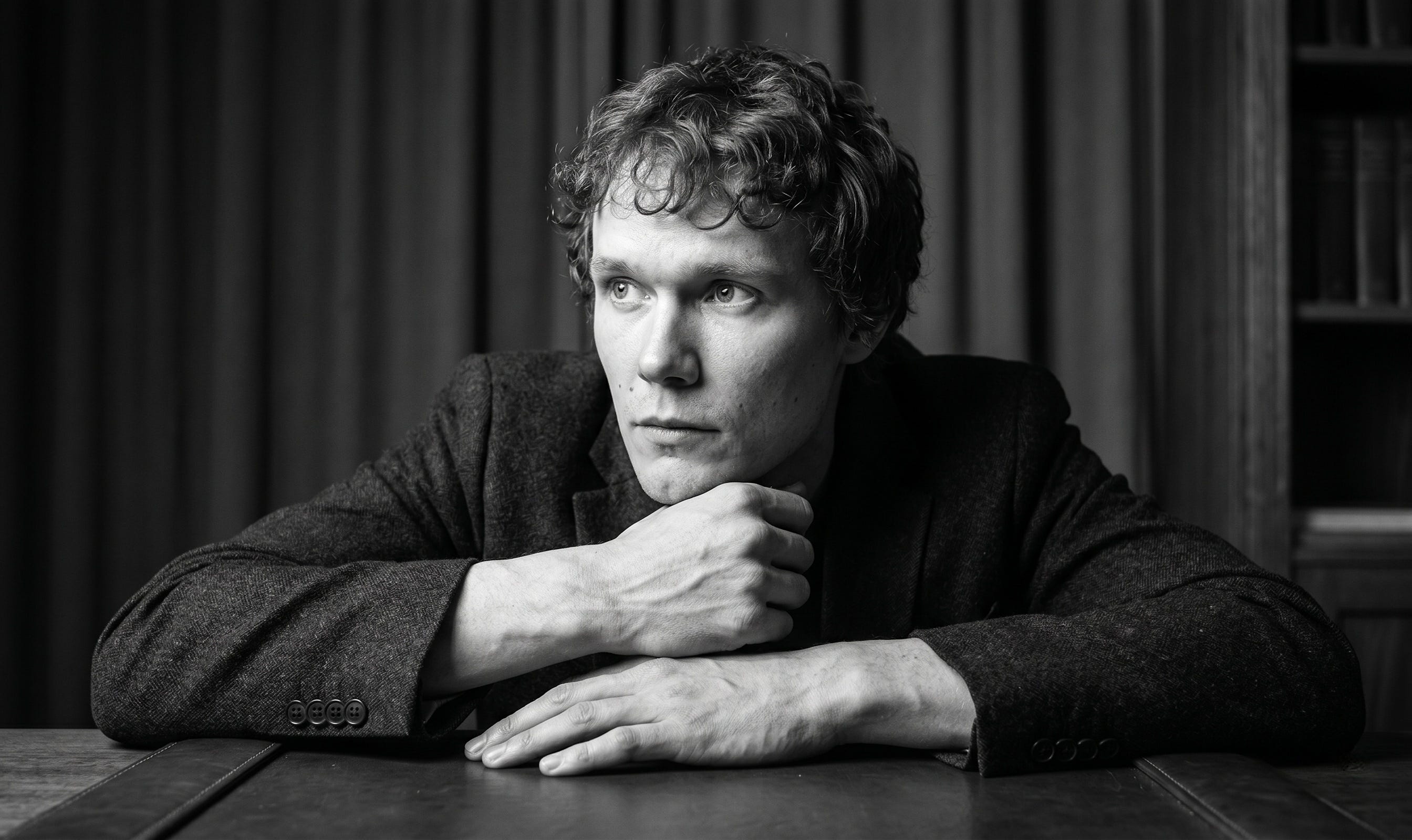
Death is an Engineering Problem
from Originals - Humans Building the Future Hosted by Matt Mireles
Science just discovered the antifreeze that makes reversible human cryonic freezing possible. The only problem is that it kills the patient. Dr. Alex Mathiasen, PhD, a 32-year-old mathematician with no lab, no chemists, an Oxford physicist co-founder and a stack of GPUs is betting his career that he can compute the poison out of existence using quantum simulation. Cryonic toxicity is the last wall. And his parents are sixty. Alex Mathiasen was seven the first time he understood that everyone he loved would die. He sat on the floor and cried, and his mother gave him the only comfort any parent has for this particular arithmetic: don’t think about it. He ignored her. He is thirty-two now, a Danish mathematician with a PhD in algorithmic optimization. For his entire adult life he has aimed that one skill at a single target, and it has carried him here — to a company called Vitrify Labs, and a proposition that sounds, on first hearing, insane. Scale beats clever. Even in biology. Mathiasen wants to build a pause button for human biology. Stripped to the studs, the idea runs like this. Take a person who has run out of time — late-stage cancer, an organ failing, the disease that took his grandmother — and freeze them in suspended animation, like Han Solo in Star Wars. Hold them there, unchanging, at 196 degrees below zero, for as long as it takes medicine to invent the cure they need. Then warm them up. The same person, resumed. He does not think this is science fiction. He thinks it is an engineering problem the world has been too unimaginative to take seriously — and that the last obstacle between us and that pause button is a poison he can compute his way around. Scale Is All You Need You would be within your rights to stop reading. The dream of freezing the body and waking it later has a long and faintly disreputable history — frozen heads, desert dewars, promises that conveniently cannot be checked for a century. But Mathiasen is not a man you wave off. Strip away the titles and the whole of him is a gift for the shortcut. During his PhD at Aarhus University he built a parallel algorithm for one of the slowest operations in machine learning — decomposing a dense matrix — and made it run, in the best case, 27.1x faster than the standard method. The paper went to NeurIPS, the field’s most selective conference, in 2020. Then, at the chip company Graphcore – an AI chip company bought by Softbank for $600M to compete with Cerebras and Groq – he ran into the lesson that now drives his company: in machine learning, scale wins. Big Pharma buys drugs, not platforms. Feed a simple model a mountain of data and it beats a clever model fed a molehill. In biology the mountain doesn’t exist, because nature is expensive to measure — so he built it, simulating molecules on Graphcore’s chips until he had a dataset of 1B examples. The previous record was 20M. It had taken two years on conventional supercomputers; he produced 50x more in days. That is the thesis: scale beats clever, even in biology. And here is the tell. He could have sold that dataset as the definitive tool for chemical machine learning. Instead he published its flaws — in his own hand, in the documentation, he warned other researchers that his shortcuts had introduced errors and that they must not use his data to rank their models. In a field full of people overselling, he undersold his own billion-molecule monument. Hold onto that. It is rarer than the math. Elegant math wins academic prizes. Functional math ships products. Mathiasen builds functional math. Why Not Just Start a Company? During a seven-month stint at Charm Therapeutics in London, he learned the broken economics of drug discovery startups up close: Big Pharma buys drugs, not platforms. So the bio teams built narrow specialists — one deep-learning model in service of one drug against one cancer — not GPTs, not the general-purpose transformers powering Anthropic and OpenAI. The bio people were ignoring the scaling laws. Build a GPT that understood biology the way GPT-5 understands language, and drug discovery becomes a query against it. The only open question was the cost of the data, which — unlike writing on the internet — does not yet exist in digitized form. Cryo scaling is beating Moore’s Law. 100x in 3 years. But every dollar at a biotech chases the next molecule, because the next molecule is what gets the company acquired. A biology GPT would cost at least as much as starting two more drug programs — so nobody starts one. Single molecules are the business model. “There’s a 100% chance it works,” laughed Etminan. “It’s just we can’t tell you how much it’s going to cost. It could cost a million bucks. It could cost a trillion.” Mathiasen felt stuck. Then a venture capitalist asked him the question founders spend their lives waiting for — why don’t you just start your own company? Thus was born Vitrify Labs, a company devoted to longevity without drug discovery. Han Solo in Carbonite His timing is not an accident. The ground shifted under this whole field in three years, and almost none of the shifting was his. The trouble has always been one brutal fact of chemistry. Water wants to be ice. Cool it and the molecules snap into rigid six-sided crystals — Mathiasen calls it water’s “hexagon fetish” — and the crystals shred cell membranes like microscopic shrapnel. The escape is vitrification: replace enough of the water with antifreeze, cool it fast enough, and the liquid never crystallizes. It goes solid the way glass does, a frozen liquid with nowhere to put its hexagons. At the atomic level, nothing moves. Cellular metabolism stops. It is, he says, “time dilation, but at the level of molecular diffusion.” Or, put more bluntly: Han Solo in carbonite. A single cell is easy — it is how IVF clinics bank embryos. The problem was always size. Bigger things hold more heat, and to rewarm them without cracking you must heat the whole mass at once, evenly, fast, which you cannot, because heat travels from the outside in. Mathiasen calls it the burrito problem: scorched at the edges, frozen in the middle. The fix is iron. Perfuse an organ with magnetic nanoparticles before cooling; when it is time to thaw, drop it into an alternating magnetic field and the particles vibrate, heating the tissue uniformly from within. From Science Fiction to the Journal Nature Magnetic nanoparticle perfusion has unlocked an epic run of scientific progress. Now cryogenic scaling is beating Moore’s Law. 100x in 3 years. In 2023, in Nature Communications, a group at the University of Minnesota vitrified a rat kidney, rewarmed it, transplanted it, and kept the animal alive. By November 2025, in the same journal, a team had pushed vitrification to liter volumes — organs the size of a pig’s liver. In March 2026, in PNAS, a German neurologist named, almost unbelievably, Alexander German recovered a vitrified mouse hippocampus from 196 below zero with its long-term potentiation — the cellular signature of memory — substantially intact. The machinery of remembering survived the glass. Researchers are now showing pig kidneys at conferences. Three dominoes in three years. And every one of those papers, read past the headline, names the same surviving villain. It is not the cold that does the damage now, nor the rewarming. It is the antifreeze itself. The Poisonous Miracle of Human Antifreeze This is where Mathiasen comes in, and what Vitrify Labs is actually building underneath the talk of solving death: a better antifreeze. He calls it the juice. The juice in use today is a brew of industrial solvents — dimethyl sulfoxide, ethylene glycol, formamide — pumped into a body to replace roughly sixty percent of its water. It works. He does chemistry inside an Nvidia GPU. It also poisons the tissue, and the longer the molecules sit there waiting to diffuse, the more they poison it. The whole game is to find a cocktail that blocks ice, slips through cell membranes, and doesn’t kill the patient — and … This is a public episode. If you would like to discuss this with other subscribers or get access to bonus episodes, visit originals.is
Embed this episode
No transcript yet.