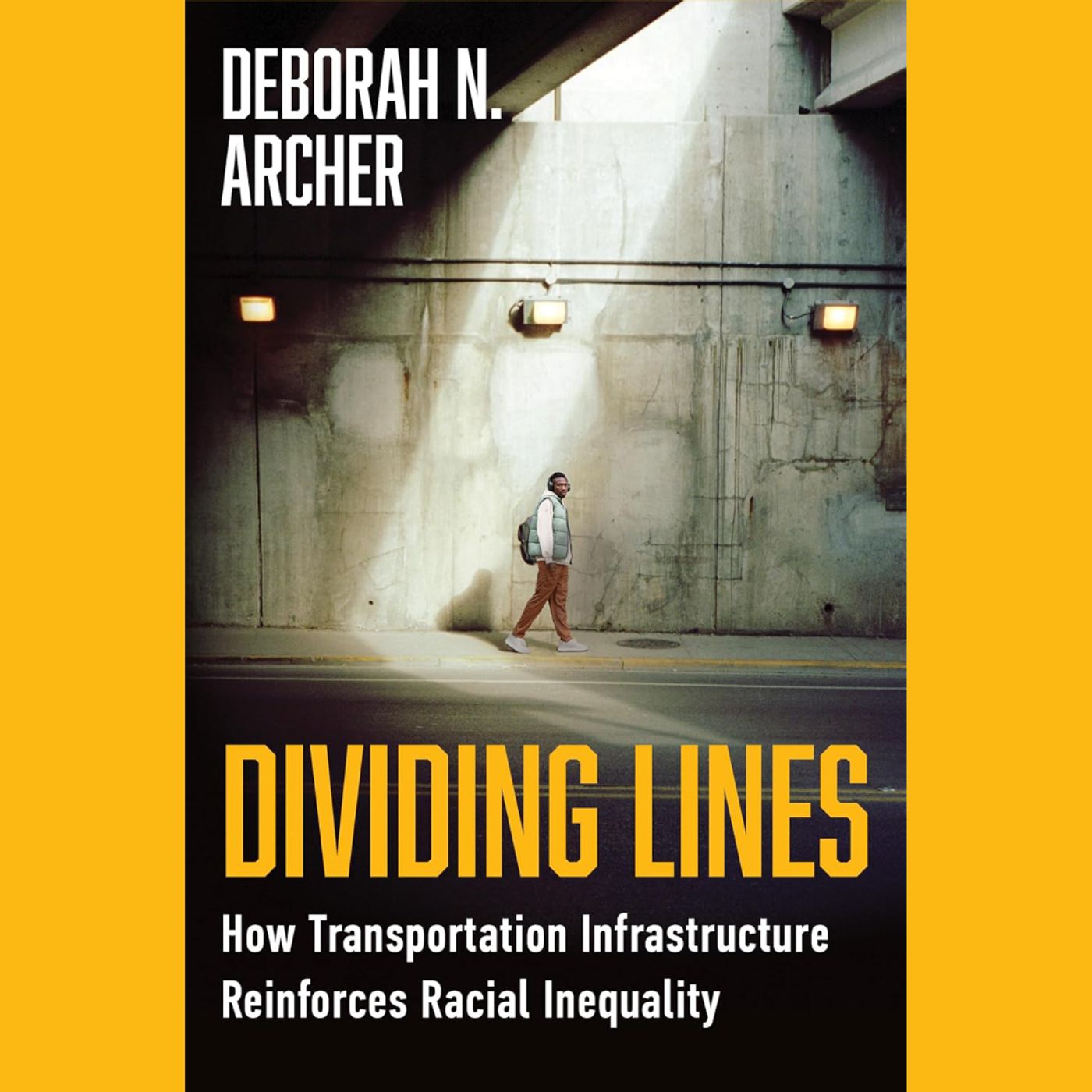
Deborah Archer, president of the ACLU episode artwork

EPISODE · Apr 23, 2025 · 8 MIN

Deborah Archer, president of the ACLU

from I Am Refocused Radio · host I Am Refocused Radio

ABOUT DEBORAH ARCHER AND DIVIDING LINES From an eminent legal scholar and the president of the ACLU, an essential account of how transportation infrastructure-from highways and roads to sidewalks and buses-became a means of protecting segregation and inequality after the fall of Jim Crow.Our nation's transportation system is crumbling: highways are collapsing, roads are pockmarked, and commuter trains are unreliable. But as acclaimed scholar and ACLU president Deborah Archer warns in Dividing Lines, before we can think about rebuilding and repairing, we must consider the role race has played in transportation infrastructure, from the early twentieth century and into the present day.As Archer demonstrates, the success of the Civil Rights movement and the fall of Jim Crow in the 1960s did not mean the end of segregation. The status quo would not be so easily dismantled. With state-sanctioned racism no longer legal, officials across the country-not just in the South-turned to transportation infrastructure to keep Americans divided. A wealthy white neighborhood could no longer be "protected" by racial covenants and segregated shops, but a multilane road, with no pedestrian crossings, could be built along its border to make it difficult for people from a lower-income community to visit. Highways could not be routed through Black neighborhoods based on the race of their residents, but those neighborhoods' lower property values-a legacy of racial exclusion-could justify their destruction. A new suburb could not be for "whites only," but planners could refuse to extend sidewalks from Black communities into white ones. Drawing on a wealth of sources, including interviews with people who now live in the shadow of highways and other major infrastructure projects, Archer presents a sweeping, national account-from Atlanta and Houston to Indianapolis and New York City-of our persistent divisions. With immense authority, she examines the limits of current Civil Rights laws, which can be used against overtly racist officials but are less effective in addressing deeper, more enduring, structural challenges. But Archer remains hopeful, and in the final count describes what a just system would look like and how we can achieve it. ABOUT DEBORAH ARCHER Deborah N. Archer is president of the ACLU, where she serves as chair of the Board of Directors and Executive Committee. She is a tenured professor and associate dean at New York University School of Law and the faculty director of the Community Equity Initiative at NYU Law. She lives in New York with her husband and two children.Get the book: https://a.co/d/3Gw8unfBecome a supporter of this podcast: https://www.spreaker.com/podcast/i-am-refocused-radio--2671113/support.Subscribe now at YouTube.com/@RefocusedNetworkThank you for your time. 

ABOUT DEBORAH ARCHER AND DIVIDING LINES From an eminent legal scholar and the president of the ACLU, an essential account of how transportation infrastructure-from highways and roads to sidewalks and buses-became a means of protecting segregation and inequality after the fall of Jim Crow.Our nation's transportation system is crumbling: highways are collapsing, roads are pockmarked, and commuter trains are unreliable. But as acclaimed scholar and ACLU president Deborah Archer warns in Dividing Lines, before we can think about rebuilding and repairing, we must consider the role race has played in transportation infrastructure, from the early twentieth century and into the present day.As Archer demonstrates, the success of the Civil Rights movement and the fall of Jim Crow in the 1960s did not mean the end of segregation. The status quo would not be so easily dismantled. With state-sanctioned racism no longer legal, officials across the country-not just in the South-turned to transportation infrastructure to keep Americans divided. A wealthy white neighborhood could no longer be "protected" by racial covenants and segregated shops, but a multilane road, with no pedestrian crossings, could be built along its border to make it difficult for people from a lower-income community to visit. Highways could not be routed through Black neighborhoods based on the race of their residents, but those neighborhoods' lower property values-a legacy of racial exclusion-could justify their destruction. A new suburb could not be for "whites only," but planners could refuse to extend sidewalks from Black communities into white ones. Drawing on a wealth of sources, including interviews with people who now live in the shadow of highways and other major infrastructure projects, Archer presents a sweeping, national account-from Atlanta and Houston to Indianapolis and New York City-of our persistent divisions. With immense authority, she examines the limits of current Civil Rights laws, which can be used against overtly racist officials but are less effective in addressing deeper, more enduring, structural challenges. But Archer remains hopeful, and in the final count describes what a just system would look like and how we can achieve it. ABOUT DEBORAH ARCHER Deborah N. Archer is president of the ACLU, where she serves as chair of the Board of Directors and Executive Committee. She is a tenured professor and associate dean at New York University School of Law and the faculty director of the Community Equity Initiative at NYU Law. She lives in New York with her husband and two children.Get the book: https://a.co/d/3Gw8unfBecome a supporter of this podcast: https://www.spreaker.com/podcast/i-am-refocused-radio--2671113/support.Subscribe now at YouTube.com/@RefocusedNetworkThank you for your time.

NOW PLAYING

Deborah Archer, president of the ACLU

0:00 8:31

No transcript for this episode yet

We transcribe on demand. Request one and we'll notify you when it's ready — usually under 10 minutes.

Big Old Life: Heather Blackbird interviews people on planet earth. Heather Blackbird loves asking questions. This podcast is a learning experience. Join me, Heather Blackbird, as I talk to people about their lives. Frequency of new episodes is a little all over the place and I'm learning as I go. Big Old Life is a small way of talking about the vastness of life, one person at a time. If you are reading this or found this podcast it's probably because someone you know gave you a link to it. :) Explicit Tales Of A Superstar DJ The Insomniac Spun seemingly out of nowhere from her complacent life in the corporate world, turned seemingly overnight from 16-Hour shift work and into the life of a literally starving artist and working musician, The Protagonist navigates her supposed rise to fame and superstardom on a journey through spiritual awakening, coming-of-age, and intimate self-realization--guided by an omnipresent force and equipped with the power of love, magic, and music. {Enter The Multiverse.} [The Festival Project] The Festival Project, Inc.™ is a multidimensional multimedia platform which encompasses exploratory and artistic social personifications and expressions on cosmic theory, spirituality, growth, health & wellness, philosophy and theoretic dynamics in entertainment such as music, design, film, television, radio, dance and festival culture, art, fashion, literature, and science. The Festival Project™ and its subsidiary Non-Profit, The Collective Complex © aims to challenge modern artistic and philosop Explicit Never Time to Give Up Shadoe Lass A nod to the classics with a note from the future. A project meant to encompass every call I wanted to make but never went through. Seriously, it's just me, calling you. Pick up the phone? :) Hosted on Acast. See acast.com/privacy for more information. Explicit ZODIAC E IL MOSTRO DI FIRENZE: LA TEORIA DELL' ACQUA Lucky Red Sono trascorsi più di vent'anni dalla sentenza che ha condannato "i compagni di merende" per i delitti del Mostro di Firenze, eppure sono tanti a credere che si tratti di un clamoroso errore. Tra loro c'è il giornalista Francesco Amicone. Lui la verità è convinto di averla trovata: dietro il “maniaco delle coppiette” si nasconderebbe uno degli assassini più ricercati degli Stati Uniti: il killer dello Zodiaco. Explicit

Frequently Asked Questions

How long is this episode of I Am Refocused Radio?

This episode is 8 minutes long.

When was this I Am Refocused Radio episode published?

This episode was published on April 23, 2025.

What is this episode about?

ABOUT DEBORAH ARCHER AND DIVIDING LINES From an eminent legal scholar and the president of the ACLU, an essential account of how transportation infrastructure-from highways and roads to sidewalks and buses-became a means of protecting segregation...

Is there a transcript available for this episode?

Yes, a full transcript is available for this episode. You can read the complete transcript on the episode page.

Can I download this I Am Refocused Radio episode?

Yes, you can download this episode by clicking the download button on the episode player, or subscribe to the podcast in your preferred podcast app for automatic downloads.
URL copied to clipboard!