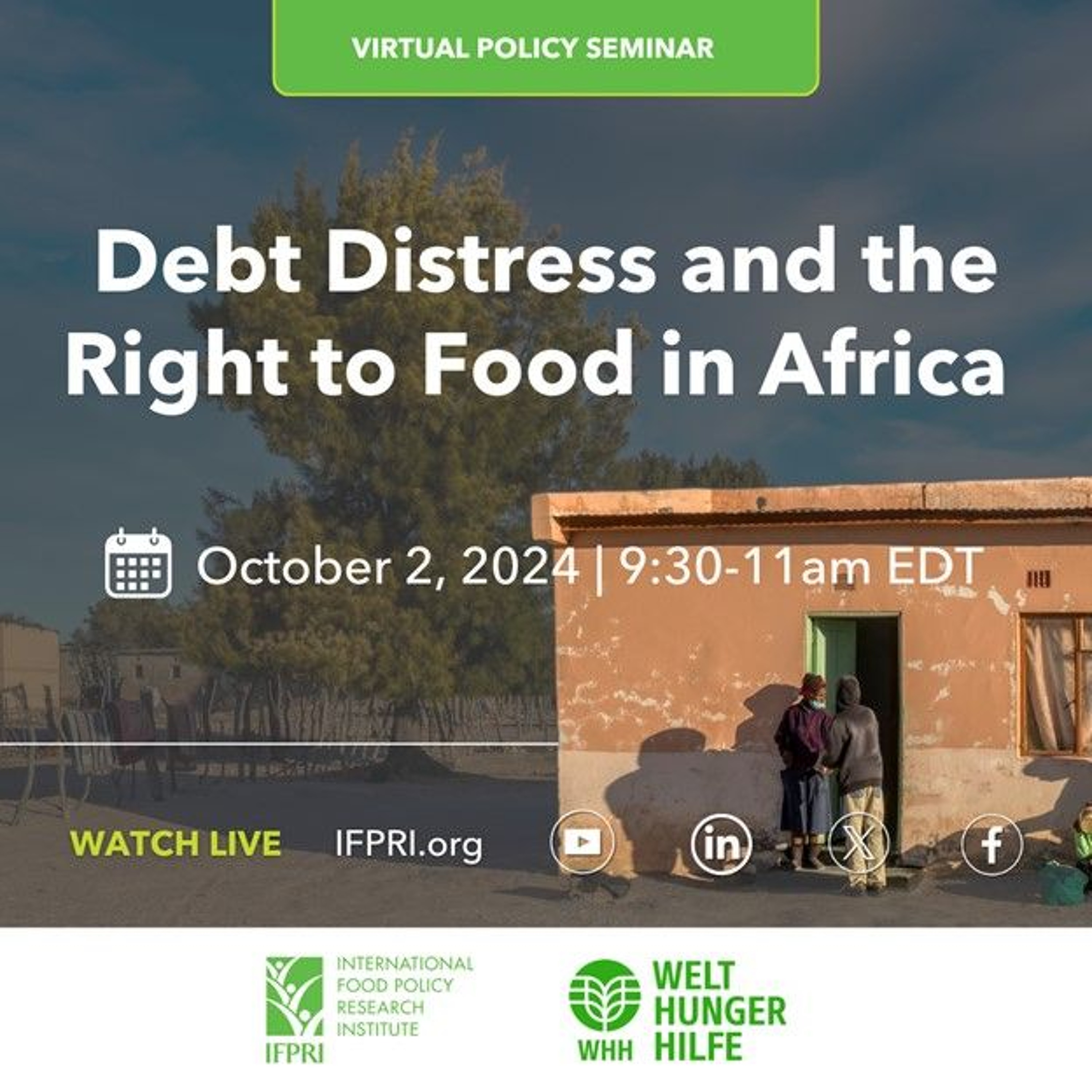
Debt Distress and the Right to Food in Africa episode artwork

EPISODE · Oct 2, 2024 · 1H 33M

Debt Distress and the Right to Food in Africa

from IFPRI Podcast · host International Food Policy Research Institute

Debt Distress and the Right to Food in Africa Co-organized by IFPRI and Welthungerhilfe (WHH) October 2, 2024 More than half of low-income countries are at risk of debt distress or have already defaulted. The debt crisis, while exacerbated by recent crises, has been looming for several years. According to the United Nations, 3.3 billion people now live in countries that spend more on interest repayments than on education or health, and in sub-Saharan Africa, governments are spending 53 percent of revenue on debt servicing. What do these debt trends mean for efforts to address food insecurity and uphold citizens’ right to food? Twenty years after the adoption of the Voluntary Guidelines on the Right to Food (RtF) by the UN Food and Agricultural Organization, many countries that adopted RtF in their constitutions still face high levels of food and nutrition insecurity. Although the Guidelines incorporate clear guidance on pursuing debt relief to allow for the progressive realization of the RtF, debt repayments and austerity measures, combined with insufficient local revenue mobilization, force governments to re-prioritize scarce resources and undermine investments in food system transformation. In the run-up to the International Development Association (IDA) Replenishment Forum in October 2024 and the release of the African Union’s post-Malabo agenda in early 2025, this policy seminar brings together speakers from international and African organizations to examine the impacts of the debt crisis on realizing the RtF in Africa and consider solutions to protect and progressively realize those rights. Opening Remarks Danielle Resnick, Senior Research Fellow, IFPRI (Presentation) Panel Discussion Michael Windfuhr, Deputy Director, German Institute for Human Rights; Member of Committee on Economic, Social and Cultural Rights (Presentation) Diana Gichengo, Executive Director, The Institute for Social Accountability, Kenya; Member of African Forum and Network on Debt and Development (AFRODAD) Geeta Sethi, Global Lead for Food Systems, The World Bank Group Jennifer Clapp, University Professor & Canada Research Chair, IPES-Food and University of Waterloo, Canada (Presentation) Nick Jacobs, Consulting Director, IPES-Food (Presentation) Closing Remarks Michael Gabriel, Director of Strategic Partnerships, US and Canada, Welthungerhilfe (WHH) Moderator Charlotte Hebebrand, Director of Communications and Public Affairs, IFPRI Links: More about this Event: https://www.ifpri.org/event/debt-distress-and-the-right-to-food-in-africa/ Subscribe IFPRI Insights newsletter and event announcements at www.ifpri.org/content/newsletter-subscription

Debt Distress and the Right to Food in Africa Co-organized by IFPRI and Welthungerhilfe (WHH) October 2, 2024 More than half of low-income countries are at risk of debt distress or have already defaulted. The debt crisis, while exacerbated by recent crises, has been looming for several years. According to the United Nations, 3.3 billion people now live in countries that spend more on interest repayments than on education or health, and in sub-Saharan Africa, governments are spending 53 percent of revenue on debt servicing. What do these debt trends mean for efforts to address food insecurity and uphold citizens’ right to food? Twenty years after the adoption of the Voluntary Guidelines on the Right to Food (RtF) by the UN Food and Agricultural Organization, many countries that adopted RtF in their constitutions still face high levels of food and nutrition insecurity. Although the Guidelines incorporate clear guidance on pursuing debt relief to allow for the progressive realization of the RtF, debt repayments and austerity measures, combined with insufficient local revenue mobilization, force governments to re-prioritize scarce resources and undermine investments in food system transformation. In the run-up to the International Development Association (IDA) Replenishment Forum in October 2024 and the release of the African Union’s post-Malabo agenda in early 2025, this policy seminar brings together speakers from international and African organizations to examine the impacts of the debt crisis on realizing the RtF in Africa and consider solutions to protect and progressively realize those rights. Opening Remarks Danielle Resnick, Senior Research Fellow, IFPRI (Presentation) Panel Discussion Michael Windfuhr, Deputy Director, German Institute for Human Rights; Member of Committee on Economic, Social and Cultural Rights (Presentation) Diana Gichengo, Executive Director, The Institute for Social Accountability, Kenya; Member of African Forum and Network on Debt and Development (AFRODAD) Geeta Sethi, Global Lead for Food Systems, The World Bank Group Jennifer Clapp, University Professor & Canada Research Chair, IPES-Food and University of Waterloo, Canada (Presentation) Nick Jacobs, Consulting Director, IPES-Food (Presentation) Closing Remarks Michael Gabriel, Director of Strategic Partnerships, US and Canada, Welthungerhilfe (WHH) Moderator Charlotte Hebebrand, Director of Communications and Public Affairs, IFPRI Links: More about this Event: https://www.ifpri.org/event/debt-distress-and-the-right-to-food-in-africa/ Subscribe IFPRI Insights newsletter and event announcements at www.ifpri.org/content/newsletter-subscription

NOW PLAYING

Debt Distress and the Right to Food in Africa

0:00 1:33:47

No transcript for this episode yet

We transcribe on demand. Request one and we'll notify you when it's ready — usually under 10 minutes.

That Hoarder: Overcome Compulsive Hoarding That Hoarder Hoarding disorder is stigmatised and people who hoard feel vast amounts of shame. This podcast began life as an audio diary, an anonymous outlet for somebody with this weird condition. That Hoarder speaks about her experiences living with compulsive hoarding, she interviews therapists, academics, researchers, children of hoarders, professional organisers and influencers, and she shares insight and tips for others with the problem. Listened to by people who hoard as well as those who love them and those who work with them, Overcome Compulsive Hoarding with That Hoarder aims to shatter the stigma, share the truth and speak openly and honestly to improve lives. The Small Business Startup School – Business Notes | Financial Literacy | Retail Psychology – For Professionals & Entrepreneurs The Small Business Startup School Inc. Starting or buying a small business? While personal circumstances may vary, business patterns remain timeless. On The Small Business Startup School, we explore strategies, insights, and practical solutions to help entrepreneurs confidently navigate their journey.Hosted by Ola Williams—a retail entrepreneur, fintech founder, and financial coach with over two decades of experience—this podcast marries financial awareness and retail psychology with optimism to deliver actionable takeaways.Join us to learn, grow, and connect as we uncover the keys to business success.Let’s continue to learn together and be encouraged to keep on connecting! DIOSA. Carolina Sanper This podcast is a sacred space created by Carolina Sanper where you connect with your inner wisdom and embody your magnetic feminine power.It is the realization that the mystical realm is where you plant the seeds of your desired reality.It is a portal to your true essence: awareness, presence, and receiving with ease. Welcome home, DIOSA. 🖤 XXX Tech by SOVRYN Dr. Brian Sovryn The crossroads between technology, sensuality, and metaphysics - and the longest running anarchist podcast in the world! Brought to you by Dr. Brian Sovryn.

Frequently Asked Questions

How long is this episode of IFPRI Podcast?

This episode is 1 hour and 33 minutes long.

When was this IFPRI Podcast episode published?

This episode was published on October 2, 2024.

What is this episode about?

Debt Distress and the Right to Food in Africa Co-organized by IFPRI and Welthungerhilfe (WHH) October 2, 2024 More than half of low-income countries are at risk of debt distress or have already defaulted. The debt crisis, while exacerbated by...

Can I download this IFPRI Podcast episode?

Yes, you can download this episode by clicking the download button on the episode player, or subscribe to the podcast in your preferred podcast app for automatic downloads.
URL copied to clipboard!