Dec 10 - A Shaker Christmas medley
from Bill’s Midwinter Music Blog Hosted by Bill Huot
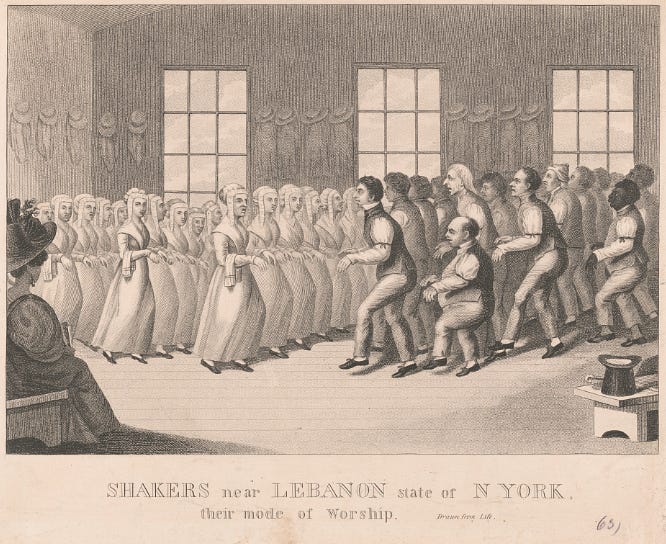
[Verbosity warning: Information about the songs is after two mini-essays about the Shakers. My good intentions to limit and report on my research fell apart again this time when I became intrigued by the rich history and cultural legacy of the Shakers and felt a need to share my findings with you.] Playlist * This is Jesus’ Birthday Mitzie Collins :40 * Celestial Choir The Boston Camerata 2:14 * Circular march The Tudor Choir :42 * While once in Judah’s lovely land Randy Folger 3:29 * A New Year Joy of Angels ad hoc choir 1:04 * Give Good Gifts The Rose Ensemble 1:40 The Shakers The United Society of Believers in Christ's Second Appearing, are a religious movement that thrived on the America frontier in the 19th century. Since that formal name is so awkward they came to be called the shaking Quakers, which became abbreviated to Shakers. Their animated and ecstatic worship practices is the reason for the common name, and like the Quakers they embraced the name that other protestants had originally intended to be derogatory. The Shakers were formed in Manchester, England in 1747. They were actually an offshoot of the Methodists, although they shared many values and beliefs with the early Quakers, including pacifism, evangelism and ecstatic worship, from before that fellow nonconformist sect transitioned to silent worship services. They believed in living simple lives together in a communal monastic style because they interpret that as the life that Jesus preached and lived with his disciples. Their beliefs included celibacy, pacifism, and that the end of the world was near. They also believed that they received direct messages and revelations from God, with the sect incorporating elements of Spiritualism which just beginning to rise in prominence at that time. The newly-established Shaker movement was not hierarchical, but by the time she was in her mid-thirties the charismatic Ann Lee (1736-1784), the daughter of one of the founders, emerged as their initial de-facto leader and came to be known as Mother Ann. In 1774 she had what she interpreted as a divine revelation, and to escape persecution in Manchester she led eight other Shakers to America. After a few years in New York City, where they continued to be harassed for their pacificism and protestant nonconformity. In 1780 (when negotiations to end the American Revolution were still incomplete) they moved to what was then the frontier in upstate New York. The Shakers’ persecution did not end in the New World. During the American Revolution particularly, and continuing after that, their commitment to pacifism was not appreciated by others. Added to that, their celibacy and a communal style of living, and their unorthodox theology and forms of worship conflicted with other protestants’ own religious beliefs and were often not tolerated. [Update: An arthouse biopic called The Testament of Ann Lee by was released in 2025 that has received considerable critical acclaim (88% on Rotten Tomato’s tomatometer and 83% on its popcornmeter) but no Academy Award nominations. That might be because although it is visually stunning and has outstanding music and acting, the accuracy of its portrayal of Ann Lee and the early Shakers is questionable (but when did correctness of the facts become an expectation for Hollywood biopics?) Ann Lee was clearly a charismatic leader, of the sort for which both reverence and legends developed after her passing. There is limited documentation about Ann Lee’s life from her contemporary times, and outside of the Shaker communities she was considered to be a controversial figure because of the sect’s pacifist and non-conventional beliefs and practices. The writer and director, Mona Fastvold, did a considerable amount of research about her subject, but according to this article in the New York Times: Fastvold said that she did not consult with the two active Shakers at any point, saying it was out of respect: “For them it’s a living religion, and for me I’m telling a story about a historical figure.” She added, “I was worried I’d be too cowed by their interpretation of her story to not make space for my own.” Before “The Testament of Ann Lee” opened, one of the active Shakers, Brother Arnold Hadd, posted an anticipatory video on a website that challenged the idea that the deaths of her children were at the root of Mother Ann’s insistence on celibacy. The deaths would have been expected, he said, because of the high incidence of infant mortality in her time. Later, after he had seen the film, in an emailed response to a request for an interview, Brother Arnold declined to comment, explaining that it was “filled with lies and inaccuracies on a scale not imagined before.” If you have seen the movie I encourage you to also watch this 12:39 minute history of Ann Lee by Brother Arnold for his very interesting and informative counter-narrative. End of Update.] But the Shakers’ adherence to their interpretation of Christ’s teachings about love for others, especially for the poor, was also apparent. For example, although they were celibate they gladly took in orphans who otherwise would have gone into orphanage/workhouses, and they took in unemployed homeless during wintertime. Despite persecution, the initial community grew and was able to spin-off new communal Shaker settlements on the expanding American frontier. In the early 19th century both the idea of living in utopian communities and belief that the end of the world was imminent (millennialism) became more widely accepted. The number of Shaker communities expanded, at its height in the 1830s peaking at 19 villages in eight states with an estimated total membership estimated at about 5-6000 people. However since then their numbers have continually withered. Only one small Shaker community continues to exist today; the Sabbathday Lake Shaker Village in Maine. And as of June 2023 that community is down to two living members, Brother Arnold Hadd and Sister June Carpenter. [Update: In 2025, 59 year-old April Baxter, a former Episcopal nun, joined the Sabbathday Shakers bringing their membership up to 3. You can hear a 3 minute NPR All Things Considered clip about that here.] They continue to live the communal and spiritual lifestyle of their beliefs, and worship in accordance with their traditions. Neighbouring volunteers seek to preserve their crumbling buildings and hope for the old village to be operated as an historic site if/when it no longer houses a living Shaker community. Click on the above link to learn about what they are doing, and perhaps make a donation to their efforts. But for a movement that had so few members the Shakers have left all of us a huge cultural legacy. They are most commonly remembered for their distinctive simple but elegant architecture, artwork, and their finely-crafted furniture. Unlike some other religious communities of the time, for example the Amish, Shakers readily embraced technological innovation. Although they did not seek patents for their own inventions, which they considered to be gifts to humanity from God that had been channeled through them, they are credited with having given us metal pen nibs, the flat broom, a prototype washing machine called a wash mill, the circular saw, waterproof and wrinkle-free cloth, the metal chimney cap for blocking rain, and they improved on the plow. Also, the screw propeller, an important alloy called babbitt metal, a rotary harrow, a turbine waterwheel, a threshing machine, the circular saw, and those the type of clothespins that are made out of single piece of wood that we sometimes still use today. This is a public episode. If you would like to discuss this with other subscribers or get access to bonus episodes, visit midwintermusic.substack.com
Embed this episode
No transcript yet.