Dec 10 - Bell-ringing peals and bell songs
from Bill’s Midwinter Music Blog Hosted by Bill Huot
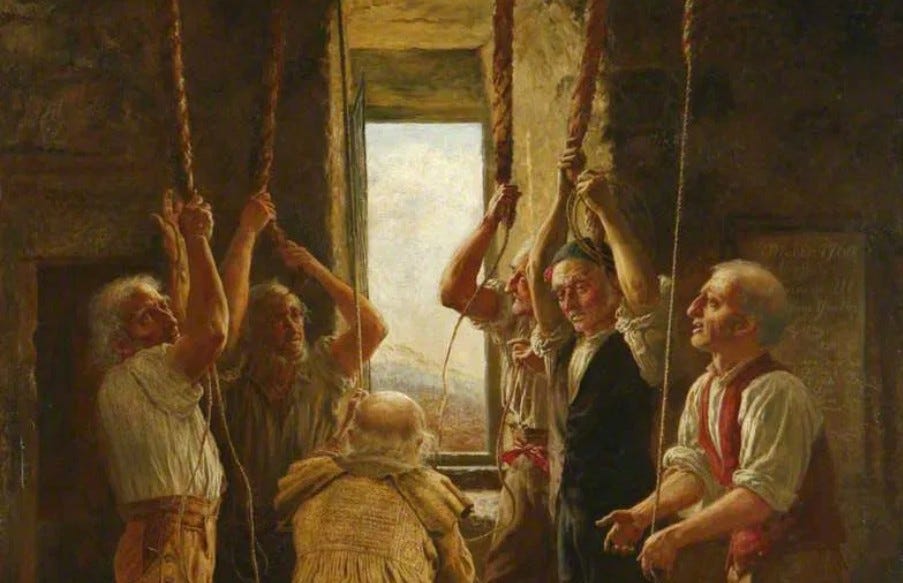
[Note: Don’t forget that you can forward these e-mails to friends who you think would like my quirky samplers of unusual music for the holiday season and my background information. I’ve gained about 50 subscribers already so far this year.] Playlist * A taste of the Grandshire peal Victoria Guild of Bellringers 1:00 * Ring Out Wild Bells Emily Brown & Alyssa Pyper 3:12 * Russian Orthodox Christmas bell peal Novo-Diveevo Convent bellringers 1:01 * Sweet Chiming Bells Nowell Sing We Clear 4:03 Music notes A taste of the Grandshire pealThe 17th century English playwright and diarist Ben Jonson said that the change-ringing of church bells was “the poetry of the steeples”. Another way of thinking about it is that they are the loudest and most public form of folk music. According to this article: Bells [have] long been part of the English aural landscape. In the eighth century, Bede wrote that a bell sounded the call to prayer at the monastic house at Hackness, near Scarborough. But by the end of the 16th century bell ringing had become a secular pastime and pleasure. A German traveler in 1602 noted that: ‘On arriving in London we heard a great ringing of bells in almost all the churches, going on very late into the evening. We were informed that the young people do that for the sake of exercise and amusements.’ And for gambling too, he was told. It is out of this milieu that change ringing developed. The first-known secular bell-ringing society, the ‘Schollers of Cheapeside’, was founded on 2 February 1603 . . . In 1628, the parishioners of Ashby-de-la-Zouch felt compelled to crack down on bell ringers. ‘None shall be allowed to ring for pleasure above twice in the week’, they decreed, ‘and that above the space for an hour at a time.’ No doubt they felt, to use a ringing term, over-belled. I live about three blocks from Victoria’s Anglican Christ Church Cathedral which has a bell tower with large bells suitable for doing the full circle change-ringing known as peals. Christ Church’s ten bells range from 250 to 1450 kilos (550 to 3200 lbs.) with diameters ranging from 66 cm (2 feet 3 inches) to 137 cm (4 feet 6 inches). They are all tuned to harmonize with the largest bell which is tuned to the note of D. They are the same size, weight and have the same tuning as the change-ringing bells of Westminster Abbey. I have a nice view of the back of the cathedral from my balcony, and hear them ringing frequently. The ringers practice most Tuesday evenings, and do a short “method” (a short duration of change-ringing) before two masses on most Sunday mornings. That makes it easy to take for granted what a rare privilege it is for me to hear this glorious “joyful noise”. Here is the Cathedral’s Guild of Bellringers’ explanation of change-ringing, from their notes about this recording: We are one of seven churches in Canada (three in BC) equipped for traditional “change-ringing” in the style that emerged mostly in England in the 16th Century. The bells are mounted on wheels which are turned by means of a rope passing round the rim of the wheel and controlled by the ringer on a lower floor, who cannot see the bell he or she is ringing. Each bell turns through nearly a full circle and is struck at the end of its swing by the clapper suspended inside the bell from its crown. [There is therefore a time delay between when the rope is pulled and the bell is rung.] This method of ringing makes the playing of tunes impracticable, so the aim of change-ringing is to produce a changing pattern of sound through a set of mathematical permutations which are both rhythmic and musical. The bells begin by ringing down the scale and, at a signal from the conductor, proceed to ring in a different order each time the bell-ropes are pulled. There are fixed rules governing the position of each bell in these changing sequences. The bells eventually return to ringing down the scale, without any one change being repeated. Since one person can ring only one bell, change-ringing is very much a team enterprise and requires great concentration on the part of all the ringers. Eight ringers were involved in the performances on this recording. Here is an interesting four minute video about Christ Church Cathedral’s bells and bellringers. This track is only a small one-minute sample from the beginning of a plain peal where it is just starting to get into the more abstract-sounding parts of the progression. A full change-ringing peal takes over 5000 rings from each of 8 bell, with the progression continuing non-stop for about three hours and 25 minutes, but those are only accomplished very, very rarely. (As far as I know, the Victoria Guild has not done one.) More common but still very challenging is a 45 minute quarter-peal, but even that length of change-ringing is challenging and uncommon. The ringers adjust the place of their bell in a cycle through a brief pause of the appropriate length in their rope-pulling. Proper ringing takes and incredible amount of both memory and concentration by the ringers, and even one bell rung out of its proper sequence means that the peal, quarter peal, or shorter change-ringing sequence is not considered to have been successful. Actually, there are a variety of peal progressions of different lengths, based on different mathematical sequences of changes. This recording is excerpted from the Grandshire Triples progression composed by Robert Roan around 1650. I got the recording from this YouTube video. These are the same bells that I get to hear every week. Ring Out Wild Bells The lyrics for this song are a poem by Alfred Lord Tennyson that was first published in 1850, the same year that he was appointed Britain’s Poet Laureate. According to a local legend, the poem was inspired by the ringing of a midnight New Year’s Eve peal by the bellringers of Waltham Abbey in Essex, north of London. They don’t do it that late here, but there is an old English custom for some churches to “ring out the old year and ring in the new one” at midnight. Sometimes the bells are first rung half-muffled for the death of the old year, then the muffles are removed to ring proudly, marking the birth of the New Year. For most churches, the midnight ritual would just be ringing the church bell enthusiastically, but like Victoria, the bell tower of Waltham Abbey is equipped for ringing the changes. Lord Tennyson happened to be staying nearby to the Abbey in High Beech and apparently a heard he midnight peal for the first time. This recording is by Emily Brown & Alyssa Pyper, and is from an out-of-print 2015 charitable fund-raising sampler album called Merry Christmas Provo Vol. 2 (from Provo City, Utah.) This music setting for the poem is by Crawford Gates and is published in the Hymnal of the Church of Jesus Christ Latter-day Saints. Below is the whole Alfred Lord Tennyson poem, and here is allpoetry.com’s analysis of its uncommonly optimistic message from that Victorian poet: Ring out, wild bells, to the wild sky,The flying cloud, the frosty light:The year is dying in the night;Ring out, wild bells, and let him die. Ring out the old, ring in the new,Ring, happy bells, across the snow:The year is going, let him go;Ring out the false, ring in the true. Ring out the grief that saps the mindFor those that here we see no more;Ring out the feud of rich and poor,Ring in redress to all mankind. Ring out a slowly dying cause,And ancient forms of party strife;Ring in the nobler modes of life,With sweeter manners, purer laws. Ring out the want, the care, the sin,The faithless coldness of the times;Ring out, ring out my mournful rhymesBut ring the fuller minstrel in. Ring out false pride in place and blood,The civic slander and the spite;Ring in the love of truth and right,Ring in the common love of good. Ring out old shapes of foul disease;Ring out the narrowing l… This is a public episode. If you would like to discuss this with other subscribers or get access to bonus episodes, visit midwintermusic.substack.com
Embed this episode
No transcript yet.