Dec 17 - Wassail!
from Bill’s Midwinter Music Blog Hosted by Bill Huot
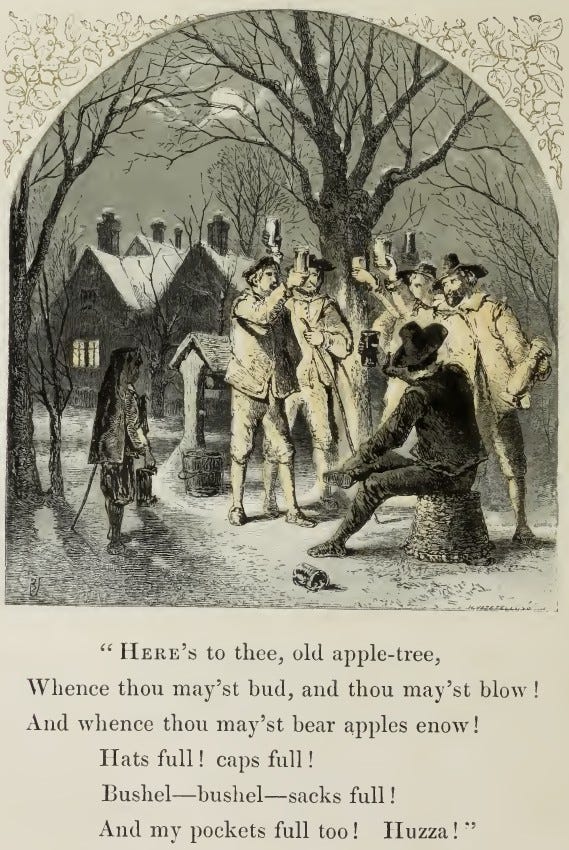
Playlist: * 1957 BBC Radio introduction w. Boscastle Breakdown 1:00 * Padstow Wassail Charlie Bate 2:48 * Somerset Gloucestershire Wassail The Kingston Trio 1:48 * Here We Come A-Wassailing (instrumental) The Night Heron Consort 2:13 * Apple Tree Wassail The Watersons 2:12 If you received my Bill’s Midwinter Music series last year, or got my Sampler CDs before I started this series, you probably already guessed that there would be a set of wassail songs again this year. I am fascinated by the ancient luck-visit traditions that are found throughout Europe, and in particular the wassailing customs and songs that survived in England’s rural areas, surviving the years of Puritan rule and continuing to be sung in their proper context until recent times. I’ll only give you a very abbreviated version of that history this time. You can hear more wassail songs and learn more about their history from my previous postings here and here, and this one includes a detailed essay on the subject. Very briefly, our very ancient ancestors would call upon their relatives and neighbours in the harsh midwinter, perhaps partly as a wellness check but also to visit and wish them a safe and prosperous coming year after winter ends. In return, the families being visited would treat their visitors to hospitality. Over time the formats for these annual visits became ritualized, with different formats in different regions and communities. We know that this type of activity is very ancient because the same general style of midwinter luck-visiting customs occurred throughout Europe, and in fact everywhere in the world in the temperate climate zones, and everywhere there are varieties in the same styles of specific local rituals. In England the custom is often known as wassailing. The word “wassail” is old English. Literally it means “be whole” but it was used as a drinking toast – “Stay healthy!” The variations on the wassailing custom often involve a wassail bowl brought by the visitors. In some variants it is brought filled with an alcoholic beverage that is also called wassail, to be shared with the hosts, or it is brought empty to be filled by the household being visited to then be shared by all. Many recipes for the wassail beverage that can be found online. This set opens with a brief introduction from an historic live 1957 Christmas Day broadcast by BBC Radio. It was an ambitious project and quite a technical achievement – the first time that BBC attempted to do a live show using performers located in six different cities, and therefore carefully structured and highly scripted. It was broadcast during the time when a folk music revival was building up in both North America and in Great Britain. The radio was hosted by Alan Lomax in London, and the West Country location was in Plymouth. I have the album but the whole show is now available online in the form of a YouTube playlist. To keep up the pace, mostly it had only brief snippets of songs from the various performers, and segments were bridged with overlapping fade-out and fade-ins. It seems dated now although still quite entertaining. I do recommend listening to it both as a window into folk music history and for the information it contains in the introductions. What I have included here is the very last part of a segment with songs from each of the six broadcast locations. Then the show’s overall host, Alan Lomax in London passes the baton to the West Country folk music collector Peter Kennedy who introduces Charlie Bate, a folk music fixture in remote western end of the country in Cornwall. After a brief rendition of the step-dance tune Boscastle Breakdown given to illustrate that wassailing included tunes as well as songs, Charlie introduces … … the Padstow Wassail, a traditional song from that small fishing village out on the farthest reaches of the Cornwall Peninsula. Here is where I do a switch. Instead of giving you the abbreviated two verses that were on the radio broadcast I have substituted a recording of Charlie singing of the whole song that Peter Kennedy had recorded a year earlier which was on Peter’s 1956 cassette West Country Wassailers. Somerset Gloucestershire Wassail is from The Kingston Trio’s 1960 Christmas album the last month of the year. [Side note: They sang the title song with the call lines that Alan Lomax had just recorded from Vera Ward Hall in 1959. Lomax brought the song to them and they were the first ones to record it on a commercial record.] At the time, the Kingston Trio had only been recording since 1958 and they were the hottest thing in pop music. All of their previous five studio albums had all risen to #1 on the Billboard pop charts. Yet this Christmas album struggled to make it to make it to #11 in that year and Columbia Records discontinued it before the following Christmas season. The company did not want a dud like that further harming the Kingston Trio’s reputation and a failed Christmas album was unheard of from pop stars. They did not release it again until 1991, well after the folk revival had run its course. I just discovered that tidbit of information and it has now led me into spending too much time trying to figure out why that happened. One possibility is that there is a standard formula for successful Christmas albums whatever their particular musical genre: The album includes mostly covers of the well-known Christmas favourites , usually with rich, lush accompaniment but sung in the performer’s distinctive style. There are usually one or two new songs that they hope will be the next lasting Christmas super-hit like White Christmas or Rudolf the Red-nosed Reindeer. If a performer were to hit the jackpot with one like that they could live off the royalties for the rest of their lives. But even if that does not happen their new renditions of the Christmas classics together with their current celebrity status almost guarantees that the album itself will be a success. The Kingston Trio did not follow that formula. All of the songs on the Christmas album were new, at least for the general public – not a Christmas classic to be heard. Not even Silent Night! Some of the songs themselves, like the title song, We Wish You a Merry Christmas, and this wassail song have gone on to become part of our familiar Christmas repertoire. In fact, the Kingston Trio’s inclusion of them on their album may have helped that by bringing them to the attention of other performers to sing. But their own renditions of them did not make a lasting impact and are usually not heard anymore. I’ll need to think about all of this further because it is an interesting phenomenon. Somerset Gloucestershire Wassail is the song that they and Columbia chose to release as the A side of the 45rpm single that was released in parallel with the album (with Goodnight my Baby, written by Kingston Trio member nick Reynolds, as its B side.) That was common practice at the time and it was sales of the singles that drove songs to the top of Billboard’s Top 40 pop chart. That single wasn’t a success either. The awkward name is because it isn’t rendition of a particular old wassail song but a mash-up of lyrics and melodies from various wassail songs that had been collected in that region of England. Its authorship is credited to Dave Guard, another of the Kingston Trio members at the time, and Wilbur Schwandt whose biggest hit was when The Mamas & The Papas covered his Dream a Little Dream for Me in 1968. While wondering why this album failed something occurred to me that I had never thought about before. I’ll need to give this a lot more consideration and research, but it seems to me that wassail songs were not part of the music of my childhood. I have checked a few sources and cannot find a North American recording of a wassail song before this version of Somerset Gloucestershire Wassail by any of the big-name Christma… This is a public episode. If you would like to discuss this with other subscribers or get access to bonus episodes, visit midwintermusic.substack.com
Embed this episode
No transcript yet.