Dec 21 Four more wassailing songs
from Bill’s Midwinter Music Blog Hosted by Daily songs & essays by Bill Huot. Runs Nov 25 to Dec 21.
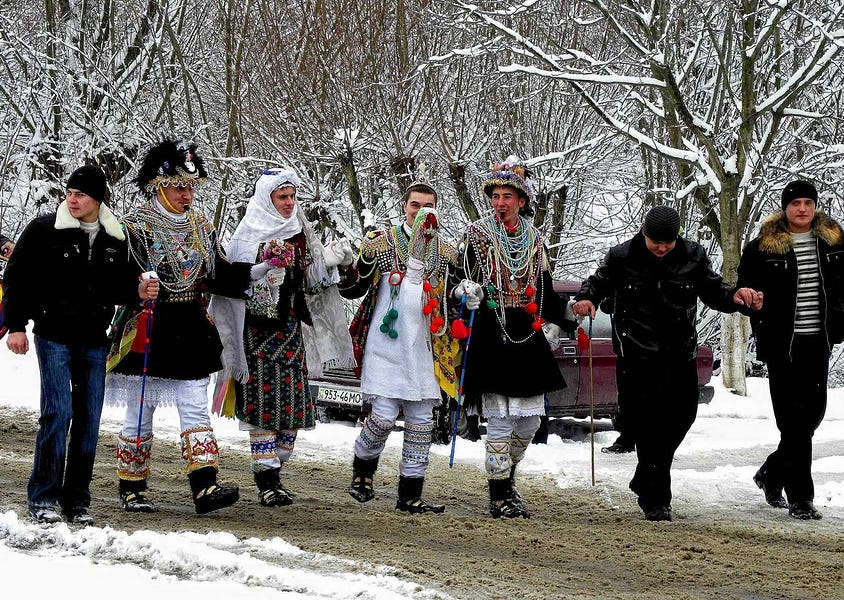
The songs: * Salut á la compagnie (Hello to this gathering) French part à Dieu song Malicorne (recorded 1976) * Legănelul lui Iisus (Jesus’s Little Cradle) Madrigal Chamber Choir (1980) * Iată vin colindătorii (Here come the Carol singers) ” * Gower Wassail Rasma Bertz & Salt Spring Island friends (2010) Today, at 4:01 Pacific Standard Time, is the Winter Solstice; the shortest day and the longest night of the year. In recognition of that, today’s songs are wassails, a type of song that I believe (as explained in way too much detail below) has a very long association with this Midwinter occasion. We now associate wassail songs (along with all Christmas music) with the long commercialized run-up to the holiday season, but historically wassailing was done in the days after the holiday. That is consistent with the fact that (as discussed in detail last year) our ancestors celebrated the Solstice several days after the actual astronomical event when they could confirm that it had happened through their own observations. Last year my Bill’s Midwinter Music series included deep dive essays into the evolution of how the seasonal cycle had been viewed by our Northern European ancestors since the dawn of humankind, and how they came to view this time of the year as the beginning of the annual cycle. I was able to complete it as a musical series, but I fell behind in writing the story that my research was revealing. I promised to complete the story someday. Today is my first installment in doing so. I had three more “Ancient Origins” essays in mind. The first would have completed the story about luck visit songs which is what I am doing today. After the background information below about the songs will be the eighth rambling essay from last year’s series to fulfill the that part of my promise. Then there was to be a final episode in the “Ancient Origins” sub-series which would have summarized the beginnings and development of modern paganism, and finally, an essay would summarize and draw conclusions about the evolving celebration of Midwinter. It was that second one that burnt me out last year. I came to realize both that it was both a very challenging of a topic to research and that I am not personally comfortable even attempting write about it. It would have been about religion: I don’t do religion. So I have decided not go there. The final part of that series is to be a final wrap-u essay that will review my research and analysis and draw conclusions about the evolving celebration of Midwinter. I still promise to do that – someday. Remember, still have good intentions to keep my postings brief this year, although I must admit that I have not been living up to my own expectations in that regard. For reasons that will be discussed below, I have come to think of wassail songs and their counterparts from other countries as having a special place in our seasonal music canon. I believe that the traditional wassail songs we sing these days may be direct descendants of ones sung by our ancient pagan ancestors at this unique time during our planet’s annual journey around the Sun. I am not saying that any of the traditional songs sung today are themselves that old. In fact, the midwinter luck-visit songs that we consider to be authentic and traditional are actually relatively new. But they are the products of a long chain of evolution to keep them relevant for changing times rather than the products of innovation. I believe that the ceremonies themselves evolve slowly but the songs evolve quite quickly. More about that later. As discussed in the December 19 posting last year and in this year’s December 8 posting, wassailing (and its modern variant Christmas caroling) are regional English variants of a genre of community folk midwinter customs that folklore scholars call luck-visits. Similar ceremonial visits have been happening throughout Europe since time immemorial. And in fact, there are parallel ritualized ceremonies of lean-season visiting and generosity found throughout the world. In the scholarly world of folklore research, using principles similar to those in linguistic archaeology, this pattern of being widespread but with regional variations is recognized as an indication of antiquity. The first song today, Salut à la compagnie, is a part à Dieu French luck-visit song for New Year’s Day. As I understand it, in medieval time the traditional custom of part à Dieu was that it was a stage near the end of well-off people’s New Year’s feasting when poor people could come to share in the left-overs in exchange for their offerings of entertainment and blessings for the coming year. The custom continued into more modern times as a children’s door-to-door New Year’s custom similar to our Halloween trick-or-treating. This is a 1976 recording from France’s legendary folk-rock band Malicorne and is from their album Almanach that samples seasonal French folk music from throughout the annual cycle of seasons. The next two Romanian songs illustrate how luck-visiting ceremonies and songs can adapt and change. As the country’s name suggests, its history was greatly influenced by having been an important bastion on the frontier of the Roman Empire. Like all Roman provinces, the people gradually became imbued with Roman culture. In the case of its people’s celebration of midwinter that included incorporating their own ancient Dacian midwinter traditions to co-exist with the Roman customs for celebrating the holidays of Saturnalia and Calends. Their indigenous ancient luck-visit customs became blended in with the Roman ones, because that was always the case with lands under Roman rule. Roman authorities were very accepting of local religions and customs provided that the people paid their taxes and did not rebel against Roman authority: They patiently let time and economic influence do the cultural colonization for them. The success of that strategy in Romania can be shown by the fact that this Eastern Orthodox country’s luck-visit custom is called colinde, and the singing itself is called colindam. Both words are derived from the name of Roman new year holiday of Calends (which gave us the word calendar.) Roman midwinter traditions would also have absorbed customs from more recent waves of conquest after the Roman Empire collapsed. In general, the Romanian custom of colinde, as preserved in its rural areas, is pretty typical of its various European counterparts, from the Iberian Peninsula to Britain, to Russia. Indications of antiquity include that although the songs are traditionally Nativity story carols variants of the colinde ritual include blessings to enrich the fertility of the soil. The first of the two Romanian songs in my medley is Legănelul lui Iisus (Jesus’s Little Cradle). It is a choral harmonization of one of the country’s many traditional folk Christmas carols. The song is performed by Romania’s Madrigal Chamber Choir and was recorded in 1980 on their album Romanian Christmas Carols. The recording was made at a time when the caroling custom, and Christmas itself, was prohibited in Romania. Like the Puritans had done in England in the 17th century, the Communist government under Nicolae Ceaușescu banned celebration of the holiday! But his reasons for doing so couldn’t have been more different from the English Puritans. Ceaușescu saw Christian leadership as posing a threat to his one-party rule and decided to impose Communist Atheism as the state religion (or is that a non-religion.) He had the Orthodox priests arrested and executed and prohibited all forms of religious observance including colinde and the singing of Christmas carols. [Digression: You… This is a public episode. If you would like to discuss this with other subscribers or get access to bonus episodes, visit midwintermusic.substack.com
Embed this episode
No transcript yet.