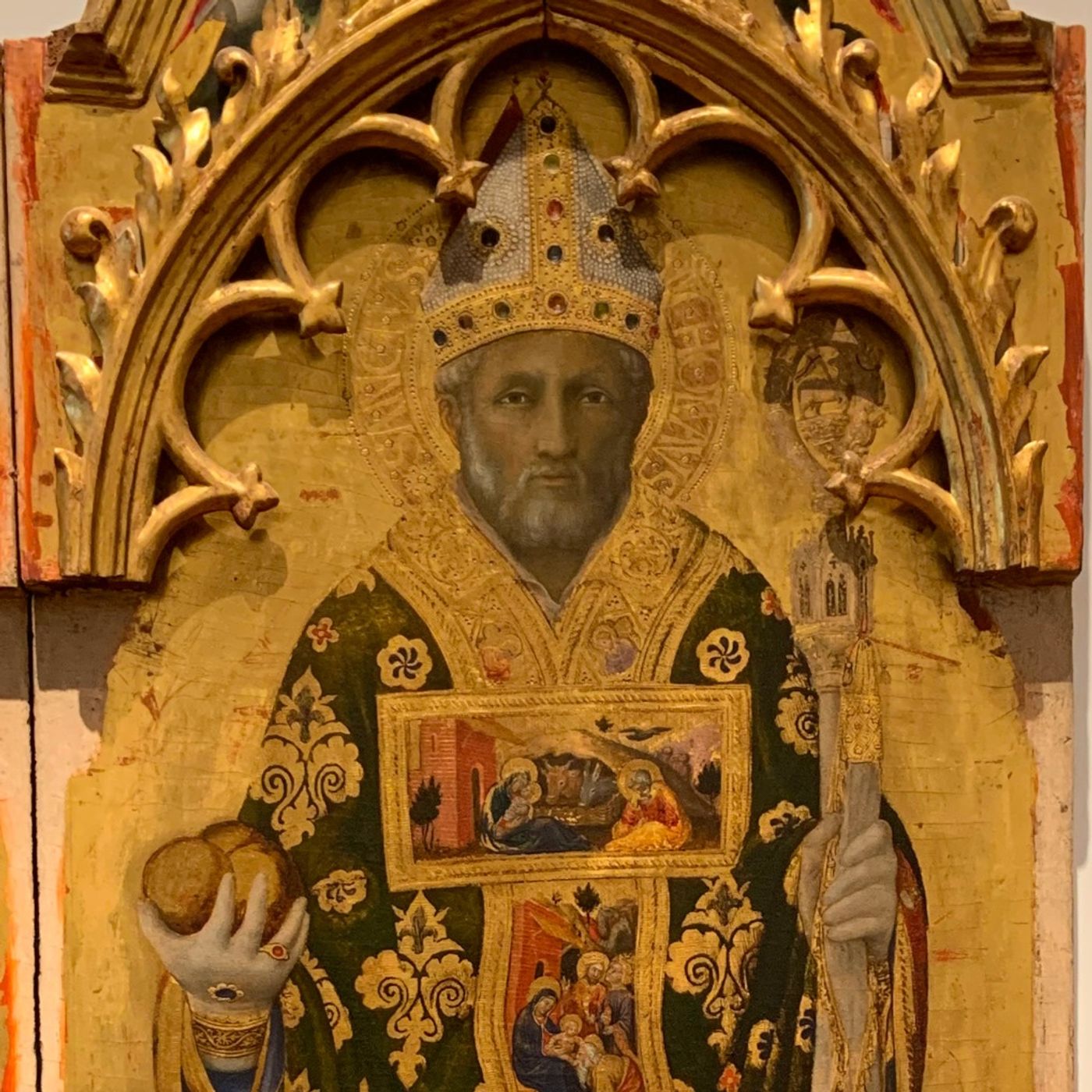
December 6: Saint Nicholas, Bishop
from Catholic Saints & Feasts Hosted by Fr. Michael Black
December 6: Saint Nicholas, Bishop c. Third–Fourth Century Optional Memorial; Liturgical Color: White Patron Saint of Russia, sailors, merchants, and children Santa Claus signed the Nicene Creed Traditions the world over are so embedded in the rhythms of daily life that their ubiquity goes unnoticed. Why a birthday cake with lighted candles? Why make a wish and then blow those candles out? The origin of this charming tradition is obscure. Why shake hands, toast by clinking glasses, cross fingers for good luck, or have bridesmaids? The sources of many traditions are so historically remote and culturally elusive as to allow diverse interpretations of their meaning. Today’s saint is without doubt, however, the man behind the massively celebrated tradition of Santa Claus, the most well-known Christmas figure after Jesus and the Three Kings. Santa Claus’ mysterious nocturnal visits to lavish children with gifts at Christmastime is not a tradition whose origin is lost in the mists of history. It is a tradition firmly rooted in Christianity. Little is known about the life of Saint Nicholas, besides that he was the Catholic Bishop of Myra in Asia Minor in the early fourth century. It is likely that he suffered under the persecution of Diocletian and certain that he later attended the Council of Nicea in 325. "Nicholas of Myra of Lycia" appears on one of the earliest and most reliable lists of the Bishops at Nicea. Some of the bishops at Nicea looked like soldiers who had just crawled off the battlefield; eyes gouged out, skin charred black, stumps for legs. These were the front-line torture victims of Diocelatian. The Emperor Constantine had called the Council, and when he entered the dim hall to inaugurate the great gathering, this colossus, the most powerful man in the world, dressed in robes of purple, slowly walked among the hushed and twisted bodies and did something shocking and beautiful. He stopped and kissed each eyeless cheek, each scar, gash, wound, and mangled stub where an arm had once hung. With this noble gesture, the healing could finally begin. The Church was free. The mitred heads wept tears of joy, and Saint Nicholas was among them. At his death, Saint Nicholas was buried in his see city. Less than a century later, a church was built in his honor in Myra and became a site of pilgrimage. And the Emperor Justinian, in the mid-500s, renovated a long-existing church dedicated to Saint Nicholas in Constantinople. In Rome, a Greek community was worshipping in a basilica dedicated to Saint Nicholas around 600. The church can still be visited today. These churches, and hundreds of others named for Saint Nicholas, prove that devotion to our saint was widespread not long after his death. When Myra was overrun by Muslim Turks in the 1000s, there was a risk that the saint’s bones would disappear. So in 1087, sailors from Bari, Italy, committed a holy theft and moved Saint Nicholas’ relics to their own hometown. In 1089 the Pope came to Bari to dedicate a new church to Saint Nicholas. And just a few years later, Bari became the rendezvous point for the First Crusade. Saint Nicholas was the patron saint of travelers and sailors, making him popular with the crusading knights. These knights, in turn, later brought the devotion to Saint Nicholas they learned in Bari back to their villages dotting the countryside of Central and Western Europe. Thus it happened that a saint famous along the shores of the Mediterranean became, in ways not totally understood, the source of gift-giving traditions that perdure until today in every corner of Europe. Legends state that Nicholas saved three sisters from lives of shame by secretly dropping small sacks of gold through their family’s window at night, thus giving each a marriage dowry. Other legends relate that Nicholas secretly put coins in shoes that were left out for him. Nicholas’ legacy of gift-giving became a Central-European and Anglo-Saxon expression of the gift-giving formerly exclusive to the Three Kings. Christmas night gift-giving in Northern lands thus slowly replaced the more biblically solid traditions of giving gifts on the Feast of the Epiphany, a custom more popular in Southern Europe and in lands which inherited its traditions. The antiquity of the Church means it has played a matchless role in the formation of Western culture, a role that no faux holidays or new “tradition” can replicate. Santa Claus has roots. He wears red for the martyrs. He dons a hat resembling a bishop’s mitre. He often holds a sceptre similar to a bishop’s crozier. And he distributes gifts to children in humble anonymity on the night of Christ’s birth. Old Saint Nick, Father Christmas, Kris Kringle, or Santa Claus is real, in one sense. In all likelihood, he signed the Nicene Creed. Our “Santa,” then, was an orthodox Catholic bishop who argued for correct teaching about our Trinitarian God. The gift of the truth was, then, his first and most lasting gift to mankind. Saint Nicholas, your service as a bishop included not only teaching correctly the mysteries of our faith but also generous and humble charity in alleviating the material needs of your neighbor. Help all of us to combine good theology with Christian action like you did.
Embed this episode
No transcript yet.