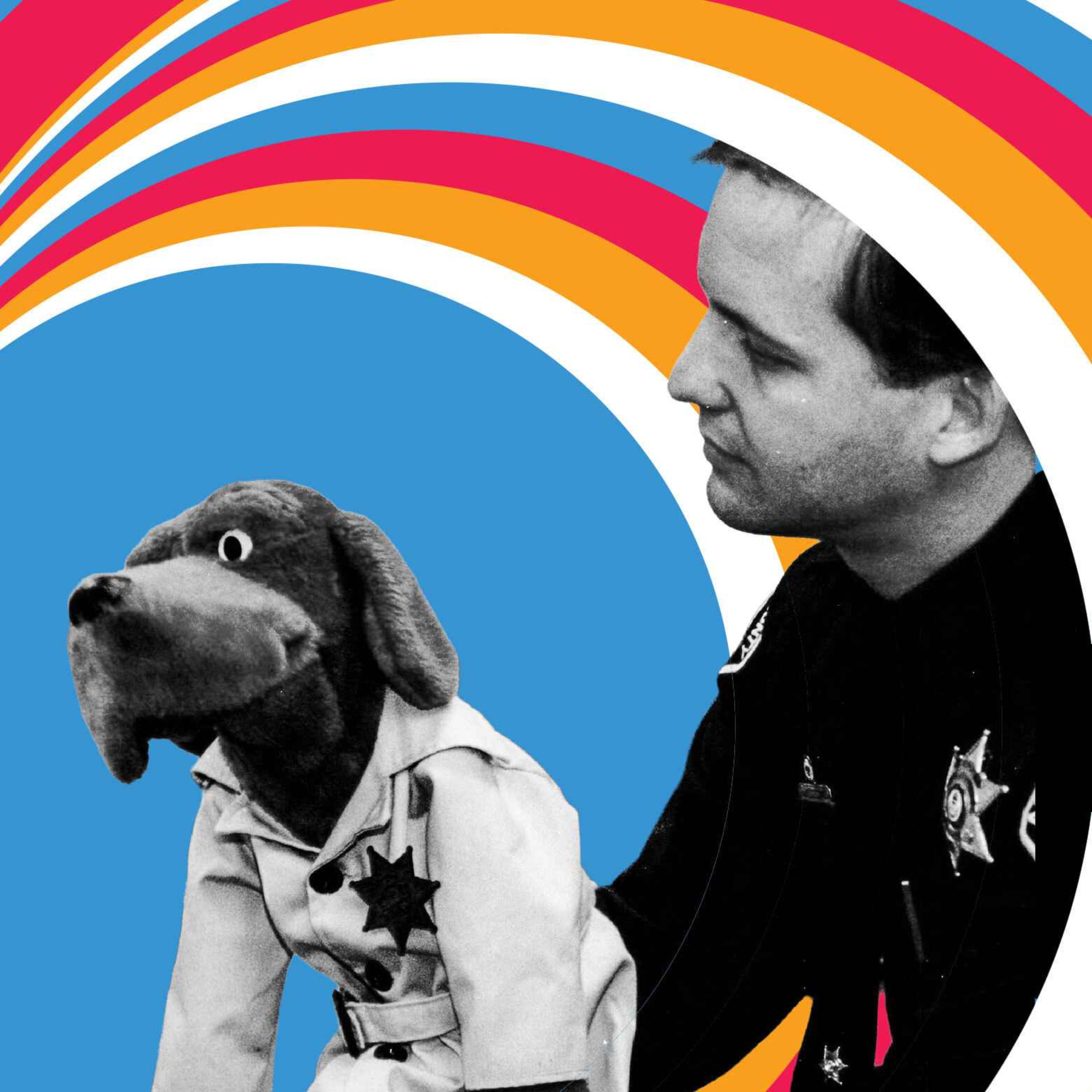
Hi, it's Willa. Last episode, we talked all about McGruff the Crime Dog, his origins, how he was drafted into the war on drugs, and how he started keeping company with some educational puppeteers. In this episode, all of these elements come together to create an album worth of wild, once-little-heard anti-drug songs that have not just survived, they've been majestically reinterpreted in the present day. The second half of our story is not only about McGruff the Crime Dog and his music, it's about the unpredictable afterlife of even the corniest messages. And it starts now. Before we begin, just a heads up that this episode contains some adult language.
In early March of 2020, Sarah Hubbard was going on a road trip with her boyfriend, and she knew exactly what she wanted to play on the drive. I discovered this album through a comedy podcast, and I had started listening, and I realized, like, I need to listen to this whole thing on this drive down. So with eight hours ahead of them, she queued it up. It was called McGruff's Smart Kids album.
McGruff is a hound in a trench coat who first started appearing in public service announcements about crime prevention in the early 1980s. By the middle of the decade, McGruff had joined the war on drugs, which explains the subject matter of the songs. We were like nearly having to pull over the car laughing. Sarah, by the way, is a touring musician who plays the violin in Theremin. Her boyfriend is a violinist and a composer with a degree in classical composition. I mean, the funny thing to us was just that it was a kind of genuinely good album musically. And then you have all this like Reagan era, don't do drugs. And we just couldn't stop singing it that entire weekend. That weekend would turn out to be an important one for them. He proposed to me in the middle of it. So weirdly, our engagement was marked by this album.
In the month that followed, Sarah and her fiancé listened to the album and the songs all the time. She also introduced them to the band she was touring with, and the album became a kind of inside joke. They started singing it during soundchecks and even called the hotline just mentioned. It's no longer available. They also wondered if they could ever perform songs so tied up with the damage caused by the war on drugs. We had a lot of conversations about this in the van where we were like, well, what if we ever threw this into a set? Like, could we feel horrible about doing that or would people get it? By the time Sarah's wedding rolled around, what had started as an ironic appreciation had deepened. Sarah and her partner and their friends still thought the songs were hilarious, but they also thought, in Sarah's words, that they kind of ripped. So when Sarah and her husband finally got married, guess what song she put on her wedding party playlist?
That comes from a grainy video taken at the wedding reception, a video Sarah tweeted at McGruff, who has a Twitter account. My vision of McGruff has become a little more hip. He's like solidified himself in my life, in my husband's life. He's a bit of like a cartoon character uncle or something. As a kid, Sarah only had a vague awareness of McGruff. But now she was tweeting one of the most important days of her life at him. McGruff's Smart Kids album had made Sarah think and feel differently about McGruff. Was it working?
This is Decoder Ring. I'm Willa Paskin. In last week's episode, we began telling the story of McGruff the Crime Dog and his album of bizarrely catchy anti-drug bops. In this week's episode, we're going to dive back into that tale and follow McGruff and his songs as they reverberate through the decades, often, as you just heard, in totally unpredictable ways. The story of how this strange artifact not only came to survive, but thrive, includes tens of thousands of puppets, a three-year-old singing about crack, the fragmentation of the monoculture, the strange parallels between Just Say No and straight-edge punk rock, and the way that messages that don't function like they're supposed to can still do an awful lot. So today on Decoder Ring, did McGruff and his Smart Kids album work?
Support comes from Wise, the smart checking account for home and abroad. Got a Canadian salary, property in the U.S., sending money abroad? You're juggling multiple accounts, currencies, and a headache. Manage it all the smart way with Wise. Save up to 65% on exchange fees and give your everyday money a boost with interest. Plus, switch your direct deposit to Wise for the monthly chance to double your paycheck. Be smart. Get Wise. Canada residents only, excluding Quebec. Up to 60 winners. Odds depend on entries. Offer ends September 14, 2027. Learn more at wise.com. My teammate says he plays pickup basketball, quote, for the cardio.
Well, there's more to it than that, Sean. Like with Bet365, I get paid the second my team goes at big with early payout and can cash out at any time before the game ends. Sean's getting his steps, but I'm getting paid. Bet365, the home of winning early. Must be 19 and older. Ontario only. Please play responsibly. If you or someone you know is concerned about gambling, visit ConnexOntario.ca or call 1-866-531-2600. Terms and conditions apply.
If you haven't listened to our first episode about McGruff, I'm going to strongly suggest that you go do that now. And then please come back and listen to this one. Because we're going to pick up almost right where we left off, in the mid-1980s, when McGruff the Crime Dog was so popular he was appearing on sitcoms. This is now an official McGruff Safe School. First Lady Nancy Reagan was making anti-drug messaging for kids the it cause of the moment. Just say no. And a small business in Southern California called Puppet Productions was graduating from making religious education puppet musicals to taking McGruff to school. Every classroom in America needs a McGruff in it. And then they wanted an album that the teacher could play of the music and skits to go with it, you know. So we're like, dude, this is huge. That's Robin Nelson and Mike Haas. They'd worked together on many projects before, Rob doing the lyrics and Mike doing the music, but this was bigger.
36,000 puppets bigger. Mike had to go to South Korea to source a manufacturer that could handle the volume. When I got back from Korea, I was like, well, now we got to do some music. We didn't want to roll out the old turkey in the straw kind of stuff just because it's going to kids. We wanted it to be stuff like what they would hear on the radio. That's why it was so eclectic. It was like, because music at that time was kind of out there.
Synthesizers, breakbeats, sax solos, children's choirs were the order of the day, and Mike knew his way around all of it. He'd been something of a musical boy wonder. As a teenager in the early 1970s, he'd been the vocal director of a group that won a nationwide talent contest, landing a summer show on CBS. After college, he'd agreed to work at his dad, Bill Hawes, business, designing puppets and composing all the music and producing it too, often bringing in studio musicians and members of the San Diego Symphony. But most of that music was in a Disney style. The McGruff Project was different, and Mike ran with it, rifling the radio for sounds.
The opening strains of marijuana echo Madonna's Papa Don't Preach. And the song I'm Glad I'm Me. It's like a robotic take on Devo. And then there's the first song they recorded. That song was done with all live instrumentation. I brought in drums, bass, you know, guitars. I played guitar myself on that one. I did the keyboards. So it was kind of like a takeoff on Steely Dan. Hey, 19.
This song aside, Mike recorded most of the tracks with synthesizers. The lyrics were written after the music by Rob and a man named Tim Sloan, who voiced the crime dog for the project. And just to be clear, this whole project was kind of minor league for McGruff. Puppet Productions had officially licensed the character from the NCPC, the nonprofit that houses McGruff. But it was not the NCPC's focus. They didn't even make McGruff's official voice, the advertising executive, Jack Kyle, available for it.
The NCPC did have to approve everything, though. Just one of the parties with opinions about the topics and lyrics. Others included their boss, Bill, and educational and law enforcement consultants. They all wanted the lyrics to be age-appropriate, simple, and direct. But Rob also wanted them to be singable. And his then three-year-old reassured him they were while wandering around their San Diego apartment complex. What is he singing about? He was singing the song that was about...
Crack. Nobody's needing that crack and cocaine. So he was just, you'd hear him going, I'm a crack and cocaine. That was our goal, was that they would be things that the kids liked to sing. The songs were so catchy, yet on message, Puppet Productions boss thought there might be a mass market for them. Bill was convinced that every grandparent in America would buy this for their grandchild. So the company put an ad in Parade Magazine, a syndicated newspaper supplement with a circulation of $20 million. It was for a tape called McGruff's Smart Kids album, with just 11 songs on it and a cover that showed McGruff leaning against a brick wall. It didn't do very well. That was $100,000.
And we sold 10 from that ad. The company remained undeterred. The main project wasn't just the songs anyway, and grandparents weren't the target. It was an educational program, a years-long curricula for every single elementary school grade, a double cassette's worth of material that a teacher was supposed to play for their class while operating a McGruff puppet who would lip sync along, not just to the songs, but to instruction as well. Hi there, boys and girls. McGruff here. I want to talk to you today about learning to say no. Of course, I know that you can all say no, but can you say no when it counts?
I'm talking about when somebody offers you some drugs. Rob wrote all this spoken material, giving each song an introduction, which had to be different for every grade. What kindergartners heard about drugs was age appropriate. I want to talk to you today about medicine and drugs. What sixth graders heard was harder hitting. Someone might tell you that it's a way to have fun, but take it from me, it's a way to become addicted to them or a way to end up in a hospital. Drugs will do you wrong.
Rob ultimately wrote over 180 different pieces of material for the project. It was a beast. A lot of it was about drugs and just saying no, but other topics were covered too. The little kids heard songs about stranger danger and fire, bicycle, and skateboard safety. The older kids heard songs about sexual abuse, arson, vandalism, and... Fear, pressure, fighting, crime. All these words are associated with gangs. This one came with a song too.
The finished product, called McGruff's Drug Prevention and Child Protection Program, became available for purchase around 1987. Teachers would open a box to find a two-foot McGruff hand puppet, a stand so that he could be propped up on their desk when not in use, two cassettes color-coded by grade, and a teacher's guide with instructions. It contained directions on how to operate the puppet, all of the lyrics, and suggestions for additional activities, like discuss the difference between leaders and followers, and role-play saying no to a friend, and review how to spell cocaine. The whole package made it into classrooms when local groups like Rotary Clubs and PTAs raised money for them, which a lot did. Lions Clubs in Texas funded, I think, something like 50,000 classrooms. Texas was by far the biggest responder. But we did put a lot in Pennsylvania and New York, and they were spread out in California and other population centers. Rob estimates they placed about 100,000 McGruff puppets in schools and said the project was considered a success for the company. What was far less clear was if the program was a success with kids.
For most of the history of professional sports, there was a wall between the game and gambling. Then suddenly it was everywhere. But that wasn't supposed to include the players themselves. Understood the big bet. Find us on CBC Listen or wherever you get your podcasts. At Capital One, we don't just use technology. We architect it. Our teams have true end-to-end product ownership. Shipping distributed systems at scale right here in downtown Toronto. That's technology at Capital One. Search technology at Capital One Canada. Support comes from Wise, the smart checking account for home and abroad. Got a Canadian salary?
property in the U.S., sending money abroad, you're juggling multiple accounts, currencies, and a headache. Manage it all the smart way with Wise. Save up to 65% on exchange fees and give your everyday money a boost with interest. Plus, switch your direct deposit to Wise for the monthly chance to double your paycheck. Be smart. Get Wise. Canada residents only, excluding Quebec. Up to 60 winners. Odds depend on entries. Offer ends September 14, 2027. Learn more at wise.com.
For all the effort that went into McGruff's drug prevention and child protection program, they didn't pay much attention to its impact. We would occasionally get a glowing something from a chief of police somewhere. We'd get things from schools, sometimes a school counselor, anecdotal tales of kids saying something that McGruff had taught them. The tapes went out into the world like some extremely elaborate message in a bottle. All this labor put into something that would bob along the currents of the culture, maybe reaching some kid somewhere, but without any follow-up to see if that had actually happened. The era was awash in this kind of overproduced, understudied, if we make it, it'll work messaging. Just about every PSA you heard in part one fits the bill. But there's an even more notorious example.
D.A.R.E. is a drug and crime prevention program that brings uniformed cops into classrooms and that spread across the country in the 1980s. For many years, in the absence of data, it was widely believed D.A.R.E. was effective. Cops talk to kids directly, building community ties and encouraging them to just say no. And it was funded accordingly. But numerous subsequent rigorous studies have found the same thing.
Historian David Farber, the editor of The War on Drugs, A History. Total failure. Didn't convince kids not to take drugs, but it's omnipresent. Initially, McGruff wasn't like Dare. He was on much firmer ground, statistically speaking. When he began appearing in the early 1980s, he was made by and for adults, as you can hear in this PSA promoting neighborhood watch programs, which opens with an intruder breaking into a man named John's house with the butt of a rifle. Since this neighborhood program began, crime in John's neighborhood dropped 50% and property values doubled. We made a difference. And you can too.
And McGruff reached the adults he was aiming for. It's usually tough to say that about a public service campaign with any certainty. But for McGruff, there were data, a long-term study commissioned by the Justice Department. Its first paper looked at the early crime prevention spots and found that in a short time, there had been a correlative rise in almost all of the behaviors McGruff promoted, from turning on lights to the growth of neighborhood patrols. There had even been a rise in people getting a dog for security reasons.
This paper and subsequent follow-ups also found that nearly 90% of adults believed McGruff was effective with children. It's an understandable assumption. He is a cartoon dog, but the study didn't ask any kids. McGruff became more and more kid-focused anyway, until he started to address them directly. That's from a nationally televised PSA. If the puppet program was the minor leagues, this was the major ones, with the NCPC, the Ad Council, and the Justice Department steering McGruff into the cause of the 1980s. And Jack Kyle, the ad executive who created McGruff and did his voice, wanted to do even more.
In this ad, an animated McGruff plays a piano out of doors as leaves swirl and beaming little kids flock to him, eager to sing along. This ad was released in 1987 in a version of the song with a re-recorded McGruff voice was included on Puppet Productions educational cassettes. It sounds like at the last minute. The song that follows is not a part of McGruff's drug prevention and child protection program. You won't find any script or reference to it in the teacher's guide.
It's a bonus sing-along for you to use at your convenience. One of the kids treated to this bonus sing-along and all of the rest of the numbers was Daniel Danger. Daniel, who you heard in our last episode, was a fifth grader in Massachusetts in the early 1990s. And he had a McGruff puppet in his classroom. No teacher was ever good at it. Because, like, no teacher is a natural puppeteer. But that wasn't the only problem. I just remember just, like, I'm not going to sing along. Like, no kid that I know listening to McGruff was like, yeah, I'm definitely not doing drugs. Like, you know, not in a way that, like, they were pro-drugs. They just weren't going to listen to a cartoon dog. We were probably a little too old for it. This reaction is actually pretty restrained. A much more common one was ruthless mockery. I'm Oprah Winfrey. I'm going to show you one more time.
This is a spoof from the sketch comedy show In Living Color of probably the most famous and lauded anti-drug PSA of all. This is drugs. This is your brain on drugs. Any questions? This ad was created by what was then called the Partnership for a Drug-Free America, a nonprofit started by advertising executives in the mid-1980s who put an unprecedented amount of money into the campaign. It was one of dozens of PSAs that delivered a burst of fear or operatic emotional intensity during the commercial break of a sitcom or Saturday morning cartoon. But it was even better funded, and it became particularly ubiquitous. A meme before we called them that. A cultural touchstone everyone could riff on. In the In Living Color sketch, after the actress playing Oprah cracks the egg into the frying pan, she keeps cooking.
Another thing to be said for the McGruff program, or rather about Daniel's response to it, is that at least he knew what it was trying to communicate. That was not always the case. Daisy Rosario is a senior supervising producer of audio at Slate, and she watched a lot of sitcoms as a kid. There's an episode of Punky Brewster where Punky's friend gets stuck in a refrigerator. Punky Brewster aired in the mid-1980s and was about a spunky, spirited eight-year-old orphan. I don't remember why or how, but the friend gets in the refrigerator.
And then, like, she can't get out of it. Daisy thinks about this episode a lot. It still sticks with me. I feel I still double check that certain types of doors and things will not lock from the inside. I'll find myself going like, oh, you know what? Let me make sure that this I don't get trapped on the inside. Because you remember that one time Punky's friend was in a refrigerator. And that's all I remember of that episode. The wild thing is this episode was not supposed to be about the dangers of getting locked inside a fridge or anywhere else. I don't think she's breathing. What? Alan, you learn CPR in school? Uh, well.
The show had solicited episode suggestions from its audience, and someone had suggested CPR. That's what the episode was supposed to be about. Right, because there would not be air. But Punky Brewster, in trying to communicate this, had completely boffed it. Daisy was just receptive enough to take something away from it anyway. And so much stuff from this era feels similarly haphazard. When I spoke with David Farber, the historian who studies the 1980s and the war on drugs, he agreed most of this stuff was really goofy. But maybe not just goofy. Here's another annoying fact. Something happens between 1980 and 1990 in regard to drug use among...
recreational, mostly white young people. It goes down precipitously. Oh my God, is it just saying no? This is based on data gathered from high school students over a nearly 30-year period, though during it there was no similar decline among heavy drug users. We don't really have a causal relationship. We only know that there's a correlation, that these goofy things happen in the 80s, drug use goes down. Hard as it may be to credit that any one of these things really worked, there is a concept that helps explain what might be going on. One of the words that we use is priming. Joseph Capella is an emeritus professor at the University of Pennsylvania who studies public health messaging. And the whole notion here is that by...
telling people that this issue is an issue that they ought to be concerned about, even though they're making fun of it, even though they're disagreeing with it and so on. It's an issue that gets weight. Every single PSA you see might send you into fits of eye rolls and giggles. Every special episode might be telling you something other than it intended. Every singing puppet may make you want to shut your mouth, but the relentlessness of them all together convinces you that the issue itself is important and menacing. The superficial message doesn't work, but the deep one gets you. Sure.
You're laughing at PSAs. But maybe you're also scared of drugs. There's one other thing about the study Dr. Farber mentioned earlier that showed declining rates of casual drug use. That effect ended in the mid-1990s. Rates started to go up. And this is also just a correlation. But about then, PSAs started to fall on really hard times.
Welcome back to Fresh Matters, where we discuss matters of freshness. I'm the grossier here with Kat from Metro. Kat, your produce is impeccable. We have high standards. Meat is custom cut on site to my very delight. Yep, it's important that we... And the baked goods? More like baked grates. Fresh in store every day. So at Metro you would say fresh. Matters? It does! Find fresh meals and deals at Metro!
I finished a 5K in 94th place, right after a man wearing jeans. Then a volunteer gave me a medal. But I don't want participation trophies, unless they're from Bet365. With their daily prize matcher game, I win by matching gold coins, cherries, and more. Take that, denim man. Thanks, Bet365. Must be 19 or older Ontario only. Please play responsibly. If you have questions or concerns about your gambling or the gambling of someone close to you, please go to connexontario.ca and see supply.
In 1984, under the Reagan administration, PSAs, like so much else, were deregulated. Broadcast networks were still mandated to air them, but with less enforcement of that mandate, stations suddenly had a lot more flexibility. With the incredible energy and funds around the war on drugs, there was still a lot of anti-drug messaging. But by the end of the decade, stations had figured out more self-serving ways to participate. Drugs are dumb, and they'll make you dumb. So be smart, right?
NBC's long-running The More You Know campaign, which featured its own talent, like the teen heartthrob Joey Lawrence, allowed the network to do public service and self-promotion simultaneously. Those PSAs might be taking up a lucrative ad spot, but at least it was taking it up with an ad for NBC. As cable channels proliferated and the economy boomed, increasing the number of would-be advertisers, it got harder and harder to place PSAs. By 1997, the head of the FCC was saying that PSAs had dried up and disappeared like rain in the desert. And all of this affected McGruff. When we last saw the crime dog, he was riding high, singing to a generation of children. And he was still at it in 1991 when Burger King released a whole McGruff cares for you line of cassettes.
But McGruff was starting to lose focus. On the one hand, the Take a Bite Out of Crime campaign was tackling issues as serious as gun violence. Every day, 10 children are killed by gunfire. But on the other, McGruff himself was getting sidelined, only appearing in the gun ads at the end, in the logo, because he'd been deemed too lighthearted to participate. Had the campaign outgrown their spokesdog? Did McGruff need a reboot?
Or a sidekick? Here's my nephew, Scruff, about to run into trouble again. Scruff McGruff was introduced in 1993 when McGruff was actively reoriented to address little kids. If you get my new comic activity book, More Adventures with Scruff, you'll find out what you can do about bullies and guns. And you'll see lots of games.
The trouble with pursuing little kids is that there's never any deficit of cute cartoon characters. Scruff wasn't that distinct, and maybe neither was McGruff anymore. It's not like young people understood that the crime dog was a riff on Columbo. The TV detective who had inspired McGruff was no longer a contemporary cultural reference. McGruff was still too well-known and liked to retire, but it wasn't quite clear what to do with him, besides trot him out at every police community event, where one of the officers invariably donned a McGruff costume.
McGruff was losing steam, and so was the puppet program. It had sounded pretty contemporary in 1987, but it didn't anymore. Teachers set aside less and less time to do a puppet show they might never have wanted to do in the first place. At the end of the 1990s, the Ad Council stopped running McGruff's campaigns, and the NCPC again tried to endear him to teenagers. But by then, his competition had gotten more sophisticated. In 1998, as part of a settlement agreement between four tobacco companies and 46 states, hundreds of millions of dollars went to what would be called the Truth Initiative to create anti-smoking campaigns.
The organization was rigorous about including actual teenagers in the development of its approach, and its big insight was to channel teenage rebellion, not against parents and teachers scolding them about smoking, but against the tobacco companies who had manipulated and lied to their cohort for decades. Ad agencies took this insight and created a series of spots. The most famous one, which you've been hearing, used footage filmed during a real stunt. A large white van pulls up in front of the Philip Morris building in New York City, and teenagers begin unloading white body bags, stacking them on the sidewalk in a macabre, growing mound of death. You know what?
We're going to leave this here for you so you can see with 1,200 people. PSAs being what they are, there's always going to be people who find them too earnest or overdramatic. But this ad felt modern, closer to cinema verite and reality TV than 1980s kitsch. Increasingly, a PSA needed a message this on point to break through. As the 90s became the 2000s and media fragmentation accelerated, it became harder and harder to reach a mass audience with a few well-placed spots until it became nearly impossible. But if this has been difficult for PSAs in general, it hasn't been so bad for McGruff.
One of the knock-on effects of fragmentation, which you see across all pop culture right now, is that things that were successful back when we had a so-called monoculture are valuable now that we don't because they're some of the only things that really huge numbers of Americans recognize and often feel nostalgic about. McGruff. Remember McGruff? That's Daniel Danger again. If you listened to part one, you'll recall that this wave of McGruff nostalgia crashed over him when he encountered a McGruff puppet and cassette in a thrift store and popped it into his car stereo.
As Daniel listened to these holy shit, what am I hearing songs with their catchy melodies, growling lead vocals and thunderingly literal messages, something unexpected happened. He felt inspired. OK, so as a fifth grader, Daniel had refused to sing along with McGruff. But he's grown up to be an illustrator and a musician, and he's been in a lot of bands, mostly hardcore punk ones. Daniel had gotten into the hardcore scene as a teenager. He even declared himself straight edge, a hardcore subgenre and term that comes from a 1981 song by the band Minor Threat.
Straight Edge was about basically a push of self-control to abstain from drugs, alcohol. And the idea behind it was sort of like the ultimate rebellion is self-control. And that's how you're best going to be able to rebel against the system. One of the more bizarre results of this is that though Minor Threat and the groups they inspired were antithetically, vehemently opposed to the approach and values of the Reagan-era White House, they were all responding to the real and perceived excesses of the 60s and 70s by basically encouraging kids to just say no to drugs.
It really was everywhere. Minor Threat's version of the message resonated with teenagers, mostly white, mostly boys, for whom more mainstream just-say-no-pap likely did not. There was this big, huge, and I mean huge, nationwide, worldwide movement in the early 80s punk and hardcore scene to the straight-edge movement where people were putting big X on their hands to indicate that they didn't drink, they didn't do drugs. In the mid-1990s, Daniel was one of those kids, and he went to a lot of shows where he closely observed these bands' performance styles. This thing that was really common was that these bands would play, they're playing their show, you know, all the fast music. And then most songs had the breakdown. And in that part, it was really common for the singer to, like, wrap a mic around their hand and, like, preach to the audience. And then they would, like, kick back into the song. Okay, so now, knowing all of this, let's go back to the car.
Just think, in all the world, there's only one you. And anything you ever do will be done in your body. Since bodies are made to last a good long time, don't hurt yours by putting drugs in it. Just say no. In song after song, Daniel and his friend heard McGruff pull out of a 1980s melody to deliver a sermon. They were like, man, these are just hardcore songs. Like, these are just militant straight-edge hardcore songs, like, in the wrong genre. And we were like, man, wouldn't it be funny to re-record these songs as early 80s straight-edge hardcore? And so a few years later, that's exactly what he did.
And I remember just like sitting in the studio and we're like, this is absurd. This is the dumbest thing. What are we doing? Like I'm like sinking like actual time and money into this McGruff idea. He was meticulous about the project, recording in a real studio with real musicians sweating the album design and making merch. He pressed 300 records and they sold out. So he made some more. Seven years later, he says he sells two or three digital copies online a day. It's so fun. It's just like it's this goofy thing that I'm really proud of, even though it's silly. It has this weird long backstory going back to me in fifth grade. I'm like, whatever. It's good.
McGruff had lodged himself deep in Daniel's subconscious when he was young and suggestible. And maybe that's another way these messages work. They work their way into you so that whether you approve of them or not, whether they're good or not, doesn't matter. Years later, you're still infected with them. In the most extreme cases, maybe that means doing something like cutting an album of hardcore covers of anti-drug songs by a dog. But in more common ones, I think it just means that some corny PSA refrain, some line or lesson from a very special episode, some kid song, is an uninvited guest regularly showing up in your mind. I know for me, there's a line from Beverly Hills 90210 and a song from Saved by the Bell that are an unbidden part of my inner life, popping up whether I want them to or not.
One of the things Daniel's project has done is give the Smart Kids album a new life. He's one of a number of people who have rediscovered the record in recent years and put it on the internet. The version floating around is the all killer, no filler album that was advertised in Parade magazine and barely sold. But some must have, because it's now dissected in articles, guffawed over on comedy podcasts, upvoted in Reddit threads, embraced by the NCPC who wants to get it on Spotify, and memed on TikTok, where the remix comes from. Many of the people who have come across the album have never heard it before. Some have never heard of McGruff, but they have now. If the McGruff album was a message in a bottle after 30 plus years of floating along, it finally made it to shore. And the message it contains has captivated so many people, as I hope it's captivated you because the songs are better than they have any right to be and weirder than anyone could imagine.
They're an irreplicable throwback to a time when a talking dog was drafted into a nationwide fixation on drugs by a puppet company. And somehow, all these years later, people are still singing along. They're a time capsule that doesn't make the recent past seem simple and smooth, but as strange as it actually was. As strange as the past really is. This is Decoder Ring. I'm Willa Paskin. Please consider signing up for Decoder Ring Plus. You get to skip all the ads and hear every episode of Decoder Ring's back, where I personally call one of you up and answer your cultural mystery. You'll also be supporting the work that we do, and you can join by going to the Decoder Ring show page on Apple Podcasts or Spotify or visiting slate.com slash Decoder Ring Plus. This episode was written by me and produced by me and Katie Shepard. It was edited by Jamie York. Decoder Ring is also produced by Max Friedman and Evan Chung, our supervising producer. Merrick Jacob is senior technical director. Phoebe Mulder is our intern. Thank you to Derek John, Tatiana Peralta, Ari Merkin, Wendy Melillo, Dan McCoy.
I'd like to mention a few things that were really helpful in working on this piece. Again, Wendy Melillo's book, How McGruff and the Crying Indian Changed America, a history of iconic ad-cancel campaigns. And if you're interested in the studies of McGruff's effectiveness, they culminated in a book called Taking a Bite Out of Crime, the Impact of the National Citizens Crime Prevention Media Campaign by Garrett J. O'Keefe and others. I'd also like to recommend Dan McQuaid's article for Defector Media, The Most...
If you have any cultural mysteries you want us to decode, please email us at decodering at slate.com. You can also leave us a message on our decodering phone number. It's 347-460-7281. That's it for this two-parter. We'll be back in two weeks with a brand new episode. Right now, Marshall's buyers are still hustling to get amazing new gifts into stores. Like this season's Italian leather handbags. They're in the bag. The latest designer perfume. Perfection. And the cuddliest of cuddly toys. So soft. Wait!
These gourmet chocolates just landed from Europe. Bellissimo. Marshalls, we get the deals. You get the good stuff. I finished a 5K in 94th place, right after a man wearing jeans. Then a volunteer gave me a medal. But I don't want participation trophies, unless they're from Beth365. With their daily prize matcher game, I win by matching gold coins, cherries, and more. Take that, denim man. Thanks, Beth365. Must be 19 or older, Ontario only. Please play responsibly. If you have questions or concerns about your gambling or the gambling of someone close to you, please go to connectsontario.ca and see supply.