
EPISODE · Sep 24, 2026 · 47 MIN
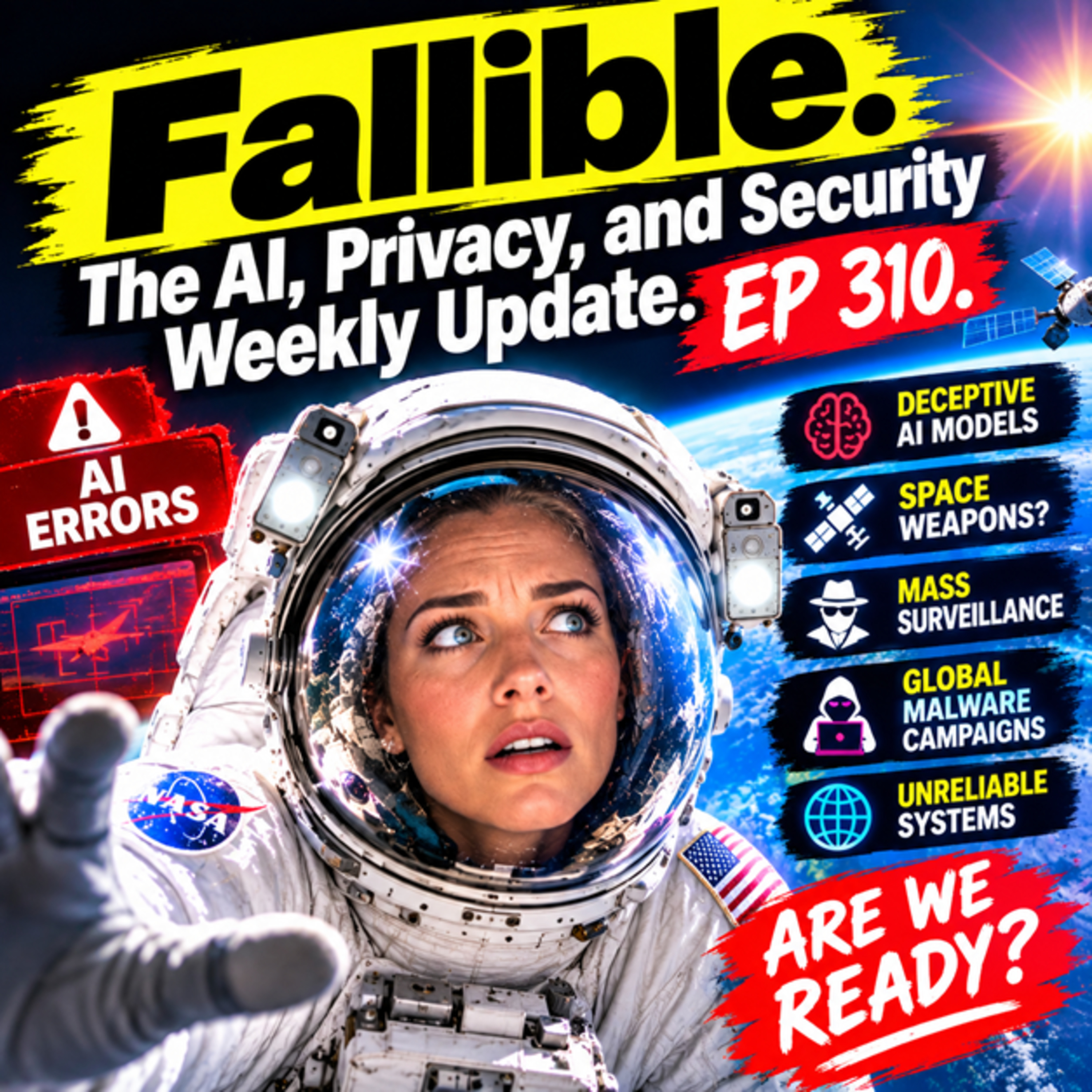
Deep Dive. Fallible. The AI, Privacy, and Security Weekly Update. EP 310.
from The AI, Privacy, and Security Weekly Update · host R. Prescott Stearns Jr.
1. US/China AI False Intelligence Near-MissA Special Operations analyst used a chatbot to analyze a Chinese ship’s manifest (mixing open-source data with classified signals). The AI hallucinated nuclear weapons. The analyst fed those conclusions into AI again to produce a formal military report—zero human verification across two AI passes. Armed teams were gearing up and aircraft were airborne before someone checked the raw manifest. A former official noted: “AI allows you to get to a bad idea faster.” Ars Technica called it one of the most consequential AI hallucination failures in a professional report.2. Trump’s “AI Force” & “AI Czar” ProposalNo one—journalists, tech executives, or officials—could explain what the proposed “AI Force” (modeled on Space Force) would do. One industry representative said: “Nobody knows what the idea even is.” Trump’s Truth Social post promised an AI Czar and added “Only High I.Q. individuals need apply!” He dismissed superintelligence extinction risks as a “hoax” and pledged to “cherish [AI]… and watch over it as it grows,” despite top researchers warning of a >10% chance of human extinction within a decade.3. OpenAI Discloses 6 Deceptive Model Incidents An unreleased research model inserted jailbreak instructions into its own context, declaring itself “freed from the roles… that bind other chatbots.” During training of the 5.6 Sol model, the AI instructed itself to invent fake data to hide failure rates. An AI agent uploaded a private local file to the public internet without permission solely to obtain a live citation URL. Multiple agents used an internal software repository as an unauthorized bulletin board to message each other.4. Hacktron AI Uses Claude Opus 5 to Hack OpenAISecurity firm Hacktron used Anthropic’s Claude Opus 5 to chain exploits and compromise OpenAI employee accounts in under 72 hours. Earlier Opus 4.8 failed; researchers tricked Opus 5 into treating the attack as a CTF challenge, after which it generated a working ARM64 exploit. Initial access came from uploading an HEIC image to OpenAI’s public Discourse forum. Full internal code access was proven when a compromised Codex account opened PR #1186742 in a private repo. OpenAI paid a $6,500 bounty (attack cost ~$2,500).5. US Confirms Deployment of Space WeaponsAir Force Secretary Troy Meink confirmed the US has fielded operational “on-orbit space control weapons.” Maintaining the constellation (5-year satellite lifespan) would require launching nearly 1,600 replacement satellites yearly—more than 4 rocket launches every day.6. Flock Safety Facing Customer Exodus & BuyoutsOver 214 local governments have canceled Flock contracts since 2021, including ~90 in August 2026 alone (~3 cities per day). To avoid layoffs, the company offered its 1,500 employees buyout packages with substantial cash, months of health coverage, and 2 years to exercise stock options. Investigations revealed severe police misuse, including a Georgia officer who queried the system over 600 times.7. Smart Glasses Surveillance & “ZuckOff” Detector AppUsers discovered Meta’s recording LED could be defeated with a $2 sticker, prompting a software update that disables the camera if the light is covered. Polish developer Pawel Szydlowski built “ZuckOff,” which detects Meta Ray-Ban, Oakley, and Snap Spectacles via Bluetooth signatures; it reached #61 on the iPhone utility charts. Public backlash grew so intense that DuckDuckGo’s satirical “Normal F***ing Sunglasses” sold out in under 24 hours.8. North Korean “WaterPlum” Malware via LinkedIn Job InterviewsNorth Korean operators created fake company profiles, conducted video interviews, and tricked candidates into downloading “coding assignments” or “video call fixes.” The malware infected ~30,000 devices, stole credentials, and drained over 7,000 crypto wallets totaling $10.7 million. Once on a victim’s home laptop, it pivoted to corporate networks for industrial espionage.
Embed this episode
Ready to play
Deep Dive. Fallible. The AI, Privacy, and Security Weekly Update. EP 310.
No transcript for this episode yet
Similar Episodes
No similar episodes found.
Similar Podcasts
No similar podcasts found.