Deep Fission Gravity Reactor
from The Innovation Attorney Podcast Hosted by The Innovation Attorney
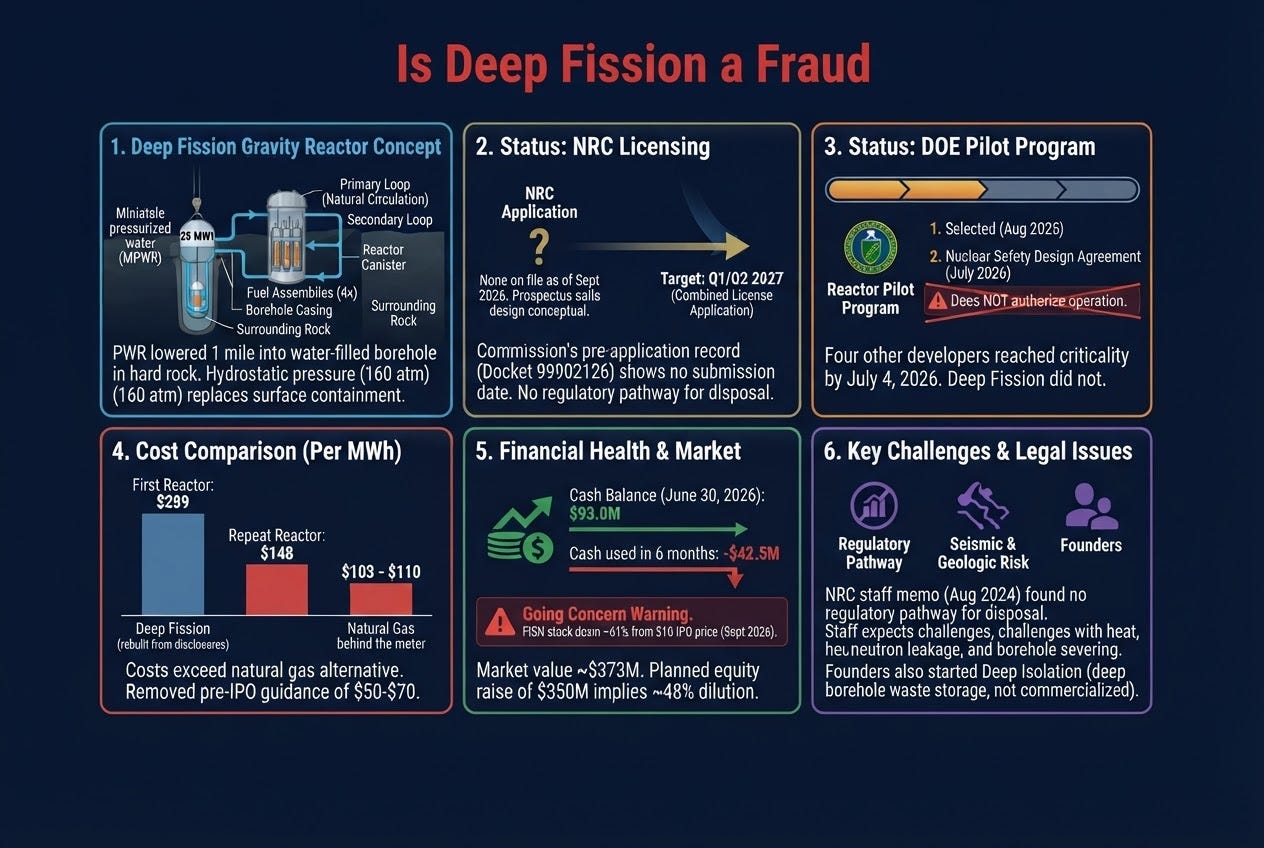
Deep Fission’s one mile deep Gravity reactor has no Nuclear Regulatory Commission license application on file as of September 2026, and its June 2026 prospectus describes the design as conceptual. The Commission’s pre application record under Docket 99902126 shows no date for a combined license submission. The Department of Energy approved a Nuclear Safety Design Agreement for the project in July 2026, a milestone that authorizes no operation. Gravity is a miniature pressurized water reactor fueled with low enriched uranium, which Deep Fission, a California company founded in 2023 and listed on Nasdaq since June 2026, intends to lower into a water filled borehole in hard rock. Data center developers and shareholders carry the exposure. Four other developers in the Department of Energy Reactor Pilot Program reached criticality on or before July 4, 2026. Deep Fission did not. The cost record is the weakest part of the file. The company removed its pre IPO guidance of $50 to $70 per megawatt hour from its prospectus, and rebuilding the calculation from the capital and operating figures it did disclose gives $289 for a first reactor and $148 for a repeat reactor. At June 30, 2026 the company held $93.0 million in cash, had used $42.5 million of it in six months, and carried a going concern warning. Two bodies of law frame the exposure. Atomic Energy Act Section 103 and 10 CFR Parts 52 and 53 govern the license the company still has to obtain, and an August 2024 NRC staff memorandum found no regulatory pathway for disposing of a reactor in a borehole. Securities Act Section 11 and Exchange Act Rule 10b5 govern the statements made to investors, and two plaintiff firms announced investigations on September 29 and October 1, 2026. Detailed Findings What is the Deep Fission Gravity reactor and how does it work The Gravity reactor is a four assembly pressurized water reactor, fueled with uranium oxide enriched below 5 percent uranium 235, that Deep Fission would lower into a cased borehole filled with water roughly one mile below the surface. The April 22, 2026 conceptual design description, revision 0, specifies four standard fuel assemblies in a 17 by 17 array of 264 rods each, a thermal rating of 25 megawatts, and a borehole of about 38 inches inner diameter with a nominal 2 inch casing. Three water loops move the heat: a primary loop that circulates by natural convection, a pumped secondary loop, and a tertiary loop that drives the surface turbine and generator. Containment is assigned to the fuel and cladding, a reactor canister, and the borehole itself, including its water column, a closure device, and the surrounding rock. The same document describes the design as being in a pre final phase, with the safety classification of structures and components preliminary and subject to refinement. The company attributes its cost and speed advantages to that geometry. The water column supplies roughly 160 atmospheres of hydrostatic pressure at depth, which the company says removes the need for the thick above ground containment structure and some of the safety systems a conventional plant carries. Spent fuel can be stored in the borehole or retrieved to the surface for conventional management. The company intends to take part in owning and operating its plants, which makes it the likely licensee and the party carrying nuclear liability. I stood reactor watches on a nuclear submarine, and the maintenance and casualty philosophy of that pressurized water plant rested on a trained crew being able to reach the equipment. A reactor a mile down a borehole removes that option from the design. Every component below the surface has to be qualified to run to retirement without a hand on it, and I did not find in the public record how that qualification will be demonstrated. How have the Gravity design parameters changed since 2024 The company’s own documents give different power ratings and borehole diameters for the same reactor. The 2024 white paper described a 30 megawatt thermal unit producing up to 10 megawatts electric in a 30 inch borehole. The April 2026 conceptual design description lists 25 megawatts thermal in a 38 inch borehole. The June 2026 prospectus describes boreholes of 30 to 50 inches, a first of a kind configuration of about 8 megawatts electric, and a repeat configuration of about 15 megawatts electric. The Commission’s pre application page lists 45 megawatts thermal and 15 megawatts electric at about 30 inches. A short seller report states that the chief executive told an August 2026 investor conference that the company is now targeting 5 megawatts electric in a 40 inch borehole and 15 megawatts electric in a 60 inch borehole, and that the chief executive acknowledged pushing the limits of borehole diameter. I did not locate a recording or transcript to verify those remarks. The direction matters because oil and gas and geothermal wells at depth are commonly drilled at diameters near 10 inches, as the same report notes, so each added inch of diameter moves the company further from proven drilling practice and adds drilling cost. Where does Deep Fission stand in the DOE Reactor Pilot Program Deep Fission has completed the second of four Department of Energy authorization milestones and has not reached criticality. The Department selected the company in August 2025 as one of eleven eligible projects, and the Other Transaction Agreement for reactor authorization took effect on November 14, 2025. The 81 page Nuclear Safety Design Agreement was approved in July 2026 and published in September 2026 with minimal security redactions, according to local reporting, and the short seller report dates the company’s announcement of the approval to early August 2026. The remaining milestones are the preliminary documented safety analysis and the documented safety analysis, and the last of those enables operation. Four developers reached criticality on or before July 4, 2026: Antares Nuclear with the Mark 0, Valar Atomics with the Ward 250, Deployable Energy with the Unity, and Aalo Atomics with the Aalo X. The short seller report states that Deep Fission targeted criticality by July 2026 in a September 2025 registration statement, that its chief executive described July 4 as the target on a November 2025 podcast, and that the company later dropped the target and characterized the milestone as a science experiment. Program status coverage in July 2026 lists the company as aiming for full power operation in early 2027 and commercial deployment in late 2027 or early 2028, and reports a test well drilled to 6,000 feet. The prospectus states that Department authorization does not permit commercial operation and does not replace the requirement to obtain NRC licenses. A company spokesperson said the same of the Nuclear Safety Design Agreement in September 2026. How long will NRC licensing of a borehole reactor take The company plans to file for a commercial license in the first half of 2027, and the Commission has announced no review schedule because no application exists. The closest benchmark is a conventional design. NuScale’s uprated 77 megawatt electric module received a standard design approval on May 28, 2025, about 22 months after the Commission accepted the application in July 2023, and that review covered an above ground module. NuScale’s original 50 megawatt electric design took roughly six years from application to the January 2023 certification rule. The Commission finalized Part 53 on March 26, 2026, published it on March 30, 2026, and made it effective April 29, 2026. The optional rule is risk informed, performance based, and technology inclusive, and Commission officials project design approvals in 18 months or less at about half the cost of a Part 50 or Part 52 review, consistent with the 18 month limit in Executive Order 14300. The company’s schedule, as the short seller report reads its investor materials, implies a decision within about a year of filing. A filing in the … This is a public episode. If you'd like to discuss this with other subscribers or get access to bonus episodes, visit theinnovationattorney.substack.com/subscribe
Embed this episode
No transcript yet.