
EPISODE · Jul 31, 2026 · 1H 16M
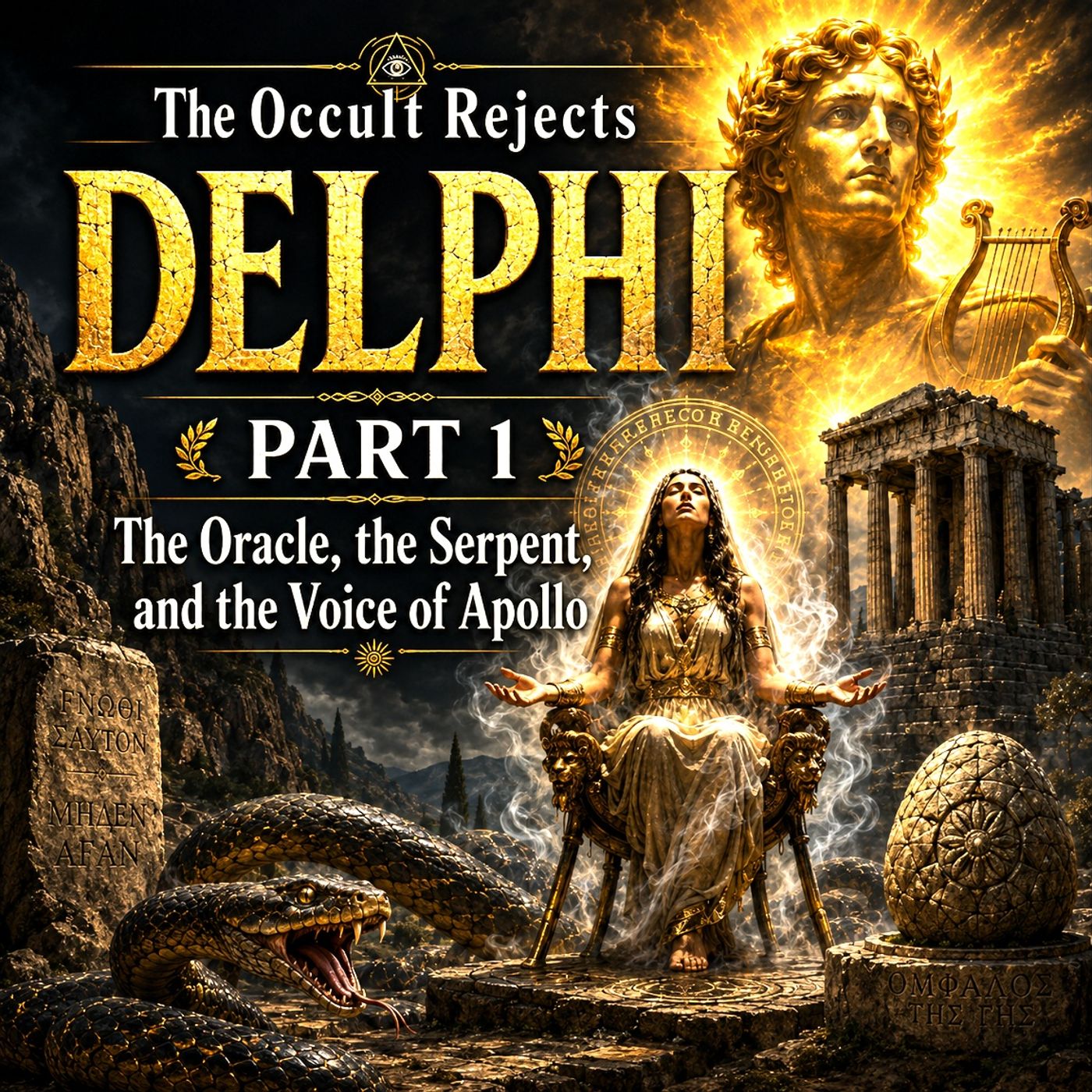
Delphi Part 1: The Oracle, the Serpent, and the Voice of Apollo
from The Occult Rejects · host The Occult Rejects
If you enjoy this episode, we’re sure you will enjoy more content like this on The Occult Rejects. In fact, we have curated playlists on occult topics like grimoires, esoteric concepts and phenomena, occult history, analyzing true crime and cults with an occult lens, Para politics, and occultism in music. Whether you enjoy consuming your content visually or via audio, we’ve got you covered - and it will always be provided free of charge. So, if you enjoy what we do and want to support our work of providing accessible, free content on various platforms, please consider making a donation to the links provided below. Thank you and enjoy the episode!Links For The Occult Rejectshttps://linktr.ee/theoccultrejectsOccult Research Institutehttps://www.occultresearchinstitute.org/Substackhttps://substack.com/@theoccultrejects?r=7auau0&utm_campaign=profile&utm_medium=profile-pageCash Apphttps://cash.app/$theoccultrejectsVenmo@TheOccultRejectsBuy Me A Coffeebuymeacoffee.com/TheOccultRejectsPatreonhttps://www.patreon.com/TheOccultRejectsFull Episode BibliographyPrimary SourcesAeschylus. Eumenides. Used for the ancient tradition of succession at Delphi and the mythic movement from older powers to Apollo.Cicero. On Divination. Used for ancient discussion of divination and the tradition of Delphic inspiration connected with breath or exhalation.Herodotus. The Histories. Used for Croesus, the danger of ambiguous prophecy, the Athenian “wooden wall” oracle, Themistocles’ interpretation, and Delphi’s role in war and public decision-making.Homeric Hymn to Apollo. Used for Apollo’s Delphic foundation myth, the serpent, the movement from sacred landscape to Apollonian institution, and the Cretan priests connected with Apollo’s dolphin form.Pausanias. Description of Greece, Book 10. Used for later ancient traditions concerning Delphi, foundation myths, Gaia, Themis, Python, Apollo, sacred monuments, and the Delphic landscape.Pindar. Pythian Odes. Used for the Pythian Games, victory poetry, Apollo, prestige, and the transformation of athletic victory into sacred memory.Plutarch. Life of Lycurgus. Used for Lycurgus, the Great Rhetra, and the tradition of Spartan law receiving Delphic sanction.Plutarch. Moralia: “On the E at Delphi.” Used for the mysterious letter E at Apollo’s temple and ancient philosophical interpretations of its meaning.Plutarch. Moralia: “The Oracles at Delphi No Longer Given in Verse.” Used for Delphic verse, the change in oracular style, and ancient reflection on why the Pythia no longer gave responses in meter.Plutarch. Moralia: “The Obsolescence of Oracles.” Used for Delphi in the Roman period, the decline of oracular centers, Plutarch’s reflections on divine inspiration, and the tradition that Delphi once had multiple priestesses.Strabo. Geography. Used for ancient geographical description of Delphi and the tradition of the oracle’s inspiration being connected with a breath or vapor rising from below.Official and Reference SourcesArchaeological Site of Delphi / Hellenic Ministry of Culture. “History of Delphi.” Used for Delphi’s geography, Mycenaean background, Apollo’s cult, Python, Cretan priests, the Amphictyony, sacred administration, Sacred Wars, Roman history, decline, and excavation.Archaeological Site of Delphi / Hellenic Ministry of Culture. “Mythological Versions of the Foundation of the Oracle.” Used for Gaia, Themis, Phoebe, Apollo, Python, Poseidon, the tripod, Athena Pronaia, the Thriae, and the dolphin/Cretan priest tradition.Archaeological Site of Delphi / Hellenic Ministry of Culture. “The Temple of Apollo.” Used for the sacred center of the sanctuary, the adyton, the temple’s rebuilding history, and the architectural setting of the oracle.Archaeological Site of Delphi / Hellenic Ministry of Culture. “The Sphinx of the Naxians.” Used for the Naxian dedication, apotropaic symbolism, civic prestige, and the monument’s role in the Sacred Way.Archaeological Site of Delphi / Hellenic Ministry of Culture. “The Treasury of the Siphnians.” Used for the Siphnian Treasury, its sculptural program, caryatids, wealth, painted decoration, and sacred display.Archaeological Site of Delphi / Hellenic Ministry of Culture. “Excavations.” Used for the Great Excavation, the village of Kastri, French archaeological work, and the modern recovery of Delphi.Encyclopaedia Britannica. “Delphic Oracle.” Used for the Pythia, Apollo’s oracle, Delphi’s high prestige, and the use of Apollo’s sanction by lawmakers, colonists, and political leaders.Encyclopaedia Britannica. “Delphi.” Used for the general history and significance of Delphi as a sanctuary, oracle, and pan-Hellenic religious center.Encyclopaedia Britannica. “Python.” Used for Python as the serpent or dragon killed by Apollo at Delphi.Encyclopaedia Britannica. “Pythian Games.” Used for the games at Delphi, their musical and athletic character, their relationship to Apollo, and the laurel wreath.Encyclopaedia Britannica. “Hieromnemon.” Used for the Amphictyony, pylagorai, hieromnemones, treasury supervision, and administration of sacred affairs.UNESCO World Heritage Centre. “Archaeological Site of Delphi.” Used for Delphi’s world heritage description, pan-Hellenic importance, sacred landscape, and historical significance.Modern ScholarshipChappell, Mike. “Delphi and the Homeric Hymn to Apollo.” The Classical Quarterly 56, no. 2, 2006. Used for the Homeric Hymn’s Delphic foundation narrative and Apollo’s Pythian identity.Fontenrose, Joseph. The Delphic Oracle: Its Responses and Operations with a Catalogue of Responses. Berkeley: University of California Press, 1978. Used as a major scholarly backbone for Delphic responses, authenticity problems, categories of consultation, and the operation of the oracle.Forrest, W. G. “The First Sacred War.” Bulletin de Correspondance Hellénique 80, 1956. Used for the First Sacred War, Krisa/Crisa, sacred access, and the political framing of Delphi’s early pan-Hellenic importance.Fragkaki, Maria. “The Great Rhetra.” Rosetta 17, 2015. Used for the Great Rhetra as a Delphic oracle and the divine validation of Spartan political order.McInerney, Jeremy. “Parnassus, Delphi, and the Thyiades.” Greek, Roman, and Byzantine Studies 38, no. 3, 1997. Used for Dionysus, the Thyiades, Parnassus, mountain ecstasy, and the fact that Delphi’s sacred landscape was not purely Apollonian.Piccardi, Luigi. “Active Faulting at Delphi, Greece: Seismotectonic Remarks and a Hypothesis for the Geological Environment of a Myth.” Geology 28, no. 7, 2000. Used for Delphi’s faulted landscape and the modern geological debate around the oracle.de Boer, Jelle Z., John R. Hale, and Henry A. Spiller. “The Delphic Oracle: A Multidisciplinary Defense of the Gaseous Vent Theory.” Clinical Toxicology 40, no. 2, 2002. Used for the modern argument that gases, possibly including ethylene, may have contributed to the Pythia’s altered state.Etiope, Giuseppe, et al. “The Geological Links of the Ancient Delphic Oracle.” Used for critique and reassessment of the geological and gaseous explanations of Delphic inspiration.Scott, Michael. Delphi: A History of the Center of the Ancient World. Princeton: Princeton University Press, 2014. Used for the broader historical arc of Delphi as sacred center, political institution, cultural symbol, and archaeological site.Strolonga, Polyxeni. “The Foundation of the Oracle at Delphi in the Homeric Hymn to Apollo.” Greek, Roman, and Byzantine Studies 51, 2011. Used for Apollo’s foundation myth and the literary shaping of Delphi’s origin story.Music, Inscriptions, and ArchaeologyFouilles de Delphes. École française d’Athènes. Used for the archaeological publication tradition connected with Delphi’s excavation, architecture, inscriptions, sculpture, and sanctuary remains.The Delphic Hymns to Apollo. Used for Apollo’s musical cult, sacred song, and the role of hymn, inscription, and performance at Delphi.Archaeological Museum of Delphi materials. Used for the Charioteer, Antinous, Kleobis and Biton, the Sphinx of the Naxians, the Siphnian Treasury, and other major finds from the sanctuary.Also want to remind people about the website, if you're into reading we have tons of information by multiple contributors, and we got t-shirts up on the site if you're interested. Fun fact, the art is all based on the eyeball.
Embed this episode
What this episode covers
If you enjoy this episode, we’re sure you will enjoy more content like this on The Occult Rejects. In fact, we have curated playlists on occult topics like grimoires, esoteric concepts and phenomena, occult history, analyzing true crime and cults with an occult lens, Para politics, and occultism in music. Whether you enjoy consuming your content visually or via audio, we’ve got you covered - and it will always be provided free of charge. So, if you enjoy what we do and want to support our work of providing accessible, free content on various platforms, please consider making a donation to the links provided below. Thank you and enjoy the episode! Links For The Occult Rejects https://linktr.ee/theoccultrejects Occult Research Institute https://www.occultresearchinstitute.org/ Substack https://substack.com/@theoccultrejects?r=7auau0&utm_campaign=profile&utm_medium=profile-page Cash App https://cash.app/$theoccultrejects Venmo @TheOccultRejects Buy Me A Coffee buymeacoffee.com/TheOccultRejects Patreon https://www.patreon.com/TheOccultRejects Full Episode Bibliography Primary Sources Aeschylus. Eumenides. Used for the ancient tradition of succession at Delphi and the mythic movement from older powers to Apollo. Cicero. On Divination. Used for ancient discussion of divination and the tradition of Delphic inspiration connected with breath or exhalation. Herodotus. The Histories. Used for Croesus, the danger of ambiguous prophecy, the Athenian “wooden wall” oracle, Themistocles’ interpretation, and Delphi’s role in war and public decision-making. Homeric Hymn to Apollo. Used for Apollo’s Delphic foundation myth, the serpent, the movement from sacred landscape to Apollonian institution, and the Cretan priests connected with Apollo’s dolphin form. Pausanias. Description of Greece, Book 10. Used for later ancient traditions concerning Delphi, foundation myths, Gaia, Themis, Python, Apollo, sacred monuments, and the Delphic landscape. Pindar. Pythian Odes. Used for the Pythian Games, victory poetry, Apollo, prestige, and the transformation of athletic victory into sacred memory. Plutarch. Life of Lycurgus. Used for Lycurgus, the Great Rhetra, and the tradition of Spartan law receiving Delphic sanction. Plutarch. Moralia: “On the E at Delphi.” Used for the mysterious letter E at Apollo’s temple and ancient philosophical interpretations of its meaning. Plutarch. Moralia: “The Oracles at Delphi No Longer Given in Verse.” Used for Delphic verse, the change in oracular style, and ancient reflection on why the Pythia no longer gave responses in meter. Plutarch. Moralia: “The Obsolescence of Oracles.” Used for Delphi in the Roman period, the decline of oracular centers, Plutarch’s reflections on divine inspiration, and the tradition that Delphi once had multiple priestesses. Strabo. Geography. Used for ancient geographical description of Delphi and the tradition of the oracle’s inspiration being connected with a breath or vapor rising from below. Official and Reference Sources Archaeological Site of Delphi / Hellenic Ministry of Culture. “History of Delphi.” Used for Delphi’s geography, Mycenaean background, Apollo’s cult, Python, Cretan priests, the Amphictyony, sacred administration, Sacred Wars, Roman history, decline, and excavation. Archaeological Site of Delphi / Hellenic Ministry of Culture. “Mythological Versions of the Foundation of the Oracle.” Used for Gaia, Themis, Phoebe, Apollo, Python, Poseidon, the tripod, Athena Pronaia, the Thriae, and the dolphin/Cretan priest tradition. Archaeological Site of Delphi / Hellenic Ministry of Culture. “The Temple of Apollo.” Used for the sacred center of the sanctuary, the adyton, the temple’s rebuilding history, and the architectural setting of the oracle.<br...
Ready to play
Delphi Part 1: The Oracle, the Serpent, and the Voice of Apollo
No transcript for this episode yet
Similar Episodes
No similar episodes found.
Similar Podcasts
No similar podcasts found.