
EPISODE · Feb 10, 2026 · 14 MIN
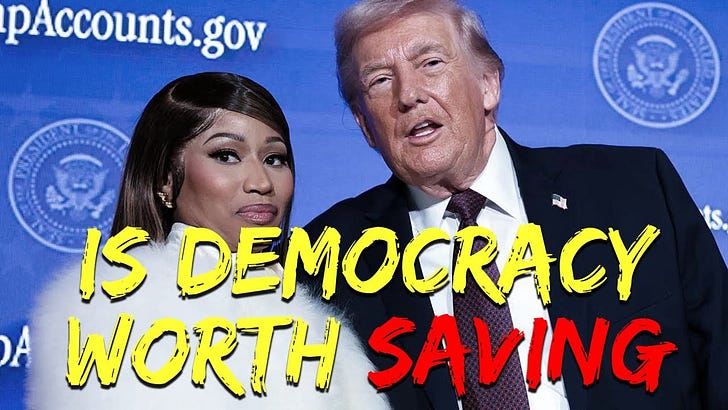
Democracy Inherently Flawed or Redeemable??
from Education is Elevation · host The Conscious Lee
Democracy Was Never Neutral — And That’s the PointEvery time we talk about democracy, somebody eventually hits you with the same line:“It’s about inclusion. Everybody deserves a voice.”That sounds good. It’s clean. It’s aspirational.It’s also ahistorical as hell.What usually gets framed as a “problem of exclusion” isn’t really about who’s left out—it’s about who gets to define legitimacy in the first place. And that distinction matters, especially for Black folks, because “exclusion” is a word that hits our nervous system differently. We’ve been excluded on purpose. Systematically. Violently.But hear me out.I don’t actually think exclusion is the core problem. I think the problem is how we understand exclusion—and how democracy has always disguised power decisions as moral ones, here’s the uncomfortable truth….Every contribution to governance is not a productive contribution.Malcolm X taught extensively about the hypocrisy of democracy and perhaps its a core feature of concept. During this discussion on The Chop Up Show I couldn’t find the words to fully explain what I was grasping for, but now I can a little in this piece. People usually talk about democracy in an idealism vs realism binary because it lets them avoid confronting power head-on. Idealism treats democracy as a moral aspiration—participation, equality, “the people”—while realism looks at democracy as it actually operates: managed access, unequal influence, and sanctioned exclusion. The tension isn’t a flaw; it’s the point—idealism launders legitimacy while realism does the dirty work of governance. Once you see that split, it becomes clear that democracy doesn’t fail when it excludes people—it reveals who it was always meant to serve.Research Over Mesearch is a reader-supported publication. To receive new posts and support my work, consider becoming a free or paid subscriber.I have political conversations all the time. Folks will unload their opinions—strong opinions—about policy, culture, identity, the future of the country. Then at the end they’ll casually say, “But I don’t vote.”And sometimes?I’m relieved.Because if your entire political worldview is built on protecting hierarchy, punishing marginalized people, and voting against your own material interests just to preserve cultural dominance—why would I want your ballot anywhere near collective decision-making?That’s when people start panicking and yelling, “That’s anti-democratic!”Is it though?Screening Ain’t the Same as DiscriminationWe need to stop pretending that screening and discrimination are the same thing.During Jim Crow, literacy tests and “count the jellybeans” nonsense weren’t about civic competence—they were about racial ideology. Black people weren’t excluded because of what they believed or contributed, but because whiteness had already decided we were intellectually and morally unfit.That’s discrimination.But saying fascists shouldn’t be shaping governance?That’s screening.Germany doesn’t allow Nazis to run for office—not because they hate free speech, but because they understand what anti-democratic ideologies do once they’re given institutional power. When someone openly says they’re willing to vote for anti-democratic outcomes, that’s not “difference of opinion.” That’s a threat to the system itself.And this is where democracy starts eating its own tail.Athens, Whiteness, and the Theft of Collective GovernanceWe give ancient Greece way too much credit.Not because Athens didn’t matter—but because collective governance existed long before Western civilization slapped the label “democracy” on it. Mesopotamia. African societies. Indigenous governance systems. Consensus-based leadership models. All of it existed before Athens decided only land-owning men counted as people.What Greece actually did was brand governance—and whiteness inherited that branding.So when people say, “Well, democracy excluded women, slaves, and foreigners back then,” they’re telling on themselves. That wasn’t a flaw of collective governance. That was a flaw of how humanity was defined.And that residue never left.Every modern democracy still carries the ghost of that original hierarchy—especially the subordination of women and the racialized boundaries of citizenship. That’s why you see white men today trying to “return democracy to its roots.” They’re not talking about civic participation. They’re talking about power.Hypocrisy or Aspiration?People love asking whether America’s democracy was hypocritical or aspirational.The Declaration of Independence said “all men are created equal” while slavery was not only legal, but foundational. Black people weren’t participants in democracy—we were objects inside of it. Pieces on the chessboard. Property whose existence could be democratically debated.That’s not a contradiction you grow out of.That’s a foundation you build on.So when Black folks, queer folks, marginalized folks struggle to see democracy as redeemable, it’s not cynicism—it’s memory.Democracy didn’t fail us later.It was never designed with us in mind in the first place.And until we stop romanticizing it—until we stop confusing Western democracy with collective governance—we’ll keep having the same fake arguments about voting, participation, and legitimacy while fascism keeps slipping through the front door with a ballot in its hand.Related Readings + Bibliography Core Texts on Democracy & Critique* Aristotle, Politics* Plato, The Republic* Alexis de Tocqueville, Democracy in America* Robert Dahl, On DemocracyBlack Political Thought & Radical Critique* Cedric Robinson, Black Marxism* W.E.B. Du Bois, Black Reconstruction in America* Saidiya Hartman, Scenes of Subjection* Frank Wilderson III, Afropessimism* Angela Davis, Freedom Is a Constant StruggleFeminist & Intersectional Critiques* Carole Pateman, The Sexual Contract* bell hooks, Ain’t I a Woman* Sylvia Wynter, Unsettling the Coloniality of BeingWhiteness, Power, and Governance* Charles Mills, The Racial Contract* Joel Dinerstein, Technology and Its Discontents* Hannah Arendt, The Origins of TotalitarianismLastly Friendly Reminder.. I need those NAACP Image Award Votes. It’s an honor be nominated for Outstanding Digital Content Creator of The Year for Politics & Culture, but I need ya’ll votes to win. You can vote everyday until Friday February 13th. Click Here To Vote Now!!Catch the full livestream from last week of The Chop Up Show with The Conscious Lee, Toya Green and The Political Plug. ToyaG: https://www.tiktok.com/@profgreenHDPolitical Plug: https://www.tiktok.com/@thepoliticalplugConscious Lee: https://www.tiktok.com/@theconsciousleeInstagram: https://www.instagram.com/thechopupshow/TikTok: https://www.tiktok.com/@thechopupshowpod This is a public episode. If you'd like to discuss this with other subscribers or get access to bonus episodes, visit theconsciouslee.substack.com/subscribe
Embed this episode
NOW PLAYING
Democracy Inherently Flawed or Redeemable??
No transcript for this episode yet
Similar Episodes
No similar episodes found.
Similar Podcasts
No similar podcasts found.