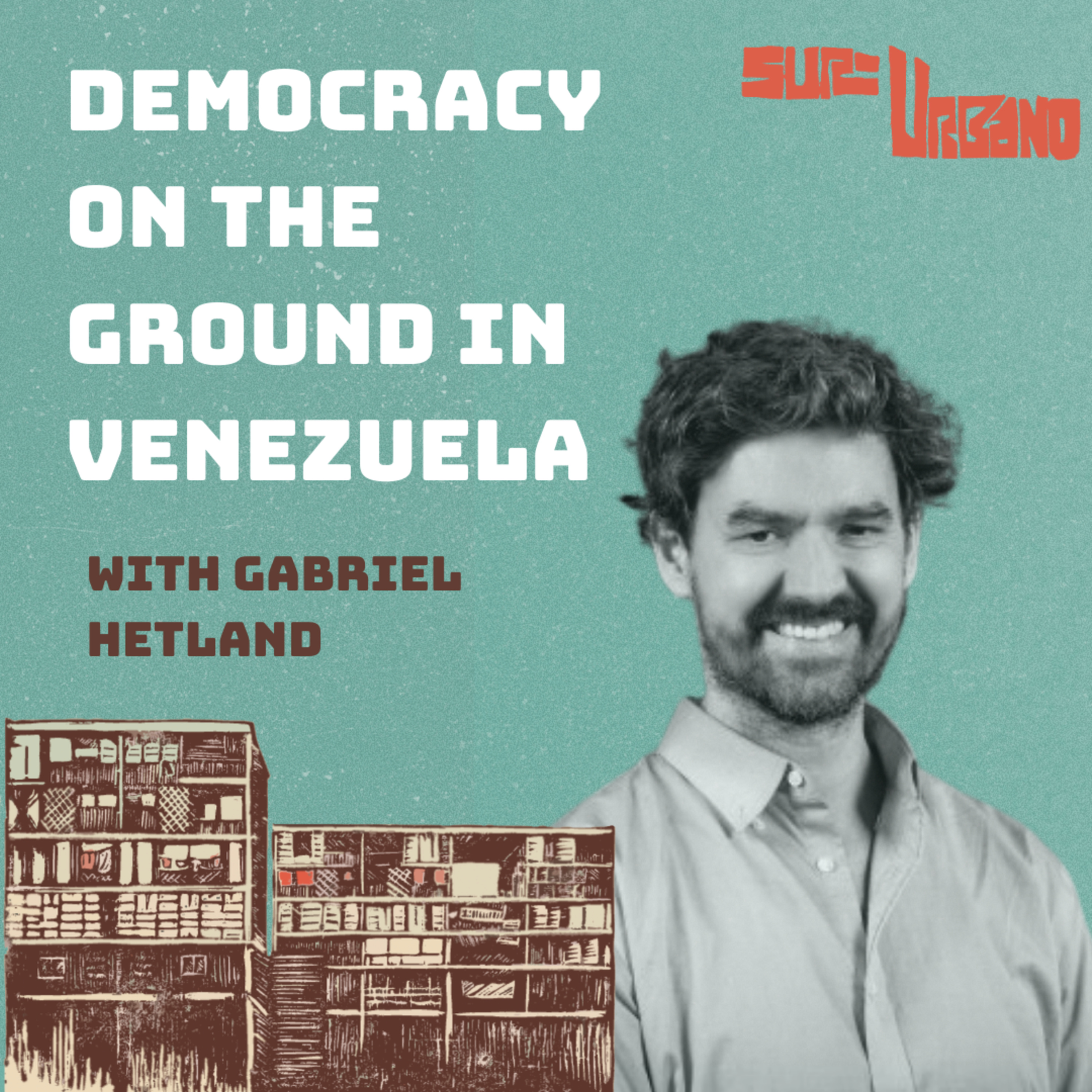
Democracy on the Ground in Venezuela with Gabriel Hetland episode artwork

EPISODE · Dec 22, 2025 · 1H 6M

Democracy on the Ground in Venezuela with Gabriel Hetland

from Sur-Urbano · host Latin American Cities Working Group

Even within the already brutal record of the Trump administration, the escalating threats of military intervention and extrajudicial killings of civilians in Venezuela stand out as a disturbing return to the most repressive eras of U.S. imperialism. As of this recording, 99 civilians have been assassinated, while the United States has begun amassing thousands of troops and warships in the Caribbean and has ordered a blockade of Venezuela’s oil industry. Earlier this month, Trump released a new National Security Strategy announcing a so-called “Trump Corollary,” which asserts a U.S. right to revive the Monroe Doctrine in order to “restore American preeminence in the Western Hemisphere and protect our homeland and access to key geographies throughout the region.” This military imperialism, and the continued perpetuation of war crimes, must clearly be rejected unequivocally. And at the same time, I side with my Venezuelan friends and comrades in recognizing that the fact that Maduro appears to be the target of an US intervention does not erase the profound violence that his regime has waged upon Venezuelans. This violence has been used not only against Opposition activists, who have been murdered, tortured or imprisoned in the dozens over the last 10 years, but also against the labor movement whose rights to collective bargaining and striking have effectively been abolished. It has also been used against indigenous activists resisting extractivist projects in Perijá and the Gran Sabana, and youth in the barrios executed by police in the hundreds. Our episode today speaks about a different political moment:  when, around fifteen years ago, Venezuela was the site of an incredible experiment in participatory democracy, simultaneously pushed from above and from below, that generated such a strong consensus that even sectors of the Opposition were drawn into participating.I interview Gabriel Hetland, associate professor of Latin American Studies and Sociology at SUNY Albany, who explores the conditions for leftist hegemony in his book Democracy on the Ground: Local Politics in Latin America’s Left Turn. While the book is a comparison between Venezuela and Bolivia, we primarily focus on Venezuela, observing participatory reform in cities governed by the Left and Right. The Venezuelan city ruled by the left, Torres, was lauded as “the most democratic city in the world”, dedicating its entire investment budget to a radical and inspiring participatory budgeting effort. But surprisingly, Sucre – a city ruled by the right opposition – also undertook a similar participatory reform, leading Gabriel to argue that for a while, Venezuela’s Bolivarian Revolution – led by Hugo Chavez – managed to consolidate hegemony: when the ruling political force forces its opponents to play the game of politics on its terrain, in this case, the terrain of popular power. Just this week, the far-right won Chile’s presidential elections, joining Argentina’s Milei, and similar right-wing shifts in Ecuador and Bolivia, joining the rise of the right in the United States and Europe. In a moment of an appearing right-wing hegemony, it is more important than ever to insist upon the conditions not only for leftist resistance, but also the construction of alternative hegemonies. Gabriel’s clear-eyed analysis, which draws from Gramscian theory but also a very rich ethnographic field work of over two years, shows the potential as well as the contradictions in populist politics, and has lessons for building democracy on the ground in this moment in which it is so sorely needed. Gabriel Hetland is associate professor of Latin American Studies and Sociology at SUNY Albany. He has written extensively about politics and social movements in Latin America and the US for scholarly and popular outlets including The Washington Post, The Guardian, The Nation, Jacobin, and elsewhere.

Even within the already brutal record of the Trump administration, the escalating threats of military intervention and extrajudicial killings of civilians in Venezuela stand out as a disturbing return to the most repressive eras of U.S. imperialism. As of this recording, 99 civilians have been assassinated, while the United States has begun amassing thousands of troops and warships in the Caribbean and has ordered a blockade of Venezuela’s oil industry. Earlier this month, Trump released a new National Security Strategy announcing a so-called “Trump Corollary,” which asserts a U.S. right to revive the Monroe Doctrine in order to “restore American preeminence in the Western Hemisphere and protect our homeland and access to key geographies throughout the region.” This military imperialism, and the continued perpetuation of war crimes, must clearly be rejected unequivocally. And at the same time, I side with my Venezuelan friends and comrades in recognizing that the fact that Maduro appears to be the target of an US intervention does not erase the profound violence that his regime has waged upon Venezuelans. This violence has been used not only against Opposition activists, who have been murdered, tortured or imprisoned in the dozens over the last 10 years, but also against the labor movement whose rights to collective bargaining and striking have effectively been abolished. It has also been used against indigenous activists resisting extractivist projects in Perijá and the Gran Sabana, and youth in the barrios executed by police in the hundreds. Our episode today speaks about a different political moment:  when, around fifteen years ago, Venezuela was the site of an incredible experiment in participatory democracy, simultaneously pushed from above and from below, that generated such a strong consensus that even sectors of the Opposition were drawn into participating.I interview Gabriel Hetland, associate professor of Latin American Studies and Sociology at SUNY Albany, who explores the conditions for leftist hegemony in his book Democracy on the Ground: Local Politics in Latin America’s Left Turn. While the book is a comparison between Venezuela and Bolivia, we primarily focus on Venezuela, observing participatory reform in cities governed by the Left and Right. The Venezuelan city ruled by the left, Torres, was lauded as “the most democratic city in the world”, dedicating its entire investment budget to a radical and inspiring participatory budgeting effort. But surprisingly, Sucre – a city ruled by the right opposition – also undertook a similar participatory reform, leading Gabriel to argue that for a while, Venezuela’s Bolivarian Revolution – led by Hugo Chavez – managed to consolidate hegemony: when the ruling political force forces its opponents to play the game of politics on its terrain, in this case, the terrain of popular power. Just this week, the far-right won Chile’s presidential elections, joining Argentina’s Milei, and similar right-wing shifts in Ecuador and Bolivia, joining the rise of the right in the United States and Europe. In a moment of an appearing right-wing hegemony, it is more important than ever to insist upon the conditions not only for leftist resistance, but also the construction of alternative hegemonies. Gabriel’s clear-eyed analysis, which draws from Gramscian theory but also a very rich ethnographic field work of over two years, shows the potential as well as the contradictions in populist politics, and has lessons for building democracy on the ground in this moment in which it is so sorely needed. Gabriel Hetland is associate professor of Latin American Studies and Sociology at SUNY Albany. He has written extensively about politics and social movements in Latin America and the US for scholarly and popular outlets including The Washington Post, The Guardian, The Nation, Jacobin, and elsewhere.

NOW PLAYING

Democracy on the Ground in Venezuela with Gabriel Hetland

0:00 1:06:18

No transcript for this episode yet

We transcribe on demand. Request one and we'll notify you when it's ready — usually under 10 minutes.

Ils nous gavent ces écolos Raje Chronique réalisée par Jenny Bernard.« Ils nous gavent ces écolos » est l’émission pour celles et ceux qui écrasent les araignées car elles sont moches ou qu’elles font peur, qui pensent que les moustiques ne sont sur terre que pour piquer ou qui aiment les animaux, surtout bien cuits ! Ces épisodes de quelques minutes ont pour objectif de faire changer leur regard sur la biodiversité avec humour et légèreté ! On va refaire le monde X "En mode coach" Lola Bon. J’ai décidé d’aborder des sujets dont on ne parle pas, par peur du jugement de l’autre, par pudeur, par insignifiance, ou par manque d’envie.Le sexe est pourtant partout. Il fait partie intégrante des relations humaines, qu’elles soient amoureuses, amicales, professionnelles, cordiales ou même fortuites. Et pourtant, on n’en parle pas, ou pas assez, ou juste pas de la bonne manière.Moi, je veux parler du sexe, du vrai, celui qui est là, devant nous, et qu’on ignore…Bienvenue sur : On va refaire le monde X En mode coach. Et Merdre ! Martin Poirot Et Merdre ! Votre émission vivante consacrée aux spectacles du même genre !Découverte des coulisses de toute les formes de créations artistiques du spectacle vivant : mise en scène, scénographie, jeu, écriture, expositions... Dans chaque émission retrouvez un artiste, un spectacle, un lieu, ou un festival. Aussi disponible en vidéo sur YouTubeUne émission animée par Martin PoirotRéalisée par Zachary GuerenneurIllustrée par Carole MarietHébergé par Ausha. Visitez ausha.co/fr/politique-de-confidentialite pour plus d'informations. Hasheur Hasheur Bienvenue sur ma chaîne ! Je me présente, Owen Simonin (alias Hasheur), je vulgarise sur Youtube différentes technologies, techniques et stratégies complexes du monde du Business. Principalement à travers la Blockchain et les Cryptomonnaies (bitcoin), je décortique même les méthodes de paris en ligne, le trading et les autres types d'investissements ou rendements passifs. Mon objectif est de simplifier les sujets et les investissements les plus complexes du milieu afin de permettre à tous de ne rater aucune opportunité.

Frequently Asked Questions

How long is this episode of Sur-Urbano?

This episode is 1 hour and 6 minutes long.

When was this Sur-Urbano episode published?

This episode was published on December 22, 2025.

What is this episode about?

Even within the already brutal record of the Trump administration, the escalating threats of military intervention and extrajudicial killings of civilians in Venezuela stand out as a disturbing return to the most repressive eras of U.S. imperialism....

Can I download this Sur-Urbano episode?

Yes, you can download this episode by clicking the download button on the episode player, or subscribe to the podcast in your preferred podcast app for automatic downloads.
URL copied to clipboard!