
EPISODE · Feb 22, 2026 · 15 MIN
Democratized Design Suite
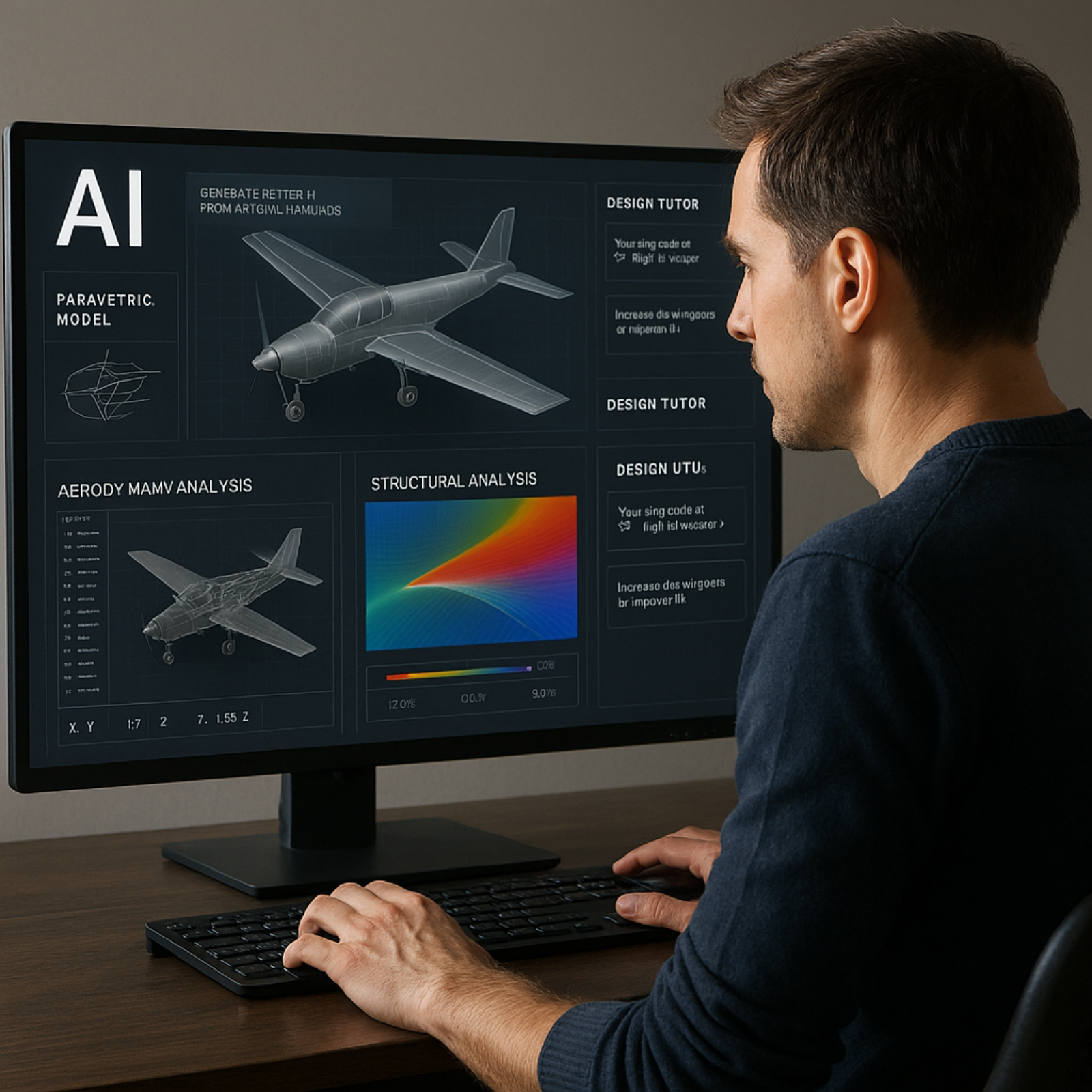
The document describes a future version of CAD with AI—not replacing CAD, but expanding it into a full, AI‑supported design ecosystem. The core idea is that modern AI can sit on top of CAD/CAE/CAM and automate the engineering work that normally requires years of training. The result is a system where a non‑expert, even a 12‑year‑old, can design a functional aircraft because the AI handles the physics, constraints, and optimization behind the scenes.The system still begins with CAD, but AI transforms how CAD behaves. Instead of manually sketching, constraining, and modeling, the user can describe intent in natural language. The AI generates sketches, infers constraints, builds parametric feature trees, and maintains design intent. It can regenerate geometry robustly and optimize shapes for goals like weight, drag, lift, or manufacturability. This is still CAD—but CAD augmented with diffusion models, neural implicit surfaces, constraint‑inference networks, and graph neural networks.On top of modeling, the system integrates AI‑accelerated simulation. Surrogate CFD and FEA models provide near‑instant feedback on aerodynamics and structural behavior. Cloud HPC handles high‑fidelity runs when needed. The AI can warn the user about issues (“your wing stalls at 14° AoA”), suggest improvements, and automatically optimize designs. Neural CFD, PINNs, reduced‑order models, and GPU solvers make this feasible.A third layer is the AI design tutor, which turns the system into an educational tool. It guides the user step‑by‑step, explains engineering principles, prevents unsafe designs, and auto‑fixes errors. This layer uses LLMs trained on engineering knowledge and connected directly to the modeling and simulation engines. The tutor makes the system accessible to beginners while still useful for experts.The final layer is cloud compute and collaboration. This includes parallel simulation, version control, real‑time co‑editing, simulation caching, and automated optimization pipelines. This infrastructure makes the system scalable and responsive, enabling complex physics and large design sweeps without local hardware limitations.The document argues that building this system is feasible with a 10‑year, $1B budget. It breaks down the cost:Rewriting a modern CAD/CAE kernel: $350MAI parametric modeling engine: $150MAI CFD/FEA surrogate models: $200MCloud compute + infrastructure: $150MTutor layer: $50MUniversal CAD import + reconstruction: $80MManagement, QA, UX, community: $50MTotal: ~$1.03B over 10 years.With this investment, the system would surpass existing tools like CATIA, NX, SolidWorks, Fusion, and Onshape by integrating modeling, simulation, optimization, tutoring, and manufacturing into one AI‑driven workflow.The result is a CAD system where users can design complex machines in hours instead of months. The AI generates geometry, runs physics, ensures safety, optimizes performance, and outputs manufacturable CAD/CAM packages including drawings, toolpaths, BOMs, and assembly instructions. The document emphasizes that all required technologies already exist in research form; the challenge is integrating them into a unified platform.
NOW PLAYING
Democratized Design Suite
No transcript for this episode yet
Similar Episodes
Mar 26, 2026 ·1m
Mar 19, 2026 ·34m
Feb 18, 2026 ·11m
Feb 11, 2026 ·45m