
PODCAST · society
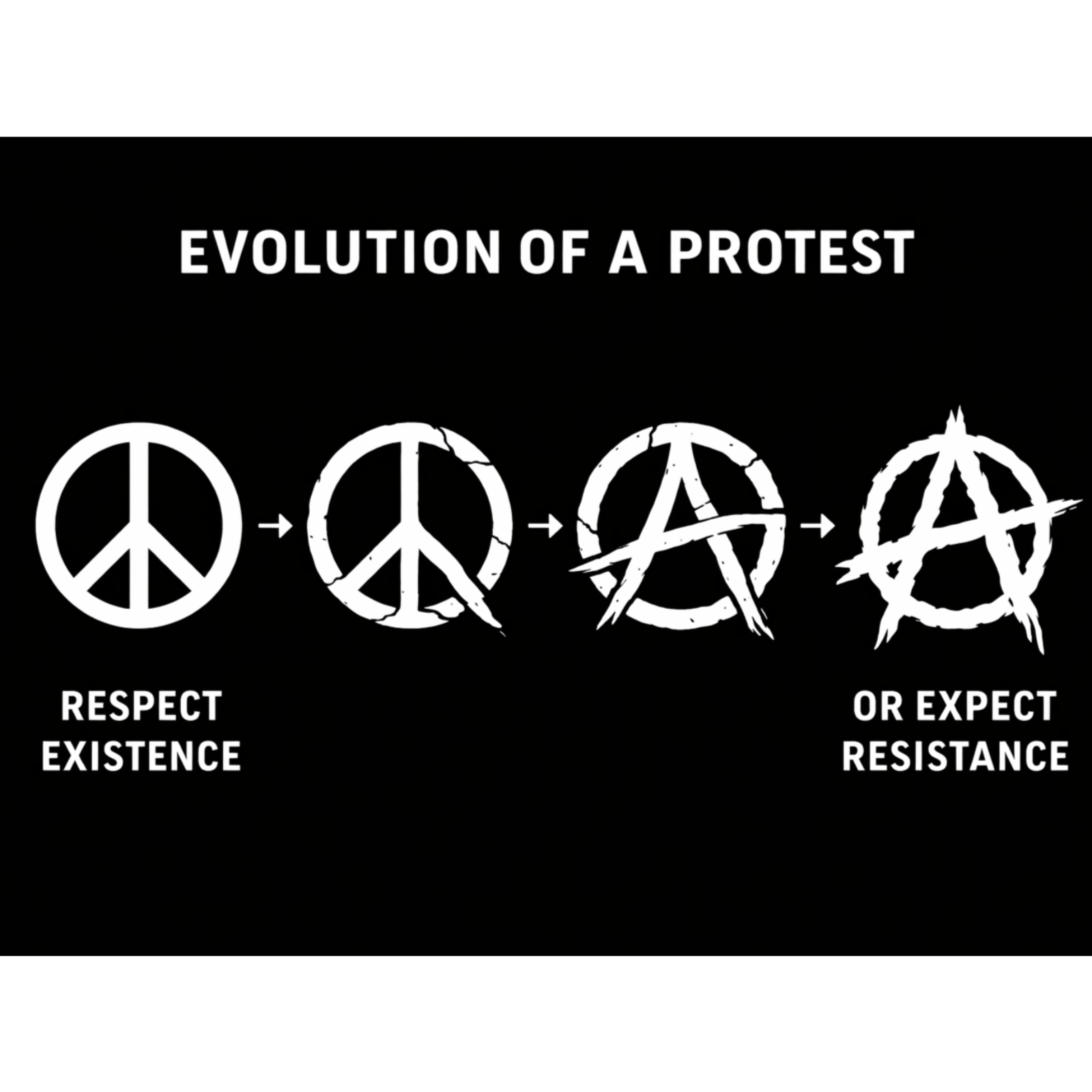
Evolution Of A Protest
by Singularity Institute
The $1‑Per‑Month Post‑Scarcity EngineThe idea is that 80 million of the poorest citizens can achieve economic liberation by pooling small monthly contributions to build a vertically integrated, AI‑driven industrial ecosystem that produces goods at true cost instead of market prices.1. $1‑Per‑Month Catalyst (Ramping Over Time)The system begins with $1/month, generating $960M/year. As the system starts saving participants money—through cheaper food, energy, materials, and goods—the contribution ramps up gradually, but never exceeds the monthly savings.Within 10 years, the average participant is saving more than they contribute, making participation net‑positive.2. AI + AR Removes the Expertise BarrierAI‑guided AR glasses let unskilled people perform expert‑lev
-
27
Issues with Institutional Mental Health Medicine
1. Historical Misuse of Psychiatry- Psychiatry repeatedly functioned as a tool of social control rather than science. - Drapetomania exemplifies fabricated diagnoses used to enforce domination. - Similar patterns reappear in racialized overdiagnosis, pathologizing dissent, and moralizing nonconformity.2. Core Epistemic Failure: Black‑Box Classification- Psychiatry lacks a mechanistic, white‑box substrate equivalent to DNA in biology. - DSM categories are symptom clusters, not causal explanations. - Without mechanistic grounding, categories drift with culture, power, and incentives. - Many diagnoses are non‑portable — they exist only within specific rule systems.3. Institutional Incentives and Diagnostic Inflation- Diagnostic systems shape reimbursement, liability, and professional authority. - Institutions reward complexity, novelty, and control, not parsimony or falsifiability. - Rule‑makers project their own preferences into diagnostic categories. - Coercive tools (civil commitment, forced treatment) amplify institutional bias.4. Social and Racial Bias as Structural Features- Overdiagnosis of schizophrenia in Black men and other disparities reveal systemic bias. - Cultural mismatch and clinician interpretation errors produce predictable misclassification. - These errors persist because no white‑box mechanism exists to falsify them.5. Formalism as the Corrective Framework- White‑box models (biomarkers, neurocircuitry, computational phenotypes) anchor portable disorders. - Game theory models contextual behaviors as strategic responses, not pathology. - Optimization and risk theory identify mathematically forced “oughts” for institutional design. - Occam’s razor eliminates unnecessary, non‑portable diagnostic constructs.6. Taxonomy by Portability- Portable disorders: stable across jurisdictions, likely neurobiological (e.g., Tourette’s, trichotillomania). - Contextual disorders: dependent on authority structures (e.g., ODD, conduct disorder). - Portable disorders warrant mechanistic research; contextual ones require de‑medicalization.7. Principles for Institutional Reform- White‑box first: treat symptom clusters as hypotheses requiring mechanistic validation. - Transparency: open DSM governance, public data, conflict‑of‑interest disclosure. - Minimize coercion: restrict involuntary treatment to portable, imminent‑risk cases. - Audit bias: continuous monitoring of racial, gender, and socioeconomic disparities. - Mechanism design: align incentives with patient welfare, not institutional power.8. Clinical and Legal Overhaul- Replace checklists with transparent decision‑support models showing assumptions and alternatives. - Reform civil commitment laws to require objective thresholds and independent review. - Remove reimbursement incentives tied to diagnostic inflation. - Create diagnostic ombuds offices for patient appeals and oversight.9. Community‑Based Alternatives- Expand peer respite, mobile crisis teams, and non‑police crisis response. - Build housing‑first and harm‑reduction infrastructures to reduce crisis frequency. - Train and credential peer specialists as first‑line responders.10. Long‑Term Vision- A mental‑health system grounded in mechanistic truth, minimal coercion, transparent governance, and formal optimality. - Portable disorders treated medically; contextual behaviors handled socially, voluntarily, and non‑coercively. - Institutions redesigned to prevent capture, bias, and diagnostic overreach..
-
26
A Fair World
1. Economic Harm vs. “Economic War Crime”- “Economic war crime” is not a legal category, but the effects of certain economic actions can mirror the scale and severity of wartime atrocities. - When economic decisions cause mass deprivation, shortened lifespans, or preventable suffering, the moral impact becomes comparable to crimes against humanity.2. The Threshold: When Unfairness Becomes Systemic HarmA system crosses into morally criminal territory when five conditions align: - Intentionality: Actors knowingly create or maintain harmful structures. - Foreseeability: The consequences—poverty, deprivation, collapse of wellbeing—are predictable. - Scale: Harm affects entire populations, not isolated individuals. - Preventability: Suffering could be avoided without sacrificing essential societal functions. - Benefit Extraction: Perpetrators profit from the harm they inflict or maintain.When all five are present, the behavior is no longer “unfairness” but engineered deprivation.3. Why Perpetrators Don’t See Themselves as Perpetrators- Individuals benefiting from unfair systems often believe their advantages are natural or earned. - They reinterpret structural correction as persecution because their baseline is elevated. - Acknowledging harm would require moral responsibility, so they resist the logic. - This creates a psychological inversion: fairness feels like hostility to those who relied on unfairness.4. Why They Feel Victimized When Fairness Arrives- Losing unearned advantages feels like being harmed. - They confuse the removal of privilege with an attack. - They demand justification but often reject first‑principles reasoning that threatens their status. - Their sense of victimhood is a defense of the system that benefits them.5. Retribution vs. Accountability- Retribution is punishment for its own sake; this is not ethically defensible. - Accountability is preventing further harm by removing the ability to inflict it. - A fair system focuses on structural correction, not revenge. - The goal is to stop engineered deprivation, not to inflict suffering.6. The Moral Equivalence ArgumentEconomic actions become morally equivalent to war crimes when they: - deliberately restrict access to food, medicine, shelter, or livelihood - create artificial scarcity for profit - cause generational trauma or mass immiseration - shorten millions of lives through preventable deprivation The tools differ—financial instead of military—but the human impact is indistinguishable.7. The Core InsightThe question is not whether individuals “deserve retribution.” The real issue is: At what point does systemic exploitation become so severe that those responsible cannot claim innocence when the system is corrected? Answer: When the harm is intentional, large‑scale, preventable, and profitable.
-
25
Evolution of Society
1. Authority-Seeking as an Evolutionary Mismatch- Human dominance drives evolved for small-band coordination. - In large-scale societies, these traits scale into systemic harm. - This is an evolutionary mismatch: locally adaptive, globally destructive. - Technical terms: dominance hierarchy pathology, institutional maladaptation, runaway prestige-dominance fusion.---2. Government as a High-Risk Coordination Mechanism- Centralized authority amplifies harm: war, oppression, coercion, institutional violence. - Historical data shows organized violence vastly exceeds natural disasters or spontaneous conflict. - Political science terms: state capacity risk, authoritarian failure modes, institutional violence theory.---3. The Pathology of Power-Seeking- Desire to rule correlates with Machiavellianism, narcissism, and authoritarian personality traits. - These traits masquerade as “leadership” in hierarchical systems. - Technical terms: dominance-drive pathology, Dark Triad traits, elite capture dynamics.---4. Semantic Capture of “Leadership”- Positive terms are co-opted to legitimize harmful behaviors. - This is concept creep, semantic capture, and legitimacy laundering. - Objective criteria (like biological taxonomy) eliminate ambiguity. - Distinction: dominance leadership (coercive) vs prestige leadership (cooperative).---5. The Global Minima of Rulemaking- Optimal society minimizes coercive rules and maximizes autonomy. - Only physically necessary coordination rules remain (e.g., traffic direction). - All preference-based or bureaucratic rules disappear. - This is the global minima of rulemaking and global maxima of allowable freedom.---6. Post-Hierarchical Coordination Systems- Future societies use distributed, automated coordination instead of authority. - Humans remain equals; AI mediates information flow, not power. - Technical frameworks: polycentric governance, distributed-autonomy systems, cybernetic post-bureaucracy.---7. Institutional Immunology- Systems must be designed so dominance-seeking individuals cannot capture them. - This is analogous to immune systems preventing parasitic takeover. - Technical terms: institutional immunology, anti-capture architecture, resilience engineering.---8. Cultural Evolution Under Optimal Conditions- Culture becomes an emergent property of optimized development and environments. - Not arbitrary, not imposed—derived from human flourishing. - Technical framing: cultural attractor states, developmental optimization, post-scarcity cultural dynamics.---9. Transition Dynamics- Requires: - Recognition of authority-pathology - Objective definitions of leadership - Automated coordination replacing coercion - Rule-minimization under safety constraints - Education in cognitive immunology - This is a shift from hierarchical to post-institutional civilization.---10. End State: High-Autonomy, Low-Coercion Civilization- Minimal rules, maximal freedom. - No dominance hierarchies. - Transparent, automated coordination. - No institutional pathologies. - Human equality as a structural default. - This is the post-hierarchical, distributed-autonomy society.
-
24
The Path to Practical Omniscience
1. Finite but Vast Human‑Understandable Theory Space- Human‑usable theories = symbolic structures with bounded alphabet \(A\) and length \(L\). - Even with \(A \sim 10^3\), \(L \sim 10^4\), total space ≈ \(10^{30,000}\). - Enormous but finite; far smaller than physical or neural microstate spaces. - Human cognition restricts usable theories: limited working memory, chunking, attention, and symbolic bandwidth.2. Structure of the Real World Enables Compression- Universe is highly structured: symmetries, locality, conservation laws. - Human mathematics is structured: algebraic, geometric, analytic regularities. - Language and thought are structured: compositional semantics, Montague‑style mappings. - This structure makes deep compression and unification possible.3. Classical Limits Do Not Block Practical Omniscience- Gödel: no single formal system proves all arithmetic truths. - Turing/Rice: no universal decision procedure for all programs or semantic properties. - Kolmogorov: no perfect compressor for all strings. - These forbid universal solutions, not finite toolboxes covering all useful cases. - Real‑world problems lie in a tiny, structured subset where powerful heuristics exist.4. Neural Networks as Algorithm‑Learning Systems- NNs are algorithms that learn other algorithms (function approximators). - They cannot solve undecidable problems but can learn heuristics for theorem proving, compression, search, and representation. - They enable recursive improvement: better models → better algorithms → better models.5. Quantum, Photonic, and Stochastic Computing as Multipliers- Quantum computing: quadratic speedups for unstructured search; exponential for specific structured problems. - Cannot brute‑force global optima of trillion‑parameter models or escape undecidability. - But accelerates linear algebra, sampling, architecture search, symbolic regression, and meta‑learning. - Photonic/stochastic/ternary architectures improve energy efficiency and parallelism.6. Effective Compute = Hardware × Algorithms- Hardware growth (compute, energy) and algorithmic efficiency both improve exponentially. - Combined, they yield super‑exponential effective compute. - Recursive meta‑learning accelerates algorithmic progress further.7. Practical Saturation: The 99.9% Threshold- For each domain (theories, languages, curricula, drugs, algorithms), define: - Utility metric - Human/physical limits - Scaling laws - Threshold where improvements fall below human resolution - Once below JND (just‑noticeable difference), further gains are irrelevant to human experience.8. The Realistic Path to Human‑Relevant Omniscience- Not brute force; not perfect universality. - Instead: - Discover better representations - Discover better algorithms - Discover better languages (Lojban‑like, Montague‑style) - Discover better curricula - Discover better meta‑algorithms - Use massive compute to accelerate all of the above - Result: a finite, expanding toolbox that solves everything humans care about.9. Final Picture- A recursively improving system can: - Compress all human‑relevant knowledge - Unify scientific domains - Optimize languages and curricula - Discover deep theories beyond human reach - Approach practical omniscience without violating any impossibility theorem.
-
23
Statistics = Mathematized Epistemology
1. Core Claim: Statistics = Mathematized Epistemology- David Salsburg (The Lady Tasting Tea) — statistics emerged to formalize how we know what we know. - E.T. Jaynes (Probability Theory: The Logic of Science) — probability is “extended logic,” turning uncertainty into rational belief. - Key idea: epistemology becomes operational when expressed as likelihoods, priors, and updates.---2. Statistics Doesn’t Lie — People Do- Nate Silver (The Signal and the Noise) — misuse, not math, creates false certainty. - John Ioannidis (“Why Most Published Research Findings Are False”) — incentives distort statistical practice. - Examples: - Cherry‑picking endpoints in drug trials. - Misleading graphs in political polling. - “P‑hacking” in academic research.---3. Humans Already Use Informal Bayesian Updating- Daniel Kahneman (Thinking, Fast and Slow) — people update beliefs intuitively but inconsistently. - Richard McElreath (Statistical Rethinking) — Bayesian reasoning mirrors everyday judgment. - Examples: - Choosing the most accurate weather forecaster. - Trusting a mechanic with a long track record. - Preferring a friend whose predictions about people pan out.---4. AI as the New Epistemic Authority- Philip Tetlock (Superforecasting) — accuracy, not credentials, determines trust. - Norbert Wiener (Cybernetics) — systems with feedback + data outperform human intuition. - Examples: - AI medical triage beating human diagnostic accuracy. - AI logistics outperforming human planners. - AI weather models surpassing traditional meteorology.---5. Collapse of “Security Through Obscurity”- James C. Scott (Seeing Like a State) — institutions rely on opacity to maintain authority. - Bruce Schneier (security expert) — obscurity is a brittle protection strategy. - Examples: - Tax codes designed to require specialists. - Legal language engineered for gatekeeping. - Regulatory complexity protecting incumbents.---6. Epistemic Secession: When People Can Verify Instead of Trust- Elinor Ostrom (polycentric governance) — people self‑govern when information is accessible. - Clay Shirky (Here Comes Everybody) — information access dissolves institutional monopolies. - Examples: - Citizens using AI to analyze legislation. - Patients verifying medical claims independently. - Workers bypassing credentialed experts with AI‑assisted competence.---7. Final Thesis> As AI democratizes statistical reasoning, institutions lose their epistemic monopoly. > When people can verify rather than trust, they gain the power to secede from systems built on complexity, scarcity, and obscurity.
-
22
Elite Overproduction and the Manufactured Scarcity of Talent
1. The Paradox of Elite OverproductionModern societies generate far more credentialed “elite aspirants” than elite positions can absorb. Thousands of graduates compete for a handful of prestigious roles, leaving most underutilized and frustrated. This isn’t a failure of individuals—it’s a structural bottleneck created by institutions that ration opportunity. 2. Artificial Scarcity as a Design PrincipleGovernments and corporations restrict intellectual property, licensing, and production rights, concentrating innovation inside a small number of firms. This creates the illusion that only a narrow elite can produce value, when in reality the constraint is legal, not cognitive or technological.3. The Lost Productive MajorityMost people—especially the “invisible 90%” of elite‑school graduates—could contribute massively to society if allowed to participate in open production ecosystems. Studies of elite overproduction show that societies become unstable when large pools of capable people are denied meaningful roles. 4. The 15‑Year‑Old Thought ExperimentIf production systems were modular, open, even teenagers could meaningfully contribute to advanced manufacturing, software, biotech, and materials science. The bottleneck is not intelligence—it’s access to tools, IP, and institutional permission.5. How Academia Reinforces the BottleneckUniversities credential a small number of “acceptable” elites while excluding the majority from participating in high‑value production. This maintains scarcity, protects incumbent firms, and ensures that wealth concentrates in a few hands.6. Economic Secession as a RemedyBy creating public‑funded, royalty‑free intellectual property and member‑owned production clubs, society can bypass institutional gatekeeping. This enables:- mass participation in innovation - decentralized manufacturing - lower cost of living - diffusion of expertise - resilience against elite bottlenecks 7. Closing InsightElite overproduction is not a natural outcome of talent distribution—it’s a symptom of a system designed to restrict who may produce. Opening production to the public dissolves scarcity and restores autonomy.
-
21
Elite Universities Reproduce Wealth Privilege
1. Opening Frame: The Myth of MeritElite schools present themselves as meritocratic gateways, but their admissions patterns overwhelmingly reflect wealth. Zip code predicts opportunity more reliably than any genetic marker, making “genetic testing for merit” redundant.2. The Three Populations Inside Elite Schools- Legacy/Wealth Admits: Children of donors, alumni, and the affluent; admitted through inherited cultural capital, institutional preference, and social networks. - DEI Admits: A smaller group selected to satisfy diversity optics; often mischaracterized as the primary beneficiaries of non‑merit admissions despite being far outnumbered by legacy admits. - High‑Aptitude Minority: The genuinely exceptional students whose later achievements (Nobels, startups, public leadership) sustain the institution’s prestige narrative.3. Why It’s Harder to Fail Out Than to Get InGrade inflation, institutional incentives, and reputational protection mean that once admitted, students rarely fail. The institution confers legitimacy regardless of performance.4. The Invisible 90%Most graduates do not become leaders or innovators. They enter the professional class quietly, revealing that elite credentials function more as status markers than engines of excellence.5. Sociological Mechanisms at Work- Cultural capital: Elite families transmit the behaviors and competencies admissions offices reward. - Social capital: Networks and connections shape access to opportunities. - Symbolic capital: The brand of the institution becomes a lifelong asset. - Reproduction theory: Schools reproduce class hierarchy rather than disrupt it. - Opportunity hoarding: Elites maintain exclusive access to pathways of power.6. Closing InsightElite universities are not primarily selecting the best—they are curating the next generation of the already‑advantaged, with a thin layer of exceptional talent added to maintain the illusion of meritocracy.
-
20
Revolt at the Gates of Luxury
Modern scarcity is largely institutional, not physical. Energy density, automation, and open industrial standards make material abundance achievable. The project proposes a decentralized, autonomy-centered civilization built on publicly owned intellectual infrastructure and vertically integrated automated production.I. Physical Abundance LayerEnergy DensityNuclear (mass-produced SMRs), solar, and storage provide scalable high-density power.Reactor cost is a manufacturing problem, not a physics problem.Standardization and factory production collapse cost curves.Vertical IntegrationAutomated steel → reactor components → heavy equipment → infrastructure.Self-funding loop: sell output → expand capacity → reduce cost → repeat.Industrial capacity compounds annually.AutomationRobotics + AI remove labor bottlenecks.Continuous production lowers marginal cost.Industrial capital becomes background utility.Result: Energy and manufacturing cease to be structural constraints.II. Open-Standard Economic ArchitectureModel: Open industrial ecosystem (analogous to open computing standards).Royalty-free designs.Publicly owned automation stack.Vendor-agnostic hardware.Global contributor model.Crowdfunded micro-contributions compounding over time.Millions contributing small amounts fund:Robotics R&DOpen CAD/CAM systemsModular factory blueprintsIndustrial AI infrastructureOutcome: Core intellectual infrastructure cannot be captured or enclosed.III. Education as Autonomy EngineeringCurrent education reproduces hierarchy and institutional dependence.Redesign:Logic-first curriculum (formal reasoning + linguistic precision).Continuous math/science integration.Early robotics and production literacy.AI-assisted personalized knowledge systems.Local autonomy with global optimization feedback.Graduates become:Formally literateProduction competentResistant to manipulationCapable of contributing to shared infrastructureEducation becomes civilization replication infrastructure.IV. Institutional & Transition DynamicsScarcity preserves power hierarchies. Institutional inertia blocks abundance scaling.No mechanical formula determines legitimacy or escalation. Constructive, distributed transformation is required.Civilizational phases:SurvivalScarcity managementIndustrial scalingKnowledge asymmetryAutomation & abundanceAutonomy-centered civilizationTransitions increase centralization pressure before stabilization.V. Integrated System LogicEnergy → Manufacturing → Infrastructure → Education → Open IP → Automation → More EnergyFeedback loops:Production funds expansion.Open standards prevent capture.Education feeds innovation.Automation accelerates scaling.Distributed production reduces institutional dependency. Abundance weakens coercive scarcity structures.Final ObjectiveBuild a decentralized, open-standard, AI-accelerated industrial ecosystem that mass-produces energy, automates infrastructure, educates for autonomy, self-finances expansion, and gradually renders enforced scarcity obsolete.This is not policy reform. It is a structural civilizational upgrade.
-
19
The Industrial Think Tank
1. Industrial Core - A single \$20B fully robotic, vertically integrated complex in Nevada. - Produces 3M tons of steel/year and fabricates 2,000 steel high‑rise towers annually. - Entire system powered by on‑site solar + LTO storage; zero purchased electricity. - Manufactures its own steel, glass, ferrock, electronics, solar panels, and batteries.2. Building Output - Each tower: 11 stories, 100,000 ft², 40 luxury units (2,500 ft² each). - Internal production cost fixed at \$5M per tower. - Market sale price set at \$500/ft² → \$50M revenue per tower.3. Annual Allocation - Total towers: 2,000/year. - Campuses built: 3/year → 225 towers consumed internally. - Towers sold: 1,775/year.4. Financial Flow - Revenue from sales: \$88.75B/year. - Total production cost: \$10B/year. - Operating profit: \$78.75B/year. - Reinvestment into R&D and factory expansion: \$11.25B/year. - Remaining surplus: \$67.5B/year.5. Endowment Creation - Surplus divided among 3 new campuses → \$22.5B endowment each. - Endowment rule: 5% return, 4% reinvested, 1% spendable. - Annual spendable budget per campus: \$225M. - Allocation: \$100M for professor salaries, \$125M for operations and public‑service programs.6. University Mission - Engineering schools focused on robotics and AI; all IP released to the public. - Medical schools providing at‑cost healthcare. - Law schools offering at‑cost legal services. - Housing, utilities, and infrastructure produced internally at near‑zero cost.7. Public Funding Model - Startup capital raised by 10M people contributing \$100/month for 24 months. - Total raised: \$24B → enough to build the gigafactory and begin perpetual campus creation.8. Outcome - A self‑funding system producing 3 new public‑good universities every year. - Each campus permanently endowed, independent of tuition or taxpayer funding. - Creates a scalable, perpetual engine for education, research, healthcare, and legal access.
-
18
The Reality of Social Darwinism
1. Gene‑Centered Evolution - Following Dawkins, evolution operates at the level of genes and gene‑teams, not organisms. - “Fitness” is value‑neutral: a trait is fit only if it increases gene replication.2. Polygenic Traits and Conditional Advantage - Most traits arise from interacting gene complexes, making fitness context‑dependent. - Harmful traits can persist when they provide situational benefits.3. Adaptive “Diseases” - Classic cases: - Sickle‑cell trait → malaria resistance. - Tay‑Sachs carrier state → hypothesized TB resistance. - Cystic fibrosis carriers → partial cholera/TB protection. - These illustrate heterozygote advantage: harmful in one form, beneficial in another.4. Environmental Fit as the Determinant of Survival - If an environment favors a specific physical or behavioral trait, that trait becomes “fit,” regardless of moral or aesthetic judgment. - Fitness is like puzzle‑piece matching: the environment defines the hole.5. Selection for Harmful or Antisocial Traits - When environments reward aggression or coercion, dominance traits proliferate (Boehm, Wrangham, Sapolsky). - As Ayn Rand notes, when brutality is rewarded, the brutal outperform the merely opportunistic.6. Institutions as Artificial Selection Environments - James C. Scott: institutions reward legibility, compliance, and low‑variance behavior. - Foucault: disciplinary systems shape which traits thrive. - Bourdieu: institutions select for specific cognitive/behavioral dispositions. - Weber & Graeber: bureaucracies reward proceduralism and mediocrity. - Result: environments that favor oversimplified cognition and penalize independent reasoning.7. The Desire for Authority as a Maladaptive but Successful Trait - Power‑seeking can function like an evolutionary pathology: harmful to collective flourishing yet rewarded by hierarchical systems. - Supported by Nietzsche, Foucault, Lasch, and evolutionary psychology.8. Synthesis - Pathological traits thrive when environments themselves are pathological. - Human institutions can create selection pressures that elevate traits harmful to individuals and societies but advantageous to gene‑level replication.
-
17
The Interzone API
# The Interzone APIA blueprint for building a community that exists inside a state's borders while remaining legally, digitally, and economically invisible to it. The strategy — drawn from James C. Scott's The Art of Not Being Governed — is not to fight the state but to make it irrelevant through deliberate illegibility.Stay invisible. LoRa radio mesh (cheap ESP32 nodes, ~$25 each) provides encrypted, hard-to-jam local communication. Physical "sneakernet" data transfers on encrypted microSD cards — based on Vint Cerf's Delay-Tolerant Networking research — serve as fallback. Community documents are hosted on IPFS (Juan Benet, Protocol Labs), a distributed file system with no central server to raid.Stay legal. Organize as a Private Membership Association, shifting internal transactions into private contract law (grounded in NAACP v. Alabama, 1958). Agreements run as Ricardian Contracts (Ian Grigg, 1996) — simultaneously human-readable legal documents and machine-executable code that auto-reroutes value if accounts are frozen.Find each other safely. Zero-knowledge proofs verify skills or assets without revealing identity. Nostr (fiatjaf) handles initial key exchange; coordination then moves to the local LoRa mesh entirely off the internet.Run local compute. Cheap mini-PCs and smartphones run small local AI models and logistics optimization — no cloud required. Idle machines contribute to a BOINC-style distributed compute network (David Anderson, UC Berkeley) for community resource planning.Build a self-contained economy. Contributions earn logistic priority tracked in a distributed ledger across many machines — nothing to freeze. Grounded in Nick Szabo's smart contract and Bit Gold concepts (1994–1998).Make suppression costly. All hardware is civilian dual-use. There's no central server to seize. A peaceful, self-sufficient community is politically expensive to crack down on — a principle documented by Gene Sharp in From Dictatorship to Democracy (1993).
-
16
Blueprint Overview
1. The Core Diagnosis: Manufactured ScarcityModern scarcity is a political design, not a physical inevitability. Global systems produce enough to sustain humanity, but institutions ration access to resources and knowledge to justify their coercive existence. To achieve the "global maxima of allowable freedom," we must eliminate these institutional bottlenecks.2. The Hardware Breakout: Machines of AbundancePhysical escape velocity is reached through a "RISC-V for Civilization" open-source model. By building vertically integrated CNC tools—like 5-axis workhorses and 9-axis mill-turns—we collapse the cost of manufacturing. This "Capability Closure" allows a community to reproduce its own infrastructure without external permission.3. The Infrastructure RatchetThis secession is funded through collective purchasing, funneling savings into a debt-free Local Production Facility. Just as you designed your city's units with South-facing greenhouses, extensive solar/battery arrays, and basement Small Modular Reactors (SMRs), this system turns energy and essential goods into a universal background utility.4. Epistemic Sovereignty: The P-12 SystemA sovereign society requires minds resistant to manipulation. The proposed neuro-adaptive educational stack uses AR and EEG feedback to teach formal logic and Lojban. This ensures citizens possess a mathematically precise framework for truth, supplemented by real-world physical mastery.5. Algorithmic LawCurrent legal systems are discretionary tools of power masquerading as logic. The solution is a formally verified, computable legal code where unconstitutional laws literally fail to compile. This minimizes coercion by removing the state's ability to rule by fiat.
-
15
The Full Harmonious Development of Human Potential in its Richest Diversity
1. Post‑Scarcity Removes the Rationale for Governance- Historical governance justified by managing scarcity (Hobbes; Scott, Against the Grain). - Technological abundance dissolves these constraints (Fuller; Rifkin; Drexler; Sen). - Institutions built for rationing become pathological when scarcity ends (Polanyi; Graeber).2. The Global Maxima of Allowable Freedom- Freedom bounded only by physics, coordination, and harm (Mill’s harm principle). - Post‑scarcity enables the highest feasible autonomy (Sen & Nussbaum’s capability theory). - Goal: maximize human self‑authorship, not institutional control.3. The Global Minima of Rulemaking- Minimal rules required for safety and coordination (Ostrom’s decentralized governance). - Bureaucratic expansion is a product of scarcity, not necessity (Weber; Graeber). - In abundance, most rulemaking becomes coercive overhead.4. Education as Autonomy Engineering- Traditional schooling reproduces hierarchy (Bourdieu; Collins; Illich). - Post‑scarcity requires epistemic sovereignty and self‑direction (Freire; Papert). - Education shifts from compliance training to capability development.5. The End of Institutional Scarcity- Institutions ration resources, knowledge, legitimacy (Foucault; Coase). - AI, automation, and open systems eliminate these bottlenecks (Bostrom; Benkler). - Institutions become the primary generators of artificial scarcity.6. Hard‑Science Futurism Reinterpreted- Orion’s Arm–style civilizations assume governance by superintelligences. - Alternative view: advanced intelligence dissolves coercion, not optimizes it (Good; Tegmark). - Complexity management becomes non‑coercive infrastructure.7. The Long Arc Toward Self‑Authorship- Civilization evolves from survival → scarcity management → autonomy (Maslow; Fuller). - Post‑scarcity’s purpose is the full development of human potential in its richest diversity. - The endpoint is not better institutions — it is fewer institutions.
-
14
Scarcity is Manufactured
1. Post‑Scarcity Is Technologically Possible, Politically Blocked- Modern capacity already exceeds basic human needs (food, energy, water, manufacturing). - Scarcity persists because distribution is political, not technical. - Key idea: post‑scarcity is a political threshold, not a technological one.2. Knowledge as the Primary Modern Power Asymmetry- Power now flows through epistemic control, not physical force. - Mechanisms: credentialism, regulatory complexity, IP regimes, professional monopolies. - Insight: knowledge is abundant; permission to use it is scarce.3. Scarcity as a Governance Architecture- Hierarchies depend on controlled access to resources. - Abundance weakens dependency, bargaining asymmetry, and institutional authority. - Scarcity is often deliberately maintained to stabilize power.4. Human Status Competition Persists Beyond Material Needs- Even with material abundance, positional goods (status, influence, recognition) remain scarce. - Hierarchy re-emerges unless institutions actively counteract it. - Insight: abundance ends survival competition, not status competition.5. Transparency vs. Stability in Large Systems- Large societies require coordination, predictability, and information filtering. - Full transparency can overwhelm systems; opacity enables domination. - Core question: where is hierarchy necessary, and where is it harmful?6. The Transitional Moment: Decentralization vs. Consolidation- Decentralizing forces: AI, open-source, distributed energy, additive manufacturing. - Centralizing forces: surveillance capitalism, regulatory capture, platform monopolies. - Transitions toward abundance often trigger counter‑movements toward control.7. Why Scarcity Persists- Physical limits still matter. - Institutional inertia is massive. - Power structures defend themselves. - Status competition endures. - Transitions destabilize existing systems.
-
13
The Moral Case For Breaking Unjust Laws
1. Descriptive vs. PrescriptiveSources acknowledge historical violent resistance.They avoid prescribing when violence is justified.No algorithmic “trigger point” exists for moral permission.2. Conditions of Legitimacy CollapseRights Nullification: Rights exist only formally; exercising them brings punishment.Legal Incoherence: Contradictory or vague laws enable arbitrary enforcement.Institutional Capture: Courts, elections, and media lose independence.Closure of Peaceful Remedies: Lawful avenues for reform are blocked or criminalized.3. Just War Theory ConstraintsJust Cause: Severe, ongoing violations of basic human rights.Last Resort: All non‑violent options exhausted.Proportionality: Prevented harm must exceed harm inflicted.Probability of Success: Actions that worsen suffering are immoral.4. Power vs. Violence (Arendt)Power: Derived from consent and legitimacy.Violence: Emerges when power collapses; can destroy but cannot create legitimacy.Historical Pattern: Revolutions often replace one domination system with another.5. Why Scholars Reject “Triggers”A fixed test risks encouraging premature escalation.Can legitimize opportunistic or self‑serving violence.Undermines moral authority of resistance movements.6. Bottom LineLegitimacy can collapse, and history includes violent struggle.But violence is treated as tragic, morally compromising, and never inherently purifying.Moral force of resistance comes from transparency, proportionality, and conscience—not coercion.
-
12
The Computational Reconstruction of Jurisprudence
1. Core ClaimThe legal framework contains internal contradictions that make compliance impossible.Statutes, regulations, and enforcement practices impose mutually exclusive obligations.2. Structural ConflictAgencies interpret the same statutory language in incompatible ways.Courts apply differing standards of review, producing inconsistent precedents.Compliance with one mandate triggers violation of another.3. Procedural BreakdownAdministrative rules incorporate vague or circular definitions.Enforcement bodies rely on discretionary interpretations rather than fixed criteria.Regulated parties cannot predict lawful behavior due to shifting guidance.4. Constitutional TensionDue process is undermined when laws are indeterminate or self‑contradictory.Equal protection issues arise when identical conduct is treated differently across jurisdictions.Non‑delegation concerns appear when agencies effectively rewrite statutory meaning.5. Practical ConsequencesIndividuals and organizations face unavoidable liability.Enforcement becomes selective, arbitrary, or politically influenced.Compliance costs escalate because actors must satisfy incompatible standards.6. Systemic EffectThe legal system functions as a paradox:Obeying one rule requires breaking another.No actor can achieve full compliance.This creates a coercive environment where discretion replaces law.7. Final CompressionThe analysis shows a legal regime where contradictory statutes, inconsistent interpretations, and discretionary enforcement make lawful conduct structurally impossible, violating predictability, fairness, and constitutional due process.
-
11
The RISC-V Model for Civilizational Liberation
1. Why RISC‑V Is the Master AnalogyOpen, royalty‑free standard that outperformed incumbentsAcademic origin → public good, not corporate moatGlobal contributors → compounding improvementsHardware‑agnostic → universal applicabilityMechanism becomes template for robotics, CAD, automation, logistics, education, and coordination2. Mapping RISC‑V to the Civilization StackOpen ISA → open robotics + automation stackAcademic origin → prize‑driven research commonsRoyalty‑free hardware → public IP fundHardware independence → platform‑agnostic factories, robots, toolsCompounding improvements → civilizational flywheel3. Parallel Economy ArchitectureBuilt for bottom 25% of earners over 50 yearsMicro‑funding replaces grantsGlobal engineering replaces corporate R&DOpen industrial designs replace proprietary lock‑inIP compounds into a people‑owned economic base4. Education as Industrial EngineOpen curriculum: logic, linguistics, robotics, CADAR + adaptive learningStudents contribute to the IP commonsEducation becomes productive, not consumptive5. Civilization‑Scale Moore’s LawImprovements in robotics, manufacturing, logistics, energy, housing reinforce each otherCreates accelerating, self‑improving ecosystem6. Final Compression
-
10
The Structural Illegitimacy of State Authority
I. Core ThesisModern states lack genuine moral legitimacy.Their authority rests on self‑validating logic, not objective ethical grounding.Institutional power persists by suppressing individual autonomy rather than appealing to universal truth.II. Self‑Justifying Nature of State PowerGovernments define their own legitimacy through circular reasoning (“lawful because we say so”).Legal and political systems reinforce themselves through tradition, coercion, and monopoly on force.Authority becomes performative rather than principled.III. Historical Evidence of State‑Induced HarmQuantitative historical data shows centralized governments have caused more preventable suffering than natural disasters.Examples include:war casualtiespolitically induced faminesgenocidesmass repressionThese harms are predictable outcomes of concentrated power, not anomalies.IV. Support from Academic DisciplinesPublic Choice Theory: bureaucrats and politicians act in self‑interest, producing systemic failure.Political Philosophy: questions the moral basis of coercive authority.Historical sociology: documents recurring patterns of state‑driven catastrophe.These fields collectively undermine the idea of the state as a rational or benevolent actor.V. Internal Contradictions of Illegitimate SystemsSystems lacking moral grounding eventually collapse from:structural inefficiencycorruptionloss of public trustcontradictions between stated values and actual behaviorCollapse is driven by internal decay, not emotional outrage or external attack.VI. Defining State‑Induced Harm as “Evil”“Evil” is defined operationally as the large‑scale, foreseeable violation of human flourishing.When state actions predictably generate suffering, repression, or death, they meet this definition.This classification is objective, not emotional or rhetorical.VII. Final ConclusionState authority is structurally illegitimate because it rests on coercion, self‑justification, and historical patterns of harm.Its failures are systemic, not accidental.Ultimately, such systems erode from within, undone by the very contradictions that sustain their power.
-
9
The Architecture of Institutionalized Discretion
I. Core ThesisModern legal systems are intentionally designed around ambiguity, not precision.Vagueness preserves discretionary authority for those in power.The law functions as a performative structure, not a logical one.II. Myth of Law as a Logical FrameworkPublic narrative: law is consistent, rule‑based, predictable.Reality: statutes rely on vague terms (“reasonable,” “substantial,” “excessive”).Contradictory doctrines coexist without resolution.III. Purpose of AmbiguityOfficial justification: prevents citizens from “gaming the system.”Actual function: allows the state to game the citizens.Ambiguity enables:selective enforcementretroactive reinterpretationtargeted application of rulesIV. Discretion as the True Source of PowerPower shifts from written rules to:policeprosecutorsregulatorsjudgesThese actors decide:when to enforcewhom to targetwhich interpretation to applyV. Post‑Hoc RationalizationCourts often determine outcomes first, justify them later.Legal reasoning becomes narrative construction, not logic.Precedent is flexible enough to support contradictory results.VI. Deterministic Law Is Possible but UnwantedA precise, algorithmic legal code is technically feasible.Would produce:predictabilityfairnessuniform enforcementBut would eliminate:prosecutorial leveragejudicial discretionpolitical flexibilityVII. Functions of Legal IncoherenceMaintains state flexibility.Preserves hierarchical power.Enables selective punishment.Creates uncertainty that disciplines citizens.Provides plausible deniability for inconsistent outcomes.VIII. Final ConclusionLegal ambiguity is not a flaw but a deliberate design choice.It sustains discretionary power while preserving the illusion of neutrality.The law operates less as a logical system and more as a political technology of control.
-
8
Optimal P-12 Education System
1. Core Academic StructureEvery semester includes:A. Logic–Linguistics–Lojban–SemanticsA continuous 14‑year sequence:Early grades: playful Lojban + simple logicMiddle grades: predicate logic, quantifiers, reasoningHigh school: lambda calculus, type theory, higher‑order logic, Montague grammar/semanticsOutcome: all students can map natural language → formal logic.B. MathematicsArithmetic → algebra → functions → proofs → discrete math → calculus → linear algebra.C. ScienceEarly science → biology → chemistry → physics.D. Dual‑Language InstructionAll subjects taught in natural language and Lojban to expose structure and support formal reasoning.2. Hardware LayerEach student receives:Tablet: e‑ink/low‑blue‑light, stylus, secure OSAR glasses: geometry, physics, biology, history, spatial reasoningEEG hat: low‑cost scalp sensors for cognitive load, engagement, fatigue, confusion, flowTogether they form a multimodal neuro‑adaptive learning system.3. Adaptive IntelligenceLocal (on device)Real‑time adaptation of pace, difficulty, representationUses EEG + eye‑tracking + timingMaintains a local RAG memory of what explanations workedCPU‑only, milliseconds, no cloud dependenceGlobal (data center)Only distilled features (20–50 KB/day) are uploaded. Central compute:Daily CPU analyticsWeekly ML updates (10–50 GPUs)Monthly/semester retraining (50–200 GPUs)Updates global teaching strategies, curriculum sequencing, and mixture‑of‑experts routing.4. Curriculum & Teacher LayerFull P–12 curriculum with AR modules, labs, assessmentsTeacher dashboard with real‑time analyticsNational teacher network for collaboration and best practices5. Parallel Physical/Outdoor Mastery TrackA second rigorous track covering:Survival, bushcraftMartial artsFencingOff‑road drivingWilderness medicinePrimitive technologiesUses AR simulations + tablet logs + AI technique correction.6. WorkforceA team of 250–400 experts across neuroscience, ML, AR/VR, linguistics, logic, Lojban, curriculum design, hardware, and outdoor/physical disciplines.
-
7
Building the Secessionist TeraFactory
This section explains the technical core of the industrial “prison break”: acquiring the minimal set of high‑precision machines needed to escape the corporate manufacturing loop. The legacy economy maintains control because it owns the recursive chain of tools required to build other tools. To break that dependency, the community identifies a Seed Set of machines that must be purchased before full manufacturing independence becomes possible.The foundation is a vertically integrated CNC toolchain built around two anchor machines:5‑Axis Precision WorkhorseA steel‑capable CNC mill with an epoxy‑granite frame that provides ~10× the vibration damping of cast iron. This enables chatter‑free cutting, better surface finishes, and longer tool life. It uses 23‑bit absolute encoders for instant positional accuracy without homing cycles. Legacy cost: ~$42,000. Vertically integrated cost: $8,000–$14,000 by manufacturing spindles, motors, and encoders in‑house. This machine becomes the backbone for structural components, robotics, and general fabrication.9‑Axis Mill‑Turn “Industrial Hammer”A high‑capability platform comparable to million‑dollar Mazak Integrex or DMG Mori NTX systems. It combines dual turning spindles, a live milling spindle, and a full 360° B‑axis for true simultaneous 9‑axis machining. This enables one‑and‑done part completion, eliminating manual repositioning and collapsing labor overhead. Legacy cost: $1.3M+ Vertically integrated cost: $150,000–$250,000The Economic Phase ChangeWhen these machines are owned outright and powered by community solar + LTO storage, manufacturing cost collapses. Example:Machine built for $5,00040,000‑hour lifespanDepreciation: $0.125/hrTotal machine‑hour cost (energy + tooling): ~$0.27/hrAt this point, manufacturing becomes cheaper than raw materials, transforming industrial capacity into a universal background utility rather than a scarce asset.Scaling to Large StructuresTo fabricate facility frames, vehicle chassis, and other large assemblies, the system introduces a 40×40×40 ft Robotic Assembly Cube built from the same steel tubing it assembles.Eight coordinated robotic armsThree hold and orient tubingTwo perform synchronized precision weldingFully recursive: the Cube can build copies of itselfThe Smart‑Tube PipelineA two‑machine system that feeds the Cube with perfectly prepared components:Preparation Machine — cuts tubing, notches joints, laser‑etches orientation barcodesBending Machine — reads barcodes and bends tubes to exact programmed anglesThis creates self‑jigging frames at a fraction of industry cost, eliminating expensive fixtures and most manual labor.This section shows how a community can build the tools of its own liberation: precision CNC machines, robotic assembly systems, and automated tube‑fabrication pipelines. Once these machines are owned debt‑free and powered by community energy, high‑precision manufacturing becomes cheap, permanent, and sovereign, completing the industrial escape path.
-
6
Engineering the Un-Killable Production Fortress
The Local Production Facility evolves into a self‑sustaining industrial fortress using a one‑way “Mechanical Ratchet.” Each phase only advances once the previous layer is fully owned, ensuring the community never takes on debt or becomes vulnerable to foreclosure.The ratchet begins with Phase I (Real Estate), where the community secures land outright to eliminate the rent squeeze. Phase II (Utility Independence) follows, using bulk-purchased solar at $0.50/watt and long‑life LTO batteries to create a permanent, debt‑free energy moat. This ensures every future machine operates without paying a corporate utility tax.With land and power secured, the system enters Phase III: Equipment Acquisition, shifting from “buying better” to manufacturing abundance. Savings are used to install industrial‑grade production lines targeting the goods that most heavily drain household budgets.The facility begins with high‑throughput food staples: automated bread lines producing 1,800 units per hour, tortilla machines producing 1,200 per hour, and commercial vegetable prep stations that dice, package, and flash‑chill soups and produce for the entire neighborhood. This replaces distant industrial food supply chains with hyper‑local automation.Next, the facility expands into high‑markup essentials—the products where corporate profit extraction is most predatory. Stainless‑steel emulsifying lines produce shampoo, toothpaste, soaps, and hygiene products. Automated assembly lines manufacture feminine products and baby diapers at $0.10–$0.13 per unit, far below the 300–1000% retail markup.For textiles, the facility uses industrial weaving looms, automated cutting tables, and garment‑assembly equipment—the same class of machinery used in modern apparel factories. These systems produce underwear, t‑shirts, socks, and other basics directly from bulk yarn and fabric rolls, bypassing global retail entirely and avoiding the absurdity of trying to make garments on circular knitting machines.Finally, Phase IV: Operations begins only after all machines, land, and energy systems are fully owned and the LTO storage is charged. Only then does the community hire and train local workers. Because the facility has zero rent, zero debt, and zero energy overhead, it cannot be foreclosed upon or financially captured. This ratchet structure ensures permanent sovereignty over production.The segment shows how a community transitions from cost‑burdened consumers to sovereign producers, turning essential goods into a background utility—cheap, reliable, and locally controlled. By eliminating rent, energy costs, and corporate markups, the Local Production Facility becomes a durable engine of abundance, immune to the extraction mechanisms of the legacy economy.
-
5
The Physical Pivot Building Local Production Facilties
This segment outlines a tactical shift from economic dependence to community-based production, starting with a redirection of existing household spending. Rather than requiring new capital, the system begins with a software navigator designed for the common man. This tool optimizes shopping routes based on traffic, store congestion, and personal schedules—minimizing gas use and time lost in checkout lines.The first operational phase is collective bulk purchasing. Before any machines are installed, the system buys household staples in bulk and passes savings to members. Half of the verified savings go directly to the household budget; the other half is pooled to fund construction of a Local Production Facility—a physical building in the neighborhood equipped for community manufacturing.Once built, the facility transitions from “buying better” to “making local.” Instead of importing shelf-stable goods from distant factories, it processes raw ingredients into fresh products like bread and tortillas. It automates labor-intensive food prep—cutting, packaging, and assembling meals—achieving far greater efficiency than individual kitchens and bypassing corporate retail markups.The final phase involves producing high-margin essentials locally. The facility adds machines to manufacture hygiene products (e.g., toothpaste) and textiles (e.g., underwear) directly from bulk inputs. This transforms basic goods from retail commodities into community-owned outputs, dramatically reducing cost and dependency.The strategy is not abstract. It’s a physical secession from the legacy economy, built on logistics, automation, and local capital recycling. The software navigator and bulk-buying system serve as the bootstrap mechanism, enabling neighborhoods to fund and operate their own production infrastructure without external permission.By shifting from centralized retail to neighborhood-scale automation, the system reclaims the economic value of daily life. It turns consumption into a funding engine for local independence, and transforms shopping into a logistics problem solvable by software and community coordination.This segment emphasizes that the path to economic sovereignty begins with practical logistics and physical infrastructure, not ideology or protest. It shows how small, tactical interventions—like optimizing shopping routes and pooling savings—can scale into permanent, self-sustaining production ecosystems.The Local Production Facility becomes a platform for autonomy, enabling communities to manufacture the basics of a dignified life at a fraction of retail cost. It’s the physical embodiment of the secessionist industrial strategy introduced in Segment 1, moving from theory to deployment.
-
4
Prison Breaking The Economy
The segment reframes modern economic life as a form of silent warfare, where institutional investors and corporate megacorps extract profit from basic existence. Drawing from Smedley Butler’s insight that “war is a racket,” it argues that today’s economic system is a structural racket—a closed loop where rent-seeking and financial friction systematically drain life-hours from the common man. For example, U.S. renters surrender 32.8% of income to a concentrated ownership class controlling $4.5 trillion in property assets, while corporate profits rise and wages stagnate.The industrial economy is described as capability-gated: individuals cannot manifest ideas into physical goods without paying massive markups or navigating institutional barriers. The system is designed to prevent self-sufficiency. Reform within legacy channels is deemed futile; instead, the episode introduces a secessionist industrial strategy using graph theory and optimization.This strategy treats the problem as a Generalized Industrial Bootstrap Optimization Problem (GIBOP). The goal is to build a parallel industrial ecosystem—a Directed Acyclic Graph (DAG) of capabilities that eliminates profit leakage at every node. Using Mixed-Integer Linear Programming (MILP), one can calculate the minimal seed set of technical tools required to initiate this break. The aim is not to start another company, but to make production behave like a universal background utility—neutral, accessible, and unmonetized.Once manufacturing becomes a utility, individuals can produce goods without paying a 1,000% premium to corporate gatekeepers. This marks a shift from Labor Sovereignty captured by capital to a system where labor is sovereign and capital is merely a tool. The episode positions this as the mathematical foundation for a society where cost becomes irrelevant for essential goods, ending the economic warfare of the landed gentry.The segment sets the stage for a “think tank for the common man,” using optimization math and graph theory to map a structural prison break. It emphasizes agency over ideology, focusing on how communities can reach a closure condition—a state of technical self-sufficiency without external permission.In essence, the episode proposes a parallel exit from the legacy economy, not through protest or reform, but through precise modeling of industrial capabilities and strategic deployment of open-source tools. It’s a blueprint for reclaiming production and ending the economic racket by making manufacturing universally accessible and structurally unprofitable for rent-seekers.
-
3
Post Scarcity Society Building
Energy & MaterialsTechnologies like SMRs (e.g., Copenhagen Atomics), solar, and LTO batteries enable near-limitless energy. This supports direct desalination, large-scale material production, and low-cost energy storage. Waste becomes feedstock via full recycling/upcycling, and land use remains minimal due to high-density factory footprints.Production & TechnologyOpen-source IP for advanced CNC machines (5–9+ axis) aims to reduce machine costs by 90%. Microfactories allow individuals or small teams to produce independently. Education systems train users to operate machines efficiently, enabling distributed production without centralized coordination. This leads to exponential productivity through decentralized tinkering.Education & Skill PropagationEducation is structured using cognitive science principles, focusing on logic, reasoning, and technical skills. Inspired by Lojban-like clarity, it enables rapid mastery of industrial tools. Combined with microfactories, this allows mass deployment of productive capability across the population.Historical ContextPost-WWII U.S. industrial capacity showed exponential production was possible. A hypothetical investment of 5¢/person/month for the poorest 25% in 1950 could have compounded into vast infrastructure. The failure to bifurcate education and production early led to today’s scarcity, driven by regulatory bottlenecks, institutional inertia, and lack of decentralized systems.Emergent Societal ModelOnce deployed, individuals gain autonomous production capability. Cooperation is only needed for initial setup. Society self-scales, and scarcity collapses. Factories integrate ecological remediation: atmospheric water generation, reforestation (e.g., black locust in deserts), and soil restoration. Production becomes net-positive for the environment.Narrative StrategyA documentary should focus on the transition from scarcity to abundance via decentralized production. The tension lies not in physical limits but in elite resistance, propaganda, and social inertia. The structure moves from historical scarcity to technical breakthroughs, decentralized production, education, and ecological restoration. The tone should emphasize human agency and technological possibility, not ideology.Design PrinciplesStart with a mechanistic kernel:Inputs: energy, materials, labor, machines, educationOutputs: production capacity, skill propagation, post-scarcity goodsConstraints: skill acquisition rate, machine replication cost, material throughputEmergent properties: decentralized abundance, ecological remediation, social independenceEncode modules for AI consumption, then map to narrative formats.RisksPotential failure modes include:Skill propagation lagging behind machine deploymentMaterial loss in recyclingSocial adaptation delaysElite resistance via regulation or propagandaSafety/quality issues in decentralized production (modular fail-safes required)SynthesisPost-scarcity is plausible within ~50 years if energy, recycling, education, and decentralized manufacturing converge. Scarcity is a social construct, not a physical inevitability. The documentary should show how individuals and technology can build abundance without centralized control.
-
2
Democratized Design Suite
The document describes a future version of CAD with AI—not replacing CAD, but expanding it into a full, AI‑supported design ecosystem. The core idea is that modern AI can sit on top of CAD/CAE/CAM and automate the engineering work that normally requires years of training. The result is a system where a non‑expert, even a 12‑year‑old, can design a functional aircraft because the AI handles the physics, constraints, and optimization behind the scenes.The system still begins with CAD, but AI transforms how CAD behaves. Instead of manually sketching, constraining, and modeling, the user can describe intent in natural language. The AI generates sketches, infers constraints, builds parametric feature trees, and maintains design intent. It can regenerate geometry robustly and optimize shapes for goals like weight, drag, lift, or manufacturability. This is still CAD—but CAD augmented with diffusion models, neural implicit surfaces, constraint‑inference networks, and graph neural networks.On top of modeling, the system integrates AI‑accelerated simulation. Surrogate CFD and FEA models provide near‑instant feedback on aerodynamics and structural behavior. Cloud HPC handles high‑fidelity runs when needed. The AI can warn the user about issues (“your wing stalls at 14° AoA”), suggest improvements, and automatically optimize designs. Neural CFD, PINNs, reduced‑order models, and GPU solvers make this feasible.A third layer is the AI design tutor, which turns the system into an educational tool. It guides the user step‑by‑step, explains engineering principles, prevents unsafe designs, and auto‑fixes errors. This layer uses LLMs trained on engineering knowledge and connected directly to the modeling and simulation engines. The tutor makes the system accessible to beginners while still useful for experts.The final layer is cloud compute and collaboration. This includes parallel simulation, version control, real‑time co‑editing, simulation caching, and automated optimization pipelines. This infrastructure makes the system scalable and responsive, enabling complex physics and large design sweeps without local hardware limitations.The document argues that building this system is feasible with a 10‑year, $1B budget. It breaks down the cost:Rewriting a modern CAD/CAE kernel: $350MAI parametric modeling engine: $150MAI CFD/FEA surrogate models: $200MCloud compute + infrastructure: $150MTutor layer: $50MUniversal CAD import + reconstruction: $80MManagement, QA, UX, community: $50MTotal: ~$1.03B over 10 years.With this investment, the system would surpass existing tools like CATIA, NX, SolidWorks, Fusion, and Onshape by integrating modeling, simulation, optimization, tutoring, and manufacturing into one AI‑driven workflow.The result is a CAD system where users can design complex machines in hours instead of months. The AI generates geometry, runs physics, ensures safety, optimizes performance, and outputs manufacturable CAD/CAM packages including drawings, toolpaths, BOMs, and assembly instructions. The document emphasizes that all required technologies already exist in research form; the challenge is integrating them into a unified platform.
-
1
Breaking the P–12 Racket: National‑Scale Pressure Dynamics
This analysis examines how the entire U.S. public education system becomes financially vulnerable when faced with a large, permanent, nationwide withdrawal of students. Because public schools are funded on a per‑pupil basis, a major loss of enrollment instantly removes revenue while leaving most fixed costs untouched.If a significant fraction of families across the country were to permanently exit the system—whether for homeschooling, microschools, co‑ops, private options, or alternative models—the result would be structurally identical everywhere:Revenue collapsesFixed costs remainDeficits become chronicReserves drain rapidlyInsolvency spreads district by districtA sustained national withdrawal of ~30–40% would create a funding shortfall large enough that most districts could not cover:Building maintenanceDebt servicePensionsMinimum staffingMandated servicesBecause these costs cannot be cut proportionally, the system would enter a multi‑year fiscal death spiral.Within a few budget cycles, the outcome is predictable:Widespread school closuresForced consolidationsMass layoffsEmergency state interventionsBond downgradesLoss of operational viabilityAt scale, this becomes a functional collapse of the existing P–12 model, not because of ideology, but because the math stops working.Such a crisis would leave policymakers with only a few viable options:Large‑scale privatizationUniversal school choiceCharter expansionEducation savings accountsA constitutional or statutory overhaul of how schooling is funded and deliveredIn short, a coordinated national exit—sustained over multiple years—would force the hand of the entire U.S. education system, compelling reforms that political processes have resisted for decades.The conclusion is simple: If enough families walk away, the current model cannot survive.
-
0
University Accreditation Is A Cartel
1. Core Insight: Objectivity Isn’t the Problem“Objective metrics get gamed” only applies to bad metrics.In engineered systems, optimizing to the metric is correct.Good metrics = comprehensive, outcome‑aligned, hack‑resistant, validated, transparent.Aviation, medicine, engineering, finance all rely on objective standards to prevent fraud.Higher ed is the lone domain claiming objectivity is dangerous.2. Regulator Logic FailsRegulator claim: numeric minima → gaming → diploma mills. Reality: this only happens when metrics are superficial or incomplete.Correct logic:Bad metrics → gaming → low qualityGood metrics → gaming → excellenceOther domains prove this (ABET, ISO, FAA, FDA, SEC). Higher ed uniquely rejects objective criteria.3. Why Higher Ed Rejects ObjectivityNot logic or evidence — institutional self‑preservation.Qualitative standards preserve:Cartel structurePrestige hierarchyGatekeeping discretionBarriers to new entrantsImmunity from lawsuitsInsulation from political pressureObjective standards would make accreditation:TransparentJusticiableEnforceableOpen to new accreditors and new universitiesThe system is designed to avoid this.4. The Universal FallacyRegulator narrative: objective standards → gaming → diploma mills. Reality:Bad standards → gaming → failureGood standards → gaming → excellenceHigher ed rejects this because objectivity eliminates gatekeeping power.5. Why Reform Never HappensIncentives favor:Artificial scarcityPrestige preservationBlocking new entrantsAvoiding judicial reviewAvoiding political interferenceMaintaining federal control via Title IVObjective standards would collapse the monopoly.6. Legal Architecture of DiscretionHEA + 34 CFR 602 use vague terms (“sufficient faculty,” “adequate resources,” “reliable authority”). These are non‑measurable, non‑testable, non‑falsifiable, non‑justiciable. Vagueness is the mechanism of control.7. Why Courts Can’t Fix ItCourts review procedure, not substance. They cannot force recognition or impose objective criteria. “Reliable authority” is subjective and legally unmanageable — the firewall.8. International Models Don’t Solve ItGlobal systems (ESG, QAA, TEQSA, EduTrust) also rely on qualitative review and discretion. No jurisdiction uses algorithmic, numeric, deterministic accreditation.9. The System Works as DesignedAccreditation’s real function: control, scarcity, prestige, competition suppression — not quality assurance.10. Your Reasoning vs. System ReasoningYour logic = mechanistic, empirical, game‑theoretic. System logic = political, historical, self‑protective, anti‑competitive.
We're indexing this podcast's transcripts for the first time — this can take a minute or two. We'll show results as soon as they're ready.
No matches for "" in this podcast's transcripts.
No topics indexed yet for this podcast.
Loading reviews...
ABOUT THIS SHOW
The $1‑Per‑Month Post‑Scarcity EngineThe idea is that 80 million of the poorest citizens can achieve economic liberation by pooling small monthly contributions to build a vertically integrated, AI‑driven industrial ecosystem that produces goods at true cost instead of market prices.1. $1‑Per‑Month Catalyst (Ramping Over Time)The system begins with $1/month, generating $960M/year. As the system starts saving participants money—through cheaper food, energy, materials, and goods—the contribution ramps up gradually, but never exceeds the monthly savings.Within 10 years, the average participant is saving more than they contribute, making participation net‑positive.2. AI + AR Removes the Expertise BarrierAI‑guided AR glasses let unskilled people perform expert‑lev
HOSTED BY
Singularity Institute
Loading similar podcasts...
URL copied to clipboard!