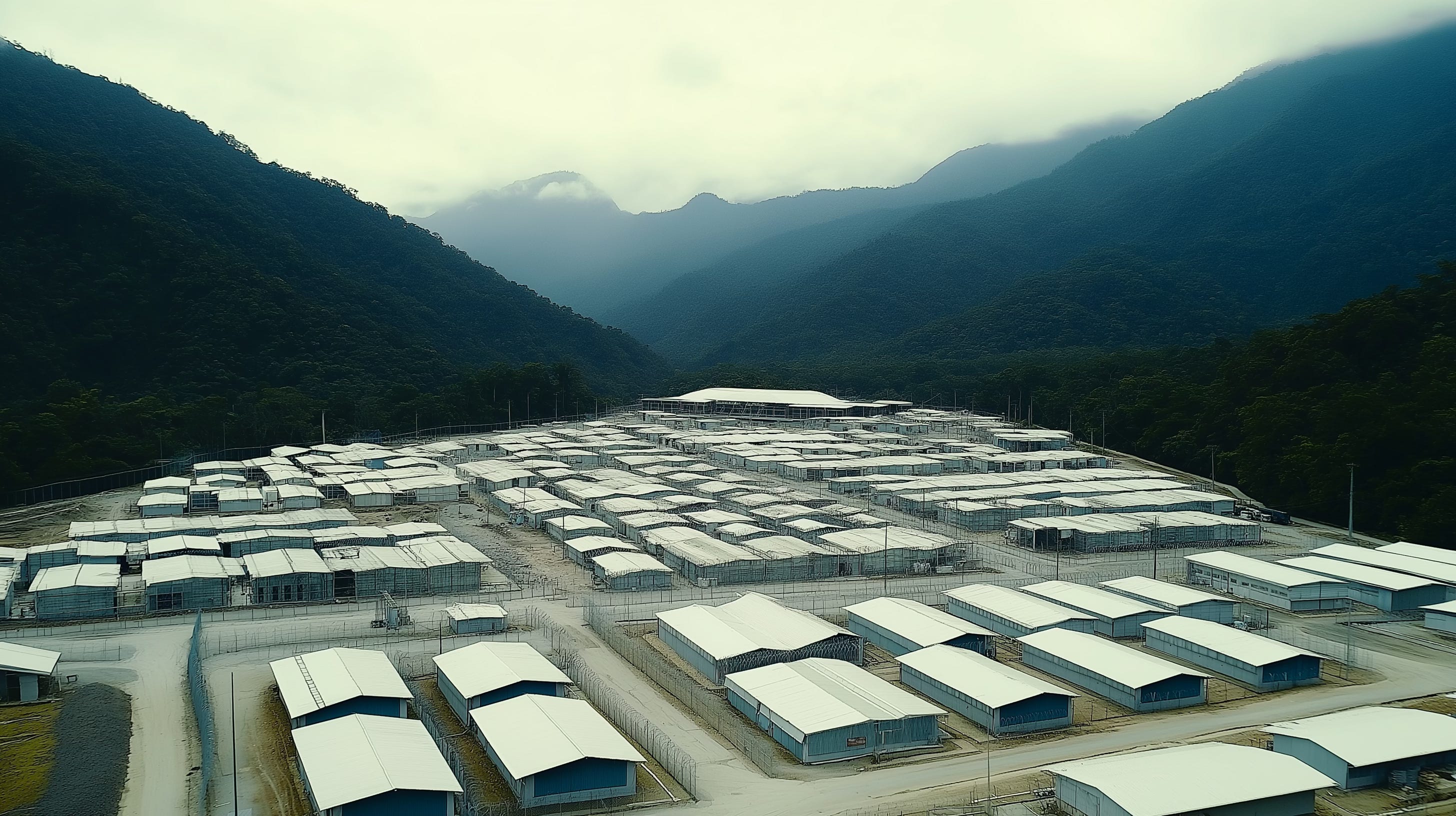
Deportation: The New Prison System
from Insanely Generative Hosted by Paul Henry Smith
February 5, 2025 Once upon a time, dear reader, the United States was known for exporting great things: automobiles, jazz, the personal computer, the concept of freedom—before we got bored with that one. But now, in what can only be described as a stroke of anti-genius, our illustrious leaders have devised a bold new export strategy: incarceration. The last vestiges of American justice have been packed up, stamped with a shipping label, and exported like so much industrial waste to a foreign depot. In a spectacle of bureaucratic cunning so insidious it could only have been devised by men too dull-witted to recognize its evil, President Donald J. Trump and his eager valet, Secretary of State Marco Rubio, have struck a deal with El Salvador’s Nayib Bukele. Under this inspired arrangement, America will now pay El Salvador to house its criminals—citizen and non-citizen alike—within the sprawling, totalitarian embrace of Bukele’s mega-prisons. Understand what has happened here. We are not sending them there to work, to rehabilitate, or even to provide some cynical economic return to the American taxpayer. No, this is an export that does not profit us at all. It is a marvel of perverse logic: a transaction in which we pay another country to take the failures of our own system, like a family who, instead of sending their misbehaving child to military school, wires money to a warlord to keep him locked in a box somewhere on the equator. The average taxpayer will wake up, go to work, and sweat over their bills, only to find that a portion of their wages will now be used to ensure that a man convicted of armed robbery in Milwaukee spends the remainder of his days baking to death inside a concrete tomb in Central America. The brilliance of it! The sheer, stupid genius! And what is the benefit? Safety? Hardly. American crime rates will not change, save for the statistics, which will be massaged until it appears as though we have solved the problem of crime itself. Soon we will hear “There are no criminals in America anymore. Look, the numbers prove it!” It will be like the miracle of Chinese economic statistics—so neat, so perfect, so utterly divorced from reality. But here is where it gets even more clever. Because these prisoners are now being housed beyond our borders, they no longer have rights. There will be no appeals. No last-minute reprieves from the governor. No access to lawyers, no courts to petition, no means of filing complaints when the water stops running and the food becomes indistinguishable from the cockroaches. Out of sight, out of mind, out of law. One can picture the moment when the first American inmate, having exhausted every avenue, attempts to file a motion only to be told that the concept of habeas corpus has been replaced with lo siento, amigo. Make no mistake, this is exile, the punishment of monarchs and ancient tyrants. The Romans, the Greeks, the despots of the Old World all knew that the most effective way to deal with the inconvenient was not to kill them, but to send them far away, where they would become someone else’s problem. And yet, even they did not have the gall to pay for the privilege. Only we, the great modern empire of freedom and commerce, could stumble upon a system in which our enemies disappear and we still manage to lose money. And who, you may ask, is the architect of this brilliant maneuver? Why, none other than Marco Rubio, that polished, ever-obedient sycophant whose greatest skill is his ability to walk upright despite lacking a spine. “No country has ever made an offer of friendship such as this,” he gushed, as though Bukele had sacrificed himself on the altar of international goodwill rather than struck a backroom deal to convert American tax dollars into a profitable prison franchise. One imagines Rubio practicing his press conference lines in the mirror, testing out his most solemn and statesmanlike expression while the people he supposedly represents are quietly flushed down the drain of the legal system. As for Trump, well, he will, as always, declare it a deal. Never mind that the United States will be the one paying for it—his is a mind that operates only in the language of transactions, not outcomes. No doubt he imagines that Bukele’s mega-prisons are like his hotels, and that the prisoners, upon arrival, will be greeted by gilded toilets and complimentary bathrobes. When it is revealed that the reality is rather more medieval, he will shrug, claim he never knew about it, and move on to his next great act of policy-making, perhaps outsourcing the education system to North Korea. And so it shall go. America will march bravely forward, blissfully unburdened by its own criminals, priding itself on its immaculate crime rates while Bukele quietly fattens his coffers with American money. The courts will become less busy. The prisons will seem lighter. The bureaucrats will pat themselves on the back for their cleverness. And the American people—slowly, imperceptibly—will stop thinking about criminals altogether. One day, a man will steal from his employer, and there will be no trial. A woman will protest the wrong thing at the wrong time, and she will not see a jury. A teenager will make a foolish mistake, and he will not serve five years in Pennsylvania—he will simply disappear. And when the last plane departs for El Salvador, and the last troublesome American is swallowed up by that great, foreign abyss, the people left behind will turn to each other and say, “Isn’t it wonderful? There is no more crime in America.” Let us stretch the canvas a bit wider, apply a heavier brush, and deepen the shadows in this grotesque mural of American folly. Because what we are witnessing is not merely an egregious act of cruelty or incompetence, nor just another costly bureaucratic blunder that evaporates public funds like morning mist. No, this is something far greater, far more damning. It is one thing to mismanage justice, another to abandon it altogether. America’s leaders have not merely outsourced incarceration; they have outsourced responsibility itself. They have given up on the idea that a nation ought to maintain its own moral house, ought to reckon with its own failures, ought to face its own people. Instead, like a corrupt landlord who simply evicts a problem tenant rather than fixing the leaking pipes, they have chosen the cheapest, laziest, and most cowardly option: export the problem, export the people, and let the world sort it out. It is an act of governance so detached, so arrogant in its cruelty, that one wonders if Trump and Rubio even bothered to ask what happens next? What, exactly, will become of the prisoners we so diligently ship abroad? When they are beaten to death in some anonymous Salvadoran hellhole, will their deaths even be recorded? Will their families be notified? When they are shuffled from one detention center to another, lost in a bureaucratic haze where American jurisdiction no longer exists, who will speak for them? Ah, but of course—they deserve it, comes the cry from the peanut gallery. They are criminals! They are not us! But this, dear reader, is the oldest lie in the book. When a government discovers that it can dispose of a category of people without consequence, that category has a funny way of expanding. First, it will be the murderers and the rapists, the ones no one wishes to defend. Then it will be the drug dealers, the thieves, the violent offenders. Then it will be those with “problematic” political affiliations. Then it will be the repeat protesters, the dissidents, the troublesome journalists. It will happen slowly, as all things do, like a boa constrictor tightening its grip—never enough at once to panic the victim, only enough to ensure there is always less room to breathe. And when the first American citizen is dragged from his home not for a felony, but for a thought crime, what will Rubio say then? He will sa… Get full access to The Generative Gazette at generativegazette.substack.com/subscribe
Embed this episode
No transcript yet.