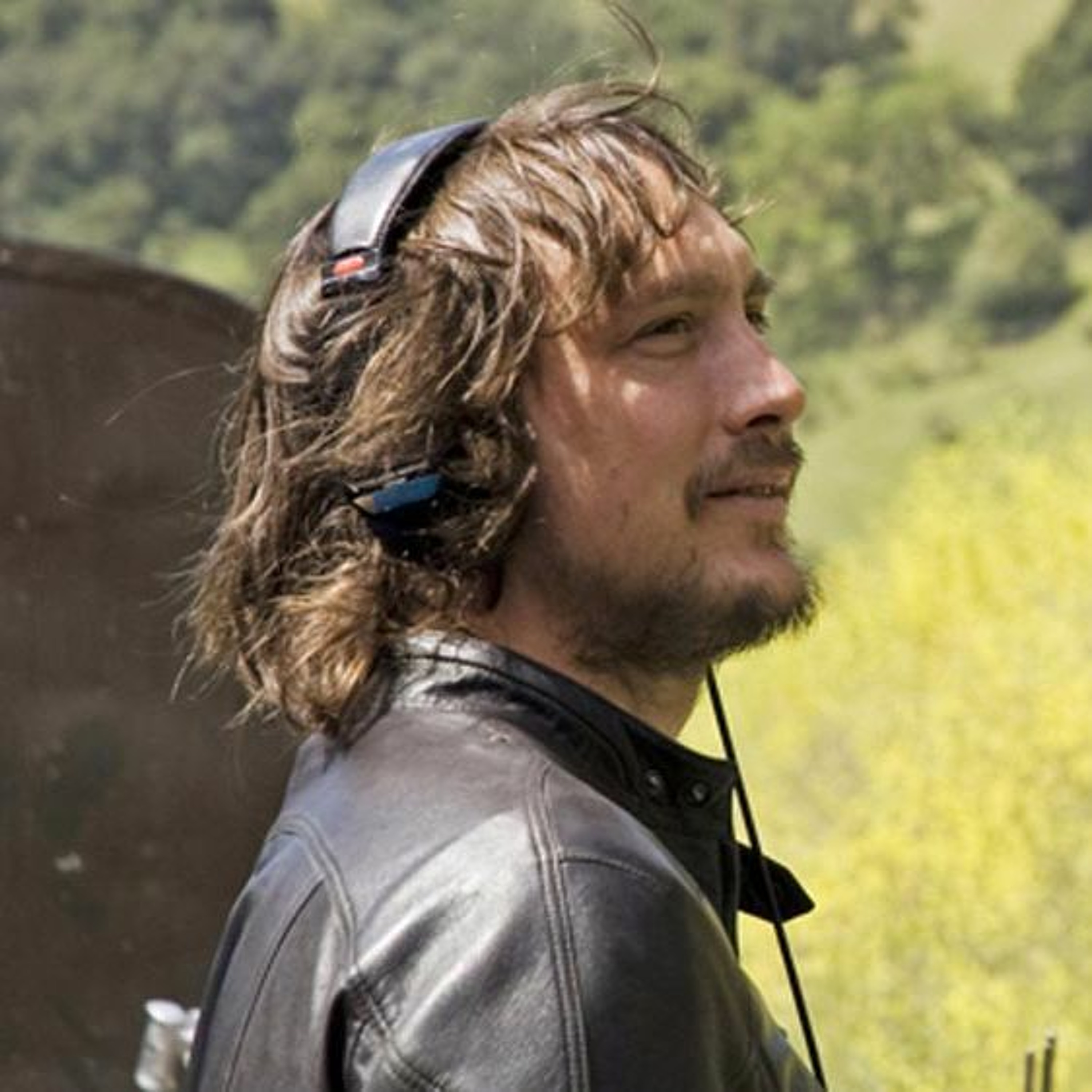
This podcast is an audio recording of a live event. It may reference visual material that cannot be represented in this recording. It may also contain strong language and adult themes. The opinions expressed in this podcast do not necessarily reflect those of ACMI. So hello. So I'm French, so my English will not be perfect. So if you have some time, maybe it will not be clear. Even if it was in French, maybe it would not be clear as well. But I will try to...
I mean, if you want to at any moment stop me and ask some questions because you didn't get something, you have to do it for sure. I'm not a theorician, so I'm more going to speak about my experience as a kind of journey. So then I'm going to start now. Okay, so it starts like when I was, I think, 10 years old. My parents didn't want to show me TV. I was not allowed to see films at home. So each time they were looking at films, they were closing the door, you know. And I was...
going through the door and look at the film. So see the film, but I didn't hear any sound from it. So I think that it started like that, that I had to reconstruct the sound of the film. I was not able to listen, you know? So I think that's a bit my first connection with the idea of putting sound and picture together. Then I think after, I was 13 years old, and it was a little show on TV for explaining to kids how people used to do sound for movies.
It was just a simple shot of a boat lying on the sand on the beach. And they showed the same shot, the same shots, one time only with the waves sound, then another time with the music, and another time with the kids playing, and another time with the seagulls. And something happened in my mind. I just, I didn't know how to, I mean, I didn't thought about it even, but it was like a kind of shock for me. And later I understood that what was for me something very impressive at this moment, that I just realized that I had the feeling that I never see twice the same picture.
And I had this great pleasure to have that. So I think I'm working with sound, but really I'm doing a lot of sound, but most of the time I'm connected to something else. Because I like this idea that actually how the sound can affect the other senses or percept I can get. So I think that's really my first... Yes, it's a basic experience when I understood that I want to do that kind of thing. Then after I went to school and I was doing like a theater or so, you know theater, and I think I just understood that you can have a life, you can make a living with something like that, something I didn't know, you know. And then I had a chance to see when I was 15 years old a foley artist working.
So for me, it was something amazing. I went to the studio, and I saw a guy coming in the studio, and it was like horses, and he was doing horses with coconuts. But for me, I was 15 years old. I said, wow, for me, it was fantastic. So I think that the fact that I was doing a lot of sports, I spent a lot of time also in nature. And it was for me, and I loved music, and I loved films. So I think this kind of mix of all these things, I thought that I should do that. So I finished my school, and then I was 17 years old. I started university.
For six months, I did mathematics, and then I just stopped and I said, so that it's not the right thing, I should do something else. So actually, I went to see all the foley artists in Paris. And one guy accepted me to be his assistant for six months, because after six months, he said that I was asking too much questions, so he fired me. And so I had to find a way to continue that. So I actually went in a lot of film school.
to meet young directors and propose them to work with them. So I start really, like I was doing, I had a monopoly of the free, to work free on short movies in Paris. I was like, people were calling me, is it you who's doing Foley for free? You know, I was like, okay, so it's need to, you know, I felt that it had to change that. So I start to actually, some of the young directors were actually starting to do their long feature film. And I was in a generation where I actually,
A lot of directors, my generation, we're starting to do some movies like Mathieu Kassovitz, Gaspard Noé. Christophe Gantz, Yann Koonen, Nikola Boukrieff. We call it the Starfix generation. Starfix was a magazine, and we tried to explore a bit. It was a bit like Les Cahiers du Cinéma, but kind of alternative, you know. These people really like horror movies, science fiction films, you know, like they were a bit like trying to do something, looking for something a bit different, like a kind of hybride between maybe a culture from an Asiatic film, American film, you know, like kind of taking some, bringing some new blood in their work.
So I was very lucky that I just arrived in that moment. So I started to work with Mathieu Kassovitz, which was the end after Polonski. I mean, that was an important film for me. So I do know what is a full artist. What is a full artist? You all know that? Okay, so for me, it's very important also because I learned sound through producing sound, you know, through my body. You know, so for me, at first, sound was a body experience, you know.
In the same time I was doing Foley, I spent a lot of time also to do field recording. For me, it was a two kind of thing, like the idea of doing sound, producing sound. But the other idea also was to actually capture sound in a natural environment or anywhere. So I was doing like that kind of double thing. Then I started to work with musicians also. And it became like a kind of weird mix, you know?
And so, and some directors asked me to do more and more than Follet, you know, some other director asked me to try to do some music, so I was like, you sure? So it became like, so now that's the kind of, I have a weird trajectory, so I can move from an opera to a play, a theater play, from an exhibition to a musical show to, I mean, and I don't, of course, I choose all the time very precisely where I want to go, and each project, I choose all the projects. It doesn't mean that I'm just following the, you know, the flow. I really try to, to choose projects. But I like these things. You know, I think I really like this idea of working with some people, but also with a set designer, DOP, choreographer, dancer, musician. You know, I really like this kind of, you said like oblique, kind of, you said transversality, something like where you're actually able to, because I think what is very interesting when you actually work in that kind of domain, that when you start to create, for example, you work with a dancer, actually is the connection between the sound and the dance, create a kind of territory which is not
precise, it's a kind of gray area, you know? So you have to, it's a possibility to create a grammar each time, you know, a new grammar. So for me, I really like this kind of idea of actually creating some weird links, working with a biologist or maybe a mathematician or sociologist or whatever, you know, because each time it creates this kind of unknown territory, you know? So that's a bit of a general idea of my trajectory. And I think I would maybe, so the idea that I'm not, in that kind of situation, I'm not recording, you know, I'm just producing sound. So the idea is that you put a film and you actually redo all the sound from the film because most of the time during the shooting, what is the most important to get is like the actors. So most of the time you use like very,
like Canon or semi-canon, like very precise microphone to get actually the actors, because you know that it's much harder to reproduce actors than to actually rebuild the other sound. So most of the time, you actually, I mean, it's for, let's say, a normal fiction movie, you know? Then you have to recreate later on all the continuity and all the sound. for the film. So you actually perform in that room. Most of the time, you have acoustic panels, so you can actually recreate different acoustics to be able to fit exactly with the sound. If you're outside, you need to create a dead room. If you are in a church, you need to, you know, so it's more like that kind of environment where you can actually have panels, you have curtains, you can actually motorize panels, and each time you are, for each sequence, sometimes even each shot, you create an acoustic situation, which is fit to what you want to do. And also, it's a particular technique we did in France, because I think the French cinema has a lot of production sound in it.
And most of the time, we're also shooting in the real set. So the sound is right, in a way. So we have developed a lot of techniques to actually try to recreate this kind of... right environment. So we're actually using a lot of different mics. We are mixing them, and the recordist, in England, for example, they record everything very close, and after they work in the editing. In France, we actually have maybe five, six, seven mics, putting in different positions. Some are close, some are far, some are off-axis, some are maybe even under a table. And live, looking at the picture, in real time, we actually rebuilt a kind of living sonic recordings.
So do you try and create the sounds without revers while you're recording it? Depending, for example, after it's quite a bit technical. It depends, for example, if you want to reproduce a huge room, you know that the first reflection will come very late. So if you're in such a room, you will never get the first reflection right. So in huge acoustics, it's much better to be quite dead, just working on axis of axis.
to get movement, but without to take the first reflection of the acoustic. And then after you work with a digital reverberation. Most of the time what I'm doing, when I work on a film, I create my own acoustics. So I actually go and record, because most of the time I go on the set. And I do model, I model, I create a model of the acoustic of all the locations. Like that when I have to integrate some sound, I can actually put the sound in the same acoustic as the production sound. Okay? So that's a full stage. So sometime where I'm doing this one.
And sometimes, of course, now, more and more, I'm doing foley on a real acoustic. For example, if I have some sound to do in a church, I'm going to a church. So I actually have a mobile studio. Of course, if you have 40 different locations in a film, it's not really interesting and it costs too much money. But if you have two or three main locations, which need to be very tasty and have a very strong character in terms of sound, I like to go. So now I have a lot of places I know in France. Most of the times, they are quite far because to be very far from the...
from the noise of the city. And so I rebuilt, you know, like, kind of, and sometimes even I bring all the equipment from the set, you know, or the chair, you know, all the props, you know, also. I'm doing that mainly with the Darden Brothers, you know, they really like to do that kind of stuff, like, keeping all the clothes, all the real props, and bring that to the studio. So yeah, it was a, you see, like, the little tomb, it's a tomb of Richard, the King Richard. King Lion, so it's easier, like, be careful.
But I can show you. I don't know, that's for later. So again, you know, we have all our props, you know, so it's like 20 years of research, you know, I've got a truck with like full of rubbish, you know, like included an 80 pair of shoes, you know, and a lot of, you know, now it's clean. It's the first day of the session. But at the end, it's like, it's a big mess. And so the idea is that...
When you do, I think the approach you have, when you do folies, that's also, it's like a copy, you listen to the sound, or you have a sound in mind, and you try to cut that in different layers. So you're like listening a sound or you have a sound in reference in your head and say, okay, to do that, it's a bit like cooking, you know. I need a bit of chicken, I will have to put some salt. So you actually recreate a lot of layers and try to exactly put all this layer together to get this result. So I think it's having a huge influence on the way I'm working, even with sound design or even with sound editing in general. It means that I really like to actually capture a lot of different layers. Sometimes I do recording where I have a photo, but I can show you. Okay.
So, for example, normally there is even one more mic. So it means that there is like one mic, which is very like film sound kind of, you know? Cardioid, like it's really like left, center, right, you know, because when you, the system of, in a film, you have like mainly five, six speakers, left, center, right, the surround, and one subwoofer, which is a low frequency. So most of the time, this first system is more like flat, you know? So it's a kind of...
let's say classical kind of sonic picture which fits to the screen, okay? And then after I have this four mic, which are totally different, they are omnidirectional. So they actually create a kind of cross like that. And it's a very immersive system. So I like to play with that, the fact that sometimes the sound is in the film, and sometimes I put the people in the film, you know? But everything is recorded on one, you know, at one time, you know? And sometimes I have even one more mic, and sometimes I have another recorder 200 meters away, and another recorder 500 meters away, you know? So I like to create, like, layers. And then after, when I edit, I like to play with this, it's a kind of anamorphosis, you know? So it's a bit like different lens, from very close up to very large, and I play a lot with that, so in one recording, I actually can move, you know?
in the depth of the sound, in a way. And for me, I like that very much, because a lot of people are putting a lot of sound like that, and it seems for me very fake. So I really try to actually get this natural feeling, or actually moving between the different layers of sound depth, you can say that. And also, the fact that this mic I use, the 4-1, they are not at all movie mics, they are like a measurement mic. So they have exactly the same, it's very close to what you hear, actually.
So they are super flat. They really fit to the way we are listening to the sound. It's not binaural mic because binaural mic are only working mainly with a headphone. No, it's a DPA or BNK omnidirectional mic. And they are very interesting because they are not very precise in terms of spatialization, but they are very close to what you hear in terms of color. So actually, when you want to create an immersion in the sound, if it's too precise in terms of localization,
it can be very disturbing, you know? So the fact that it's omnidirectional and quite not precise in terms of localization, but very right in terms of color, general feeling of color, actually it gives you a very good feeling of immersive, you know, like an immersive kind of feeling, you know? And I like to also, because for me it's like, let's say that this first mic will be more like a... the classic sound from movies in a way. So it's more a cultural reference with the movies. And the other one is more like a human reference. So I like to play with this idea of this kind of double culture, like this culture of film and the culture also of actually you as a human in a sonic environment. So I like to play with that kind of two double grammar, you know, and to play with it. So photo, check if there is something more interesting. So and that's the other kind of situation where actually I'm going to speak that later.
That's more like a situation where it's not about making a sound for the picture. It's actually to create sound library for sound design. So that's something I really... I do that a lot still for a lot of sound designers, which are friends. They ask me, oh, I have a monster. It's like 20 meters high. He's like, you know. Or I have a... I have a big whale, which is fighting. Or I have an explosion in the submarine. You know, like, whatever.
And so they ask me, can you do that? So actually my work is like, okay, I start to make some experiments. I go in the studio. And sometimes, most of the time, I take like one or two weeks in a music studio with a lot of mic. And I go and I buy a lot of props. And I experiment for eight hours or 10 hours a day, trying to find texture or sound, which actually seems to be interesting. So I start to do a kind of quick editing with it, just to understand if it's the right direction or not. So that's also a part of my job, to build some library for some supervisor or some designer.
I still like a lot to actually share the work with a lot of people because I think sound community is very nice because we need to be humble because nobody takes care of it. So it's not like if you're a famous DOP or famous actor or whatever, you know, so I think the sound community is very nice. And we share a lot, you know. I have connection with sound designers all over the world and we exchange sound, we speak, we exchange our tricks, our technique, you know. It's actually very, very nice.
So in that case, I really focus on the texture. So I have this at my headphone, and then I really sometimes even close my eyes, and I have a lot of mic. I will have a contact mic, omnidirectional mic, cardioid mic. Sometimes I have even capture, pressure. I mean, any kind of things I could use. And I try to combine these things to actually create some interesting material. And most of the time, I'm recording a very, very high definition. Like that, I can actually have more room to pitch or to change. You know, if you get a huge definition, then after you can actually slower.
When you transform the sound, it's okay, you know? And then the fact is that you use like a measurement mic. There are mics which are much, much, much more wilder than our ears, you know? This mic, not this one, but this, the first mic, for example, is like, I think, 80 times more sensitive than our ears. So it's like when you are in a very, very silent place, you can put the mic at the bottom of the room, do that, and you can record it with no hiss.
So it's going to go in that kind of world where you don't have access normally, and you can get an amazing, even little partial harmonics or some very low frequency resonance. So it's going to you to access to another world. Like I have also a microphone to record bats, for example, which are recording until 500 kilohertz with a one megahertz recorder. So you can actually record the sound you can't hear, you know, which is sometimes very beautiful because you're recording, for example, you are in the desert, you're recording here, nothing. You come back and you start to play.
and you pitch down the sound, and a lot of insects just appear. You know, it's like a kind of reveal, you know, it's also interesting because it gives you the things that you, your audition is very narrow, in fact, you know? It's like also when I work with Philip, I try to start to work, I'm going to speak about that later, but I start to work with systemometers, which are systems which are able to recording. Amplitude of 24 hours. I mean like 0.001 Hertz. So you actually are able to reveal some shape or some form or some things which you don't have access to. And I really like that. Also, that's something I really like to actually
reveals that kind of vibration in general, you know. I like also in general also to do sonification of data, sonification of pictures, sonification of any kind of things. I really like the idea to actually bring to sound a lot of different form and shape. That's something, yeah, to kind of listen what you can see normally or listen what you could feel with your body or, you know, like, I don't know if it's clear, but okay. So I'm going to show you some film and I, because maybe it's going to, I don't know.
This is Paris in the film And this is the suburb. I will explain you after the idea.
I don't know if you have seen this film. At this time we were very stupid and young and we were doing this film just by intuition. So we ended it by doing it on Paris in Mono. And the suburb, like super wild and super... So all the sequence where these Indians are going to Paris, everything is like now on Mono. And when they come back to their land, it's like super... You know, everything is super... That's what's happening. And I just understood that after we did that like that, we had this feeling. But in fact, it's exactly what's happening. For example, if I put you in Amazonia, you know?
First, I mean, I don't know if you had this experience, but when you arrive in the Amazonia and you go in the jungle, everything seems flat. Extremely flat, like monophonic. Why? Because it's not about localization, it's not about transfer function, it's not about, it's cultural. You don't know whether if the sound you listen are insects, or if they are birds, or they are, you know, whatever. So everything seems flat. And then, day after day, if you are with people who actually know the environment, they will start to explain you what is what.
And you will see that you start to actually get a larger and larger picture of the environment where you are. So I think that was a very interesting thing because actually these people, they're going to their foreign land, you know, Paris, and everything is mono. It's a bit like the same feeling. They don't know what is what, you know. And when they come back to a suburb, everything becomes like extremely defined because that's their territory, you know. So I think it's a, most of the time, I mean, that's also something interesting, that most of the time when you work with film, it's very intuitive. And most of the time you understand later on what you did.
With experience, after you get older and you have more overview and you start to actually be more conceptual and know about it because you accumulate all this experience. But I think at the start when I worked, I was really like intuitive. And I think, I mean, that's the way I... That's my story, okay? So that was a very important film for me, because Lion was quite big in France, and it became like a new kind of new cinema. So I profit a lot of this thing, so a lot of people start to call me and ask me to work on films. So you have some time opportunities, and I was there at the right moment, and it was fun. And then after, another thing which was very important for me was this film.
Okay, so what is particular that this you think it's a production sound maybe or it's not production sound it's totally rebuilt and We really try to it was a very precise work we have to do because during the shooting it was a very noisy and We won't really want to actually give the feeling that it was really like real production sound So we are actually, for each shot, we built the studio for the acoustic, putting the mic in exactly the same situation, working a lot, performing a lot, you know, to try to get exactly the right feeling of it. So I think that when I saw that recently, I was a bit like, wow, you know, so I was even a bit, even me, I was thinking again that it was a production sound, and I called the mixer, and he said, no, no, it was totally rebuilt. So I think that was very interesting. So it's not mean that it's...
the truth, but it seems right, you know? So for that kind of film, I mean, you don't have to make it right all the time. But actually, if you really work on it, you can really make believe that the sound is there, you know? So it's totally rebuilt. The Bracing has been re-recorded later. It's Folet, and it was a wonderful sound design by Gerardi, which was, for me, my master. He did the sound for Delicatessen and for a lot of great films. And yeah, so for me, that's, in a way, that's, after that,
I had the feeling that I had to start to do other things and to open a bit my field, you know, because I had the feeling that if I will stay in the Foley studio, I will become a kind of baron or king of the Foley, and it will be very boring, you know? Can I just ask a quick question about a scene? A scene like that, would you try to go to the sound and perform them in real time as a performance? Yes. Rather than loading a holodeon into the internet? No, no, no. I learned when I started to work 27 years ago as a Foley artist, we were recording on tapes.
So no editing, you know, we had like four tracks, and this has been recorded later on, but the technique which was developed in France, we are really like performing, you know, so we are performing and performing and performing and trying to exactly get the, but not only me, the recordist also, trying each time for each shot to actually get the right mix of, change, you know, the positioning of the mix of the mic to get actually some little weird, you know, phasing stuff or little resonance or, you know, like, so it's a, yeah, it's a. For example, when I do sound effect, like I showed you the photo before, I don't work with picture. I just get the picture, but it's more like to have a kind of ID, you know. I try to be more free, but actually for this kind of work, you really need to be totally stuck on the picture, you know, and work with the picture, work with the picture, you know. Just going back to the sound libraries that you're creating. Yeah. Do you do much in the digital realm after you record them, or do you mostly try to get it right with your heart? I try to get 95% right during the recording.
For me, normally what I load to myself is just like to pitch one octave down or two octave down when I record a 192, just a low cut, just cutting the general shape, you know, general spectrum, you know, and that's it, you know, I try to... Can you give me the example of the monster? Do you create layers to produce that when you try to capture all the time? I try, again, I try to be the more closer from the, yeah. So it means that I'm going to do, most of the time, I do, for example, a monster voice.
You put a lot of ONA nuts in your mouse to get a maximum of high frequency. Like that when you're going to slow down, you get a lot of, you know, still a lot of... Precision. So the thing is like you record and then you slow down and you say, oh, okay. So you have to move back, you know, all the time you're like trying to do in real time and listen, you know, slower to get a much more, you know. So it's always a work you do to be the more close possible, you know, from the right sound, you know. Because each time you process, for me processing is really like, in a way, if I'm processing the sound, it's a kind of failure.
I mean for me, of course, I spent a lot of time when I was younger using for hours smoking pot and using a lot of plugins, you know, like a guitar pedals. Yes, but for example, I like to, for example, if I'm recording explosion, I like to combine like some explosion, but Let's say I'm going to take the low frequency of one, which is, I slow down, and then the attack of another one. And then, you know, we're trying to be the more organic possible, you know, in a way, you know? So, of course, after I say some, and then after also I work with a lot of people, you know, because if I know that I need to work on certain kind of work, I can go to IRCAM, or I have friends which are very good with processing machines like Kima or Max, you know, so I like to collaborate with people which are actually very good in certain kind of work. I don't do it myself because...
to work properly with this machine, you need to spend two or three years to actually, it's like a modular synthesizer, you know, you need to, it's very time consuming. So actually, in that kind of situation, I prefer to collaborate with people. Okay, so then after, I'm gonna show you, maybe, weathering height, yeah. Okay, so I have, for that, I have, I need to go to five minutes 40. So the film, have you seen this film or not? It's a very interesting film from, she don't like this film, Andrea, but...
It's a nice film. I really like it. Okay, so I'll show you that. I'll show you this part and I'll show you another one, which is later on. It's an amazing place. I recommend you to go there. It's the most in north of England. It's absolutely scenic and stunning. It's an amazing place. I will take you from among the heathens and gather you out of all countries and will bring you into your own land.
Then will I sprinkle clean water upon you, and you shall be clean. From all your filthiness, and from all your idols, will I cleanse you. And what will be his name? Heathcliff. Do you reject Satan? Don't struggle now. Okay, so what is interesting with this film, there is a 12 minutes of dialogue, so everything is trapped, and everything is totally rebuilt.
So there's no production sound at all. So the idea is that I spend a lot of time in the location, three weeks, to record all the atmosphere, even all the sound inside the feed, all the props, everything was actually re-recorded in the same situation. Even all the off-screen sound. And for example, the girl which is singing, we just added, so we said to Andreas that we need to keep the house. So we keep the house for six months. And each time we need to actually redo something, we are coming back to the house and re-record the new elements. For example, at one moment, Andrea said because the idea that she wanted to have a film without any music. So for example, but at one moment, we missed some music. For example, the little girl singing. It's something we had after. So we came back to the location with the actress. We found, we looked for a song which was fitting to the moment, I mean, with the mood of the film. And we actually re-recorded her.
actually running in exactly the same location. So I think you don't think that it's totally rebuilt, because actually you recreate the context, you rework with the contextual material of the shooting, the location. So we worked also with an ornithologist. We spent one week with an ortelegist to actually record all the birds from the place, you know. So everything was extremely precise, you know. So all the birds you can hear are actually the right bird in the right place at the right moment of the season, you know. Even the fire, it's not made with wood. We actually redid some tuff, you know, like they were using tuff at this period, to actually have the exact sound of the...
of the fireplace, you know? And I'm doing a lot of that now for each film. It's meaning that I am actually spending at least one or two weeks in the shooting. It's... Did you decide to do this during the shoot or just after the shoot? In parallel. During the night, I was recording all the little elements. And during the day, I was going out from the set like...
I had an assistant and we were walking in this huge park and trying to get a lot of different sound each time. And I would say like maybe 98% of the sound you can hear on the film are recorded in the mouth. So that's what I try to do each time when I do a film I really start to start from scratch. To recreate the full library. Because I think that sometimes of course you need a door sound or you need a tiger.
The film is not very rich. But if I can, I really try to get everything. The atmosphere, the sound effects, the acoustics. The idea is really too simple. A bit like I said about the foley, to actually recreate all this layer, to capture all this layer in the best way possible, to actually recompose that. And of course, everything was recorded with also not like a movie microphone, but again, measurement microphone. Because also what is interesting with measurement microphones is that the spectrum is much more wide, so you have much less masking.
Because, you know, is that one of the first things that when I was working in movies is why people are recording everything with the same mic, you know? It means that everything is going to be stuck, you know, in the same area with the same characteristic. So the idea that I always combine mic, I can even use ribbon mic. I mean, I have a lot of different mic from static, dynamic, ribbon, tube, you know, and with a lot of different preamp, and each time I try to actually get the, find the right mix of technique to get exactly what I want, you know? For example, if someone is speaking and you recall something which is a lot of transient with very high frequency, I will use a ribbon to actually control the high frequency if I want to, you know, like each time I'm gonna... But I try to do everything during the shooting, you know, like when I recall. Not to actually process after the sound.
So I also, you know, the feet in the mud, the father coming, you know, the dogs, you know, the horses, everything was recorded during the shooting. Yeah, yeah. I mean, even, you know, for example, it was very interesting because people say, but it costs a lot of money, you know, you can do that, but nobody can do it. Why? Because why? Because I think that when we get the right sound, you need less time to edit. So what I do is that I have a deal with the producer, and I say, okay, you remove two weeks of sound editing, and you let me go in the shooting and record whatever I want. And after I can go very fast because I have a...
I mean, a lot of good material actually to work. For example, in that situation, you know, they wanted at the start, the set designer wanted to put some fake stone, you know, in the house. And I said to him, if you do that, the sound, the voice is going to be awful. You know, it's going to be like, the acoustic will be awful. So we decided also to give 5,000 pounds from the sound department to the set department to actually get the acoustic right.
And I think that most of the people, they are always very close-minded. It's the only thing about the sound. It's the same thing with the DOP, which is a friend. I said there are some sequences where we're going to have a problem to shoot. So can we do pre-light? It's going to be easier for us to work. The same thing with a costume designer. You work with a costume designer, and you start to find some fabric which are actually not making too much noise. So for me, it's not about sound. It's more like the approach you have to work. It's like to actually get the bigger picture and try to work in a collaborative way. And most of the time, it's not costing more money.
I was in Cannes last year, and I did a film with a French team, and the film was costing 4 millions. And we did American Monet with 1.5 millions. And after the screening of American Monet, the French director came to see me and said, yes, but you have so much money to do that. So we had like a third of the money. But we really actually worked from the script with the DOP, with the producer, with the sound recordist, Rash Omar, which is an amazing sound recordist. And we actually took a lot of time to actually think about how we're going to work together. And where are we going to put the money? How are we going to...
And I think nobody does that anymore. So when I start to work a long time ago, it was more like in the Nouvelle Vague, so the people were much more collective because they had this kind of political background where actually it was important to have a kind of collective way of working. And then in the 90s when... Everything starts to be specialized, sun editing, picture editing, even dialogue editing, music editing. Even in Hollywood, you have some door editor, you know, or some gun editor, you know, so it's like totally, it's become totally stupid, you know, absurd, you know. So the idea to...
to try to reconnect people together. For me, that's the most important now. I think that even Sonic-wise, I can speak about my work, but for me, the most important to get a good result is actually to try to reconnect the different people together. You know, to work on pre-production and to create a link between pre-production and shooting, to be in the shooting, to actually have some input from the post-production to actually help that process, and actually, in the post-production, to actually recreate also a very strong link between picture editing and sound editing. Because what's happening most of the time, if you do films, that's most of the time what's happening if you don't work together during the mix.
The director says, can I hear the Avid? It's like the tracks from what have been edited from the picture editing. And most of the time you have worked a lot and you come back to the sound of the picture editing, which is most of the time like bad sound. But because it has been in the process of doing the things, these sounds become very important. So what I do is that when...
I go to the shooting, so I create a whole library, and when the picture editor starts, he has a folder with all the sequences, with all the sound, and the same sound, but thematically reorganized. And I said, okay, you use these sounds. And they actually use the sound, and that becomes my base for working, you know? So I think it's... I mean, I think it's common sense. I mean, it's not like something amazing. It's just like normal, I think, to do that way. But most of the time, the people don't do that kind of thing. You know, it's having lost, you know, because what's important is to be a professional, you know, like to be a good picture editor, to be a good song. It's been nothing. You know, I think if you can't work together, it's been nothing all of that. You know, it's like you lose 40 or 50 percent of the work which have been done, you know, because of misunderstanding, because it's, you know, it's so simple to actually communicate.
It doesn't mean that you need to communicate through sound. With Andrea, sometimes when I was in the shooting, she would send me some poems, she would send me some paintings. You don't need to speak about sound, but you have to feel the project and to feel the mood of the project. Actually, conceptually, and also... in terms of sensation, you know, in terms of to share the intuition and to share also the general concept of the film, you know, because the storytelling exists, you know, the basic of most of the film I'm working with is you have a storytelling and you're not going to change the storytelling. So you have room on other levels, you know, and that's that kind of area where you need to actually share ideas and try to create some life, you know.
Do you have any question on that? No? Okay, there's something very special about the... I'm very lucky, in a way, because most of the people, they actually work with me when they don't want to put music. So I'm a kind of alternative to, I mean, they want me to have a musical approach of the sonic world in a way, you know? And maybe this, at one moment, this is going to create a pollution which will bring a musical work.
You know, but it's not like the idea of you have sound and you put music on the top of it, you know. I mean, I'm not working on that kind of... I can work on that kind of film, but if I'm some supervisor or some designer on a film, if people ask me to work on their film, it's most of the time because they don't want that. They want actually the music to be like a pollution or to leaks, you know, from the process of doing the sound of the film, you know. It's not something you put on the top of it, you know. It's not like icing the cake or, you know, it's not like that. So most of the time...
When I work on this project, I am actually, if there is a musician, I'm working with a musician from the start. And what's happened quite often is that actually the director asked me to think about music for the film. So little by little, in some years, I tried to make a collective. I have maybe now eight, ten musicians I used to work, but I wanted that to grow. So each time there is a new project, sometimes I'm listening to music, I try to...
looks, you know, to listen to things and I try to find something interesting and then I meet the guy I try to because it's not easy to do music for film. So I try to always find a procedure, you can say process, process is not nice, but to find a way to integrate the work of the musician in the film. And it's a very specific film for music because a very bad music can be an amazing music film and wonderful music can be an awful music for a film. It's like, it's very, yeah, it's very special, you know, so. So most of the people also I'm working with as musicians are more like a performer or so people who are able to improvise because I think I feel very close to that kind of approach through the idea of the fact that I've been a fully artist and I like to produce a sound and to be able to react in real time with the picture. So I think all the musicians I'm working with now they are people which are actually improvising.
from different kinds of music, from contemporary music to electronic music, jazz, whatever the name is, you know. But people who have this kind of work, and most of the time we try to find together a way to work and to approach the project. And sometimes I'm going to ask one musician to come and do things. I say, like, look at the colors, and I'm going to bring another musician. I say, can you work with editing? You know, like, also sometimes to create different layers, also, but maybe with not the same idea.
And then after I try to do something with it, and I like to do that kind of thing also. So I like the idea that you get a lot of different structure, which are maybe sometimes raised by different ideas, and then after moving into these different layers, because I think it gives a lot of room actually for the audience to actually build their own story. I like this idea of creating a lot of room, yes, for the people, you know, because for me... Yes, make no sense to do something for me, you know, I really like to For me it's important. Yeah, and to keep some of this kind of mysterious things, you know like to to to Agence is a yes is doing the job in fact This is you who will actually do this on the soundtrack, you know your brain which we see the film and picture on and listen to the sound and you will have a kind of mix and I try to make these things not too obvious in a way or to all or extremely too precise or too hollow or to you know
Like you have to be active, you know, I think. I hate this kind of big film where everything is like over. You have the story, the picture, the sound, everything is going in the same direction. It's like so redundant. You want to vomit after, you know, it's like, it's not, I mean, for me, it's awful, you know. Sometimes I go to see that kind of big blockbuster, and I'm like, ugh. Sometimes, most of the time, I go out before the end, because, you know, it's like, it's too noisy to, I think it's like, stupid. Can I ask a question about, I think you might be able to play something rather good?
When I started to work on the project, it was Johnny Greenwood who was supposed to make the music. So we had a very droney kind of music, which was quite nice. And the producer decided that it was not good enough for the film, because it's a big prototype, but it's like a Ghostbuster in the same time. So I discovered the music at the end, because the music came very late, in fact. But the process was very long because they spent so much time to actually put, you know, because all the large shots, they are like 3D CGI, and they have to replace the face of the, you know, and it was like the really, like the Uncanny Valley effect. They were spending like months and months to get it right. So they tried to, so I was doing like a, I was redoing and redoing and redoing the sequence. One time the guy had like a hammer, and the next time he had like something else, and then after, it was like.
I was doing the same film, like I've done the film maybe six, five times. So it was like, no, this time it's, you know, a drill. So, no, but I was not the sound supervisor or sound designer on this particular film, Gravity. I was really like, I had worked with Glenn Fremontle, the sound supervisor, on a film with Annie Boyle. And we tried to work on Sunshine. It was kind of very immersive.
sequence. Then on 127 hours, it had like this kind of also sequence where you actually listen the sound from inside. And so I think when Glenn asked me to say like, can you help me to do this film? He asked me also, what do you feel? How we should approach the sound? Like the fact that, of course, there is no sound in space. So for me, it was obvious that it became like you have sound inside of the suit because it's pressurized. And you have also contact. So if you have contact, you can actually feel the vibration.
So it's become like we start to work mainly with a lot of contact mic. We even create some contact mic. We transform some, we took some device for petroleum, like, what's it called? We took a lot of different sensors to actually create some sound. And the idea is that I've recorded everything through my body. So in fact, all the sound have been recorded. I was doing things and I had a microphone on my body. So actually I used my body as a...
You know, the pedal effect, you know, like kind of... So to get exactly this kind of right feeling of listening to the sound through the body, you know, which is also very immersive. And of course, like, it's a bit obvious, but it's a bit like a fetus, you know, in the water, you know, like this kind of cosmonaut, you know, so there's also something very connected to the internet world, you know, or maybe the memory of your, you know, this moment in your life, it's also connected where, you know, maybe you swim under the water, you know, it's something like that, the idea of floating. you know, floating, you know? So I think it becomes very obvious that more and more we are working that everything has to be recorded through that. And even the low tone you have at the start of the film, like, it's actually my head. I put some mic, you know, I ingest some mic, you know, and it's actually the pressure of my blood in my head, which is, we can see a bit of it. It's not a very good copy, but.
That is affirmative. Surprisingly, control hasn't heard the morning rush. Well, it's day one, and I'm bumping my way down Berger Street looking for a sister of a friend of mine. Streets are full of people. I think there's no way I'm going to find this girl. Proceeding to override. And all of a sudden, I look up. And there she is. I'm about to yell at her. And I see she's holding hands with some short-haired guy in board shorts and a Margaritaville shirt. And then I realize that this guy is not a guy. That my girl is holding hands. ISS, this is Houston. Explorer, this is Houston. Mission abort. Repeat. Mission abort. Initiate emergency disconnect from Hubble. Begin re-entry procedure. ISS, initiate emergency evacuation. Copy, Explorer. Stop airlock. Houston, elaborate.
I'm sure you have seen the film. So the idea was also to create a mechanical distortion, a lot of mechanical distortion, because it was this idea of contacts. So we want to create actually a lot of strong sound. So I built a lot of little machine or little setup to actually create with a transducer to actually create a lot of mechanical distortion. So instead of having most of the time what you get like electric or electronic distortion, you have like really like a mechanical distortion.
So it was the idea also to actually create some sound which you never heard before. I'm sure a lot of people have worked with that, but in a way, use kind of original material to actually try to create a kind of grammar. I did the same thing on a film called Ocean. which were only underwater. So I spent like one month in lakes, in the sea. We built an underwater, an echo chamber, and then we used a lot of different hydrophones. And I spent like one month in a wetsuit, like recording sound under the water, to try to actually get some interesting material. And I think that...
I mean, that's the way I'm working in any way, that I like to experiment and I think I like to try each time to bring some, you know, for me it's very boring if I start to work on a project and using sound I have already used. It's like, you know, I feel like it's disgusting or something like that. I mean, it's, you know, it's like to... to eat the same food every day, you know, it's like very depressing, you know, so I really like to do that. And also what is very important, for me, it's like when I work on a film, I spend a lot of time to listen to sound.
So when I start a film, I have like all the library and I try to put all the sound on all different sequence. And I try, because I think it's impossible to anticipate how my brain will react if I mix sound and picture together. So I spend a lot of time, you know, even sometimes half of my editing time to listen to sound. To try to see how they react, what mood they give, you know. And I take notes and I try to understand. And then after from that, I really work on the start of the film because I think the start of the film is actually the place where you actually just create the grammar of the film.
If you're doing like a film and then you start to work with an FX sequence, and you're doing something crazy, and then after it makes no sense with the way you have built the whole film, it looks like an effect, like stupid effect, like a decorum, you know, it's awful. So for me it's very important actually to work on the first reel most of the time, the 21st minute, and see how I can actually integrate the elements I have chosen in the start of the film. Like that, it's like you recreate the... Like the sound of the film, you know? And then after you... That's why most of the time the editing is very fast for me. If I get the right sound, I can sometimes edit a film in two weeks, three weeks, but I'm going to spend a lot of time to listen and to record. You know, but I like also that the things need to go fast, you know? I like to think a lot, to try a lot, but then when I actually do the work, I like to go fast, you know? I like to go in this kind of, you know, I don't know how you call it, but you know, to be very concentrated and not be disturbed by something else, you know? Because I know already what I want to do, I know...
What I've chosen I know how the sound reacts, you know, so I it's really like a Like kind of live experience or so you know like something very quick and fast, you know and most of the time after What I like when I have some people working with me like we exchange also reels You know, sometimes I say like, okay, I take your, you know, I go in the exchange of room, you know, we, we, just because I think that sometimes you, of course, the people I asked to work with me are people I really like, so I think that it's nice to actually have the input of everybody and try to, maybe they're going to bring you some good ideas or, you know, I like this idea of, before, when I started to work, I was trying to do something very homogenic.
But more and more I like the idea of I prefer things like That's why I like this idea of doing things very quickly or so because you don't polish, you know things It's a bit raw, you know, and I like this kind of feeling, you know things are not too polish I'm always a It's funny because I told you after a while, but no, I'm always working with mixers. There's like some people I really like. I love Tom Johnson from LA. He's a Skywalker ranch. I love Cyril Oz in France, which is an amazing French mixer. I imagine they have to have this same sensibility as you, that they don't try and polish your work too much if you try to keep it. Exactly. They don't go further and make it. No, but you know, it's already...
The mixing work has changed a lot. A long time ago, you were bringing some tracks on tapes, and they have to rebuild the sound. Now, when you arrive in the mix, it's already very well built, in terms of space, in terms of level, in terms of stems, it's quite clear. So I asked a mixer to be creative, so most of the time what I'm doing is that I see the film with him, and I said, okay, in which seconds, to define where they want to work. If they said, oh, I want to work with that. So I don't...
work too much with that. I let them build, you know, the things. And they say, okay, but this one, this one, this one can be prepared. Like that, I don't lose too much time with it because it's not very interesting on the sequence. You know? So I give them a lot of room with what they want to work with. Because if you prepare everything after this, it's very hard to have actually feelings, you know? So I try to, everything which is important is quite raw. You know? And everything which is not raw, but, you know, not too much.
prepared because they can really, you know, work on it, you know. So that for me is very important also because it's a, for me, mixing is not a validation of my work. You know, I don't care about it. What's important is actually to push, you know, boundaries and use the mix as a new layer of, you know, and actually, I love when the guys say, okay, remove everything you have done. And that's always I say, you can do whatever you want. I'm here, but I don't try to interfere, you know. If I see that the director on the mixer,
I try not to perturb that. For me, it's very important. Just to give them the idea that they can do exactly the opposite of what I've done, it's okay. I think it's alright. It's a rogue movie. It's largely contained within a band for young people. There's music. There's sorts of music that's very rambutious. They sound all over the place. And then they pull over and then they spill out onto the streets. They get back in the band. I can show... Have you seen the trailer? It's not the start of the film because it's not released, but I can show you the trailer. It gives you a bit of feeling of the mood of the film. And then after I tell you...
It's a business opportunity. We go door to door, we sell a magazine. We explore, like, America. We party. Come with us. Say hi. Hey, yo. Yeah, buddy. Got anybody who's going to miss you? Not really. Okay, good. You're hired. Is she okay? Oh, yeah. You just got to keep reading your prayers, darling. I've been trying to be Christian, but I can see the devil has a hold of the two of you. The devil has a hold of your daughter.
Where are you going? You make money. Hop in. I like a girl who's smart. It's a party, it's a party. Hey, can I party too? What are you doing? Do you have any dreams? A future dreams? Who has ever asked me? You think you're special? You don't mean anything. Scared?
I'm sorry, this is stupid bullshit of, you know, people which are trying to selling film. The film is much better than that. But just to give you a bit of the feeling of the picture, you know, like the mood of the film. What is interesting, what I did also, I spent a lot of time, in fact, I joined them in Willstone in North Dakota, because a big part of the film was shot there. So I went there and spent like one week, the last week of the shooting. And then we took a car with a production sound recordist, my friend, and we came back.
the whole trajectory of the film, through the start of the film, and I spent like two weeks to re-record, you know, because he had like this, you know, he was there during all the shooting, so he actually told me all the story and what, you know, so we came back for two weeks with a car and re-recording in all the locations, trying to find the right mood, the right sound, you know, so actually we had like all the trajectory, you know, we had all the sound from all the different cities, you know, and again working with the idea of the film, and it was very interesting to work with the production sound recorders, because first he's an amazing guy, and then he was really in the intimacy of the, of the film, so he had a lot to say about the film, you know, and the way Andrea wanted to work. And we knew that also, that Andrea wanted to, most of the time, you know, in film, when you have a music sequence, you remove the music to get the actor right. And Andrea said, I don't want that. This is fucking bullshit. That's not the music of the film, that's the music of the kids, because the kids are not actors, they are like real people, and I want them to actually bring the music. So fuck you, I don't want to cut, you know, like, I don't want, they're going to shoot with the music all the time, when they want, you know.
So he said, yes. So Rush, in fact, he put a lot of microphones everywhere. There were maybe 24 microphones in the van. And also the van was really transformed to a nice sounding system. Because we know that if the sound will be nice, it's going to be easier. That if you have a shitty, distorted sound. And then after, it was a huge work because there is something very important on the film with Andrea that we are working with an amazing dialogue editor, Swedish, Linda Forsten. And we have to rebuild everything.
Because the idea that Rush was recording all the time because it was not really like and you never know when it's film or when it's life, you know, so everything is always, everything is recorded. That's why it's like Alexa, you know, so you can record hours of shooting. It's not 35, so you can shoot, shoot, shoot, shoot. So everything was like recorded. So after four months, knowing that you have a lot of constraint of editing with music, you have to rebuild a lot of dialogue through all the other tech of all the material which have been recorded.
And each time the editing was changed, she had to come back to all the sound rushes to take this world, to recreate, you know, so it was a crazy work. But at the end, I think she was right, you know, because you can really feel that they are in the real sonic environment and they react to that, you know, it's really connected to the music you hear, you know. And I think that... that's the right positioning we should have as a technician. When I say that as a technician, it's to be able to actually say always yes to that kind of idea. Because most of the time, everybody will say, no, this is stupid, it's gonna be impossible, whatever. And at the end, you have something like super
I don't know how he says that, like flat or, you know? So I think it's always important to say, yes, let's go, but let's try to think about it. And let's try how we actually can go there and we can achieve that idea, but let's be clever with that, you know? Not trying to fight against, but be more resilient and actually, you know, use that thing to try to actually make it even better, you know? So of course we keep the van, also we record all the music in the van after, the acoustic, you know, whatever. So again, we had a mic also always outside.
So we had like five or six terabytes of sound. And again, 99% of the sound of the film is from the sound material which have been recorded during the shooting or just after with the production sound recordist. And it brings something, I don't know, it's so different that when you use like classic libraries or sound, you know, it's, I don't know, it's real right. It's a lot of work, it's very complex because you have to, it's a huge constraint, but I think at the end you get something really Tasty, yeah. Maybe we're gonna move to any question about that. So you know this film, when you will see it, it's quite amazing to think that this is a two hour and 14 minutes film and it costs 1,500,000 pounds. And I think this is, in terms of production value, it's like amazing. But the core of the team, it's a very small team. You know, we are like six, seven people. And it was ridiculous because it was an American production. So we had like this small team of people around Andrea.
And you had like, following us, like six or seven cars from the production, you know, waiting each time, playing with video games with their mobile phone. So executive world, you know, so. And Andrea tried to actually, and they were costing a lot of money, so actually, it was, I mean, it was like, I mean, at the end it was a real joke, you know, they were like, even then they felt like stupid, you know, they were doing nothing and just following with big cars and shooting. It was a... So if you can reduce that kind of thing, you know, like to try to find a way, I mean, the more you can prepare the film, you can actually create a kind of project, a strong idea for the film between technicians. I think it's very important because also productions start to feel that, oh, you know, it's consistent, you know, and it's like you react as a team and you have much more power in a way, you know.
So I think it's very important. And actually, it's crazy because I don't understand why the production don't do that more. Because if you have a team of technicians, which most of them, they really love their job. It's actually the idea of working together before to share ideas, whatever. Of course, everybody is super happy to do that.
I mean, it's very rare, you know, so me now I'm in a positioning where actually I can actually say from the start like we do that, you know, and I really push for that. But sometimes you arrive on film and, for example, it can be the transition with Pareno, Zidane. I just, so, I want to show you the sequence, 34 minutes. Okay, so.
So you understand, I mean, then I met Philippe and it was another part of my life in a way. Because of course this idea of transformation of the real or this kind of, you know, anamorphosis between reality and fiction became like really clear that we can work together, you know. So on this film I didn't do the whole sound editing, I did the foley. He called me for the foley and I think he liked the idea that when he came in the studio I bought a lot of roll of grass. and he came into the studio, and I was like, I was wearing a footballer costume, and it was like real grass. He was like, what the fuck? And then I think that was a kind of, for me, of course, I didn't on purpose to be dressed like a real footballer. I wanted to create something, a little event with him, knowing his work a bit, you know? And so then we started to work like that. I think it was a kind of, it was abuse, you know?
Actually, before that, when he was shooting, he was in relation with the Hollywood sound editor. And the guy said, no, you don't need to record the sound of the crowd sound. We're going to do it. You know? Easy, you know? And then, of course, they didn't do it properly. And the sound of the crowd is extremely complex in that kind of situation to recreate because it's 50,000 people who actually react in real time in very subtle dynamic. So they spent like four months to recreate.
Re-edit, re-record some new crowds, going in a lot of football matches to actually get exactly the right movement, you know? So, of course, if I'd been there, I would have, you know, for me, I would have, like, put... I would have said, you can do whatever you want, but we have to get that, you know? That's going to be really, like, the organic, you know, the link between the... Because you can't see the match, so it's going to be the storytelling, the reaction of the crowd. So it's obvious that you have to get that, you know? It's going to be very subtle.
So then after, we just started to work together, and he called me two years later, after this film, and he said, I'm shooting a film in San Francisco about a train. Do you want to come and work with me? And I said, yes, of course. And it was 1968. I'll just show you a bit. I mean, for the people who have seen the exhibition, it's this one. And so on and so on. So...
I came back to this first idea. It was my first work with him. So I had come back to this first feeling of when I was 13 years old and I was looking at a film with different layers. So like just the trend, just the atmospheric sound, just the hair, just the natural, just, you know, like, we tried to work in that way. And also the idea that with Darius Gonji, which is an amazing DOP, he was shooting in 17 millimeters. And 17 millimeters is very specific because it gives you the feeling that you have a better definition than in real life. Because in fact, the focus point is amazingly wide. And even if your own view is like, your focus point is very, very narrow.
It gives you the idea that it's bigger than your own fucking points, you know? So we want to try to do that. And then also, that's the first time I was starting to work with like this measurement microphone. And so I really record the trend like you record a classical orchestra in the 60s or 70s. It's like this DPA microphone for the technicians 4006, 4007, 4041, 4060, 4061, you know.
There is, for example, to get the low frequency, I have some microphones very close to the track. So I use high-pressure microphones, which are used to make some measurements on the reactor, plane reactors. Then after, to get the normal body, I use reference microphones, which are very close to our ears. Then after, I put some... To get the acoustic, because there's some shots later when the train is going in between the cliff, so I put some...
Some panels to get only the acoustic they're going from the from the cliff so I use all the kind of microphone I mean that was the idea like to really work like you if you go in a sense at Abbey Road or Air you know they really it was this kind of way of recording you know old-fashioned Dekatree and with a lot of small microphone to actually help but it was and then I put microphone also under the bridge to get you know like it was really like And I said okay, I can't of course I can't I can't record during the shooting but you give me the train for one day So I could move, how do you call it the motor wagon? How do you call it the one which has a motor, the locomotive? So for each shot I was moving the locomotive to get only the track sound or to get only the motor. So I could have that and record actually all the different possibilities with different wagons, different old trains for some sequence, more modern ones. So it was like, again, it was the idea to record that.
in the best way possible. So it's not really, there's nothing amazing, it's just like trying to just do the things the better you can, you know, like, and so Philippe was very happy with, and also after we had nature, whatever, and also I spent like one week in the park to actually record all the birds, also the leaves in the trees, the hair in the herbs, you know, so it was, again, it was this idea of actually getting everything from the context to the context, you know. And then after, what we did after? Which one we did after?
Maybe CFZ? I'll show you a bit of CFZ. Let's start. It might be load. The idea that the first idea of the project of Philippe was actually to build a kind of weird garden, which would be five gardens around the earth, but which are actually topographically totally like one. So he decided to create a kind of imaginary garden, but...
Repartir, disperse, or in five positions, very distant positioning, and then it was not possible to do it, but... At the start, it just gave me the idea of like a garden, like a print, you know, I don't know, it's like the five fingers, you know, it was like, for me, kind of, I don't know why I get this idea, but then when I work with Philippe, he always, you know, we speak about the project, I redo what I want, you know, I'm totally free. And then I went to, so I said, like, there's something with the idea of the print, of the contact with the, you know, the... It's a garden, you know. And I went to see a geological institute, a French geological institute, and I tried to speak about them, about recording, of course, the vibration of the earth. And, of course, they mainly record sound which are, they're looking for all the earthquake sound, so that's what they get. And I said, but when you can't get that, what do you have? I said, we have a lot of artifacts. So we have the roots of the trees, which are moving. We have the wind, which is pushing on the ground, you know. And then we have two main sound.
which are like the two main heartbeat of the Earth. The first one is like every, in average, every seven seconds, the waves on the coast. It's created, you know? And the second one is a deep swell in the ocean. Every certain second, it's created a column that hits the bottom of the ocean. I said, great. Fantastic. That's kind of too, you know? So I said like, yes, but we can't really hear that. It's so low that you...
So I went to see another friend from AirCam and I said, is it possible to actually, and this data, where they are? It's very easy to get them on the internet because the people are actually sending data to all over the world. So I said, can I get this data? So yes, but they are like buffered, so they're like every sort of packet, you see like unpacked, you know, like unpacked. So we create a software to actually read unbuffering, I don't know if you say that, like to recreate a kind of time.
Correct, you know? And then we put that in a resonator to actually create, in real time, the sound, the shape of what's happening, but in the human audition, you know? So all the sound from the start of the sequence are actually all the sound you can get from all the artifacts, you know? So all the little click, all the little sound, all that is what you can get in real time when you actually push the sound in the human audition. So what we did, also, because...
It's systemometers, so it's a device which actually moving like that. It's a three axis device, you know. So I said like, okay, we're gonna try something. We're gonna take one, the horizontal movement. We're gonna create a sound with that. And we're gonna take actually the two other parameters, and we're gonna actually move the sound. We create with horizontal data in the space. So we use something I want to use, there's something called SPAT, which is a software that actually permits to move.
in a very realistic way. So in a way, we create this kind of idea of topographic sound, you know, which are actually creating another scale, another part of the spectrum, the sound of the hearth in real time. So actually, I asked a guy to install a systemometer during the shooting, and Darius had a headphone, and he was listening to the, when he was shooting the film, he was listening in real time to the hearth, you know? And we started to do things like that, and we saw that it would have been very interesting to continue to do that work. So after, we did always with Darius, Gonji, the same GOP. We did Marilyn. Of course, all that is the work I'm doing with Philippe Parrenoire. So I show you a bit of... The vestibule is lit by two brass sconces. The walls are covered by Janestown blue wallpaper. One door leads to the hallway, one door to a closet. In the closet, there is a luggage rack.
The walls are covered with wallpaper. Wallpaper with gold flowers and black stems. There are two openings. One leads to the living room. The walls of both rooms are painted a sand color.
I stop now because I have another version to show to you. I think I made a mistake. That's the older version. Because with Philippe, what is special is that we sometimes look at the film we have done and say, it's boring. The music is not good. So we redo the editing quite often on the mix and the soundtrack. And the collectors, they receive a new film. So they're a bit confused. So I don't know if I put that actually here. Maybe I need to find it because the other version is better. I'm going to see if I have the other version.
I might not have it. Anyway, what was interesting on this film is like we... We continue to work with this idea of actually doing the shooting. In the studio, we create a studio, a music studio. So actually, we have the camera monitor. And I was with my assistant and we were actually improvising the soundtrack and sending his act to the headphone of Darius.
So he was actually reacting to what we were doing and at the same time we were actually reacting to what he was doing and it was a kind of feedback thing which was very interesting. And since, always when we work with Darius, we always do it like that. And even sometimes he's doing film without me and he calls me and says, can you make a film, a music for me? So sometimes he's shooting and I'm doing music for him to listen, to shoot, you know? It's kind of, I mean...
And so that was the first thing. And the second thing was to try, which is not easy, to recreate the voice of Marilyn Monroe. As you can see here, you can feel a bit of an artifact. But the idea that when I worked on 127 Hours, I understood that I said to you that there is this sound like people which are able to redo the voice of the actor. So we went to, we made a casting in Los Angeles and New York to actually find someone which had a very, very, very close to the voice of Marilyn Monroe. The texture, we are really right.
But then after, we understood that it was not exactly right in terms of prosody. So the prosody was not right. The prosody is a bit like the music of each of us. In fact, most of the time, we think that what is characterized our voice is the texture of the voice. But in fact, it's not. It's more like the prosody. It's more like the musical way, you know, we speak. So we understood that the texture was right, but not the prosody. So we actually worked with Zircam again with descriptors.
computer software to actually analyze a lot of piece of voice of mind manual to understand how you move from A to T, T to B, B to C, you know? And then after, word by word, we try to recreate actually the right movement between each sound, you know? So, of course, you hear a bit of artifact, but the general fusing is quite right, you know? And that's it. And I like, because it was the same idea with the writing or something.
This is a robot which is writing exactly like Marilyn. So it's a three-axis robot, and they spend six months actually doing the same trick, like to understand how you can move from one letter to another to make things exactly right. So actually we have a robot with the Marilyn writing. Philip did his own writing. So sometimes he has the machine to write. So you can write anything you want, and it's exactly doing the right positioning between the letters, knowing that there is always a bit of randomness to make it even better. So the idea was also to do this idea of algorithm.
to recreate what characterizes a person, which is most of the time the writing and the voice, through an algorithm. So it was this idea of, yeah, that's the kind of idea that Philip liked to play with this kind of, and even working also with an iconic figure. So the more you go into the film, you start to understand that something is wrong. Things get really wrong. And again, for example, sorry. Everything starts to be distorted and to be, you start to repeat all the time the same thing. You know, like.
become a kind of really weird dystopic world you know like more and more polluted by his own fiction in a way like destroying himself in a way getting becoming a monster in real time you know so you get only the one tone which is connected obviously to the to the light but if you just put a room tone you will never see the you know it's how you can really transform the way of actually the strategy of attention you know how you can use the sound to have this move in and actually focus on certain parts Then we become very repetitive and... Things start to become really... The wind becomes extremely strong. I mean, everything is... We start to... Four red apples in a transparent glass bowl. And a few magazines on a walnut coffee table. And so on and so on and so on, you know? So... And then even it starts to be very like... Like in Naked Lunch, you know? It starts to be a bit like... You know?
Okay, so that's, and so on and so on. So I think that each time what I try to do with Philippe is to, to, maybe in the last film, what I have, Mariettino, Ghost. That's, that's also something. That's the kind of thing we like to do also. In fact, it's just a film version, but normally that's a device where you have actually a cellular automaton, software as a cellular automaton, you know, like this kind of thing, which actually generates some planar, some emergent shape. And this is actually created with a data pattern mining kind of puzzle, which actually creates an editing, a random editing, which is coming from the idea of, you made like 400 drawings, and each drawing is connected to one sound, but all the sounds have a different lens.
So actually, it generates all the time a new film. And so the length of the film is just the duration of the life of the automaton. So it's a self-generating, you know, it's a self-generating, you can say that, kind of system. Which is also a link we can do also. We like to do that kind of thing. Also, there's another one I can show you. Ah, I'm not good with that. Where is it? More analog? Stupid things of...
Sonification of a picture, so you just transform picture to I mean you create like a link between the colors and intensity and the sounds so It's just something we did like during the week. Oh, we're gonna generate We did two films like that during the show two new film so Just like stupid ideas we have and we okay, so We try and also this is also linked to the to the thing with I mean I'm going to show you the show we have done because the last show we did in Before this one was a show at the state. I don't know about this software So this another Level of complexities that this is actually a colony of bacteria, which is actually doing the show
So I just have a friend which is biologist and he's working on cellular memory. And he has created some bioreactor with yeast or bacteria and actually work about the idea that there is not only a kind of Darwinist system, but there is also a kind of flash memory in the organic life, which in fact is quite a kind of Pavlovian flash memory, which are able to react in real time to the environment. So the idea is that we connect this colony of bacteria to the environment through a weather station. And so we bring input. And we try to see how it reacts. And from the way it reacts, we work with a mathematician to actually couple information to actually create some patterns, which are actually creating the show in real time. So the show is evolving. It's not like a randomness from the 70s. It's more like the idea of an evolving show. So the show is actually now a bit dead. Because the bacteria, I think there is a mushroom in it. Because it has a problem with sterilization. So I think now the show is nearly dead.
So we're going to have to reopen and bring some new things into it. Philippe wants to stay a bit like that, I think, for maybe one month and try to... Maybe I think he's changing the name of the show because it's not the same show anymore because it's static. So we change the things. We invite some musicians also to actually... Because with this interface, you can interface with...
It's a very special field. It's like a lot of computers. Some of them take care of the motor, some of the light, some of the sound, some of the movement of the sun in the space. So it's a bit like a zoo of automatons, which are living together. We define some rules, some constraints to live together. So actually, you can interface that with a colony of bacteria, but you can actually ask some friends to come and to actually play the show. So I asked some friend musicians actually to... I asked Stephen O'Malley to come with his guitar and actually activate the show with it. I asked with Jack, which is a young...
Guy as factory floor so I mean this bunch of people I work with to actually come and actually Play with the show until we are reconnect the bacteria to come back to life. Maybe we can know so I think It's a and then after the in a way this was very complicated It's very complicated. This kind of project is very complicated. It's very time-consuming It's like 20 hours a day for six months. It's extremely complex because you need a to create a symbiotic structure with elements so diverse, it's very complicated. So that's why we were so happy also to come back here and actually do a show with a human, you know, with projectionist. And I think that's also very important for the next adventure I will have with Philippe. It's actually to come back to, I think we have been a bit, it was not a kind of singularity, but we tried to reach something like a bit strange, I think. And we want to come back to something more...
more human, you know, and I think that was a very important exhibition for us to come back here in ACMI to have a more simple constraints and actually to come back to something in a different scale but also at a more human scale because it was a it's a bit kind of weird monster you create and it's maybe it's it's not kind of fascist but there's something a bit strange when you do it you have a tournament you it seems a bit wrong but it was extremely interesting, you know, and and okay, so maybe it's a time for question or I think it Yes, so I just know I just showed you a bit of the another exhibition because I think it's interesting the exhibition we did in a No, not this one. This one. It's also kind of a to show you the setup So we have like this marquis Each marquis has its own sound and we have different piano Like this clavier piano which are connecting me each to each other and
The idea is that, for us, it was a bit like a gamelan. And so we work on each sound. I mean, I did that with a friend. I work a lot with Rob Aikin, Aiki Aubrey-Love. And we went to New York. He's working in a shop called Control, which is a place where you can buy a lot of modular sensitizers. And so we spent like two weeks, two nights, to actually create some texture with a photo from H. Marquis and a film from H. Marquis to actually find the mood or the character of H. Marquis.
And then after, each marquee has a speaker. It was a bit like this idea that Stockhausen never did, that they actually create a kind of musical space. So in fact, it's not you who's doing the composing, it's the trajectory of the people in the room. So you actually create your own music by moving in the exhibition. So it was a very interesting process also. Okay, that's it. So to show you that each time we try to do new things. So let's go for the questions. If you have some questions. No questions.
Questions? No questions. It's Angar Bicocca. It's a huge space in Milano. And we did another one. I'll just show you the space also. It was at the Armory Park. Again, no, not this one. The Armory Park. It was another big room. And it's a bit like, we use a bit like the trick, you know, Risse just died. For the people who know Risse, it just died like one week ago, I mean, some weeks ago. And so we also define some rules between the pianos. So some pianos are actually...
He said he liked a lot to work with the create rules between this clavier. So it was also a big space. And of course, not of course, but Philippe also invited Tino Segal to actually come with the girls, one of his work, which are actually an only kind of girly version. But you can't see them because in the work of Tino, you never have the right to film or to record them. Totally immaterial work.
So you add this... Okay. But yeah, you have questions? No? No questions. But I think for me the most important is to... What I try to... Because most of the time I do speeches like that with more like composers or like sound designers or sound people or directors. So I don't know who you are. But what I try to tell the people is that there is a lot of room to try things and to actually experiment.
And if you are really serious with your practice, I think people can be confident with you, even if you're going in a very weird area or strange place or territory to actually bring some weird ideas. So I think for me it's really to encourage the people also to try things and to fail, to fail, to fail, to fail. Because a lot of people are so scared, so afraid to fail or to don't do the right things or to, you know, so I think for me the failure is my biggest motor in a way. You know, it's bringing me a lot of energy. So it's, and most of the time, some failure will become like amazingly beautiful. So I think it's also for the people to, yeah, to take risks, in fact. I think it's very important to take. Even me, when I work on some time on a more simple project, I put me, if the project is simple, I try to bring, to create for me internally a lot of constraints.
I always try to make it, you know, I think it's always, and that's why I like to work with Andrea, with people like Andrea or Philippe, or Ben Russell, Ben Rivers, these people, they really push, they really go, we go very far all together. It's really like a journey, and of course, after, it can be weird, because you don't know where starts your life, what is work, what is life, it's a bit confusing. It can have a lot of impact on your own life, on your own, you know, but if you like what you're doing, that's something which is, for me, very important, like, to have this kind of positioning to really, be in each project at 200% or 300% and try to, yeah, to move on, you know, to continue to create things. That's also why, for me, I have no secret at all. Everybody can go in my studio at any time, you know. Often I have some people which are coming, and for me there is no, you know, because I think it's also pushed me to have to continue to, not to use all the recipe, but to continuously continue to search for new, you know. Voila.
You have been listening to an ACME podcast. For more recordings, go to soundcloud.com slash ACME online or the ACME website.