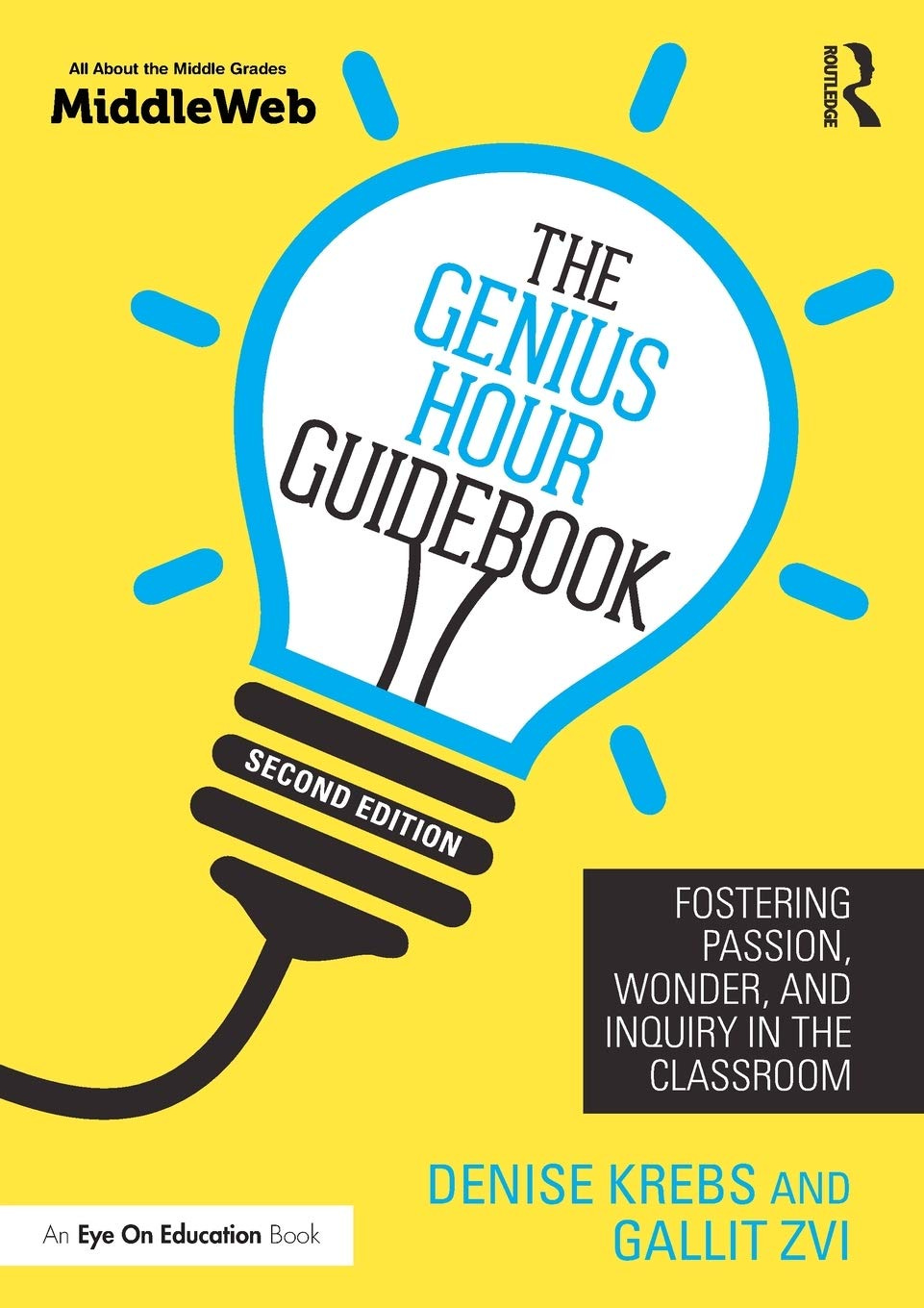
Develop Fearless Learners: The Genius Hour Guidebook
from Read by Example Hosted by Matt Renwick
What world are we preparing our students for? The future is difficult to predict, yet we are confident that a capacity for lifelong learning, including a willingness to take risks and make mistakes, will be essential. One approach to developing fearless learners is described in The Genius Hour Guidebook: Fostering Passion, Wonder, and Inquiry in the Classroom by Denise Krebs and Gallit Zvi. Both classroom teachers, Denise and Gallit share their experience in supporting students’ ideas and independence, including: * the importance of first building trust and community, * how Genius Hour can foster critical thinking, and * favorite picture books for inspiring readers and learners. Enjoy this site but not subscribed? Sign up today - most content is free. Related Resources * Transcript + Audio * Buy the book! * A Middleweb article by Denise and Gallit about genius hour for remote learners * My experience (here and here) using genius hour with my own children * Every podcast episode on Apple (if you can, leave a rating!) Share this episode with a colleague. Full Transcript Matt Renwick: Welcome Gallit and Denise, thank you for talking with me today. You are both practicing teachers, correct? Gallit Zvi: Yeah. Well, I'm on maternity leave right now, but until I had my baby, I was. Matt Renwick: Congratulations. Gallit Zvi: Thanks. Matt Renwick: And where are you specifically located? Gallit Zvi: So I am in Surrey, British Columbia, Canada. So a suburb of Vancouver. Wonderful school district up here in BC. Denise Krebs: And right now I'm located in Bahrain teaching in a bilingual school, Arabic and English speaking school. Matt Renwick: And just with your classroom work, the first edition of your book, The Genius Hour Guidebook was born out of your work in the classroom, as well as networking with other educators online. And I think this was how I came across the first version of your book on Twitter. And at that same time, my wife was teaching second grade and she had a few students with some significant needs, especially around behavior. I suggested The Genius Hour Guidebook and its apprentice for her at the end of the school day, as part of her action research project. She implemented it and the results were impressive. For one student, their behaviors were reduced by 70%, seven, zero since implementing Genius Hour. Matt Renwick: And when she asked kids what made the difference, they noted that they just wanted to think at the end of the day. Your second edition of the book is out now and I wanted to make other educators aware of the power of Genius Hour in the classroom. And so with that, there's certainly more to it than just wanting to tinker, but what is Genius Hour and why should teachers incorporate it into their classrooms? Denise Krebs: Yeah, I'll go. It is tinkering as part of it, but it's a time in the school week when students are given autonomy, they're empowered to do their own learning. They get to choose what they want to learn at the time when teachers get out of the way and let them learn purposefully. That's why those second graders felt empowered. They didn't want to misbehave because they were entrusted to wonder, to learn, to create, to do research, to take action, to produce things they can spend time mastering. They choose the learning adventure. So, we think they become fearless learners. They make learning visible then by sharing their projects or what they've been doing and the process. So a lot of times with a larger global audience or just at their school level or with people. It's hard to just put it in a few words, but Gallit, do you want to add anything? Matt Renwick: That's good. Gallit Zvi: I think the short version of it for me always is it's passion-based and inquiry-based learning smushed together. Matt Renwick: And you mentioned too, trust. That you're trusting the kids to use this time for their own passions and interests. And I believe at some point it was mentioned Genius Hour should be proceeded with building community and relationships. And how did teachers know when kids are ready for self-directed learning? Gallit Zvi: Good question. So, we talk about that early in the book where we talk about how for us, we don't start a Genius Hour project with a new class until we've spent some time building community in the classroom. And so how do when you build that community? I guess it's just a feeling you have, it's hard to say that X, Y, and Z has to happen before for you go, but for me, if I have a new class of students, I generally spend the first few months working on building community. So having classroom meetings, going outside and doing leadership challenges, playing games together, just spending that time, getting to know each other and building that trust before we say, "Hey, we want you to do something that can be a little bit risky, to take the chance and work on a project and share the obstacles you're facing with the rest of the class." Gallit Zvi: That's some vulnerable work that they're taking on. And so we want them to have that sense of community first. So I thought about this before. I don't know that this happens and then you know you've built it. It's more of that feeling you get where you know that there's some trust here, the kids are getting along well, there's a sense of community. And so for me, our school year goes September to June. So generally I would spend September, October, November, and then not really bothered starting in December because we're only there for half the month. So usually a Genius Hour, we would start when we come back in January after winter break. Gallit Zvi: But that being said, I've also had the pleasure of teaching the same students for two or three years in a row. And so if I have the same group of kids or mostly the same group of kids, we usually start way earlier then, because they already know what it's all about and they're eager to start. They don't want to wait until term two. They're ready to go. But I guess you as a teacher, every class is going to be different. And so you get that feeling with your kids when you know that. Matt Renwick: You can tell when the kids are already by that level of trust between each other and among each other too, because you're asking them to make mistakes and try new things. Gallit Zvi: Yeah. Matt Renwick: I like this quote you included in the book, it's from Alan November, from his book that I've also read and enjoyed, Who Owns the Learning. He said, "If we teach one skill to prepare our students to survive in a web based world, it should be that of critical thinking and the analysis of online information." Survive is a strong word. And I would agree with that verb choice. How does Genius Hour strengthen critical thinking with students? Denise Krebs: Yeah. We know these last few years in America, especially navigating online information, misinformation, disinformation, it is so critical. It is a matter of survival, isn't it? We have people who are believing conspiracy theories and going doing crazy things. So critical thinking is a key to healthy living and healthy choices to make needed changes in the world. We have to have critical thinkers. And of course, Genius Hour is no panacea for that, but it is a step. It's one step in a process of students learning to trust themselves, to solve their own learning dilemmas, to make good choices and have a mentor facilitator teacher with them as they do it. So, yeah, it can happen and talking about that quote was about online, but, but yeah we have to teach critical thinking. Matt Renwick: And speaking of online information or any information, I love that you devoted an entire chapter to picture books, then inspire kids to engage in Genius Hour. This is a literacy leadership site, any titles in particular that you would highly recommend for any classroom K-12 Gallit Zvi: Yeah. We love picture books there. They're our favorite. We love them so much. So in the book we talk about 16 different titles. There's way more of the course that you could use for G… This is a public episode. If you'd like to discuss this with other subscribers or get access to bonus episodes, visit readbyexample.substack.com/subscribe
Embed this episode
No transcript yet.