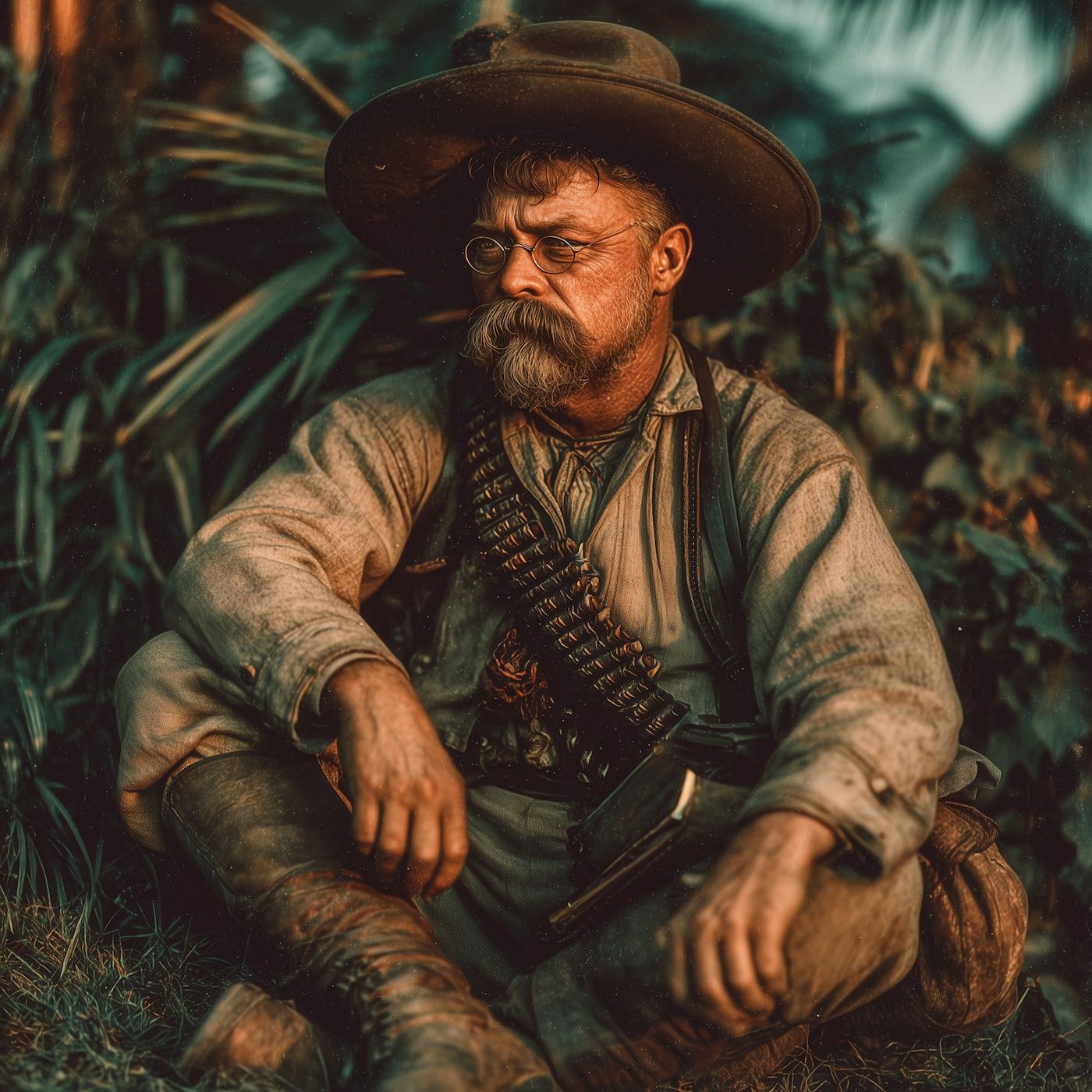
DH Ep:21 The Lost Chapters of Theodore Roosevelt episode artwork

EPISODE · Jun 27, 2025 · 58 MIN

DH Ep:21 The Lost Chapters of Theodore Roosevelt

from Disturbing History · host Disturbing History-True Stories

In this episode of Disturbing History, we dive into the staggering, stranger-than-fiction life of America's most ferocious leader—the one and only Theodore Roosevelt. He wasn’t just a president. He was a warrior, a naturalist, a writer, a boxer, a conservationist, and, quite possibly, the first U.S. president to publish a serious account of a Sasquatch encounter.Born a sickly child with severe asthma, Roosevelt seemed destined for a quiet, fragile life—until sheer willpower turned him into a force of nature.As a young boy, he stood along the streets of New York City watching Abraham Lincoln’s funeral procession. That same child would grow into a human dynamo with a near-photographic memory, devouring two to three books a day, authoring 35 of his own, and writing over 150,000 letters during his lifetime.But his unstoppable energy was matched by devastating personal tragedy.On Valentine’s Day in 1884, Roosevelt’s wife and mother died in the same house, mere hours apart. His haunting diary entry read simply: “The light has gone out of my life.” In the aftermath, he disappeared into the harsh wilderness of the Dakota Badlands—where he lived as a cowboy, hunted thieves, and captured outlaws at gunpoint. It was here, he would later say, that he truly became the man who could one day lead a nation.As president, Roosevelt became a catalog of firsts: the youngest man to ever assume the office at age 42, the first to ride in an airplane, own a car, dive in a submarine, travel overseas while in office—and the first to keep a hyena as a pet in the White House.He boxed regularly until a punch cost him vision in one eye. Then he took up jujitsu. He swam naked in the Potomac River, banned Christmas trees to protect the environment, and famously despised his own nickname, “Teddy,” because it reminded him of his late wife.But perhaps one of the most fascinating—and least discussed—aspects of Roosevelt’s life lies buried in his 1893 book The Wilderness Hunter. In a chapter easily dismissed as folklore, he recounts a tale told to him by a seasoned trapper named Bauman: a terrifying encounter in the Montana wilderness with a bipedal creature that walked like a man, stalked their camp, and ultimately killed Bauman’s partner by snapping his neck. Roosevelt, never one to flinch from mystery, referred to it as “a goblin story which rather impressed me.”Some believe it to be the first widely published Sasquatch account in American literature—and the fact that Roosevelt included it in his work speaks volumes.Roosevelt’s love of the wild wasn’t just personal—it became policy. As president, he protected over 230 million acres of American wilderness, an area larger than France. He established national parks, bird reserves, monuments, and national forests. His legendary camping trip with John Muir in Yosemite laid the groundwork for the modern conservation movement. He understood the wild was not just a resource—but a mystery worth protecting.Even after his presidency, Roosevelt couldn't resist danger. In 1912, while campaigning under the Bull Moose Party, he was shot in the chest. The bullet passed through his steel eyeglass case and a 50-page speech in his coat pocket, slowing its path. Bleeding, he refused to seek treatment until he finished delivering his speech. “Friends,” he said, “I don’t know whether you fully understand that I have just been shot.”Later, he embarked on an African safari where he and his team collected over 11,000 specimens for the Smithsonian. Then, nearly a decade after leaving office, he pushed further—into the deadly heart of the Amazon on an expedition to map the River of Doubt, which would later bear his name. He contracted malaria, nearly died, and was forced to make a partial confession: that the limits of his body were finally catching up to the boundlessness of his will.This episode explores the Roosevelt most people never learn about—a man who lived so far outside the bounds of normal life that encountering a mysterious creature in the woods seemed... almost expected.He was the last president to embody the mythic energy of the American frontier, and his writings reflect a man willing to treat the unexplained not with ridicule, but with curiosity and respect.We also reflect on how Roosevelt’s legacy of conservation is entangled with mystery: the very forests and wilderness areas he fought to protect remain the same places where cryptid encounters continue to be reported today. Whether it was political power, personal loss, wild adventure, or brushes with the unknown, Theodore Roosevelt always chose to meet the world head-on—whether it made sense or not.Have a forgotten historical mystery, disturbing event, unsolved crime, or hidden conspiracy you think deserves investigation?Send your suggestions to [email protected] History is a dark history podcast exploring unsolved mysteries, secret societies, historical conspiracies, lost civilizations, and the shadowy stories buried beneath the surface of the past.Follow the show and enable automatic downloads so you never miss a deep dive into history’s most unsettling secrets.Because sometimes the truth is darker than fiction.

In this episode of Disturbing History, we dive into the staggering, stranger-than-fiction life of America's most ferocious leader—the one and only Theodore Roosevelt. He wasn’t just a president. He was a warrior, a naturalist, a writer, a boxer, a conservationist, and, quite possibly, the first U.S. president to publish a serious account of a Sasquatch encounter.Born a sickly child with severe asthma, Roosevelt seemed destined for a quiet, fragile life—until sheer willpower turned him into a force of nature.As a young boy, he stood along the streets of New York City watching Abraham Lincoln’s funeral procession. That same child would grow into a human dynamo with a near-photographic memory, devouring two to three books a day, authoring 35 of his own, and writing over 150,000 letters during his lifetime.But his unstoppable energy was matched by devastating personal tragedy.On Valentine’s Day in 1884, Roosevelt’s wife and mother died in the same house, mere hours apart. His haunting diary entry read simply: “The light has gone out of my life.” In the aftermath, he disappeared into the harsh wilderness of the Dakota Badlands—where he lived as a cowboy, hunted thieves, and captured outlaws at gunpoint. It was here, he would later say, that he truly became the man who could one day lead a nation.As president, Roosevelt became a catalog of firsts: the youngest man to ever assume the office at age 42, the first to ride in an airplane, own a car, dive in a submarine, travel overseas while in office—and the first to keep a hyena as a pet in the White House.He boxed regularly until a punch cost him vision in one eye. Then he took up jujitsu. He swam naked in the Potomac River, banned Christmas trees to protect the environment, and famously despised his own nickname, “Teddy,” because it reminded him of his late wife.But perhaps one of the most fascinating—and least discussed—aspects of Roosevelt’s life lies buried in his 1893 book The Wilderness Hunter. In a chapter easily dismissed as folklore, he recounts a tale told to him by a seasoned trapper named Bauman: a terrifying encounter in the Montana wilderness with a bipedal creature that walked like a man, stalked their camp, and ultimately killed Bauman’s partner by snapping his neck. Roosevelt, never one to flinch from mystery, referred to it as “a goblin story which rather impressed me.”Some believe it to be the first widely published Sasquatch account in American literature—and the fact that Roosevelt included it in his work speaks volumes.Roosevelt’s love of the wild wasn’t just personal—it became policy. As president, he protected over 230 million acres of American wilderness, an area larger than France. He established national parks, bird reserves, monuments, and national forests. His legendary camping trip with John Muir in Yosemite laid the groundwork for the modern conservation movement. He understood the wild was not just a resource—but a mystery worth protecting.Even after his presidency, Roosevelt couldn't resist danger. In 1912, while campaigning under the Bull Moose Party, he was shot in the chest. The bullet passed through his steel eyeglass case and a 50-page speech in his coat pocket, slowing its path. Bleeding, he refused to seek treatment until he finished delivering his speech. “Friends,” he said, “I don’t know whether you fully understand that I have just been shot.”Later, he embarked on an African safari where he and his team collected over 11,000 specimens for the Smithsonian. Then, nearly a decade after leaving office, he pushed further—into the deadly heart of the Amazon on an expedition to map the River of Doubt, which would later bear his name. He contracted malaria, nearly died, and was forced to make a partial confession: that the limits of his body were finally catching up to the boundlessness of his will.This episode explores the Roosevelt most people never learn about—a man who lived so far...

NOW PLAYING

DH Ep:21 The Lost Chapters of Theodore Roosevelt

0:00 58:34

No transcript for this episode yet

We transcribe on demand. Request one and we'll notify you when it's ready — usually under 10 minutes.

Bitcoin Gateway Lea meakin Welcome to Bitcoin Gateway, the podcast where we dive deep into the world of Bitcoin, hosted by Lea Meakin. This show is for anyone who’s ever felt overwhelmed by the complex world of cryptocurrencies and wants a simple, straightforward explanation. Each episode, we’ll break down the basics of Bitcoin, explore its history, and discuss its potential impact on the future of finance. Whether you’re a complete beginner or just looking to expand your knowledge, Bitcoin Gateway is here to help you understand Bitcoin, one episode at a time. Explicit WTF Conspiracy ? Operation: Disclosure Jolly West Welcome to Conspiracy Theory Or Not?, your deep dive into the world of secrets, shadows, and speculation. This podcast is dedicated to unraveling history's most controversial and mind-bending conspiracy theories, asking tough questions and exploring hidden truths. Whether you're a skeptic or a believer, we take you on a journey through some of the most mysterious events and covert operations ever revealed.In this episode, we explore the dark and mysterious world of MK-Ultra—a top-secret CIA program that ran from the 1950s to the early 1970s. The program's purpose? To develop mind control techniques for use in espionage. But as we will uncover, the methods employed often crossed ethical boundaries, involving everything from drugs to hypnosis and, in many cases, torturous experimentation.We’ll investigate the history and controversial practices behind MK-Ultra, shining a light on its disturbing experiments, key figures, and pivotal events. Drawing from two essential books, "The Sea Explicit Vampires of White Chapel Transmissions From Atlantis Entertainment Vampires of White Chapel follows the story of FBI Agent Arianna Grayson as she hunts the serial killer, Allister the Annihilator but gets more than she bargains for. She discovers he’s a vampire, sired by the notorious murderer Jack The Ripper. Grayson is pulled into the world of the vampires and the show follows her story as an unwilling fledgling, Allister’s fall to monstrosity and the real history of Jack and his vampire origins. (Fiction Podcast/Horror) Explicit The Midnight Cinema Screening Unkn  Welcome to The Midnight Cinema Screening.This is basically the place where we hang out after midnight and talk about movies and TV shows that stuck with us… the good, the bad, the weird, and the ones that probably shouldn’t exist but somehow do. I also talk about true crime. If you love horror, cult classics, creepy shows, and the occasional random deep dive into something strange, you’re in the right place. Nothing here is super scripted or overly serious. It’s more like sitting around with friends after a late-night movie, breaking down what worked, what didn’t, and the moments that made you pause the screen and go, “Wait… what just happened?”Some episodes we’ll be reviewing movies.Some we’ll be talking about TV episodes.And sometimes we’ll just go down a rabbit hole about the weird history behind something we watched.So if you like late-night movie talk, dark stories, and conversations that feel a little unfiltered Explicit

Frequently Asked Questions

How long is this episode of Disturbing History?

This episode is 58 minutes long.

When was this Disturbing History episode published?

This episode was published on June 27, 2025.

What is this episode about?

In this episode of Disturbing History, we dive into the staggering, stranger-than-fiction life of America's most ferocious leader—the one and only Theodore Roosevelt. He wasn’t just a president. He was a warrior, a naturalist, a writer, a boxer, a...

Is there a transcript available for this episode?

Yes, a full transcript is available for this episode. You can read the complete transcript on the episode page.

Can I download this Disturbing History episode?

Yes, you can download this episode by clicking the download button on the episode player, or subscribe to the podcast in your preferred podcast app for automatic downloads.
URL copied to clipboard!